I've searched here and googled shallow foundation frost protection, etc until my eyes bled. I would like to know how to create a thermal break between the slab on grade with hydronic heat and the overhead door opening aprons. If it matters this is a pole barn, 48" frost line, 6" pour without thickened perimeter.


You are using an out of date browser. It may not display this or other websites correctly.
You should upgrade or use an alternative browser.
You should upgrade or use an alternative browser.
Thermal breaks
- Thread starter Ggg
- Start date
Musicinabottle
Banned
- Joined
- Jul 24, 2016
- Messages
- 3,371
Every time I've done those, you cut a 45 degree angla at the top of your rigis insulation, in my case 2 inch, and that goes around your stem wall with the long point of the 45 at the top of your slab, and then in at least 4 feet in from the stem wall directly under the slab. In your case, just under the slab 4 feet or whatever, unsure your Winters. I did a large 30,000 square foot hanger in which I did the entire 6 inch slab with 2 inch. I like to use the Re mesh grid in place of the rebar and then you have something to attach the pex to.

Musicinabottle
Banned
- Joined
- Jul 24, 2016
- Messages
- 3,371
This floor doesn't have any stem walls, footings, or thickened perimeter. It's 6" thick instead of the 4" indicated in the picture.
I know. I was just saying that in every case where there is a stem wall, you would insulate down to the footers, so you'd think, that in the absence of the stem wall, you'd still run some sort of rigid insulation down below the usual frost line around the perimeter. I've done uite a few pole buildings, but the concrete flat work usually went to someone else, though I have done a few. Are you doing the heat or someone else? What do they advise?
wssix99
Well-known member
I've searched here and googled shallow foundation frost protection, etc until my eyes bled. I would like to know how to create a thermal break between the slab on grade with hydronic heat and the overhead door opening aprons. If it matters this is a pole barn, 48" frost line, 6" pour without thickened perimeter.
You are not alone. I had similar problems when building my garage. There's nothing out there on this topic...
You'd have to figure out some more details of the slab first, I think... Since you have a pole barn - you aren't a slab-on-grade. Your poles support the structure, (with a slab-on-grade, you structure is supported by the slab) so you would have a floating slab.
I understand that a pole barn has some latitude as to how the edges are formed. Once you figure this out, the other details are academic.
Given that your floor will be heated, I don't think you would want it to extend into the wall cavity (between the outer poles) where the space is only partially insulated above across the full depth.) Have you thought of this detail? Would you use wood, etc. to fill the ground space between the poles?
Musician bottle; I am hesitant on digging that far down and removing all the soil from one side of the poles possibly causing them to shift. I plan on installing the radiant heat myself.
Wssix99; Thanks for the terminology clarification. Yes I do plan on pouring a few inches of concrete between the inner and outer grade boards. Mostly to keep the interior walls from touching the floor and wicking up water. My plan for insulating between the poles was to dig say 2' down around the outside of the poles, then put rigid foam board between the concrete and ambient air.
Wssix99; Thanks for the terminology clarification. Yes I do plan on pouring a few inches of concrete between the inner and outer grade boards. Mostly to keep the interior walls from touching the floor and wicking up water. My plan for insulating between the poles was to dig say 2' down around the outside of the poles, then put rigid foam board between the concrete and ambient air.
Last edited:
crook038
Well-known member
I'm in the same boat as I prepare to setup my radiant heat for my pole building build. I dug down 2 ft inside the skirt board and installed vertical insulation to prevent frost from creeping under the slab, but what to do at the overhead door transitions? Digging down 2 feet was back breaking work, glad it's done.
Sean
Sean
Attachments

wssix99
Well-known member
Wssix99; Thanks for the terminology clarification. Yes I do plan on pouring a few inches of concrete between the inner and outer grade boards. Mostly to keep the interior walls from touching the floor and wicking up water. My plan for insulating between the poles was to dig say 2' down and put rigid foam board between the concrete and ambient air.
Great. So, you would have an inner grade board that would keep your floating slab (with the radiant tubing in it) isolated from the wall cavity? If so, you could insulate the edges of your slab by putting some foam board on either side of that grade beam.
As you follow that insulation around the side of the slab to your door opening, you'll come to the problem....
You'll want to continue that edge insulation across your threshold to make a thermal break and lay out your foam edge insulation for the slab in such a way that:
- The door falls on top of or outside of that foam (on non-heated concrete)
- Your floating slab is a perfect rectangle/square shape (if you have any jogs/corners in the slab to put the thermal break where you want it, that will create a "reentrant corner" and will promote cracking in your slab)
The end result of this is that either you will have a small section of floating threshold that just sits between your driveway and slab or hat your driveway comes through your door opening a bit. (I'd be inclined to isolate the threshold from the driveway with an expansion joint and pin the two together so you control cracking. (This will create reentrant corners outside your structure and will promote cracking in the driveway if you don't isolate the threshold.)
I have a 1" piece of foam board that creates the thermal break between my concrete threshold and my radiant slab. After the floor cured, I carved out the top bit of that foam, filled the gap with Slab Gasket (below), and then sealed the edges with Sikaflex. It's been phenomenal.
http://slabgasket.com/slab-gasket-gallery/index.php
I apologize for the picture orientation, this is the only website that I have issues with.
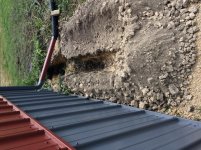
Here is the start of the trench to put the 2" foam against the outer edge of the slab. My problem is the closest I can get to the wall is 14", and that's after removing the auger closest to the wall. Nobody has a trencher that will get any closer. The larger rocks were playing havoc with the trencher causing it to bounce around a lot.
Here is the start of the trench to put the 2" foam against the outer edge of the slab. My problem is the closest I can get to the wall is 14", and that's after removing the auger closest to the wall. Nobody has a trencher that will get any closer. The larger rocks were playing havoc with the trencher causing it to bounce around a lot.
Attachments
Last edited:
vtcat
Well-known member
There is always a bit of a problem at this spot.
I always set the driveway apron down from the slab -- so ...the overhead door sits on the driveway. Yes -- I have a little curb .... I like this vs having it flat. Keeps lot's of junk from entering. The foam under the garage floor buts to the apron and goes down.
My aprons are small and I normally have a thermal break just past the front of the garage - so the whole apron is not connected to the driveway slab. Even with the heat off I don't have a huge problem doing it this way. I also normally pour the apron thicker vs the garage floor. I don't like the idea of making this spot thinner with the use of insulation between the two. The only exposed / uninsulated area is the face of the driveway slab -- and it's inside the door.
I always set the driveway apron down from the slab -- so ...the overhead door sits on the driveway. Yes -- I have a little curb .... I like this vs having it flat. Keeps lot's of junk from entering. The foam under the garage floor buts to the apron and goes down.
My aprons are small and I normally have a thermal break just past the front of the garage - so the whole apron is not connected to the driveway slab. Even with the heat off I don't have a huge problem doing it this way. I also normally pour the apron thicker vs the garage floor. I don't like the idea of making this spot thinner with the use of insulation between the two. The only exposed / uninsulated area is the face of the driveway slab -- and it's inside the door.
wssix99
Well-known member
Here are some pictures:
This is what my door looks like from the outside with the door open. It shows the isolated sill (traditional expansion joint separating the sill and the driveway) and the Slab Gasket covering the 1" of foam I have between the sill and the slab. As yeldogt mentions, a dust lip is key. You can put that anywhere. I put mine in the middle of my sill, just outside of the thermal break.
View media item 74509
Here is a shot of the door closed, coming right down on the thermal break and the slab gasket.
View media item 74508
Here is an inside view. My walls are ICF, so I have foam from foundation to ceiling. The ouside of my foam for the thermal break is lined up with the outside of the foam on my walls. To get proper placement of the door, I set my door's mounting boards back in to the foam.
View media item 74507
For this pole barn, the trick would not be moving the door (like I did) but moving the grade boards on the door's wall and the foam covering them. That foam would be continuous across the grade boards and the across thermal break. (This will keep the slab from having re-entrant corners and cracking problems around the doors.) The other grade boards would need foam over them to insulate the heated slab, but they could be in a different position than the boards on the door's wall.
This is what my door looks like from the outside with the door open. It shows the isolated sill (traditional expansion joint separating the sill and the driveway) and the Slab Gasket covering the 1" of foam I have between the sill and the slab. As yeldogt mentions, a dust lip is key. You can put that anywhere. I put mine in the middle of my sill, just outside of the thermal break.
View media item 74509
Here is a shot of the door closed, coming right down on the thermal break and the slab gasket.
View media item 74508
Here is an inside view. My walls are ICF, so I have foam from foundation to ceiling. The ouside of my foam for the thermal break is lined up with the outside of the foam on my walls. To get proper placement of the door, I set my door's mounting boards back in to the foam.
View media item 74507
For this pole barn, the trick would not be moving the door (like I did) but moving the grade boards on the door's wall and the foam covering them. That foam would be continuous across the grade boards and the across thermal break. (This will keep the slab from having re-entrant corners and cracking problems around the doors.) The other grade boards would need foam over them to insulate the heated slab, but they could be in a different position than the boards on the door's wall.
Great. So, you would have an inner grade board that would keep your floating slab (with the radiant tubing in it) isolated from the wall cavity? If so, you could insulate the edges of your slab by putting some foam board on either side of that grade beam.QUOTE]
My initial thoughts were to pour a few inches of concrete inside the wall cavity between the inside and outside grade boards. To make a curb of sorts to keep water from wicking up the interior wall covering.
wssix99
Well-known member
My initial thoughts were to pour a few inches of concrete inside the wall cavity between the inside and outside grade boards. To make a curb of sorts to keep water from wicking up the interior wall covering.
I'd suggest protecting your wall with vapor barrier, regardless. (Water wicks up through concrete, also.)
Concrete will create a thermal mass on the other side of that grade board and will have an affinity for holding the heat you are putting into the interior slab. To the extent you can fill that cavity with more air/insulating material, the less heat you should loose.
Last edited:
crook038
Well-known member
Crook038 how deep did you insert the foam insulation?
The foam is 24 inches top to bottom, the finished height of the floor will be at the top of the foam.
Sean
Thanks for the link!
Thanks Sean
Segway to another question;
I am running water to my shop. I've seen black plastic tubing used a lot without any complaints. The box stores refer to it as "irrigation" tubing. I also see blue plastic tubing labeled "potable" water line. The store can't give me an answer if I should use one over the other.
If it matters, yes I want potable quality water, not just something to wash my car with.
Segway to another question;
I am running water to my shop. I've seen black plastic tubing used a lot without any complaints. The box stores refer to it as "irrigation" tubing. I also see blue plastic tubing labeled "potable" water line. The store can't give me an answer if I should use one over the other.
If it matters, yes I want potable quality water, not just something to wash my car with.
Last edited:
Unfortunately I have read this several times and my head is spinning after each read.
wssix99
Well-known member
Unfortunately I have read this several times and my head is spinning after each read.
You can rest easy because most of it doesn't apply to you!
For a pole barn, all you need to worry about is Figure 15. If you take your band insulation and extend it downward vertically, that will help. You can can think of this insulating acting as a "skirt" that traps heat under the slab (keeping it escaping to the outside) like a hovercraft skirt traps air underneath it.
Firebrick43
Well-known member
Thanks Sean
Segway to another question;
I am running water to my shop. I've seen black plastic tubing used a lot without any complaints. The box stores refer to it as "irrigation" tubing. I also see blue plastic tubing labeled "potable" water line. The store can't give me an answer if I should use one over the other.
If it matters, yes I want potable quality water, not just something to wash my car with.
Do NOT use irrigation tubing. Most of it is 100 psi rated. Sounds like enough but supply lines are constantly pressurized and deal with high forces such as water hammer. Find a potable pipe rated at least 160 psi, 200 or 250 is highly suggested.
Also be careful as some of the polyethylene tubing is Sidr or standard inside pipe ratio meaning the inside diameter remains the same as the pressure ratings (and therefore thicker wall) goes up. These use a brass or plastic barbed fitting with an outside clamp to make connections.
Others are SDR or stadardard dimentions ratio, meaning the outside dimension remains constant and the inside diameter shrinks as the pressure rating increases. It uses compression fittings with a stiffener inserted inside the pipe.
Make sure when you lay the pipe in the trench that it is not tight/straight but in a lazy s and if you have sharp stones that it well surrounded by 6+" of sand.
The trench is almost a straight line, no curves. My thought after seeing the blue line was to use 1.5" dia black as a conduit to run the 1" blue line through. No rocks to deal with, I trenched 4' down and was still in topsoil.
Firebrick43
Well-known member
Trench can be straight, just lay the pipe in the trench in a lazy s. Keeps it from pulling out of the fittings when it gets cold and shrinks slightly. I wouldn't worry about putting it in a sleeve.
TractorJeff
Well-known member
I put a sleeve in for a future water line as it enters the building on the wall facing the house but if and when sink goes in, it will be at the back wall. I installed a drain pipe for the sink and the electric conduit comes under the slab and thickened edge also. All pipes come up inside the building this way as it is being built with a 6 inch knee wall do to grade and height issues.
OH_Varmntr
Well-known member
I made the trench from the house to the shop. I would like to install another water spigot on the opposite side of the shop. My question is how deep do I need to dig that water line? The slab will be heated.
I considered an in-ground hydrant but didn't want to trench under my slab or around the perimeter for more line. I also didn't want to have another buried splice (tee) as a potential failure point.
So I'm going to run an interior water line to a through-the-wall style faucet instead. I figured with an indoor water line, the environment would be more stable than underground. This should give me more flexibility in placement as well since I'm also not 100% sure where I want one right now.
After trenching the supply line into the shop (about 4-5' in from the outside wall) I decided against trenching a line across the shop. The rock I have is a pita to trench through. The trench walls keep falling in making a 4" trench 18-24" wide.
Last edited: