To avoid these ads, REGISTER NOW!

thermal imaging cameras

1956chevy210

Member
Joined
Dec 2, 2015
Messages
18
Hello all,

I'm putting a lift in my shop in a few months, and the problem is I have in-floor hot water heat. I did not erect the shop so I don't have a map of the tubes. So, I need to find them.

A lot of folks say to use a thermal imaging camera. Can anyone recommend one they used? Will any thermal camera made in the past couple of years do just fine for this simple job? I see they make thermal cameras with built in screens (which probably **** for resolution), and ones that connect to your phone. Cost is a consideration because I doubt I'll use it much after finding the tubes.

Second, I thought about wetting the floor with a fine mist of water and waiting to see where the water evaporates first. I imagine in my mind that dry lines would show up plain as day if I am patient.

I've tried using my laser thermometer, but the temp seems to bounce up and down a lot.

Thanks for reading,

1956chevy210
 
To avoid these ads, REGISTER NOW!

OneEyedMan

Well-known member
Joined
Sep 4, 2015
Messages
157
I have a Snap On thermal imager and it works fine for finding our in floor tubes. I think most modern thermal cameras would do likewise. I have the best luck after a weekend when the floor is cooled then run the heat for a few hours. The lines show up well enough then.

I’ve bought super cheapies on sale for sub $100 and they had tiny screens but if the contrast was enough, they also showed the lines. I’ve never tried the water trick but I’m wondering if your window to observe would be pretty brief if the lines were done right, I.e. properly spaced and insulated.
 

rlitman

Well-known member
Joined
Oct 18, 2010
Messages
24,582
Location
Long Island
Keep in mind that the thermal sensor's native resolution is going to be much lower resolution even than the screen of an old timey mp3 player, and the sensor's resolution is what the camera is up-scaling onto whatever screen (built-in or phone) it's shown on. So I would look at the sensor's actual themal resolution, and not worry about the screen resolution. For what you're doing, almost anything will work. More expensive and higher resolution sensors will let you scan larger parts of the room at once, but if you're just locating a tube to drill for some anchors and aren't in a hurry, it won't matter what quality imager you use.

The water pan is a viable option, but may take some careful lighting and luck to work.

As for the laser thermometer, all it is is a 1x1 thermal camera. The problem is you need to maintain a careful distance of only a few inches and sweep the floor slowly at this consistent height to get useful results. I'd look for the pattern of water evaporating first.

If you're lucky enough for it to happen to be PEX-Al-PEX, you could connect a tone generator to the metal and search for it with an inductive probe, but that's only possible if your tube has a conductive part.
 

mike93lx

ALLIANCE MEMBER
Joined
Dec 9, 2013
Messages
37,411
Location
Richmond, VA
There have been a bunch of threads on this, so some searching will be worth it.

I have a Flir One, which plugs into my phone. I haven't pointing it at a heated slab, but based on the detail I have seen from it, I expect it would work well for this.
 

Lassen Forge

Well-known member
Joined
Apr 26, 2014
Messages
15,064
Location
The romantic hills of central Umbria, Italy,
There have been a bunch of threads on this, so some searching will be worth it.

I have a Flir One, which plugs into my phone. I haven't pointing it at a heated slab, but based on the detail I have seen from it, I expect it would work well for this.

I also have a Flir one, and it has saved me more than once. Not cheap, but worth every penny.
 

finn

Well-known member
Joined
Mar 27, 2005
Messages
16,203
Location
The UP, God's country
I have a SEEK that plugs into my iPhone.

it’s probabl ten years old by now and rarely gets used anymore, so I would recommend just getting a cheap generic camera now, as I would think the generic camera has caught ou surpassed what was available from the name brands of a few years ago.

one trick I used was that once you locate the tubes, shut off the heat overnight and stand up the posts in aproximately their final location. The next morning turn the heat back on and drop an ice cube in the holes drilled in the baseplate of the post.

You’ll get an image with great resolution showing proximity of the proposed drill holes to the tubes.

Double check your post layout, mark the perimeter footprint with a Sharpie, and start drilling
 
To avoid these ads, REGISTER NOW!

rlitman

Well-known member
Joined
Oct 18, 2010
Messages
24,582
Location
Long Island
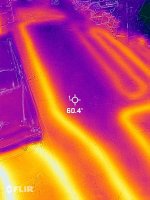
I have a FLiR one that connects to my phone. Below is a sample of an image. There is definitely a margin of error.

FLIR_20220203_071405.jpg
There is a parallax error issue with these dual sensor systems that merge an optical image with the thermal. Because the lenses are inches apart, they digitally compensate for this but the accuracy of those outlines depends on how far you are from the surface.

If you switch to a strictly thermal view and use your fingertip to mark the floor loop center, you'll be spot on (within the width of your finger, which is good enough to drill).
 

TurnipTruck

Well-known member
Joined
Aug 28, 2005
Messages
1,552
Location
Southcentral Alaska
one trick I used was that once you locate the tubes, shut off the heat overnight and stand up the posts in aproximately their final location. The next morning turn the heat back on and drop an ice cube in the holes drilled in the baseplate of the post.
Years ago, I borrowed an $80k thermal imager from work to help a friend find the tubes in his older shop so he could install a two-post. We stood the posts up approximately where he wanted, left the heat off all night and cranked the heat the next morning. The thermal camera seemed to indicate that the tubes were bent in the area where the posts were, but he was adamant that those tubes were dead straight. We eventually discovered that the relatively cool posts were cooling the concrete more than the surrounding area giving the thermal appearance of bent tubing when in fact they were straight. Something to be aware of.
To eliminate parallax, I lay something like a carpenter pencil on the surface and move it around until it appears to be directly above and in line with the buried tube.
 

BobnCO

Well-known member
Joined
Apr 2, 2023
Messages
199
Thats cool! I also have the Flir camera and love it, on the right day/climate you see studs in the wall etc.
 
To avoid these ads, REGISTER NOW!
Top Bottom