To avoid these ads, REGISTER NOW!

Thermocouple Thread and pitch size ?

dogdog

Well-known member
Joined
Nov 15, 2011
Messages
12,711
does any one know what is the thread / pitch and size of the thermocouple in gas appliances?

Should be universal but can't seems to measure with the thread gauge or tap/die set I have, pretty much have all the common size but not odd ball ones like 1/2-28 stuff.

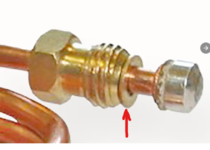
The aluminum end in the pic with the thread. it is screwed into the gas valve to provide the mV need to keep the pilot open.

need to know the thread / pitch and size. I am guessing the original installer cross threaded that piece and over time the aluminum thread have fallen out, no longer grabbing well... otherwise replacement valve is $400...
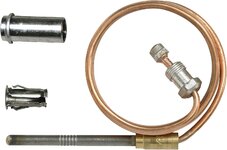
 

Attachments

  • Honeywell thermocouple.jpg
    Honeywell thermocouple.jpg
    94.7 KB · Views: 18
To avoid these ads, REGISTER NOW!

rlitman

Well-known member
Joined
Oct 18, 2010
Messages
24,736
Location
Long Island
There are two different depth standards. The "universal" thermocouples will have a brass washer between the flare and the nut. If you leave the washer in place on one that has a shallow seat, it will feel like it's stripped out. Clip off that washer and it'll screw in like you expect.
 
OP
D

dogdog

Well-known member
Joined
Nov 15, 2011
Messages
12,711
There are two different depth standards. The "universal" thermocouples will have a brass washer between the flare and the nut. If you leave the washer in place on one that has a shallow seat, it will feel like it's stripped out. Clip off that washer and it'll screw in like you expect.
Pretty sure this one is stripped out or semi stripped out. The water heater uses the same thermocouple and seats properly.
There is no washer, if you are referring to that end of the tip where that nut is…it seems to be some sort of insulator between the two dissimilar metal like the jacket is one conductor and the inside material is another….

I am googling, it goes wild from 3/8 to 7/16 and m8 m9 or m10…..
 

rlitman

Well-known member
Joined
Oct 18, 2010
Messages
24,736
Location
Long Island
Hummm, I had trouble finding a good online picture of what I ran into. This is the washer I'm talking about. It's absolutely tiny, and when left in place, it makes the nut feel like the hole's threads are gone (it ALMOST feels like it catches and then slips). Clipped that off, and bingo, it worked perfectly.
Screenshot 2024-01-09 122955.png
 
OP
D

dogdog

Well-known member
Joined
Nov 15, 2011
Messages
12,711
Hummm, I had trouble finding a good online picture of what I ran into. This is the washer I'm talking about. It's absolutely tiny, and when left in place, it makes the nut feel like the hole's threads are gone (it ALMOST feels like it catches and then slips). Clipped that off, and bingo, it worked perfectly.
Screenshot 2024-01-09 122955.png
yea non of the honeywell / everbilt branded ones have that. so that is not an issue. I am saying it's really stripped at the gas valve... It's been limping like that since the new install back in 2008... was ok still holds it in place before, now getting a bit more wear on those crossed threads. Figure I try finding a tap to repair the threads or cross finger if they have the thread repair. probably Can't use epoxy since it need to be conductive, that is also the ground point for the thermocouple as well.
 
OP
D

dogdog

Well-known member
Joined
Nov 15, 2011
Messages
12,711
11/32" 32UNS
thanks I'll give that a try. 32 pitch... 11/32 might be right since 3/8-24 was close but a tat bigger when I test with the die on the failed thermocouple. and thread doesn't fit.
 
To avoid these ads, REGISTER NOW!

The Cobbler

Super Moderator
Staff member
Joined
Oct 24, 2013
Messages
26,118
Location
Niagara Region, Ontario, Canada
I have had good luck putting a pc of copper wire into the hole of damaged threads to get a better fit. since this is not a sealing surface, I would try it before I replaced the valve or got into any expensive machining .
I would start with something like 22 g wire, flatten it a bit with a hammer , insert it & thread in the fitting from the thermocouple
 

RPH

Well-known member
Joined
Dec 17, 2006
Messages
4,190
Location
Michigan Thumb
I have had good luck putting a pc of copper wire into the hole of damaged threads to get a better fit. since this is not a sealing surface, I would try it before I replaced the valve or got into any expensive machining .
I would start with something like 22 g wire, flatten it a bit with a hammer , insert it & thread in the fitting from the thermocouple
Just like packing a valve stem. Should work, innovative fix!
 
OP
D

dogdog

Well-known member
Joined
Nov 15, 2011
Messages
12,711
Is there a machine shop supply around u? Or a thermocouple manufacturer?
machine shop supply would be traver tools online they are 1 hours drive, machine shop that is a no, probably not for public walk-ins. the rent is too dam high here. , 11/32 - 32 pitch they have the tap set on amazon and ebay. for $15 I guess that would be heck a lot cheaper than $400+... if push comes to shove , I guess I would give @The Cobbler trick with a piece of fine copper wire a try. Valve is in excellent condition shame to just throw it away.
 

rlitman

Well-known member
Joined
Oct 18, 2010
Messages
24,736
Location
Long Island
It just needs to stay put. You could cut a notch into the fixed pad of a c-clamp and that would work as well as threading it in. Heck, you could tie a bow around the nut with wire, and pull that into the valve with zip ties. It would look something awful, but doesn't compromise the fail-safe nature of the system.
 
OP
D

dogdog

Well-known member
Joined
Nov 15, 2011
Messages
12,711
It just needs to stay put. You could cut a notch into the fixed pad of a c-clamp and that would work as well as threading it in. Heck, you could tie a bow around the nut with wire, and pull that into the valve with zip ties. It would look something awful, but doesn't compromise the fail-safe nature of the system.
Yes, A fabricate clamp might also be a good idea 👍
 

bonneyman

Well-known member
Joined
Apr 22, 2010
Messages
8,857
Location
Desert SW
I had to replace the thermocouple on my 2004 water heater, and found a standard t-couple wouldn't screw in to the pilot safety on the gas valve. Thing is reverse thread! So I cut of the screw on the thermocouple gently so as no to damage the copper, then sliced a groove in the original screw connector and slide it over the replacement t-couple. Worked fine!
 
OP
D

dogdog

Well-known member
Joined
Nov 15, 2011
Messages
12,711
I had to replace the thermocouple on my 2004 water heater, and found a standard t-couple wouldn't screw in to the pilot safety on the gas valve. Thing is reverse thread! So I cut of the screw on the thermocouple gently so as no to damage the copper, then sliced a groove in the original screw connector and slide it over the replacement t-couple. Worked fine!

On the probe end at the standing pilot,I find the Honeywell one works well for both the Burnham boiler and the AO smith while the homedepot branded one will only work on the boiler. But surprisingly the end that connected to the gas valve are the same.
 

djb2

Well-known member
Joined
Apr 3, 2010
Messages
639
Location
Redwood forests
To add to almost-closed thread:

The traditional/standard gas thermocouple thread size is 11/32" 32 TPI. There are many imported appliances (gas logs, patio heaters, etc.) that have metric M8 and M10 threads. Replacement thermocouples sometimes list a "M9" or "M9 x 0.8" size. It appears that this is not a manufactured size, but rather the US standard size reported as a metric approximation:

11/32" == 8.73mm, 32 TPI == 0.79mm pitch

There are plenty of ancient thermocouple thread sizes, including a briefly-used reverse (left hand) thread. But you'll only encounter those on very old equipment.
 
To avoid these ads, REGISTER NOW!
Top Bottom