To avoid these ads, REGISTER NOW!

Thermostat Wiring

tarupido

New member
Joined
Mar 21, 2024
Messages
4
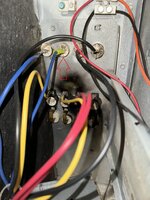
I have a Rheem system 3.5 ton, 20kW heat strip. The specs shows is a 1 stage. Now, from the control board I have the following wires going out of the cabinet:

Yellow connected to the thermostat at Y1 and to the outside unit.
Brown connected to the thermostat at C and to the outside unit.
Green connected to the thermostat to G
Red connected at the thermostat to R and to the outside unit.
I also have:
White and blue to W2.
White and black to W1.

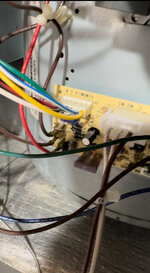
On the defrost board outside I have the following letter and cable wires:
Y with yellow wire, B with blue wire, D with purple wire, Red with red wire and C with brown wire. I don't have "O" in the blower or on the defrost board nor orange wire.
What am I missing? The AC is working. No need to rush since the house is vacant but, I will be moving in this summer. What can I do?
I also see 2 flashing red lights. Flashing at the same time is normal.

My problem is the Blue and the Purple. Blue is connected to letter B on the board and Purple to D. The thermostat am using is a Nest Thermostat and it has letter B. Do I connect the blue wire to letter B on the thermostat?
I also has W1 and W2 coming out of the control board in the attic.
Assuming I connect Blue to B on the thermostat, what do I do with purple coming out of the defrost ? I read somewhere and they suggest to connect Purple to W1 and W2.
Once I do that, it will be like placing a jumper from W1 to W2, correct?
I was thinking on connecting it to W1 coming out of the control board to the thermostat and see if the heat works. If not connected to W2 and see if it makes any difference
If am wrong can you please correct me on all and everything. The 1st picture is of the defrost board outside, the second from the control board in the attic, the 3rd one is of the codes. The last one is of the wiring diagram of the control board in the attic. Sorry I didn't get one from the unit outside.
 

Attachments

  • Defrost board.jpeg
    Defrost board.jpeg
    495.5 KB · Views: 16
  • Control Board # 2.jpeg
    Control Board # 2.jpeg
    1.7 MB · Views: 15
  • Codes.jpeg
    Codes.jpeg
    253.7 KB · Views: 15
  • Wiring Diagram.PNG
    Wiring Diagram.PNG
    6.2 MB · Views: 17
Last edited:
To avoid these ads, REGISTER NOW!

fitter30

Well-known member
Joined
Jun 23, 2019
Messages
2,968
Location
Peace Valley,mo
Is this all electric heat or heat pump? Heat pump would need a O terminal for the reversing valve. Take a pic of the whole wiring diagram.
 

chinboys

Well-known member
Joined
Jun 20, 2011
Messages
434
What a coincidence that my class in HVAC school just reviewed thermostat wiring a few weeks ago.

You didn't state whether the above setup with the NEST thermostat ever worked correctly.
Or whether the NEST thermostat is set for use on a heat pump system

I would match the wiring diagram and its terminals and color choices to correlate to a thermostat wiring block that can handle your system.
Here is a copy of the thermostat terminals and what 24V AC and a common lines can be used by the thermostat to cool and heat (heat pump).
You need to have a R (24 V AC) and a common line (ground reference).
You need a W line for primary heat.
You need a Y line for cooling.
You need a G line for manual or automatic fan control in heat or cooling or to turn on the fan when the heating or cooling system is off.
You need an O or B line to tell the heat pump to switch from its default mode to that of heating or cooling. the default mode depends on where the heat pump is stationed. Heat pumps above or below a certain latitude (eg. Florida are defaulted to cooling mode and are switched by O or B line to the heat mode via the reversing valve whereas heat pumps up north are defaulted to heat mode.
The E or Aux line is used for emergency or aux heating and may be also known as the W2 terminal.

The defrost system or circuitry is managed by the heat pump's system board in heat mode to prevent the outdoor coil from icing up during really cold temperatures near freezing with high relative humidity.

I have faith in you to use this info to fix the problem. Good luck.


LabelDescription
RThe R wire is the power wire for your heating and cooling system.
If you only have one R wire (no Rh or Rc), you can connect your R wire to either Rc or Rh on the Nest thermostat.
Note: Don't connect any Jumper wires to the Nest thermostat.
Rh
  • If you don’t have an Rc wire, the Rh wire is the power wire for both your heating and cooling systems.
  • If you have an Rh and an Rc wire, the Rh wire is the power wire for your heating system.
Some HVAC systems, called dual transformer systems, use separate power sources for heating and cooling (Rc and Rh). If you have both an Rh and an Rc wire, you have a dual transformer system.
If you have a dual transformer system, it's strongly recommended that you contact a local professional to prevent damage to your system.
Rc
  • If you don’t have an Rh wire, the Rc wire is the power wire for both your
    heating and cooling systems.
  • If you have an Rc and an Rh wire, the Rc wire is the power wire for your
    cooling system.
Some HVAC systems, called dual transformer systems, use separate power sources for heating and cooling (Rc and Rh). If you have both an Rh and an Rc wire, you have a dual transformer system.
If you have a dual transformer system, it's strongly recommended that you contact a local professional to prevent damage to your system.
W or W1The W or W1 wire controls your heating system.
Y or Y1In most systems, the Y or Y1 wire controls your cooling system.
If you have a heat pump, your Y or Y1 wire controls your compressor. Your compressor is responsible for heating and cooling your home.
What to do when your thermostat has two labels
G or G1The G or G1 wire controls your fan. Your fan pushes the warm or cool air through your vents into the rooms of your home.
O/BHeat pump systems use a changeover valve controlled by the O/B wire. Your changeover valve tells your system when to switch between heating and cooling.
What to do when your system is heating when it should cool
Tip: O/B wires are typically orange, but you should not rely on ZFoxHVPmNf6UlyLeFHIQcuvI802mBSDYi3zKE9SDPOk-No=w50.png color alone to determine the function of a wire.
Some systems have separate O and B wires.
ESome thermostats have an E connector. The E wire turns your emergency heat on or off. Emergency heat is usually used when it’s too cold outside for your regular heater to keep your home warm.
Learn more about emergency heat
Y2The Y2 wire controls the second stage of cooling in conventional systems, which can help cool your home faster.
In heat pump systems, the Y2 wire controls the second stage of your compressor, which can help heat or cool your home faster.
AUXHeat pump systems sometimes have auxiliary heat to help heat your home more quickly or to help heat your home when it’s too cold outside for your heat pump to run.
Learn more about auxiliary heat
CThe C wire is also known as the common wire. This wire connects your system to the common ground and can help provide power to your thermostat.
Note: If your system can’t provide enough consistent power to your Nest thermostat, you may need to connect a C wire or the Nest Power Connector to fix power-related issues.
Learn about the C wire
W2The W2 wire can control different types of heat based on the type of system you have.
What to do when your thermostat has two labels
If you have a conventional system
In some cold areas, you might have a furnace with different stages of heat, low and high, to help heat your home quickly when it’s very cold outside. The wire in the W2 connector controls the second stage of heat.
Learn more about multistage systems
If you have a heat pump
If you have a heat pump, the W2 wire may control your auxiliary heat. Auxiliary heat helps heat your home when it’s too cold outside outside for your heat pump to work efficiently.
Learn more about auxiliary heat
In some heat pump systems, the W2 wire may control a separate furnace to help heat your home. These types of systems are called dual fuel systems because the heat pump and the furnace use different heat sources.
Learn more about dual fuel
 
Last edited:
OP
T

tarupido

New member
Joined
Mar 21, 2024
Messages
4
What a coincidence that my class in HVAC school just reviewed thermostat wiring a few weeks ago.

You didn't state whether the above setup with the NEST thermostat ever worked correctly.

I would match the wiring diagram and its terminals and color choices to correlate to a thermostat wiring block that can handle your system.
Here is a copy of the thermostat terminals and what 24V AC and a common lines can be used by the thermostat to cool and heat (heat pump) PROVIDED the NEST thermostat can manage a heat pump system.
You need to have a R (24 V AC) and a common line (ground reference).
You need a W line for primary heat.
You need a Y line for cooling.
You need a G line for manual or automatic fan control in heat or cooling or to turn on the fan when the heating or cooling system is off.
You need an O or B line to tell the heat pump to switch from its default mode to that of heating or cooling. the default mode depends on where the heat pump is stationed. Heat pumps above or below a certain latitude (eg. Florida are defaulted to cooling mode and are switched by O or B line to the heat mode via the reversing valve whereas heat pumps up north are defaulted to heat mode.
The E or Aux line is used for emergency or aux heating and may be also known as the W2 terminal.

The defrost system or circuitry is managed by the heat pump's system board in heat mode to prevent the outdoor coil from icing up during really cold temperatures near freezing with high relative humidity.

I have faith in you to use this info to fix the problem. Good luck.


LabelDescription
RThe R wire is the power wire for your heating and cooling system.
If you only have one R wire (no Rh or Rc), you can connect your R wire to either Rc or Rh on the Nest thermostat.
Note: Don't connect any Jumper wires to the Nest thermostat.
Rh
  • If you don’t have an Rc wire, the Rh wire is the power wire for both your heating and cooling systems.
  • If you have an Rh and an Rc wire, the Rh wire is the power wire for your heating system.
Some HVAC systems, called dual transformer systems, use separate power sources for heating and cooling (Rc and Rh). If you have both an Rh and an Rc wire, you have a dual transformer system.
If you have a dual transformer system, it's strongly recommended that you contact a local professional to prevent damage to your system.
Rc
  • If you don’t have an Rh wire, the Rc wire is the power wire for both your
    heating and cooling systems.
  • If you have an Rc and an Rh wire, the Rc wire is the power wire for your
    cooling system.
Some HVAC systems, called dual transformer systems, use separate power sources for heating and cooling (Rc and Rh). If you have both an Rh and an Rc wire, you have a dual transformer system.
If you have a dual transformer system, it's strongly recommended that you contact a local professional to prevent damage to your system.
W or W1The W or W1 wire controls your heating system.
Y or Y1In most systems, the Y or Y1 wire controls your cooling system.
If you have a heat pump, your Y or Y1 wire controls your compressor. Your compressor is responsible for heating and cooling your home.
What to do when your thermostat has two labels
G or G1The G or G1 wire controls your fan. Your fan pushes the warm or cool air through your vents into the rooms of your home.
O/BHeat pump systems use a changeover valve controlled by the O/B wire. Your changeover valve tells your system when to switch between heating and cooling.
What to do when your system is heating when it should cool
Tip: O/B wires are typically orange, but you should not rely on ZFoxHVPmNf6UlyLeFHIQcuvI802mBSDYi3zKE9SDPOk-No=w50.png color alone to determine the function of a wire.
Some systems have separate O and B wires.
ESome thermostats have an E connector. The E wire turns your emergency heat on or off. Emergency heat is usually used when it’s too cold outside for your regular heater to keep your home warm.
Learn more about emergency heat
Y2The Y2 wire controls the second stage of cooling in conventional systems, which can help cool your home faster.
In heat pump systems, the Y2 wire controls the second stage of your compressor, which can help heat or cool your home faster.
AUXHeat pump systems sometimes have auxiliary heat to help heat your home more quickly or to help heat your home when it’s too cold outside for your heat pump to run.
Learn more about auxiliary heat
CThe C wire is also known as the common wire. This wire connects your system to the common ground and can help provide power to your thermostat.
Note: If your system can’t provide enough consistent power to your Nest thermostat, you may need to connect a C wire or the Nest Power Connector to fix power-related issues.
Learn about the C wire
W2The W2 wire can control different types of heat based on the type of system you have.
What to do when your thermostat has two labels
If you have a conventional system
In some cold areas, you might have a furnace with different stages of heat, low and high, to help heat your home quickly when it’s very cold outside. The wire in the W2 connector controls the second stage of heat.
Learn more about multistage systems
If you have a heat pump
If you have a heat pump, the W2 wire may control your auxiliary heat. Auxiliary heat helps heat your home when it’s too cold outside outside for your heat pump to work efficiently.
Learn more about auxiliary heat
In some heat pump systems, the W2 wire may control a separate furnace to help heat your home. These types of systems are called dual fuel systems because the heat pump and the furnace use different heat sources.
Learn more about dual fuel
The Nest Thermostat as you may already be aware has almost all the letter you mentioned. I end up using the R, Y, B, W1 and W2. As I mentioned, The R(red) goes from the control board to the thermostat and to the defrost board. The Y(yellow) from the control board to the thermostat and to the defrost board. B(Brown) from the control board to the thermostat and defrost board. What is throwing me off is the 2 letters on the outside unit. D and B. I end up connecting B(blue) to the B thermostat and D to W1 and W2 at the same time.
Why did I did this? I noticed that every time I hooked the D to W1 or W2 the house wasn't getting enough hot air. So, I decided to connect it to both. Once I did that the house got worm again.
Now I don't know if this setting is going to work in the summer for the AC. Another thing I noticed is, the heat strips are not coming on. I say that because I went up in the attic and it wasn't showing and amps been pulled. The breaker is getting 240V but not amps are being pulled on that side. The other breaker is working fine.
Answering your question, about if the thermostat was working? I called 2 or 3 techs in the area and all of them told me that something was wrong because the house wasn't getting hot. One told me the contactors, other the board and a 3rd the strips. It was one thing after another. Finally I decided to go up and get an idea. Take a look at what I found. No one bother to tell me they saw this (please see pic 1). The blue wire was like a chicken without a head sparking all over the cabinet. I never paid for the replacement of any of the parts they told me. I just felt that whatever they were saying it was not right. I purchased the entire block, for lack of a better term and replaced all of the heat strips, limit switches, contactors, breakers, etc. Still having the same problem. Then I looked at the wiring coming out of the cabinet, somehow or someone crossed, browns with blues, with whites but, am not going to blame any of the HVAC techs that showed up at my house. I know, I know, am not supposed to get hook on the colors but, on whatever the wire is doing. After searching all over the internet, I got to this place. Hopefully I can get some help on whatever I did.
 

Attachments

  • Pic 1.jpg
    Pic 1.jpg
    793.5 KB · Views: 8

PWC Repair

Well-known member
Joined
Dec 27, 2012
Messages
3,173
Location
Arkansas
O/B terminal is your heat pump reversing valve. Ruud/Rheem uses B. The difference in the B and O besides color is the energizing of the reversing valve solenoid coil. Some brands stay energized to cool and some are energized to heat. Basically it's a copper routing deal through the valve.
The purple wire is used in DEFROST mode. When it's cold enough to cause some frost or ice buildup your heat pump kicks into defrost. When it does,...you are basically switched into A/C mode, not so great in the winter. So when the board calls for a defrost cycle it sends a signal on the purple wire inside to your air handler to bring on the strip (emergency) heat. That keeps you from feeling the cold air while in defrost.
 
To avoid these ads, REGISTER NOW!
OP
T

tarupido

New member
Joined
Mar 21, 2024
Messages
4
O/B terminal is your heat pump reversing valve. Ruud/Rheem uses B. The difference in the B and O besides color is the energizing of the reversing valve solenoid coil. Some brands stay energized to cool and some are energized to heat. Basically it's a copper routing deal through the valve.
The purple wire is used in DEFROST mode. When it's cold enough to cause some frost or ice buildup your heat pump kicks into defrost. When it does,...you are basically switched into A/C mode, not so great in the winter. So when the board calls for a defrost cycle it sends a signal on the purple wire inside to your air handler to bring on the strip (emergency) heat. That keeps you from feeling the cold air while in defrost.
Just to make sure I at least did one wire the proper way, can you please help me answering this question
Rheem which is my equipment uses B (purple wire), this wire goes directly to the letter B on the Nest Thermostat? If you take a look at the pictures I posted at 1st, I don't have a place to connect the wire coming from the defrost board which is letter B (purple wire) on the control board at in the attic.
 

PWC Repair

Well-known member
Joined
Dec 27, 2012
Messages
3,173
Location
Arkansas
B....should be a blue wire going to B on the T-stat........some T-stats have a B/O switch, others it's in the digital menu......select B

Purple should come from a D terminal for Defrost FROM the outdoor unit. It would end up tied in with W1 (white) at the air handler. That is how it brings on the strip heat during defrost. That function is NOT controlled by the T-stat. In fact, you don't HAVE to use the purple defrost wire at all.
 
OP
T

tarupido

New member
Joined
Mar 21, 2024
Messages
4
B....should be a blue wire going to B on the T-stat........some T-stats have a B/O switch, others it's in the digital menu......select B

Purple should come from a D terminal for Defrost FROM the outdoor unit. It would end up tied in with W1 (white) at the air handler. That is how it brings on the strip heat during defrost. That function is NOT controlled by the T-stat. In fact, you don't HAVE to use the purple defrost wire at all.
You are right, B has a blue wire and D is the one with the purple wire, sorry. Reading your comment it looks like I did it right except for D, the purple wire. I didn't see any changes when I connected the purple wire to W1 or W2. The system only started heating when it was connected to both W1 and W2. I have no idea why. I tried connecting it to one 1st or the other with no luck. The ac was still blowing cold air. Yes, the compressor outside was working with W1 or W2 but not heating.
 

PWC Repair

Well-known member
Joined
Dec 27, 2012
Messages
3,173
Location
Arkansas
W1 and W2 are for your electric heat strips. Your heat pump should kick over into heat mode with the B terminal. Y is the compressor and so it runs during cooling. It ALSO runs during heating EXCEPT the signal on blue switches the reversing valve. That REVERSES the flow and pumps heat inside instead of cooling. You need to make sure the new T-stat is set up in heat pump mode with electric auxillary. That's the standard heat pump mode. If it's NOT, then you will only get a/c from the outdoor unit because the T-stat does not know to send out the signal on B.
 
To avoid these ads, REGISTER NOW!
Top Bottom