I know Nova and others make them but I've been seeing more and more out of China at a reasonable cost. Klutch & Bosch seem to carry very similar items w/really trick features (built in tach, DRO, laser):
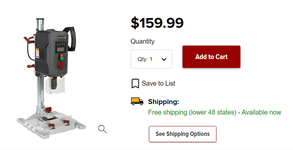

Without a doubt, I thought this would be a brushless multiphase motor, them being so cheap thanks to li-ion power tools this was a natural evolution. Looks like it's a universal motor & not a BLDC, 1 hp (if truly rated) is no joke in such a small package. I really like that the motor doesn't take up space behind the head, though would be nice to see these w/more throat depth.Now days, probably cheaper to manufacture that than something with pulleys and belts.
Looks pretty cool.
It's a two gear w/the variable being electronic so not planetary. Here's a teardown of the bosch which I have a hunch are coming off the same line:Great that it has two built-in speed ranges; I would assume it’s a planetary set.
OK, at 3:00 into the video it appears to be a reduction set that is two shaft.It's a two gear w/the variable being electronic so not planetary. Here's a teardown of the bosch which I have a hunch are coming off the same line:
It's why I originally thought brushless, I didn't think a universal motor would have the torque, that, plus I can actually buy a brushless one on aliexpress. Quite a few youtubers punching big holes in steel and wood using fostner bits w/these Bosch's. Loud though.OK, at 3:00 into the video it appears to be a reduction set that is two shaft.
And yes, I get that the variable part is electronic. My point was that, given the torque curve of a universal motor, they would need more than electronic control for the larger bits; it takes geared or pulley reduction.
I've gone down that rabbit hole and no doubt is an option. I like the packaging of these drill heads. FWIW (free treadmill may be cheaper):You can also upgrade your current drill press.
I buy used 90 VDC NEMA 56 industrial motors and swap them on my drill press. Dart, Minarik, etc DC motor speed controllers can be found for pretty cheap on eBay. You still maintain the step pulleys for changing the max speed of the drill press if needed. I find that rarely change the step pulley speeds.
 www.vevor.com
Treadmill motors can work. But I find most treadmill motors have wildly inflated horsepower ratings, especially the ones that break the laws of physics (>100% efficiency). On the use market, I usually can find reasonably priced Baldor, Leeson, etc. industrial motors with a NEMA 56 form factor for easy Installation.I've gone down that rabbit hole and no doubt is an option. I like the packaging of these drill heads. FWIW (free treadmill may be cheaper):
Explore VEVOR Brushed Motor - Shop Durable & Versatile Tools
VEVOR Brushed Motor is an electric motor using brushes and a commutator, used in house appliances and some vehicles are effective. Shop now for reliable power!
that link I posted has new 56 frame DC motors. I can't remember the reasoning but if I recall, DC motors do fall short to VFD 3/phase option in terms of torque at low speed but entry point is likely lower. I sourced a cheap VFD from china & 3 phase are easier to find used but we'll see longevity wise (for VFD).Treadmill motors can work. But I find most treadmill motors have wildly inflated horsepower ratings, especially the ones that break the laws of physics (>100% efficiency). On the use market, I usually can find reasonably priced Baldor, Leeson, etc. industrial motors with a NEMA 56 form factor for easy Installation.
I have good hearing and the high pitch whine of VFDs was annoying in a quiet shop. So I ended up using DC motors for converting drill presses, belt grinders, etc to variable speed.that link I posted has new 56 frame DC motors. I can't remember the reasoning but if I recall, DC motors do fall short to VFD 3/phase option in terms of torque at low speed but entry point is likely lower. I sourced a cheap VFD from china & 3 phase are easier to find used but we'll see longevity wise (for VFD).
What machinery in your experience is a good source of 90v dc motors?
I hear you on the VFD whine (no pun intended). I actually considered converting a drill press to BLDC (brushless dc) which are quiet and more efficient than regular DC and higher torque but did not pull the trigger. These are mostly off scooters at the moment but come w/controllers. The voltage is an odd 48V.I have good hearing and the high pitch whine of VFDs was annoying in a quiet shop. So I ended up using DC motors for converting drill presses, belt grinders, etc to variable speed.
DC motors usually come standard with a base and face mount. AC motors are usually one or the other. This is really handy for things like belt grinders where both interfaces are used.
Also, I have been able to find quality DC variable speed drives on eBay for a lot cheaper that quality AC VFDs.
Usually I find industrial DC motors on Criagslist. It can take some patience. For example, I purchased a like new 3hp 1800 rpm 180VDC Superior Electric? motor off of Craigslist for $100. The new Baldor 240VAC 3hp variable speed regenerative drive was $20 off of Ebay.

I wonder what the real continuous power output is of those motors. The listed 2000W is close to 3hp. 50A continuous current draw would be pretty impressive.I hear you on the VFD whine (no pun intended). I actually considered converting a drill press to BLDC (brushless dc) which are quiet and more efficient than regular DC and higher torque but did not pull the trigger. These are mostly off scooters at the moment but come w/controllers. The voltage is an odd 48V.
Here's a somewhat involved build using a BLDC from a hoverboard. Note the packaging (direct drive) allowed to ditch the extra length from the back. I don't trust this is equivalent in torque as the original setup but the beauty about these hub motors is that some come with a planetary gearbox.