To avoid these ads, REGISTER NOW!

Things to put in/checklist before pouring a pad?

Spoon33

Active member
Joined
May 20, 2015
Messages
41
Location
Oklahoma City
Should have a pad poured in a few weeks for a 24x40 shop. So I was seeing if I could pick yalls brain for ideas on what I need to do on my end. So obviously the electricity will be run, and some tubing for a cold water sink. Also need to run something for the waste water and I am still deciding if I want a floor drain or not. Outside of that, anything else? It'll be an insulated shop in Oklahoma if that matters.

I have a natural gas stem on my back porch that I currently use for my grill, but not sure what I would do if I split that off and ran it into the shop.

So fire away please with a checklist of things I need to make sure is done before the slab is poured.

Thanks,
Clint
 
To avoid these ads, REGISTER NOW!

lakeroadster

Well-known member
Joined
Jan 19, 2015
Messages
5,166
Location
Central Colorado
Specify that the sub-base gravel be material that has Proctor data, and make sure a density test is performed on the compacted sub-base materials before any wire-mesh or rebar is installed.

Specify that the gravel be compacted to 92% of maximum density as determined by standard proctor.

Specify that the density not vary by more than 4% over the area that will support the slab.
 

naturalgas

Well-known member
Joined
Dec 6, 2014
Messages
497
Location
Metrowest Ma.
I will tell you the gas line for grill will be too small to be of any use. You will need to tap in close to source(meter) and length of run and load will dictate pipe size to shop.


Sent from my iPad using Tapatalk
 

ysacres

New member
Joined
Apr 21, 2016
Messages
4
Location
Wazzu WA
A couple things I did.
1. ran 1/2 inch pvc from the air compressor to the other walls, I have air on all four walls.
2. set a four foot chunk of I beam flush with finished concrete, if I need an anchor, I can weld a hook or whatever, torch it off when done.
 

Moose364

Well-known member
Joined
Oct 21, 2014
Messages
282
Location
East Texas
I installed 2" PVC conduit from my breaker box location to the other side of the shop its cheaper to go across than around when you decide you want a 50+ amp service on the other side of your shop.
Other thing I did was cement a 4" piece of heavy pipe 3' below slab with cross rods welded into it left 4' above slab. Cut it down to the height I wanted and mounted a big 7" vise on it you can't move that thing with a D7 wish I would have installed 1 more for a pipe bender.
 

matt_i

Well-known member
Joined
Mar 14, 2008
Messages
10,725
Location
SE Michigan
Not sure if you are pouring or not. Using release agent (Mazola corn oil works great) on the forms helps out a lot. DOuble checking anchor bolt locations with your detailed wall framing plans saves time. Having the proper number of anchor bolts on-site helps. Knowing the location for garage doors so the slab can be properly beveled for water runoff helps. Having the crushed stone base compacted. Having the stone base reasonably leveled with respect to the forms so you don't have a "thin center". Setting and properly lapping the vapor barrier. Setting and wire-tying steel reinforcement, planning to have it pre-set to height on chairs or dobies or agree to having it pulled up to a mystery location during the pour. Making sure the plant mix is actually what is poured (prespecify a slump to the plant and it will be pre-done for you). Having a way to maintain water retention during the cure (spray with water, curing sealant). Having all the tools on site (screed, float, finishing steel trowel) plus running water to clean them up at the end. Checking the weather to make sure an all-out rain isn't going to pock your freshly poured slab. These are some issues that come to mind.
 

pmiranda

Well-known member
Joined
Jul 15, 2008
Messages
1,504
Location
Austin, TX
Low voltage conduit (phone, security cameras, speakers?) separate from high voltage.
Pretreatment for termites or other pests.
Vapor retarding barrier... if that makes sense for your application.
 
To avoid these ads, REGISTER NOW!

cshield09

Member
Joined
Oct 20, 2015
Messages
5
I'd heavily recommend using chairs for holding steel reinforcement in the slab - and I'd use rebar, not welded wire fabric.

Do you have a tornado shelter? There are drop-in prefabricated units that you could add later; designate a spot for one now and add grade beams/rebar around the future opening.


Sent from my iPhone using Tapatalk
 

mburrus

Well-known member
Joined
Nov 15, 2014
Messages
235
Location
Miami, Fl
i agree with that. i passed up welded mesh for tied #3 rebar on 12" centers... cost a lot more, but i have no control cuts, and a 6-6.5" slab, and ive had 0 cracks, have stacked a dozen cubes of block and driven my 7000lb forklift on it too... i placed the rebar on 3" strip chairs every 5 or so feet to support the bars and ensure they were in the dead middle of the slab...

make sure there is NO RAIN forecasted... it poured just after we did my slab, and the surface is very weak/chalky... i am planning to grind down till i get better concrete and then polish.
 

Radix2

Well-known member
Joined
May 28, 2014
Messages
1,853
Location
the thumb!, MI
Hey, great thread, I was going to post the same topic but fortunately did a search first.

I put in big conduits from the house for misc future use, a spare waterline to the street end of the building in case we hook up to city water someday. Added hot and cold pex lines from the mechanical room to a spot by one if the garage doors. Floor drains are already in, stub outs for a bathroom are already in.

Already talked to the contractor about verifying slight thickening for lift area. Final compaction and foam going down in next day or so, then heating contractor is putting pex down. Going with wire mesh over pex. Full deep foundation with ICF frost walls.

Still sitting here trying to think of any "nice to haves". No pull pots or under lift lights since I really don't have the layout well enough defined to execute. I feel that electrical can go in the walls.

An airline feed from the workshop side to the garage side is the best idea I am missing I think...what can I get quickly that would work through a slab...?
 

Bluedodge

Well-known member
Joined
Jun 22, 2015
Messages
1,995
Location
Michigan (not the Detroit part)
The concrete trucks usually bring a little too much product.

Throw together a few extra 2x4's / 2x6's for a stoop by any man doors.

If they get filled, cool it's free concrete. If they don't get filled, you're only out the cost of a few boards.
 

gordopost

Active member
Joined
Jan 13, 2010
Messages
39
Location
Daytona Beach FL
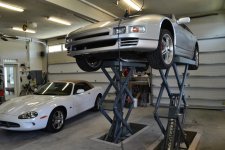
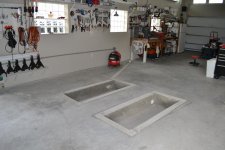
Lift pits for scissors lift -

Build forms using 3/4" plywood with about three or four rebar crossovers per side.
 

Attachments

  • Scissors Lift Install (3).jpg
    Scissors Lift Install (3).jpg
    139.3 KB · Views: 93
  • Scissors Lift Install (9).jpg
    Scissors Lift Install (9).jpg
    144.4 KB · Views: 103
  • zcar.on.lft (7).jpg
    zcar.on.lft (7).jpg
    142.1 KB · Views: 102

Radix2

Well-known member
Joined
May 28, 2014
Messages
1,853
Location
the thumb!, MI
Darn you guys with the scissor lifts...making me second guess the two post. Not a huge mechanic and the space saving is enormous....
 

rburke65

Well-known member
Joined
Nov 10, 2007
Messages
12,349
Location
Canfield, Ohio
Plan your saw cuts and your lift placement ahead of time. You don't want a cut going through a base plate location or close to a post.
 

4x4_G30_Sportvan

Well-known member
Joined
Jan 3, 2013
Messages
547
In OK you will want air entrained concrete.

The best advice.... Be on site when they pour. That way you can correct any small thing before it gets, well, set in stone.

I used both rebar and 4' x 12' cattle panels on concrete chairs.
Specified 4500PSI mix.
put in PEX-AL-PEX tubing for future hydronic radiant heating.
Put 2" foam underneath also.
 

ysacres

New member
Joined
Apr 21, 2016
Messages
4
Location
Wazzu WA
An airline feed from the workshop side to the garage side is the best idea I am missing I think...what can I get quickly that would work through a slab...?

I ran 1/2 inch PVC from where the compressor is to the center of the other three walls, I just quick couple the compressor to the PVC when I need air at the other places, works great, no hose laying on the floor, and inexpensive.
 

pcmeiners

Well-known member
Joined
Aug 13, 2009
Messages
7,878
Location
In the only town in Pennsylvania, Bloomsburg.
Make sure you get a statement from the crete truck driver that NO extra water added beyond the stated PSI. Do not trust the contractor. Get a sample of the crete just before the pour (if nothing else, empty milk container), even if you have no intention of testing the driver will believe it may be. Pour early in morning, be near the truck, do it soon, hot day is not the best for working/curing.
 

flan

Well-known member
Joined
Feb 3, 2016
Messages
427
Make sure you get a statement from the crete truck driver that NO extra water added beyond the stated PSI.
I got a load once for a driveway pad and the driver asked my buddy that was helping me what slump He wanted, and my buddy rambled off a number. to adjust slump does the driver add water while the concrete is in the truck? Is this what everyone means when they say don't add additional water? If you don't add any water what does the concrete show up from the plant slump wise?
 

UpNorther

Well-known member
Joined
Jan 20, 2016
Messages
318
Location
Brainerd, MN
Should have a pad poured in a few weeks for a 24x40 shop. So I was seeing if I could pick yalls brain for ideas on what I need to do on my end. So obviously the electricity will be run, and some tubing for a cold water sink. Also need to run something for the waste water and I am still deciding if I want a floor drain or not. Outside of that, anything else? It'll be an insulated shop in Oklahoma if that matters.

I have a natural gas stem on my back porch that I currently use for my grill, but not sure what I would do if I split that off and ran it into the shop.

So fire away please with a checklist of things I need to make sure is done before the slab is poured.

Thanks,
Clint


Im pouring my pad in about 6 weeks, so nice to follow this post to.
My planned stubs are:
- floor drain by small overhead
- drain trough by big overhead
- run underground 3/4 conduit from panel to each wall/ future bar/work stations
- run low voltage stub from outside (coax/cat 5)
- slop sink drain ( i live in the country, so it's just going to a 5 gal bucket a few feet down)
- water line from outside to slop sink
- deeper pad area for possible 2 post hoist

hope any of these ideas help
:thumbup:
 

pcmeiners

Well-known member
Joined
Aug 13, 2009
Messages
7,878
Location
In the only town in Pennsylvania, Bloomsburg.
Some companies add water before truck leaves the concrete provider. Some add the water at the pour site. Personally I want it added at the site. Concrete needs a specific amount of water to cure correctly, and needs to be poured/worked within a specific time window .

When most are talking about additional water, they are referring to added water beyond which is needed for full cure. Almost all contractors try to get additional water so there is less work to move the crete and to increase the time to work the concrete. Additional water weakens the concrete, and is a cause of surface issues. Most Contractors care very little of the after effects of excess water, they are paid, and the courts let them away with shoddy work.

As to slump...
http://www.lmcc.com/concrete_news/0801/5-minute-classroom-slump.asp
Basically, your going to tell the crete supplier your PSI strength concrete you want, have the driver sign as to the PSI strength poured, that about it, unless you want additives. Your not going to be dealing with slump. Remember to get a sample of the pour, stay by the truck during pour with a 12 gauge to keep the contractor away. :)

As a reminder, even with the correct amount of water, if the ground is not compacted properly, rebar, mesh and fiber are not going to make up for it.
 
Last edited:
To avoid these ads, REGISTER NOW!
Top Bottom