To avoid these ads, REGISTER NOW!

This electrical passed Home Inspection

Gigfy

Well-known member
Joined
Jan 30, 2011
Messages
82
My daughter and son-in-law (young couple) bought a decent starter home (except the electrical).

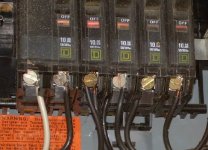
This has to rate as some of the worst electrical to pass home inspection. The subpanel had lots of 14 ga. wire on 20A breakers. Lots of wires packed through a hole made for a 3/4 fitting w/ no fitting (i.e. wire crammed against sharp metal opening).

The main opening has the terminal adapter backward with no nut on it.

The range wire was only rated for 40A, on a 50A breaker.

The wire for the sub only uses 3 wires and the wire is only rated at 75A on a 100A breaker.

Several neutrals were double tapped.

I don't think the inspector even realized the house had a sub, because it was behind a door. But I would think the lack of branch circuits in the main 200A panel, and a 100A branch circuit in the main, would have been a clue the house had a sub.

What is really sad is that when they first moved in the house, my daughter called me and told me the brand new dryer they bought for the house didn't work. My son-in-law had a volt meter, and through long distance diagnosis, I was able to tell them both leads of the 240v dryer outlet were wired on the same leg (This passed home inspection too.)

They called the home warranty outfit, who sent someone out to fix the dryer circuit (in the sub) but he didn't tell them about all the other dangerous issues. The home warranty (the seller bought the policy) charged them $150 to fix the one electrical problem. The exclusion says they don't cover code issues. But again he didn't mention any other issues.

My son-in-law/daughter are several states away, so I've only been to see them once, in their new house. My time was limited, so I couldn't fix everything. I just wanted to get the electrical safe enough so that their house wouldn't immediately burn down. Replaced all the overfused breakers with correct ones, except the breaker to the sub. Couldn't find a 70A double pole breaker locally.

I tested the current draw on the sub when they had everything on (range had all burners and oven on) and the sub was drawing below 70A, so I left the 100A breaker for now.

I didn't want to dig into the sheet rock to properly fix all the wires coming through the 3/4" naked hole, but I was able to split the romex cables up and send them through other knockouts, so they aren't so bunched up. I followed the same crappy pattern in the box of sticking the terminal adapters upside down through the holes with no nuts on the backside, just as something to keep the cables from touching the sharp metal in the knockouts.

Separated double tapped neutrals.

My time ran out, so I had to leave the rest. Here are the before pics. I didn't take any "after" pics, nothing to be proud of there.

This should be a training example in how not to do Home Inspections.
 

Attachments

  • KIMG0456[2].jpg
    KIMG0456[2].jpg
    131.7 KB · Views: 436
  • KIMG0454[1].jpg
    KIMG0454[1].jpg
    152.5 KB · Views: 489
To avoid these ads, REGISTER NOW!

zmaxmotorsports

Well-known member
Joined
Jan 11, 2013
Messages
11,948
Location
South of omaha
And people wonder why I hate home inspectors,If I had $1.00 for every obvious code violation I've seen them walk by to point out something that's obviously not a violation I'd pay cash for a nice 67 big block corvette.:spit:
 

tyme2par4

Well-known member
Joined
May 16, 2016
Messages
571
Location
NH
I'm glad I know enough of what to look for in an inspection. Although the inspector I used was very good, and caught even more issues than I noticed.
My house had a number of the same issues you noted, but they were noted in the inspection report. The scary part is what you can't see. Since moving in I've found at least 3 illegal splices inside walls. And I completely replaced the main/sub panels with a new 200A service.
 

nh_yota

Well-known member
Joined
Mar 10, 2015
Messages
4,076
Location
Seacoast New Hampshire
Home inspectors are a mixed bag. Most of them are useless but I know a few in my area who were previously contractors or in the trades and they know their stuff. The problem is that most people who know enough stuff to be a decent home inspector can make better money doing something else.

Code inspectors can be just as bad as home inspectors but there is the additional assumption that they're supposed to know their stuff because they previously worked or currently work in the trade. Often times they have political/personal chips on their shoulder that can cause you additional grief.

The best bang for your buck is to hire true contractors/tradespeople and pay them whatever consulting fee they charge to do an inspection. This is not to say that all of them are the best and the brightest, but at least you stand a better chance at finding out more pertinent details or problems.

Home warranty companies are scum and you're better off setting a pile of money on fire than paying for one of them.
 

theoldwizard1

Well-known member
Joined
Feb 22, 2011
Messages
43,106
Location
SE MI
3 wires to a sub WAS legal in the past ! Ground was just the closest water pipe.

My gut says, the only way to make that box "right" is to replace it. And if you do that, 4 wire to the sub will be required.
 
OP
G

Gigfy

Well-known member
Joined
Jan 30, 2011
Messages
82
"3 wires to a sub WAS legal in the past !"

Wizard,

Did NEC ever allow 3 wire subs in attached structures? I didn't think they did, but I don't know electrical history that well.

Wyliesdiesels mentions it's never been allowed in the FAQs pinned at the top of the forum.

"4-wire feeders to panels in attached structures have always been required."

I'm not trying to argue, rather satisfy my own curiosity.
 

wyliesdiesels

Well-known member
Joined
Aug 14, 2012
Messages
19,994
Location
Modesto, CA
OP- Was an electrical inspection specifically part of the home inspectors work order?

3 wires to a sub WAS legal in the past ! Ground was just the closest water pipe.

My gut says, the only way to make that box "right" is to replace it. And if you do that, 4 wire to the sub will be required.

Was never allowed for subs in attached due to the potential for parallel return paths and the shock potential it creates.

That was only allowed for detached structures up until 2008.
 
Last edited:

danb35

Well-known member
Joined
Oct 24, 2014
Messages
172
Location
SE Georgia
In the couple of home inspections I've observed, the inspector went to great pains to point out that it was not a code compliance inspection--so it's entirely possible that some, or even all, of the issues noted would be outside the intended scope of the inspection.
 
OP
G

Gigfy

Well-known member
Joined
Jan 30, 2011
Messages
82
"Was an electrical inspection specifically part of the home inspectors work order?"

I didn't see the inspection report myself, but I'm pretty sure electrical was included. My daughter looked at the electrical section and told me there was something the seller had to fix inside the main panel as a result of the home inspection.
 

yeldogt

Well-known member
Joined
Jan 2, 2012
Messages
18,184
When buying home it's wise to pull all relevant doc's from the governing authorities after you make an offer ... that way you see what permits were filed. This is especially true with private wells and septic. Home inspectors are not code officials -- they may catch obvious problems like flying splices in an attic. Not going to report how the main panel was wired -- they don't remove the cover. My guess is unless there was a dryer in the house there was no way to check the outlet.

Entry level houses = entry level owners ... they do stuff on the cheap and w/o permits
 

larry4406

Well-known member
Joined
Jan 27, 2006
Messages
19,073
Location
Northern Virginia
When buying home it's wise to pull all relevant doc's from the governing authorities after you make an offer ... that way you see what permits were filed. This is especially true with private wells and septic. Home inspectors are not code officials -- they may catch obvious problems like flying splices in an attic. Not going to report how the main panel was wired -- they don't remove the cover. My guess is unless there was a dryer in the house there was no way to check the outlet.

Entry level houses = entry level owners ... they do stuff on the cheap and w/o permits

Agreed.

Then after you find out what if any permits were ever pulled, then use Google Earth and the time fly back slider at the top to see what transpired over the years. My house deck was added yet no permit, basement was finished yet no permit, lots of sketchy stuff we tore out after closing but it was in and addressed in our home inspection report and we got some price concession for the various home inspection items.
 

reader2580

Well-known member
Joined
Dec 31, 2014
Messages
14,516
Location
Minneapolis, MN
A home inspector can't possibly know everything about electrical. Some may not even remove the cover on the main panel. I doubt they would ever check things like voltage on a dryer receptacle.
 

zmaxmotorsports

Well-known member
Joined
Jan 11, 2013
Messages
11,948
Location
South of omaha
A home inspector can't possibly know everything about electrical. Some may not even remove the cover on the main panel. I doubt they would ever check things like voltage on a dryer receptacle.
They don't know much of anything about plumbing or mechanical system codes either.
But they're really good about punctuation I've noticed when I get on their forum though.:spit:
 

LXCam

ALLIANCE MEMBER
Joined
Apr 23, 2013
Messages
19,093
Location
AZ
That's ***** OP, fortunately you know your way around a wire so the next trip out they'll be all set right? ;)

My daughter and the sperm donor bought their starter home last year. I didn't have a chance to go over till the day after they closed. Holy ****, what you have is nothing compared to the things I found. I swear the previous home owner had to have paid off the inspector. The **** this guy let slide was overwhelming and I mean major stuff.
 

lowe.joshua51

Well-known member
Joined
Jan 24, 2018
Messages
78
Location
Southeast Kansas
I'm in the middle of a remodel and when I took the drywall down in the kitchen there were 2 boxes that were just mudded over with live wires stripped and bare in the box..... Needless to say I'm thankful my grandpa is an electrician.
 

Dagny

Well-known member
Joined
Jul 25, 2014
Messages
2,980
Location
Northern Wi.
If a sub panel only has 240 volt loads 3 wires would be safe. I think the very old code books forbid the grounding of neutrals.
 
To avoid these ads, REGISTER NOW!
OP
G

Gigfy

Well-known member
Joined
Jan 30, 2011
Messages
82
When buying home it's wise to pull all relevant doc's from the governing authorities after you make an offer ... that way you see what permits were filed. This is especially true with private wells and septic. Home inspectors are not code officials -- they may catch obvious problems like flying splices in an attic. Not going to report how the main panel was wired -- they don't remove the cover. My guess is unless there was a dryer in the house there was no way to check the outlet.

Entry level houses = entry level owners ... they do stuff on the cheap and w/o permits

That's very true. They bought the house from a guy who remodels and sells houses. On hindsight, I doubt even that guy got all the required permits.

Re: Dryer outlet

The Home Inspector didn't have to test the dryer recep to determine the faulty wiring. When my son-in-law originally described the problem to me over the phone, I asked him several questions while he was looking at the panel. I was able to determine the remodeler had wired the dryer recep using two twin/tandem/half breakers in one slot in the panel. I would have thought if someone could determine this by phone, a competent inspector could do it in person.

That's why I think the inspector never even realized there was a sub panel in the house. But, this doesn't reduce the incompetence of the home inspector, imo. Anyone with a basic knowledge of electrical work would have realized there had to be a sub from looking at the main.

If it's true that many home inspectors don't even open up the main panel, their services are probably a waste of money at best, and fraud at worst (at least as far as the electrical portion goes). People count on home inspections to catch basic mechanical deficiencies. I think that's supposed to be the point of home inspections. I think most banks require it for loans.

Of course, like any field, there are good and bad home inspectors. When I bought my house years ago, the inspector did remove the cover to the main (I was present during the inspection) and noticed some basic problems (i.e. couple double tapped breakers). He also caught some mechanical issues on the framing. He was decent home inspector. I can't say the same for the one who inspected my daughters house, at least from an electrical safety standpoint.
 

KenC

Well-known member
Joined
Dec 20, 2009
Messages
2,577
In my experience, limited as it is, with home inspectors they don't enter the attic or crawl space and neither do they remove electrical panel covers. Never saw one with a meter either so don't know how a dryer recpt could be determined good or bad. Or any other switch/recpt either for that matter.

edit: search for home inspector check lists. Lots of them online and the electrical section will shock you. Pun intended.

here is an example from a realty site explaining electrical inspection:Electrical: Inspectors will check if the visible wiring and electrical panels are in good shape, light switches work correctly, and there are enough outlets in each room.

Note: 'visible wiring'
 
Last edited:

jd_1138

Well-known member
Joined
May 8, 2013
Messages
17,043
Location
NE Ohio
What a shame. The inspector and seller ought to be on the hook to get that straightened out. That house may not even be insurable like that.

I'd make sure they have like 5 smoke alarms and a couple CO detectors.
 

PCustoms

Well-known member
Joined
Jul 23, 2011
Messages
22,403
Location
VT
Of course, like any field, there are good and bad home inspectors. When I bought my house years ago, the inspector did remove the cover to the main (I was present during the inspection) and noticed some basic problems (i.e. couple double tapped breakers). He also caught some mechanical issues on the framing. He was decent home inspector. I can't say the same for the one who inspected my daughters house, at least from an electrical safety standpoint.

This is key. The inspector isn't (and really can't be) an expert in all trades. The inspection items should be clearly called ou in the contract, and the buyer should understand what they are getting. Most inspectors won't open panels, they'll check basics like integrite of outlets, gfci etc. And make recommendations. Mine stated he shouldn't open the panel, but we were curious about a few things and he took a peak to note in the report some issues I was already aware of. At rhe end if the day most items are recommendations/barging tools for the buyer.

Btw, what do you mean by "double tapped breakers"? As far as I am aware most breakers are rated for multiple wires.
 

malibu101

Well-known member
Joined
Jul 1, 2005
Messages
3,908
Location
Walnutport PA
This is NOT to defend any home inspectors. Their safety practices (insurance, etc.) may not allow them to take the cover off of a panel.

Arc flash is no joke. Where I work we have strict training and practices of how to go about removing covers and poking into energized equipment using FR clothing of the proper Cal/Cm.
IF a fault was to occur on the incoming lines of a residential service the energy would be substantial. No doubt more than 8Cal/Cm, probably requiring a 25Cal/Cm suit.

Do many of us go ******** right into a live panel? Yes, me included.
BUT again, lawyers and money may be the reason for a home inspector to not open a panel.
ALTHOUGH that is not a reason to let it go sight unseen for the new buyer.
:willy_nil:willy_nil:willy_nil:willy_nil

Oh the conundrum.
 

teamextreme

Well-known member
Joined
Aug 10, 2013
Messages
867
Location
Lakewood, CO
They called the home warranty outfit, who sent someone out to fix the dryer circuit (in the sub) but he didn't tell them about all the other dangerous issues. The home warranty (the seller bought the policy) charged them $150 to fix the one electrical problem. The exclusion says they don't cover code issues. But again he didn't mention any other issues.

How did they get away with calling this a code violation? The 240v outlet was not supplying 240v, that's a defect. I'd be fighting that call.

I'll call myself lucky with all the horror stories of inspectors. I've used 2 over the past 5 years and both were excellent. Checking in detail all the systems, including the panel, and finding many things I would have overlooked.
 

wyliesdiesels

Well-known member
Joined
Aug 14, 2012
Messages
19,994
Location
Modesto, CA
If a sub panel only has 240 volt loads 3 wires would be safe. I think the very old code books forbid the grounding of neutrals.

Except in the OPs case, the branch circuits are on the sub, which would mean 120v circuits and a neutral. So bonded sub is no bueno in this case...

Grounding of neutral has always been required for main service panels...

That's very true. They bought the house from a guy who remodels and sells houses. On hindsight, I doubt even that guy got all the required permits.

Re: Dryer outlet

The Home Inspector didn't have to test the dryer recep to determine the faulty wiring. When my son-in-law originally described the problem to me over the phone, I asked him several questions while he was looking at the panel. I was able to determine the remodeler had wired the dryer recep using two twin/tandem/half breakers in one slot in the panel. I would have thought if someone could determine this by phone, a competent inspector could do it in person.

That's why I think the inspector never even realized there was a sub panel in the house. But, this doesn't reduce the incompetence of the home inspector, imo. Anyone with a basic knowledge of electrical work would have realized there had to be a sub from looking at the main.

If it's true that many home inspectors don't even open up the main panel, their services are probably a waste of money at best, and fraud at worst (at least as far as the electrical portion goes). People count on home inspections to catch basic mechanical deficiencies. I think that's supposed to be the point of home inspections. I think most banks require it for loans.

Of course, like any field, there are good and bad home inspectors. When I bought my house years ago, the inspector did remove the cover to the main (I was present during the inspection) and noticed some basic problems (i.e. couple double tapped breakers). He also caught some mechanical issues on the framing. He was decent home inspector. I can't say the same for the one who inspected my daughters house, at least from an electrical safety standpoint.

Did your famiy pay for the home inspection?

I would ask for a refund...
 

wyliesdiesels

Well-known member
Joined
Aug 14, 2012
Messages
19,994
Location
Modesto, CA
How did they get away with calling this a code violation? The 240v outlet was not supplying 240v, that's a defect. I'd be fighting that call.

I'll call myself lucky with all the horror stories of inspectors. I've used 2 over the past 5 years and both were excellent. Checking in detail all the systems, including the panel, and finding many things I would have overlooked.

Yes this is an excellent point....It was an incompetent installation...

I would demand a refund..
 

PoorOwner

Well-known member
Joined
Feb 10, 2007
Messages
5,032
Location
CA
Home warranty are very useless for electrical! They told me they don't cover wiring issues because it is "inaccessable", LOL. The outfit who came out proposed to knock 2 holes on the outside of the house and run conduit for a new wire if I wanted to they will give me a quote for that.

If a receptacle was loose, or something is missing a wirenut on it, they will probably do something like that - after you pay your deductible.
 

zmaxmotorsports

Well-known member
Joined
Jan 11, 2013
Messages
11,948
Location
South of omaha
This is key. The inspector isn't (and really can't be) an expert in all trades. The inspection items should be clearly called ou in the contract, and the buyer should understand what they are getting. Most inspectors won't open panels, they'll check basics like integrite of outlets, gfci etc. And make recommendations. Mine stated he shouldn't open the panel, but we were curious about a few things and he took a peak to note in the report some issues I was already aware of. At rhe end if the day most items are recommendations/barging tools for the buyer.

Btw, what do you mean by "double tapped breakers"? As far as I am aware most breakers are rated for multiple wires.
Most breakers other than Sq d are not designed for multiple wires that I'm aware of.
 
OP
G

Gigfy

Well-known member
Joined
Jan 30, 2011
Messages
82
Btw, what do you mean by "double tapped breakers"? As far as I am aware most breakers are rated for multiple wires.

This is my error. I had assumed breakers could not be double tapped for the same reasons a neutral is not supposed to be. I didn't realize most breakers were designed for the application.

How did they get away with calling this a code violation? The 240v outlet was not supplying 240v, that's a defect. I'd be fighting that call.

I agree and told my son-in-law and daughter to do the same. They are young, intelligent, but fairly passive people so they just wanted to move on.

Same thing for the electrical inspection (as Wylies points out). Should have asked for a refund, but my kids just wanted to move on, plus they have Dad to fix things:headscrat
 
Last edited:

tdkkart

Well-known member
Joined
Jun 17, 2006
Messages
6,887
Location
Eastern Iowa
Most breakers other than Sq d are not designed for multiple wires that I'm aware of.

I ran into this exact problem with an inspector when i was selling our last house, had to email him the spec sheet on the SQ D breakers that were in the garage panel to show him they were indeed designed to be double tapped.


IMO, home inspectors are just about useless except to point out obvious issues to unknowing newbie homeowners. The problem is, most of their contracts specifically exclude them from some of the most important issues. Roof inspections from the ground only in most homes. Basically nothing that requires a ladder to access. No heating equipment if it's too warm, no cooling equipment if it's too cold. No electrical, etc etc.
Sadly, the general population these days is completely clueless as how a house is supposed to be built and how the systems inside operate, so home inspectors have become almost a necessity.

Trades making more money than a home inspections?? Ha, that's funny. Home inspectors around here get $3-400 for an inspection. A couple hours on site, an hour or so printing up the report, and you've made your money before lunch. 2 of those a day and you'll easily triple or quadruple a tradesman's hourly wage.

BTW, much to the horror of many of the people in this thread, in MANY parts of this country there were no permits inspections etc prior to 25 or 30 years ago. I worked for an electrician in the county I grew up in, houses around there were built from start to finish, basement to roof, with no inspections whatsoever even in some of the small towns.
My parents put up and new modular home 10 years ago, the only item that a was permitted and inspected was the septic system, and thats done by the state Department of Natural Resources.
My house was built in 1976, there's no inspection or permit records prior to about 2003, other than a rough sketch of the septic system and well at the county health department.
 
OP
G

Gigfy

Well-known member
Joined
Jan 30, 2011
Messages
82
Btw, what do you mean by "double tapped breakers"? As far as I am aware most breakers are rated for multiple wires.

Most breakers other than Sq d are not designed for multiple wires that I'm aware of.

Well now I'm not sure if most breakers allow double tapping or not. Now that I think about it the breakers the home inspector flagged in my house for being double tapped, weren't listed for it. As I recall they were the type with the screw (not the lug type) and they didn't have the little bracket to accept two wires, but this has been more than 15 years ago.

I assume breakers listed for it would say so, either on the breaker or the enclosed specs?
 
Last edited:

zmaxmotorsports

Well-known member
Joined
Jan 11, 2013
Messages
11,948
Location
South of omaha
These are the only commonly available breakers I normally come across that are meant to be double tapped at the breaker.
Both sq D models.
 

Attachments

  • attachment-1.jpg
    attachment-1.jpg
    51 KB · Views: 58
  • attachment.jpg
    attachment.jpg
    5.8 KB · Views: 55
  • Square-D-Breaker.jpg
    Square-D-Breaker.jpg
    138.3 KB · Views: 58

sberry

Banned
Joined
Jun 18, 2005
Messages
35,747
Location
Brethren, Michigan
I have never seen a flash suit in common residential work. Companies insure faulty wire all the time, look at appliance store installers and even ****** electricians have insurance. I think at some point the question may have been about tandem breakers whoops, I see not.
 
Last edited:

theoldwizard1

Well-known member
Joined
Feb 22, 2011
Messages
43,106
Location
SE MI
I know it does not look right, but code does allow splices inside of a load center. That said, you could take to neutrals (preferably on opposite rails), splice them to a third wire and put that on the neutral rail.
 
To avoid these ads, REGISTER NOW!
Top Bottom