To avoid these ads, REGISTER NOW!

This should be fun! Replacing a large steam boiler in a small room.

To avoid these ads, REGISTER NOW!

PCustoms

Well-known member
Joined
Jul 23, 2011
Messages
23,684
Location
VT
Somehow, I can't see the boss authorizing a few grand for a tool to move one thing, once.

Built a brand new building years ago, spend $$$ on polished floors so we could use these. Boss went around chewing out anyone who left **** on the floor during final build out.

1st load we moved, 1st caster hit the expansion joint and PSSSSHHHHH instantly deflated.....

Next weekend had a crew chasing cracks and filling.
 
OP
B

Beerhippie

Well-known member
Joined
Oct 13, 2023
Messages
10,340
Location
Far NE Oregon
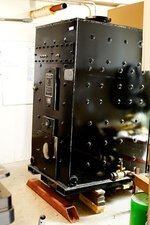
Three weeks or more and it's finally here!

54469824306_64f8bc5a20_o.jpg

As advertised, a bare hull, but intact.

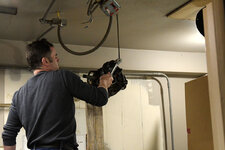
Tomorrow's projects include threading this little 2 1/2" pipe:

54470108938_9a7d89774c_o.jpg

Which is 82" from the floor to the bottom of the pipe.

With this little tool:

54470090298_abb5f0ec55_o.jpg

Or, rather, cluster-fudge of tools. The threading head weighs about 80 lb.

Speaking of little tools, I'll be needing to open and close a gate valve pretty often for blowing-down the boiler about once a week. Gate valves stick closed, so I made a tool for cracking it open:

54470197685_1e69cd7394_o.jpg

It even fits!

54470197680_95a75a8908_o.jpg

After threading that pipe, it's time to wedge the new boiler hull back into place and get it as perfectly located as possible so all the plumbing lines up... wish us luck!

Then weld it down, plumb it and commission it--and get it inspected.
 

TurnipTruck

Well-known member
Joined
Aug 28, 2005
Messages
1,609
Location
Southcentral Alaska
Ooof. NOW is the time for a globe valve or an angle valve outboard of the gate. Broken or stripped stems can cause steam-powered bullets to ricochet around the room.
How much pressure are you dealing with? A straight wall staybolt boiler could be good for as much as what, maybe 50 psi?
What are the PSVs set to?
 

no704

Well-known member
Joined
Apr 27, 2016
Messages
5,257
Best of luck to you. I know you will get it done hell or high water!
 
OP
B

Beerhippie

Well-known member
Joined
Oct 13, 2023
Messages
10,340
Location
Far NE Oregon
Ooof. NOW is the time for a globe valve or an angle valve outboard of the gate. Broken or stripped stems can cause steam-powered bullets to ricochet around the room.
How much pressure are you dealing with? A straight wall staybolt boiler could be good for as much as what, maybe 50 psi?
What are the PSVs set to?
The boiler runs at 10-15 psi. PSV is set to 15 psi. Walls and ceiling of the room are three layers of 5/8" fireboard--not much ricochet potential--and two walls are outside walls, including the one nearest that valve.

Why thread the pipe?

Weld it!
I'm not a certified steam or pressure welder. I doubt anyone in the county is.

Boiler inspector says we need a cert. welder, but can thread pipe ourselves.

Interesting (and irritating) fact: Boiler manufacturers say a boiler of 15 psi or less is low-pressure. Oregon State say 15 or above is high--so according to the inspectors, ours is a high-pressure boiler and we can't do any welding.

Best of luck to you. I know you will get it done hell or high water!
Come Hell or HOT water--better yet, STEAM!
 

Old tool guy

Well-known member
Joined
Apr 13, 2023
Messages
3,502
I made that up, i don't know what i’m talking about. But if you could limit the pressure to 14.9 then you would be considered low pressure by the local code.
 

Max

ALLIANCE MEMBER
Joined
Jun 16, 2018
Messages
3,385
Location
Georgia
You’re way past this now, and I hope the new boiler install is going well for you. But one technique I’ve used in the past in moving safes is to put 1/2” or 3/4” steel pipe under it and roll it.

If you can pry up a corner to get the pipe under this technique works well. I generally lift it enough that I can get two pipes under so it’s balanced. The only trick is making sure it doesn’t move too much when you lower it.
 
OP
B

Beerhippie

Well-known member
Joined
Oct 13, 2023
Messages
10,340
Location
Far NE Oregon
You’re way past this now, and I hope the new boiler install is going well for you. But one technique I’ve used in the past in moving safes is to put 1/2” or 3/4” steel pipe under it and roll it.

If you can pry up a corner to get the pipe under this technique works well. I generally lift it enough that I can get two pipes under so it’s balanced. The only trick is making sure it doesn’t move too much when you lower it.
I have a small pile of 3" pipe that would work well for that... if we were moving it in a straight line--or even close. We can get it halfway into the room with the forklift--the straight part of the move--then it has to make a sharp 90 degree turn to the left.

We'll have it in by noon. God willin'.
 
OP
B

Beerhippie

Well-known member
Joined
Oct 13, 2023
Messages
10,340
Location
Far NE Oregon
Well, noon turned out to be somewhat optimistic. It seems threading a 2 1/2" pipe in place is a non-trivial exercise--especially when using genuine vintage tools. The drive chuck thing that goes into the Rigid 700 power drive threader was FUBAR--the grooves that re supposed to engage the pins of the drive were pretty much gone. While I was on my way to the rental place to see if they had another (they didn't), my coworker Andy figured out that we still had a functioning Armstrong drive:

54471959881_c560bde918_o.jpg

He just finished "breaking the chip" and is getting the giant gear-drive die back into place before cutting thread with a 2' cheater on the old Crafty 1/2" drive. It took about a half hour to get the pipe threaded by hand.

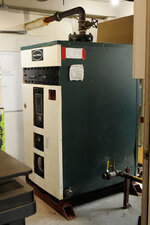
After lunch, it was go time. Reverse of removal, the installation went just about the same.

54471959886_1829c26869_o.jpg

The first of the sleepers bolted in place. Once we had both down and secure, it was fiddle-fartin' around to get the various pipes aligned. I used a couple of pry bars to make fine adjustments.

54471959896_eebe3ca81d_o.jpg

54472229023_7dafd7d50e_o.jpg

With those two pipe fittings aligned, everything else should fit just fine.

Now to weld the boiler to the sleepers and start installing the cladding and insulation--in the morning. Hopefully, I'll have 'er back online and brewing beer by early next week--sooner if I can.
 
To avoid these ads, REGISTER NOW!

American Locomotive

Well-known member
Joined
Jan 8, 2017
Messages
11,125
Location
Rhode Island
Does this process steam system have good condensate recovery?

If not, constantly adding raw feedwater like that will rapidly eat the insides of a boiler without treatment. Open steam applications require special feedwater treatment systems and monitoring that inject additives into the feedwater. It will greatly increase boiler life.

I will agree with the others that replacing that blow down valve with something better should be done. Gate valves ****, and that valve will seize and and break halfway open one day.
 
OP
B

Beerhippie

Well-known member
Joined
Oct 13, 2023
Messages
10,340
Location
Far NE Oregon
Does this process steam system have good condensate recovery?

If not, constantly adding raw feedwater like that will rapidly eat the insides of a boiler without treatment. Open steam applications require special feedwater treatment systems and monitoring that inject additives into the feedwater. It will greatly increase boiler life.

I will agree with the others that replacing that blow down valve with something better should be done. Gate valves ****, and that valve will seize and and break halfway open one day.
Our condensate return system isn't quite sealed--it's vented to atmosphere--but I'd say we add well less than a gallon a day when running. I'll be installing a ion-exchange water softener and treatment injection system on the make-up water soon.

Same for the gate valve--I agree that they **** (this wasn't my design). After the ~$28K we've spent so far, the wallet needs to recover some--which means making beer!

As much as possible, I'll be using water from our 185F, atmospheric-vented hot water system to fill the boiler, as it's somewhat softened and fully de-gassed.

The burner is back on--why the f*&^% can't anyone use studs instead of bolts on **** like this? Burner probably weighs 80 lb and is extremely awkward to handle--but I got it done by myself, as my helper disappeared as soon as I was ready to install it.

Between the sheet metal with sharp holes from the self-drilling screws and the fu#$ing Chinese pipe threads--razor sharp--I can't find a square inch of my hands without a shallow, irritating cut.
 

American Locomotive

Well-known member
Joined
Jan 8, 2017
Messages
11,125
Location
Rhode Island
I am not an expert, but I believe water softeners are generally discouraged for steam boiler use, something about it being hard to control water PH inside the boiler because of residual chlorides and sodium.

It's probably worth calling around and seeing if there are any process steam people around to consult about proper feed water treatment. I would think you should get at least twice that life out of a boiler that size?
 
OP
B

Beerhippie

Well-known member
Joined
Oct 13, 2023
Messages
10,340
Location
Far NE Oregon
I am not an expert, but I believe water softeners are generally discouraged for steam boiler use, something about it being hard to control water PH inside the boiler because of residual chlorides and sodium.

It's probably worth calling around and seeing if there are any process steam people around to consult about proper feed water treatment. I would think you should get at least twice that life out of a boiler that size?
The IX softener is a suggestion form our boiler water consultants. AFIK, the IX system exchanges sodium ions for calcium--not the anions.
 

T444e

Well-known member
Joined
Feb 25, 2016
Messages
469
I have never seen a boiler (comfort heating or process heating) with manual makeup. They all have had automatic makeup with some having a bypass for fast fill. I'm not sure boiler code would even allow manual makeup.
 
Last edited:
OP
B

Beerhippie

Well-known member
Joined
Oct 13, 2023
Messages
10,340
Location
Far NE Oregon
Today was a basic *****.

For one thing, the burner ended up 1 1/2" farther north than the original location. Absolutely no idea how or why--everything wlse is right where it should be. I had to replace a close ****** in the gas line with a 3 1/2" one:

54476524484_f568992d5c_o.jpg

Right there. But it's done. More little tiny cuts to the hands from the Chinese threading.

Getting a piece of 11" stovepipe to fit a 10" system took a couple of hours:

54475488367_ca451fc8dc_o.jpg

But that, too is done.

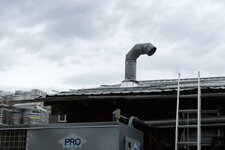
The vent stack is now weathered in, just in time from the looks of the sky:

54476329446_eee416040e_o.jpg

Silicone fire-rated caulking is right up there with anti-seize--all I have to do is look at the vent stack and I have it all over me.

Tomorrow is the plumbing that's sitting on top of the boiler, then the electrical--hopefully, first fire on Monday.
 

PCustoms

Well-known member
Joined
Jul 23, 2011
Messages
23,684
Location
VT
Surprised you don't need a gas license to work on this in a commercial setting.

I.e. that exhaust looks a little sketchy...
 

American Locomotive

Well-known member
Joined
Jan 8, 2017
Messages
11,125
Location
Rhode Island
Surprised you don't need a gas license to work on this in a commercial setting.

I.e. that exhaust looks a little sketchy...
There is no freaking way this is okay:
Screenshot 2025-04-26 092449.jpg

That's an engineered sealed exhaust venting system with a random piece of stove pipe crinkled up and crammed into it. You have a forced draft burner/boiler. If that connection leaks (which it does, just look at it!), you could kill everyone inside your plant. I also don't think your "vent cap" is a proper listed cap - which is required.

It's one thing if you want to cobble up some stove pipe for your mountain cabin wood stove, it's a completely different thing in a commercial environment with people working. The "cap" is a code violation and your boiler connection is a wrongful death and gross negligence charge waiting to happen.

I was a facilities guy at one point, too. We did a lot of stuff in house, including things we probably should not have. But we knew where to draw the line, and things like appliance exhaust venting was one of them.@Beerhippie , I repeat: this will kill someone, you will be blamed, and you will go to jail.
 
Last edited:

PCustoms

Well-known member
Joined
Jul 23, 2011
Messages
23,684
Location
VT
There is no freaking way this is okay:
Screenshot 2025-04-26 092449.jpg

That's clearly an engineered sealed exhaust venting system with a random piece of stove pipe crinkled up and crammed into it. You have a forced draft burner/boiler. If that connection leaks (which it does, just look at it!), you could kill everyone inside your plant. I also don't think your "vent cap" is a proper listed cap - which is required.

It's one thing if you want to cobble up some stove pipe for your mountain cabin wood stove, it's a completely different thing in a commercial environment with people working. The "cap" is a code violation and your boiler connection is a wrongful death and gross negligence charge waiting to happen. You either need to research what venting system you have and do it correctly, or hire someone to rip it all out and start from scratch.

@Beerhippie , I repeat: this will kill someone, you will be blamed, and you will go to jail.
Thanks for taking over where I left off, I didn't want to be rude but it really didn't need to be said.

There's also the whole aspect of the gas supply to the unit itself around here that absolutely requires a license plumber in a situation like this for the same reasons you note above
 
OP
B

Beerhippie

Well-known member
Joined
Oct 13, 2023
Messages
10,340
Location
Far NE Oregon
Thanks for taking over where I left off, I didn't want to be rude but it really didn't need to be said.

There's also the whole aspect of the gas supply to the unit itself around here that absolutely requires a license plumber in a situation like this for the same reasons you note above
OK-I'll find a boiler installer to re-do the vent system--it's been like that for twenty-odd years.

As for the gas, the gas man comes on Monday. He's the one who originally installed the gas system--which is exactly as he built it, except for the longer ******.
 

PCustoms

Well-known member
Joined
Jul 23, 2011
Messages
23,684
Location
VT
OK-I'll find a boiler installer to re-do the vent system--it's been like that for twenty-odd years.

Just because it's been wrong before doesn't make it right today.

If anyone ever got injured (or worse) due to this installation it would likely shut you guys down at best.
 

PoorUB

Well-known member
Joined
Mar 29, 2021
Messages
11,889
Location
Fargo, ND
OK-I'll find a boiler installer to re-do the vent system--it's been like that for twenty-odd years.
The venting required should clearly mentioned in the installation instructions. At least it will mention a Category the venting falls under. You may have to study up a bit on vent Categories to understand what needs to be done. It wouldn't hurt for you to have a better idea of the requirement so some fly by night HVAC guy looks at it and says, "Its fine!"

I agree, the venting looks sketchy, but without reading the installation manual, I won't go into particulars.
 

PoorUB

Well-known member
Joined
Mar 29, 2021
Messages
11,889
Location
Fargo, ND
Gee Whiz!
As for the venting, I assume it is a PEP LE series? Here is what the manual shows for venting instructions,

VENTING
All Columbia boiler models utilize a pressure fired burner and need only to be properly vented. For
situations where unusual conditions may exist, consult the factory for proper venting.
Locate the boiler as close as possible to the chimney or other approved exhaust vent. For boiler mod-
els with a rectangular flue outlet, first bolt the supplied smokehood in place. Attach all flue piping to
the round flue connection and make each connection secure. The flue pipe should not be inserted
beyond the inside wall of the chimney.
DO NOT REDUCE THE SIZE OF THE FLUE OUTLET OR FLUE PIPING.
Columbia Boiler recommends the use of galvanized B Type vent for stack connections suitable for
temperatures to 550F. The flue pipe should be pitched upward at least 1/4” per foot of run. Avoid the
use of tees, sharp bends, and long horizontal runs. Install a draft regulator if required


I have never seen a piece of gas or oil fired equipment be so vague of venting requirements. In this case, most companies will say Category I and vent according to those requirements. These guys are well, use B-vent, or what ever! I have never seen "recommended" in installations, usually it reads "required". And, "install a draft regulator if required" It is their boiler, they should know if it is required!
 

Aileron

Well-known member
Joined
Apr 15, 2019
Messages
483
Location
outside
Sorry if this sound rude but you need to put down the tools and stop. You better get a boiler company in there and staighten it out. You cant run a 11 "pipe into a 10". If this is how the first boiler operated , its death was self inflicted. You cant turn a 90 down on the roof either. I'm betting you had flame impingment on that first boiler and it was never tuned.

 
Last edited:

walta

Well-known member
Joined
Jan 13, 2017
Messages
2,321
Location
Dutzow Missouri
Getting a piece of 11" stovepipe to fit a 10" system took a couple of hours:

54475488367_ca451fc8dc_o.jpg

But that, too is done.

The vent stack is now weathered in, just in time from the looks of the sky:
Just to be 100% clear did you reduce the size of the vent pipe where it enters the flu?

After the new boiler is up and running, I think a proper autopsy of the failed boiler is in order.

This set up has killed 2 boilers already. Steam boilers should not fail in less that years 20 years. Lasting over 30 years is the norm.

If you can’t get an expert on site then ship the victim to the expert.

Walta
 
Last edited:
To avoid these ads, REGISTER NOW!
Top Bottom