To avoid these ads, REGISTER NOW!

Thread chaser or Die for Hardened Bolts (ARP)

Blue98GT

Well-known member
Joined
Mar 20, 2012
Messages
60
I run hardened (10.9) ARP bolts with my pullers for steering wheel removals since I've found they they rarely bend. I remove lots of steering wheels for my business (+/- 1000/yr). Over time the threads flatten out and I am unable to correct them with my dies since the bolts are so hard. I can't even file them with my standard files.

I'm in the salvage yard with these so sometimes the threads I'm putting these in are slightly (or very) cross-threaded and I have to put them in anyways, which damages the threads.

Does anyone know of a thread chasing system that can correct the threads on these or am I just stuck with replacing them when worn out?
 
To avoid these ads, REGISTER NOW!

dnschmidt

Well-known member
Joined
Oct 3, 2014
Messages
7,287
Location
Phoenix, AZ
When the bolt is harder than the die I think you know the answer to your question. You might want to use a Lange (which doesn't manufacture their thread chasers they come from a company who's name I can't recall at the moment) and try one of them. MeMaster-Carr sells individual thread chasing dies so you don't need to buy the entire set. Since chasers move the metal rather than try to cut the metal this might give you a fighting chance at success.

Here is a link: https://www.mcmaster.com/products/thread-chasers/thread-repairing-dies-for-tight-spots/
 

rlitman

Well-known member
Joined
Oct 18, 2010
Messages
24,651
Location
Long Island
tl;dr: I think your time would be best spent looking for a quantity discounted source on bolts.

Thread chasing files are meant to help you salvage a bolt that just needs a little help. But they also remove some of the thread (true thread chasing files are intentionally not all that sharp, so they do roll the thread a bit while cutting), leaving you with a bolt that will more easily cross-thread, and more easily tear out of marginal holes. I often use a small triangle file for thread chasing, but that's only worse in this way, and it doesn't roll anything. And as you have discovered, files cut easily on softer materials, but not so much on harder stuff.

A re-threading die may help a little, and you should probably own one to touch up your puller bolts with each use. That at least might buy you more life out of bolts that are starting to lose their shape, since rethreading dies (Lang is the biggest maker of them) as explained above help to roll the thread back into shape without cutting. But there comes a point where bending metal back leaves it fatigued.

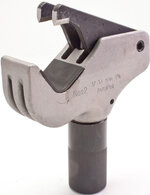
There are also single point universal external thread chasers. I've seen a few styles, but they all seem to cradle the bolt in a V notch while you spin the bolt with a pair of teeth straighten the thread as it goes around. Like this:
 

JradM

Well-known member
Joined
Sep 4, 2019
Messages
1,820
Location
Alberta
I wouldn't have expected grade 10.9 bolts to be harder than a threading die, even a carbon steel die. I don't know, but wonder whether thread chasers might actually be softer - they're not actually cutting threads after all.

1-820-344.jpg

I'd be tempted to just run the bolts through a HSS die instead and see what happens. Of course, if you're saying that's what you have already...

Maybe a different style of thread chaser would work better in this application? I'm thinking of the ones from NES, for example, because they are designed to push as much as cut. That might not be cost-effective though.

s_thread_restoring_tool_external__78820.1437064831.jpg
 

rust in the eye

Well-known member
Joined
Oct 2, 2017
Messages
2,807
Location
Chicagoland
If the threads are worn out you already have the obvious answer.
Carrying chasers for those buggered threads in the steering wheels is perhaps a means to have the ARP bolts last longer.
WTF are you doing with 1k steering wheels?
 

SynViks

Active member
Joined
Oct 20, 2020
Messages
25
Location
PDX
I'm in the salvage yard with these so sometimes the threads I'm putting these in are slightly (or very) cross-threaded and I have to put them in anyways, which damages the threads.
Running a tap through the hole before inserting the bolts would probably be a good way to avoid this issue.

ARP threads are rolled, not cut. If you cut the thread it will reduce the strength (not sure how much that matters in this context). I don't think they make thread rolling dies for hand held use so I'm not sure if there's a ideal solution unless you can find a nut that's harder than the bolts.

Have you tried using 12.9 bolts?
 

woody 73

Well-known member
Joined
Apr 14, 2009
Messages
11,546
Location
The Great State Up North
I hate to even say this but bite the bullet and buy more sets of ARP bolts and move on. I had a project, with cutting just the bolt holes, in hardened railroad track and I went through a **** load of drill bits. That hardened **** is causes me to lose sleep at night.
 

vssjim

ALLIANCE MEMBER
Joined
Aug 5, 2007
Messages
2,713
Location
McLean Va.
When the bolt is harder than the die I think you know the answer to your question. You might want to use a Lange (which doesn't manufacture their thread chasers they come from a company who's name I can't recall at the moment) and try one of them. MeMaster-Carr sells individual thread chasing dies so you don't need to buy the entire set. Since chasers move the metal rather than try to cut the metal this might give you a fighting chance at success.

Here is a link: https://www.mcmaster.com/products/thread-chasers/thread-repairing-dies-for-tight-spots/
JAWCO is a manufacturer oh these and have many sizes
 

timgunn1962

Well-known member
Joined
Mar 31, 2018
Messages
159
Location
Lancashire, England
10.9 suggests metric threads. 10.9 seems to be a fairly unusual standard in industrial fasteners IME (though it seems more common in automotive fasteners): if something stronger than 8.8 is needed, it has been normal to go straight to 12.9 IME.

Running a die down a 10.9 fastener will completely negate the 10.9 designation: the only reason I can see for using ARP, or similar, premium hardware, is the expectation of better fatigue performance/life and you'll certainly lose that with the die.

ARP hardware is pretty high-end and rather spendy, as far as I can tell. I'd expect any reputable brand (Unbrako, Holokrome, etc) of High-Tensile industrial fastener to get the job done, particularly given that there's much less of a fatigue issue in your application than in an engine where ARP fasteners might make economic sense: you are talking in terms of 1000 stress cycles/year. That's only about 10-seconds-worth of stress cycles on a 6000 RPM engine.

Could you use 12.9 socket-head cap screws and decent (preferably hardened) washers?

I'd not expect steering wheels to use much over M6, perhaps M8, fasteners. At work, we use M8 and M10 SHCS to attach bearing puller plates for removing blower bearings and consider them expendable, as the cost of the screws is negligible compared to the bearings,

The 12.9 SHCS tend to be pretty cheap (a box of 200 M6 x 50 12.9 SHCS costs about the same as a decent M6 die here in the UK). Alternatively DIN 6921 hex flange bolts in 10.9 or 12.9 grade?

You'll still be best served replacing them as soon as things feel at all suspect, but the sticker shock is likely to be dramatically reduced.

For those unused to the metric designation, the first number, before the decimal point/full stop, refers to the Ultimate Tensile Strength (in hundreds of MPa) and the second number refers to the Yield Point as a proportion of the UTS.

A 10.9 metric fastener has an Ultimate Tensile Stress of 1000 MPa and a Yield stress 90% of the UTS. That translates to 145,000 PSI UTS and 130,000 PSI yield.

A 12.9 metric fastener has an Ultimate Tensile Stress of 1200 MPa and a Yield stress 90% of the UTS: 174,000 PSI UTS and 156,000 PSI yield.

As a comparison, a Grade 8 SAE fastener has an Ultimate Tensile Stress of 150,00 PSI and a Yield stress of around 130,000 PSI (Proof load is 120,000 PSI, which is the minimum load it can withstand without permanent deformation (yield)).

The ARP website does mention that they manufacture in some higher-spec materials for racing, etc, but you are "only" using the 10.9 fasteners: ARP's "vanilla" grade.
 
To avoid these ads, REGISTER NOW!

SynViks

Active member
Joined
Oct 20, 2020
Messages
25
Location
PDX
I wouldn't have expected grade 10.9 bolts to be harder than a threading die, even a carbon steel die.
The lowest grade non-stainless fastener ARP sells is 8740 which has a UTS of *at least* 20k PSI higher than grade 10.9 standard. Not sure what OP means by 10.9 ARP bolts.
 

dchawk81

Well-known member
Joined
Jul 31, 2014
Messages
14,418
If the threads are worn out you already have the obvious answer.
Carrying chasers for those buggered threads in the steering wheels is perhaps a means to have the ARP bolts last longer.
WTF are you doing with 1k steering wheels?
He's stripping cars down at a salvage yard. Steering wheels can bring money online.
 

ChevyEFI

Well-known member
Joined
Sep 2, 2012
Messages
8,775
Location
Phoenix, AZ
Threaded puller parts are consumables.

ARP fasteners with wave-loc, higher than required hardening, and rolled threads for a repetitive use job? Not necessary, with higher cost per piece.

I am sure you have war stories of wheels that require force exceeding my imagination.

You're in a salvage yard on the reg. You probably have an endless supply of puller bolts you could swap into use. OEM bolts can be gold.

Or, like me, you really really like washer headed bolts and hate lesser bolts.
 

OccupantRJ

Well-known member
Joined
May 15, 2009
Messages
11,221
Location
Eastern North Carolina
My question is what type of puller are you using? If it is a flat bar with two bolts doing the work, I would go with a puller about an inch thick with slots or holes for the pull bolts along with a fine thread puller screw of 5/8 to 3/4” diameter in the center. Set it up snug close to the wheel, then a battery impact will make short work of it.
 

johninct

Well-known member
Joined
Dec 21, 2010
Messages
2,598
Can you get a nut the same hardness as your bolt and try that. I don't know if this would work but could you get a nut, screw it all the way in on your bolts threads, screw the bolts in to do the pulling and then back the nuts off to chase the threads when done?
 
OP
B

Blue98GT

Well-known member
Joined
Mar 20, 2012
Messages
60
Thanks for the replies. To answer some questions, I prefer a flanged head on the bolt since I don't have to run a washer. Lower grade bolts with flange heads tend to bend at the threads unless I have both bolts exactly seated at the same depth, especially when I'm forcing it. I run a pretty standard 2 bolt puller (think Crow's Foot puller without the 3rd hole) with a socket welded to the top for easy impact use.

ARP bolts were chosen mostly because I tried several different grades/types and I've had the best overall results with these. I found something that works and stuck with it. One of the bolts I run is ARP651-3500.

Description of the bolts per ARP "These high-strength ARP bolts are great for installing most accessories. The 180,000 psi tensile strength bolts are made of 8740 chrome moly with a black oxide finish. Pack of 5 bolts includes matching washers."

I'm not an expert on metallurgy and/or grading standards. I am under the impression that these exceed 10.9/Grade 8 standards.

I run Metric (most import Vehicles) and SAE (GM and Ford). Dodge I can find bolts off the engine that have an integrated washer. If the threads roll, I just find new ones in the salvage yard.

Speed is king. I can remove between 70-90 wheels in the course of a day. Tapping questionable holes takes time. Sometimes I'm up in a vehicle away from my other tools and choose to run what I have. I grease the threads every few pulls. The ARP bolts hold up to a few lightly cross-threaded holes. On average I get about 200-300 pulls per set. 95% of holes are clean. The 5% cause the most wear.

I would like something I can use in the field to repair threads if one gets rolled. Carrying spares is something I do. I am hoping these can be fixed and not treated as consumable parts, but maybe that's just what it is. I could cut the damaged threads off, but then that changes the length of the bolt I have to work with and 3.5" is pretty ideal.

I'm considering cutting small flutes with a dremel in some ARP bolts. I'm sure the bolts are harder than any steel in the steering wheel. Maybe this will solve the crossthreading issue. This will require field testing.
 

dnschmidt

Well-known member
Joined
Oct 3, 2014
Messages
7,287
Location
Phoenix, AZ
The self taping solution your proposing is very good. Rather than a Dremel which will produce a very thin cut I'd try a die grinder with a 1/16" thick wheel to give some clearance for the chips.
 

SynViks

Active member
Joined
Oct 20, 2020
Messages
25
Location
PDX
As some one who just had some ARP 2000 bolts machined for a project, I don't see how you'll get smooth thread engagement after taking a grinder to the threads.

I think an ARP nut of higher grade than your bolts, threaded with some oil, might help you get some more time out of your bolt threads?
 

rust in the eye

Well-known member
Joined
Oct 2, 2017
Messages
2,807
Location
Chicagoland
Thanks for the replies. To answer some questions, I prefer a flanged head on the bolt since I don't have to run a washer. Lower grade bolts with flange heads tend to bend at the threads unless I have both bolts exactly seated at the same depth, especially when I'm forcing it. I run a pretty standard 2 bolt puller (think Crow's Foot puller without the 3rd hole) with a socket welded to the top for easy impact use.

ARP bolts were chosen mostly because I tried several different grades/types and I've had the best overall results with these. I found something that works and stuck with it. One of the bolts I run is ARP651-3500.

Description of the bolts per ARP "These high-strength ARP bolts are great for installing most accessories. The 180,000 psi tensile strength bolts are made of 8740 chrome moly with a black oxide finish. Pack of 5 bolts includes matching washers."

I'm not an expert on metallurgy and/or grading standards. I am under the impression that these exceed 10.9/Grade 8 standards.

I run Metric (most import Vehicles) and SAE (GM and Ford). Dodge I can find bolts off the engine that have an integrated washer. If the threads roll, I just find new ones in the salvage yard.

Speed is king. I can remove between 70-90 wheels in the course of a day. Tapping questionable holes takes time. Sometimes I'm up in a vehicle away from my other tools and choose to run what I have. I grease the threads every few pulls. The ARP bolts hold up to a few lightly cross-threaded holes. On average I get about 200-300 pulls per set. 95% of holes are clean. The 5% cause the most wear.

I would like something I can use in the field to repair threads if one gets rolled. Carrying spares is something I do. I am hoping these can be fixed and not treated as consumable parts, but maybe that's just what it is. I could cut the damaged threads off, but then that changes the length of the bolt I have to work with and 3.5" is pretty ideal.

I'm considering cutting small flutes with a dremel in some ARP bolts. I'm sure the bolts are harder than any steel in the steering wheel. Maybe this will solve the crossthreading issue. This will require field testing.
Sounds like these bolts pay for themselves many times over. Me? I'd treat them as consumable and not fret over the fact they wear out.
 
OP
B

Blue98GT

Well-known member
Joined
Mar 20, 2012
Messages
60
Thread Update: I cut flutes into the bolts with a dremel. This has solved 99% of the problems. I still grease the bolts and haven't had to swap any out since. The hard ARP bolts with flutes act like a tap in the softer metal.
 
To avoid these ads, REGISTER NOW!
Top Bottom