
To avoid these ads, REGISTER NOW!

Thread Chaser / Restorer vs Tap & Die

_brian_

Well-known member
Joined
Jun 23, 2019
Messages
360
Location
Wisconsin, USA
Start: What I have.
I have a reasonably complete set of SAE and metric tap and die sets. I also have thread chasers for spark plugs and O2 sensors only, or anything that takes the same thread as those.

My Question:
Does anyone see a reason to get a thread chaser / restorer set? I know Lang has one and the same set is sold by nearly everyone ... Craftsman, MAC, etc. which can be acquired for approx $70 if you get it with a cheaper brand's sticker on it.

Normally, I just use my taps and dies, and I often hear that a thread restorer set is a poor man's tap and die set or for those who are not ever making new threads anyway, just cleaning. I have chasers for spark plugs and O2 sensors because I chase them every time for cleaning purposes, not actually thread cutting or restoring. Obviously a restorer is less risky to use as it is not really a cutting tool, but as an semi experienced tap and die user, is there any reason I would want to use a restorer vs a tap or die for the purpose of fixing a damaged thread?
 
To avoid these ads, REGISTER NOW!

Tallpilot

Well-known member
Joined
Jan 13, 2017
Messages
2,384
Location
Orlando
Even as an experienced tap user, you will inevitably take metal off with a tap. Of course we are talking about microns but that is going to reduce the thread depth/angle. Depending on how close the tolerance was from the original tapping that may get the hole out of spec.

This is really an issue very similar to the perennial torque Nazi arguments. Yes, the installation is now outside of the engineer’s original spec. Does that matter in practice? Many times not because the stakes are low (we’re not working on spaceships) even if it does fail but it likely won’t over the remaining life of the machine. Depending on age half the other joins on the machine are probably out of spec too (corrosion, fatigue, poor repairs).

Should you get a thread chaser set and use it for cleaning instead of a tap. Of course, use the right tool for the job. Can you get away with just using a tap? More often than not.
 
Last edited:

_Riddle

Well-known member
Joined
Sep 18, 2018
Messages
135
Location
Storms End
I have the Lang 971 kit and it has paid for itself with the amount of crusty dirty fasteners it has saved on my dual sport motorcycles. It cleans well and will fix slightly deformed threads if needed. I don't have any experience with cleaning threads using a tap or die, but I've read they can remove metal. I often clean out dirt/sand/rust from the same fastener multiple times so using a tool that is meant for thread cleaning (and not cutting) is a big use to me.
 

txvwnut

Well-known member
Joined
Jan 1, 2015
Messages
7,650
Location
Bedford, Texas
For just general thread get a thread chase set, as mentioned above taps and dies can take metal off of the fastener or out of the hole. I’ve used taps and dies that worked great at just chasing then I’ve had some that would remove metal.
 
OP
B

_brian_

Well-known member
Joined
Jun 23, 2019
Messages
360
Location
Wisconsin, USA
Thank you for the replies. Yes, a tap and/or die can and if not careful will remove metal absolutely. I see that is the biggest concern and it seems hit and miss. I gather my answer then is how much do I wish to risk. Safest bet is get the chasers / restorers. This is why I have chaser for plugs and O2's, but I guess I will look more at getting myself a chaser set.

Thanks again, question answered with reasoning.
 

Packard V8

Well-known member
Joined
Mar 16, 2009
Messages
7,380
Location
Spokane, WA
Your opinions and results may vary, but I'm not talking theory; FWIW, I've only been doing this for sixty years and if you're careful, you'll be unlikely to harm the existing thread using a tap or die.

Go into a large engine rebuilder. Every day, block and head threads are chased with an old tap in an air drill.

I've had and used the Snap-on thread chaser set and have had occasions when it was just too loose to clean the threads enough to trust they'd give an accurate torque reading. A tap or die got them clean.

jack vines
 

bwringer

Well-known member
Joined
Jan 1, 2013
Messages
10,318
Location
Indianapolis
As always, the real answer is "all the above".

Sometimes you need all available options at your disposal. Seriously, you really do. I work on a lot of old motorcycles, and you need a vast array of tools to work with threads.

One thing I don't have that I should probably get soon is a "universal" thread restorer. You know, one of those widgets with two "claws" that can be clamped on and rotated to clean up external threads of any pitch.
https://www.amazon.com/dp/B075W99B5H/?tag=atomicindus08-20

And if anyone ever makes a tool that can salvage mushroomed threads on an axle or pivot bolt, they'll probably sell one to me. Way too many people think it's OK to beat on seized axles... Sometimes you can grind off the mangled bit and have enough left to work, but often it's off the fleaBay or a dealer for a clean example.
 

M6erfan

Well-known member
Joined
Dec 6, 2014
Messages
10,170
Location
'Merica!
Especially in aluminum. I've used taps in a pinch but they remove metal, chasers are much better if just trying to clean up threads.
 

Wamsutta

Well-known member
Joined
Jan 8, 2014
Messages
10,887
Location
Amarillo, Texas
Does anyone see a reason to get a thread chaser / restorer set?

I do, because not everything is cut with the same tap. Taps very from brand to brand and from part number to part number. You could have two different 5/16-18 taps and the thread pitch; shape of the threads; plus the depth of the threads might be different. Points being: If you go chasing threads with a cutting tap, you could end up doing some cutting where you don't want to be doing some cutting....
 

2ndGearRubber

Well-known member
Joined
Mar 24, 2014
Messages
14,185
Location
Pittsburgh
Fix threads with a chaser (maximize metal left in threads), cut with tap/die. Unless the bolt is beyond messed up, a chaser will do the job. If the threads are just messed up at the tip, using a thread cutting device is unlikely to hurt anything.
 

Sgtboz

Well-known member
Joined
Mar 6, 2017
Messages
115
i'd get a rethreading set in addition to a tap and die set. i wouldnt want to subject a nice sharp tap or die to cleaning all that rust and thread filling **** that gets on a bolt or nut. i use the rethreaders unless they just arnt doing the job. dont forget to lube it up first.
 

Tallpilot

Well-known member
Joined
Jan 13, 2017
Messages
2,384
Location
Orlando
https://www.tooldiscounter.com/prod...D4OW5SI0C0C_G_5cwmNc7QeBjcphWAPRoCqNwQAvD_BwE

Pretty cheap. Made in USA and rebranded by just about everyone. The Craftsman one was probably the cheapest one on sale, maybe they are still available if you can find a Sears or Lowe’s will start carrying them. They are over $100 on the trucks but of course come with red carpet warranty if your driver doesn’t disappear. At this point just get the Lang from wherever is cheapest and be done with it.

Snappy sells them individually for $5 with free shipping. So self warranty is pretty easy and you would need to break a whole bunch of them (~15) before you broke even from a truck version. I’ve never broke a thread chaser but somebody probably has.

https://shop.snapon.com/product/TRT57
 
Last edited:

nelstomlinson

Well-known member
Joined
Jul 27, 2009
Messages
649
Location
Interior Alaska
... FWIW, I've only been doing this for sixty years and if you're careful, you'll be unlikely to harm the existing thread using a tap or die.

If threads are dirty but undamaged, a tap or die won't do harm, probably. If the threads are damaged, the tap or die will surely cut off the damaged metal. The thread chaser may push the damaged thread back into shape, and leave it stronger than the tap would have.

For damaged threads, use a chaser, for dirty threads, it doesn't matter much how you clean it. I need to buy a chaser set. I've been saying that for 20 years now.
 
OP
B

_brian_

Well-known member
Joined
Jun 23, 2019
Messages
360
Location
Wisconsin, USA
This was an interesting reply to me. First off, I learned that Kastar uses the brand Lang, and under that brand name, the price goes up. Secondly, many of the sets I see today are 40 piece whereas the one referenced here is 48 piece... and actually includes a size I recently needed that my tap/die set does not have, the M10-1.00. For anyone who is interested, this was for a caliper slide pin bolt.

Thanks to all for the replies. I have my answer and product to get.

https://www.tooldiscounter.com/prod...D4OW5SI0C0C_G_5cwmNc7QeBjcphWAPRoCqNwQAvD_BwE

Pretty cheap. Made in USA and rebranded by just about everyone. The Craftsman one was probably the cheapest one on sale, maybe they are still available if you can find a Sears or Lowe’s will start carrying them. They are over $100 on the trucks but of course come with red carpet warranty if your driver doesn’t disappear. At this point just get the Lang from wherever is cheapest and be done with it.

Snappy sells them individually for $5 with free shipping. So self warranty is pretty easy and you would need to break a whole bunch of them (~15) before you broke even from a truck version. I’ve never broke a thread chaser but somebody probably has.

https://shop.snapon.com/product/TRT57
 

dledinger

Well-known member
Joined
Apr 14, 2009
Messages
345
I prefer using thread restorers on damages threads, for the reasons stated.

If chasing good threads to remove old Loctite, or whatever, a tap is fine.
 
To avoid these ads, REGISTER NOW!

mbshop

Well-known member
Joined
Nov 23, 2010
Messages
1,539
Location
visalia ca
I used taps for over 35 years. Saw no issues doing this. Most times it a hole here or a hole their. Not like you are doing the same hole over and over. So for me, just not an issue.
 

oldwino

ALLIANCE MEMBER
Joined
Nov 16, 2009
Messages
1,917
Location
Sonoma County California (wine country)
i'd get a rethreading set in addition to a tap and die set. i wouldnt want to subject a nice sharp tap or die to cleaning all that rust and thread filling **** that gets on a bolt or nut. i use the rethreaders unless they just arnt doing the job. dont forget to lube it up first.

Me thinks we have a winner!

One thing I would like to find is chasers in small sizes i.e. #6,#8 etc. I use taps and dies here only because I can't find chasers
 

sberry

Banned
Joined
Jun 18, 2005
Messages
35,747
Location
Brethren, Michigan
I might have should have had chasers but 40 years in and I am going to resist. Most cases for standard use nipping a thread or 2 with a tap doesnt mean squat.
 

ekimneirbo

Well-known member
Joined
Nov 21, 2018
Messages
132
Location
Kentucky
If you were working in a precision maching facility and producing threads within a certain "class" of fit, retapping a hole might be a worry. For general consumption I would not worry about any additional metal that might be removed by using a tap in a hole already containing a thread.
Taps have tolerances when produced. When they are used, they can also wear just like any cutting tool. The variation in the actual thread you are rechasing can affect what happens. If you rechase a thread and screw the component in place...and it holds, then everything is fine. If it pulls the thread out, then put a heli coil or threadsert in it. There is no possible way to know how every thread is going to react. If it is so marginal that a few metal flakes are produced and the thread becomes weakened, then it probably would have failed eventually anyway. You need to finish with a "bottom" thread tap, and they often will produce some metal because the production shop did not use a "bottom" thread tap. They may have used a "plug" tap.
Taps come in 3 types: Starter, Plug, and bottom. Many times only a "plug" tap is used as the bottom tap is not good at starting the initial thread.

Precision threads are ground, not tapped. With general production methods, taps are expedient and precise "enuf". So generally don't worry about variations among tap manufacturers, they are still more precise than the threads you are working with for
almost all general manufacturing purposes.
 

Mr Ratchet

Well-known member
Joined
Mar 3, 2011
Messages
930
Location
Michigan
I have and use both. I use taps and dies for cutting new threads. Anything with an existing thread get the thread chaser/restorer. Only in a pinch will I use a tap/die on existing threads and It's usually an odd size or really small one.
 

rshadd

Well-known member
Joined
Dec 29, 2009
Messages
1,598
Location
Doylestown, PA
Chasing threads is fine for unique or expensive bolts, but getting a new bolt or nut is cheap compared to some of the better thread restored kits.

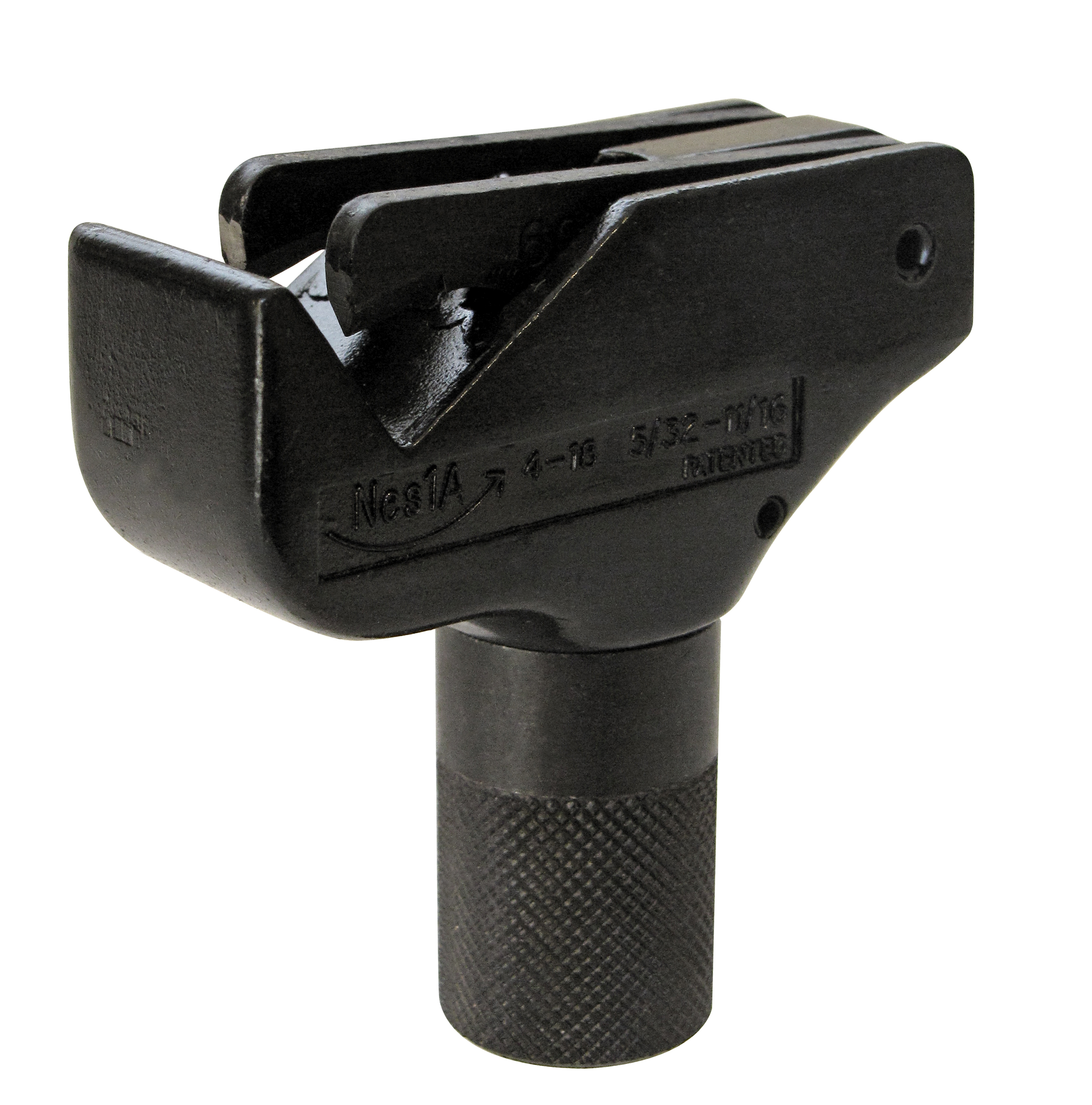
I have a NES1A that works great on external threads. Most threads get buggered up at the end of the bolt which make starting a die difficult. The NES1A is nice because you can start the tool on good threads.

Nes1.jpg

http://www.nes.co.il/nes-1a/
 
Last edited:
OP
B

_brian_

Well-known member
Joined
Jun 23, 2019
Messages
360
Location
Wisconsin, USA
I have a separate gauge and also each of my tap/die sets (SAE & metric) each have a cheap one included for the specific parts in the kit. Using the wrong tap, die or chaser makes using the right tool (tap or chaser) irrelevant.

If you don't have one already, make sure you purchase a thread pitch gauge so you use the correct thread restorer. I have the one below from amazon that works well.

https://www.amazon.com/dp/B004ROIU2A/?tag=atomicindus08-20
 
OP
B

_brian_

Well-known member
Joined
Jun 23, 2019
Messages
360
Location
Wisconsin, USA
Wanted to report back... I order, received and have used the Lang 971 as suggested above. I am happy thus far. Thanks for the feedback and suggestions.

Also... I can feel a difference in using the chaser vs the tap/die set. I am unsure if for the purposes I use this for that it makes a difference, but I can say there is for sure a difference in how it does the job.
 

crguy

Well-known member
Joined
Jan 24, 2016
Messages
2,659
Location
SW Washington
The only time a tap should remove metal from an already tapped hole is to bring the threads closer to exact size, clean up damaged threads, etc.. They don't automatically remove metal every time you run them thru the hole.
 

Tallpilot

Well-known member
Joined
Jan 13, 2017
Messages
2,384
Location
Orlando
Wanted to report back... I order, received and have used the Lang 971 as suggested above. I am happy thus far. Thanks for the feedback and suggestions.

Also... I can feel a difference in using the chaser vs the tap/die set. I am unsure if for the purposes I use this for that it makes a difference, but I can say there is for sure a difference in how it does the job.

:beer:
 
OP
B

_brian_

Well-known member
Joined
Jun 23, 2019
Messages
360
Location
Wisconsin, USA
A few days ago I would 100% agree with this statement. However, now I believe that although it might be minimal and essentially irrelevant, a tap will remove some metal.

After using this set of thread restorers, the feel of the tool tells me that when a rough spot is encountered, the tap turns easy while the restorer turns hard. Those are poor terms to use, but it is hard to explain the feeling in my hand. I agree they do not "automatically" remove metal, but the simple fact that they are run through or over the threads by a person most likely not using the same tap basically does guarantee that SOME metal will be removed, no matter how minimal it may be.

Having said that, I am unsure if it actually makes a difference in many cases for my purpose which is general automotive. What I do feel though is that where there is a damaged thread, the tap will cut to fix it where as the chaser will reform (bending vs cutting) to fix it.

The only time a tap should remove metal from an already tapped hole is to bring the threads closer to exact size, clean up damaged threads, etc.. They don't automatically remove metal every time you run them thru the hole.
 

rustbucket5

Well-known member
Joined
Apr 22, 2015
Messages
252
i use thread chasers, same kit discussed. i prefer not to take the chance because if im trying to save a fastener its usually important or expensive as at my shop we have a vast array of new and used bolts from all makes and models of golf carts and its usually better to just grab another so if im taking the time to restore it i want to use the appropriate tool. but i do agree that there are a lot of cases where its not going to make a difference using one over the other.
 

pstemari

Well-known member
Joined
Jan 7, 2012
Messages
903
Location
Seattle
The point of chasing a thread is to remove the material that's out of place. You can form it back in place, like a thread-forming tap or a thread restorer, or you can cut away the material that's in the way, which is what a normal thread cutting tap will do.

As far as changing the dimensions of the thread, that's not going to really happen unless you whale on the tap and it's not in straight.The tolerance on taps between different manufacturers is not going to be significant. What you can run into is the H limit being different.

Taps are generally slightly oversize from the basic diameter in order to provide some clearance. This amount is the H value (there's also undersized taps with L values). The exact amount will vary with size and class of fit. Unfortunately, you have to look up in a table to figure out what H value is needed for a particular thread and class of fit. IIRC, the H value is roughly the oversize amount in half thousands, eg H1 is up to 0.0005" oversize, H2 is up to .001" oversize, etc.

Sent from my Pixel XL using Tapatalk
 

bonneyman

Well-known member
Joined
Apr 22, 2010
Messages
8,855
Location
Desert SW
Even as an experienced tap user, you will inevitably take metal off with a tap. Of course we are talking about microns but that is going to reduce the thread depth/angle. Depending on how close the tolerance was from the original tapping that may get the hole out of spec.

This is really an issue very similar to the perennial torque Nazi arguments. Yes, the installation is now outside of the engineer’s original spec. Does that matter in practice? Many times not because the stakes are low (we’re not working on spaceships) even if it does fail but it likely won’t over the remaining life of the machine. Depending on age half the other joins on the machine are probably out of spec too (corrosion, fatigue, poor repairs).

Should you get a thread chaser set and use it for cleaning instead of a tap. Of course, use the right tool for the job. Can you get away with just using a tap? More often than not.

^^^This^^^ :thumbup:
 
To avoid these ads, REGISTER NOW!
Top Bottom