To avoid these ads, REGISTER NOW!

Thread ID for a lathe spindle adapter

JradM

Well-known member
Joined
Sep 4, 2019
Messages
1,819
Location
Alberta
What size adapter should I be looking for? My thread gauge says it's metric 1.5, the calipers 19.69mm?
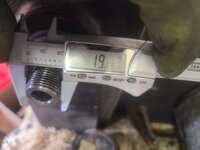
20211031_104828.jpg

I have one of those 37" tube lathes that was sold under a bunch of different brand names 15-20 years ago. I wanted to put a chuck on it and 1" x 8 tpi is by far the most common.

At first I just eyeballed it - I measured 1 inch and counted 16 threads. Figured it was about 3/4" - which meant it was the very common 3/4" x 16tpi. I ordered an adapter from Amazon - only to find that it won't thread on! Hence I busted out the calipers and thread gauge.
 
To avoid these ads, REGISTER NOW!
OP
J

JradM

Well-known member
Joined
Sep 4, 2019
Messages
1,819
Location
Alberta
Could it be a M20x1.5 spindle?
I guess? I just would have expected it to measure closer to 20mm if that's the case.

I have threaded faceplates for the lathe which thread on very precisely, making me think it's not just a sloppy threading job. However, it seems much too large to be 19mm...

I did some googling after posting - everything I found indicates it actually should be 3/4" x 16tpi. Now I'm sort of wondering about my adapter - I didn't measure it!

Also, even though my thread gauge said the spindle has metric 1.5 threads, google also leads me to believe this would work out to approximately 15.7 TPI - so maybe when it is so close and I'm only measuring a short section it just seemed to fit.

Who knows! Maybe I'm just encountering a slightly oversize 3/4" x 16tpi male thread and a slightly undersized female thread.
 

BukitCase

Well-known member
Joined
Apr 11, 2017
Messages
1,075
Location
Oregon
I have an even older Craftsman wood lathe (bought new around 1980), dug it out for a grandson's project idea (new girl friend, looking for "wow" factor gift :=)

It too has a 3/4 -16 thread, I couldn't find a face plate that wasn't 1"-8 pitch but DID find one with an included adapter to 3/4-16.

also found that nearly all morse tapers on newer stuff is MT2, the old Craftsman is MT1.

So far his "little" project is costing me a couple hundred$$$, but SOMBODY needs to actually "educate" kids instead of the indoctrination they get in what's laughingly called "school"... Steve
 
OP
J

JradM

Well-known member
Joined
Sep 4, 2019
Messages
1,819
Location
Alberta
Sounds like the same lathe as mine. They seem to have been sold under a whole slew of brands, including Craftsman, Mastercraft, Shop Pro, Craftex, Clarke.... Come to think of it, I'm not even sure I remember what "brand" mine is. 😄

They all look like this though (presuming its the same one):

1635796985192.jpeg

I found a Clarke manual online, which also says the spindle is "3/4 UNF thread". Here's a link to the manual in case this helps anyone else.

Mine was missing all the adjustment handles when I got it. I bought it disassembled though, so I didn't realize that at the time. That took a bit of work to track down or make replacements for all the bits and bobs. It actually works reasonably well (despite the horrible rep they get on the internet), once you have everything adjusted.

I need to get back out to the shop and see what's up with that silly adapter I bought... Maybe I was just being too gentle.
 
Last edited:
OP
J

JradM

Well-known member
Joined
Sep 4, 2019
Messages
1,819
Location
Alberta
Alright, still stumped.

It's definitely NOT 16tpi.
20211102_121001.jpg

And IS metric 1.5.

20211102_121158.jpg

I think you were right mgdoug3 - it's got to be M20. 🤦‍♂️

I'm not sure the adapter I need exists as an off-the-sgelf option. Maybe there's a Morse taper 1 to 1"x8tpi adapter?
 

metlmunchr

Well-known member
Joined
Sep 10, 2011
Messages
1,279
It's likely M20x1.5. In cutting threads on a lathe, you'd typically undersize the major diameter by 0.1 mm, giving you 19.9 mm. But, if it's like most lathe spindles and has a face for the chuck to seat against, it wouldn't be unusual to undersize the thread a bit to make sure that the chuck is able to seat without being misaligned by a thread that doesn't have the appearance of what you'd call precision.

I've got a 12" Logan that has a 2 1/4" threaded spindle nose. Once you break the chuck loose to remove it, the fit of the thread is fairly loose on that one too.
 
OP
J

JradM

Well-known member
Joined
Sep 4, 2019
Messages
1,819
Location
Alberta
It's likely M20x1.5. In cutting threads on a lathe, you'd typically undersize the major diameter by 0.1 mm, giving you 19.9 mm. But, if it's like most lathe spindles and has a face for the chuck to seat against, it wouldn't be unusual to undersize the thread a bit to make sure that the chuck is able to seat without being misaligned by a thread that doesn't have the appearance of what you'd call precision.

I've got a 12" Logan that has a 2 1/4" threaded spindle nose. Once you break the chuck loose to remove it, the fit of the thread is fairly loose on that one too.
That makes sense.

This is pretty frustrating - it doesn't seem like anyone offers an M20x1.5 to 1"x8TPI spindle adapter. I make have to DIY a solution.

My current idea is to buy this "Nova Type 3 - M20 x 1.5 RH Chuck Insert" from KMS tools for $23.
LL-I3NS_LRG.jpg

However, from my research on various forums (because Nova doesn't publish the specs) , the external threads will be 1.5" x 8TPI.

I imagine I could spin it onto my spindle though, and file the diameter down to 1" and then use a die to cut new threads. e.g. with this:
10T931_AS01?$zmmain$.jpg

I'm not sure what level of precision this would get me - but there's one way to find out!
 
OP
J

JradM

Well-known member
Joined
Sep 4, 2019
Messages
1,819
Location
Alberta
Or I could attack it from the other end - e.g. buy a spindle adapter that already has 1" x 8TPI on the outside but a smaller inner diameter. Then drill it out and tap the internal threads.

E.g. here's an adapter for 5/8" smooth-bore to 1" x 8 TPI

61QQJVJn8YL._AC_SL1192_.jpg

I was just thinking going from the outside might be more precise. if I enlarge an existing hole there's a chance it might drill out ever so slightly off-center.

It would be AWESOME if I could just tap the adapter I have now, but I suspect 3/4" (19.05mm) is too close to 20mm to give me enough metal to tap.
 
OP
J

JradM

Well-known member
Joined
Sep 4, 2019
Messages
1,819
Location
Alberta
Well, $65 later I have the 5/8" smooth bore to 1" x 8 TPI adapter, a 17.5mm drill bit and an M20 x 1.5mm tap coming in the mail. I'm feeling reasonably confident it will work.

I'm definitely guilty of the "sunk costs" fallacy though. Between all the missing knobs, the expensive link belt I bought to reduce vibration, the replacement live center, etc., the new chuck, this adapter... I've probably managed to turn a $100 lathe into a $110 lathe. 😄
 
  • Like
Reactions: RTM

BukitCase

Well-known member
Joined
Apr 11, 2017
Messages
1,075
Location
Oregon
Sorry about all your frustrations, BTDT - I had several ideas to post day before yesterday, but kept getting an "oops" with no explanation - tried multiple times, then updated my browser and tried again, nada - other posts made most of my comments irrelevant, so this is just a TEST to see if I'm still a leper :( ... Steve

Wow, guess I'm CURED :geek:
 
To avoid these ads, REGISTER NOW!
OP
J

JradM

Well-known member
Joined
Sep 4, 2019
Messages
1,819
Location
Alberta
Sorry about all your frustrations, BTDT - I had several ideas to post day before yesterday, but kept getting an "oops" with no explanation - tried multiple times, then updated my browser and tried again, nada - other posts made most of my comments irrelevant, so this is just a TEST to see if I'm still a leper :( ... Steve

Wow, guess I'm CURED :geek:
Welcome back! 😜

BTW, in case anyone is curious, I ended up going with the "tap the inside" of an adapter over my preferred "file down the outside" simply because it was faster and cheaper to get the pieces for the "tap" approach all from one place.

If I did things the other way, I was going to have to get the Nova adapter from KMS or Blackforest Wood Company - but it would be a special order item from either with uncertain timelines (I once waited nearly 6 months for a special order from KMS, so I wasn't eager to do it again).

Then I'd pay about $30 for the big M20 die from Grainger (which was, surprisingly, the cheapest place I found it (keep in mind I'm in Canada)).

Conversely, I could order the adapter with external 1"x8tpi threads, an M20 tap and the appropriate-sized drill bit from Amazon. All were in-stock with Prime shipping and I would not have to drive from my farm to the City to pick anything up.

I'd still prefer to do things the other way around, but I want this sorted by next weekend, not next year. 😄
 

metlmunchr

Well-known member
Joined
Sep 10, 2011
Messages
1,279
I have the 5/8" smooth bore to 1" x 8 TPI adapter, a 17.5mm drill bit and an M20 x 1.5mm tap coming in the mail.

Hate to be the bearer of bad news, but the tap drill for M20x1.5 is 18.5 mm. The tap drill for standard class metric threads is always major diameter minus 1 thread pitch. Actually, the same is true for all 60° threads, but it's more convenient for metric as they're specified by pitch rather than TPI so no conversion math is required to find the pitch.

FWIW, your approach of drilling and tapping is much better than attempting to cut an external thread with a 1" die. Starting a large die such that it cuts straight is particularly difficult on a short stub where there's not enough length to make use of the adjustable starting guide that's typically found on one side of a die stock.
 
OP
J

JradM

Well-known member
Joined
Sep 4, 2019
Messages
1,819
Location
Alberta
Hate to be the bearer of bad news, but the tap drill for M20x1.5 is 18.5 mm. The tap drill for standard class metric threads is always major diameter minus 1 thread pitch. Actually, the same is true for all 60° threads, but it's more convenient for metric as they're specified by pitch rather than TPI so no conversion math is required to find the pitch.

FWIW, your approach of drilling and tapping is much better than attempting to cut an external thread with a 1" die. Starting a large die such that it cuts straight is particularly difficult on a short stub where there's not enough length to make use of the adjustable starting guide that's typically found on one side of a die stock.
Well that's annoying. I believe you, but the specs for the tap I ordered indicate a 17.5mm drill bit. I just didn't pause to think about it at the time.

That makes sense though - 2.5mm of material to tap through is probably too much for the depth of the threads.
 

metlmunchr

Well-known member
Joined
Sep 10, 2011
Messages
1,279
The pitch for a standard M20 bolt is 2.5 mm, so the tap drill would be 17.5 mm. The problem with so much catalog information, and it seems to get worse continuously, is that the info is aggregated by people who know nothing about the subject they're working with. It isn't the fault of the person doing the work, but rather can be blamed on the prevalent management theory that says every employee is just a SS number that's easily replaceable by any other SS number with a pulse so long as the replacement will work cheaper.
 

BukitCase

Well-known member
Joined
Apr 11, 2017
Messages
1,075
Location
Oregon
Yeah, that full mm difference in drill size for 2.5 vs 1.5mm pitch means the tap would be taking a .020" deeper cut if using the smaller drill - IME, that's MORE than enough to break a tap in steel - PITA, but maybe LESS of a PITA than paying twice for a tap? ... Steve

BTW, metlmunchr I'm glad to see I'm not the ONLY one who's tired of "retarded son-in-laws" and/or non-tech secretaries getting stuck with jobs that REALLY should have an educated/experienced person doing it. (OK, probably my shortest rant EVER :=)
 
Last edited:

Mallen

Well-known member
Joined
Aug 11, 2021
Messages
649
Do you have a big drill press that can hold the tap to get it started or is it to big? (That's why I like to use ER tool holders instead of the Jacobs chuck. I can get them any size I want) Not under power, just to keep things aligned vertically. Alignment is going to be the big issue for you. If you don't get that pretty close to perfect the chuck will wobble. Make sure the table of any drill press you use is absolutely perpendicular to the spindle. A test or dial indicator can help here. Mount it to the spindle (if you have a spot on the spindle to mount it, it works or you can chuck up a piece of hefty steel rod that you know is straight) and rotate it around in a circle on the table.

It bears asking, how much would a local machine shop charge you to tap it. Probably too much but it might be worth asking around. Probably in person. Considering how much you end up spending in failed attempts and tools to do it.
 
Last edited:
OP
J

JradM

Well-known member
Joined
Sep 4, 2019
Messages
1,819
Location
Alberta
Thanks for the advice. I went ahead and ordered an 18.5mm drill bit too. I'm sure I'll have more opportunities to use it.

I'll have to see this bit in person to figure out if I can put it in my drill press chuck. I think my chuck goes up to 5/8ths.

Alternately, my neighbor has a big metal lathe - I ought to be able to use that to tap at least. Actually, I'm a dummy. It would make sense to use it to drill too. 😄

BTW, neither of us know how to cut threads on it (I'd feel shame, but at least I'm not the guy that owns it 🤣). I've watched some Youtube videos that make me think I could do it in a pinch. I considered just making this whole adapter from scratch, but since I'd need the bit and tap anyway, I figured I would spend $20 and have it half done.
 

Mallen

Well-known member
Joined
Aug 11, 2021
Messages
649
Thanks for the advice. I went ahead and ordered an 18.5mm drill bit too. I'm sure I'll have more opportunities to use it.

I'll have to see this bit in person to figure out if I can put it in my drill press chuck. I think my chuck goes up to 5/8ths.

Alternately, my neighbor has a big metal lathe - I ought to be able to use that to tap at least. Actually, I'm a dummy. It would make sense to use it to drill too. 😄

BTW, neither of us know how to cut threads on it (I'd feel shame, but at least I'm not the guy that owns it 🤣). I've watched some Youtube videos that make me think I could do it in a pinch. I considered just making this whole adapter from scratch, but since I'd need the bit and tap anyway, I figured I would spend $20 and have it half done.
Ok, you got it licked. You don't need the drills. You don't need the tap. You just need to get your neighbor to help. This is exactly what a "screw cutting" lathe is for. He can chuck it up, adjust it so there's no runout with a dial indicator, then cut the inside to the right diameter and cut the threads.
 

WAS Jr

Well-known member
Joined
Nov 8, 2014
Messages
275
Just a heads up, back when metal cutting lathes had threaded spindles, the manufacturers sized the threads for a 80 percent thread engagement, for precision and snugness. If you cut for example 1 1/2 x 8 threads using the usual dimensions and clearances, like on a faceplate or chuck backing plate, don’t be surprised if it was a tight fit. Bubba, who knows nothing but what he sees on YouTube, would whip a die on his spindle and lose all the precision.
Bill S
 
To avoid these ads, REGISTER NOW!
Top Bottom