To avoid these ads, REGISTER NOW!

Thread locking stainless PERMANENTLY

loosanarrow

Active member
Joined
Jan 19, 2023
Messages
42
Something is keeping me awake thinking about it. Can someone help?

Looking for some advice. I need to permanently attach a stainlesss wing nut to a stainless screw. 10-24 threads, the wing nuts aren’t very “tight” on the screw threads in general, and the wing nuts will be right on the end so the screw just comes through flush with the wing nut. Basically I want to turn the screw with the wing nut and I can’t use a wing screw because I need the 82° countersink head on the other end of the screw.
I want to retain the corrosion resistance but it has to be super tough and strong and good to go with rough treatment like banging around and using pliers to turn and also be underwater long term.

I have been considering silver solder (braze), but concerned the high heat will compromise corrosion resistance. Thought about epoxy, but not sure it will take abuse like banging around and overall bumps and shocks. Maybe low temp solder sweated into the threads? I have a mig welder, but don’t really want to change the gas and wire for this operation.

Any ideas out there? Ideally it would be shock proof and corrosion resistant and waterproof and strong enough to bend the wings on the nut without turning and permanent.

Thanks for any help!
 
To avoid these ads, REGISTER NOW!

thunderalley3

Well-known member
Joined
Aug 25, 2019
Messages
459
Location
Daytona Beach Fl
Check out green bearing locker loctite. give it a test run on a couple of screws before actually assembling the piece. I have never had it come loose and you have to heat it to get things apart.
 

goldtang

Well-known member
Joined
Feb 11, 2012
Messages
469
Location
Western Australia
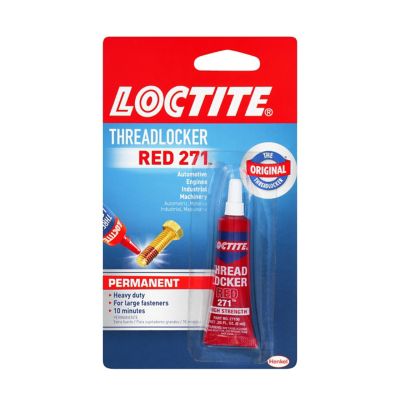
Have a look at Loctite Threadlocker Red 271
Threadlocker Red 271 is a permanent solution for locking and sealing threaded fasteners and is only removable once cured by heating up parts to 500°F (260°C).
 

SMOKEYBEAR

Well-known member
Joined
Jan 3, 2016
Messages
447
West System epoxy and add the fiber filler might do it, test one to see if performs like you want it to..

Maybe there is a specialty fastener out there if you do some more searching?
 
OP
L

loosanarrow

Active member
Joined
Jan 19, 2023
Messages
42
My concern with loctitite in general is that these are not very snug fitting threads, and only a few threads on a 10-24 wing nut, and will be subjected to a lot of abuse and potentially years of intermittent submersion in water. Ideally it would be a one piece fastener, but I have not been able to locate anything like what I need.
I also considered some type of punch and hammer to smash the threads together, but again I am concerned that over years of using pliers and bumps and bangs, it could loosen.
 

mike93lx

ALLIANCE MEMBER
Joined
Dec 9, 2013
Messages
37,337
Location
Richmond, VA
I'm really curious on this seemingly very unique application.

If you share more info, you might get a suggestion you haven't thought of
 
OP
L

loosanarrow

Active member
Joined
Jan 19, 2023
Messages
42
Ideally it would be strong enough to fail somewhere other than the threads if given the he-man stomp test. You think RTV would be that strong? Could be, I have not tried it. I don’t ever want it to loosen or come apart without destroying the assembly.
 

Firebrick43

Well-known member
Joined
May 12, 2015
Messages
13,971
Location
West central Indiana
My concern with loctitite in general is that these are not very snug fitting threads, and only a few threads on a 10-24 wing nut, and will be subjected to a lot of abuse and potentially years of intermittent submersion in water. Ideally it would be a one piece fastener, but I have not been able to locate anything like what I need.
I also considered some type of punch and hammer to smash the threads together, but again I am concerned that over years of using pliers and bumps and bangs, it could loosen.
638 and 680 green loctite is gap filling. It will gaps up to .015”

If you put a weight such as a sledge hammer head behind the head of the screw and use a center punch and a good heavy ball peen on the end to swage the shank I can assure you that the nut will never come off unless cut off. The shank should only stick out 1/8 to 3/16 of an inch past the nut if you do this.

I really don’t see your objection to silver braze? Get some flux and safety-silv 56 in 1/16” diameter, form a very small ring and put it over the shank and heat with a small torch. I have brazed together dozens of SS fittings with no problem with the brazing. Play the heat over the SS steel and remove it at the first sign the ring melts and is drawn in.
 
Last edited:
OP
L

loosanarrow

Active member
Joined
Jan 19, 2023
Messages
42
So I am using this as an adjustment for a bracket that goes through a steel bar and pulls it tight to a plate. It is a device I am prototyping at the moment. I am on the road currently or I would post a picture.
But the general problem is one that could apply in a number of applications, which is to make just a few loose threads 100% permanently solid on a small stainless screw. Maybe I will just end up having to weld or silver braze it, but my concern is compromising the corrosion resistance. It may even be used in saltwater or brackish water on occasion.
 
OP
L

loosanarrow

Active member
Joined
Jan 19, 2023
Messages
42
Oh and it not only has to not come off, but it can’t turn further on either. So the wing nut is on the very end of a 10-24 stainless screw, has to be solid to not loosen either direction with abuse and all weather and submersion in corrosive situations.
Appreciate all the replies! I will try smashing and loctite for sure. Wish I had a Time Machine to see how those hold up to years of use down the road….
 
OP
L

loosanarrow

Active member
Joined
Jan 19, 2023
Messages
42
Stainless may actually be a good candidate for smashing since it also galls so easily. Hmmm.
 

Firebrick43

Well-known member
Joined
May 12, 2015
Messages
13,971
Location
West central Indiana
Silver brazing has been commonly employed in SS ship parts forever.

If you use 56 percent silver alloys and not the lower allows containing lot of zinc corrosion is not a problem. Nor are you going to change the SS properties at brazing temps if you heat just to the point the solder flows.
 

PCustoms

Well-known member
Joined
Jul 23, 2011
Messages
22,193
Location
VT
Stainless thumbscrews?

Having a real hard time picturing what you're doing
 

Slowboat

Well-known member
Joined
Nov 5, 2010
Messages
595
Location
Green Mountains
G-flex epoxy would be a good choice. Strong. Gap filling, totally fine submerged.

The only challenge is that to remain stainless it needs oxygen. Underwater you are probably ok, but could end up with crevice corrosion at some point.
 

NUTTSGT

Super Moderator
Staff member
Joined
Sep 14, 2009
Messages
50,852
Location
Northern Central Ohio
You're talking about something going into production now for something around the house or shop

Cross the Clear RTV off the list.
 
To avoid these ads, REGISTER NOW!

Zeus36

Well-known member
Joined
Oct 1, 2016
Messages
814
Location
Ventura, California
Something is keeping me awake thinking about it. Can someone help?

Looking for some advice. I need to permanently attach a stainlesss wing nut to a stainless screw. 10-24 threads, the wing nuts aren’t very “tight” on the screw threads in general, and the wing nuts will be right on the end so the screw just comes through flush with the wing nut. Basically I want to turn the screw with the wing nut and I can’t use a wing screw because I need the 82° countersink head on the other end of the screw.
I want to retain the corrosion resistance but it has to be super tough and strong and good to go with rough treatment like banging around and using pliers to turn and also be underwater long term.

I have been considering silver solder (braze), but concerned the high heat will compromise corrosion resistance. Thought about epoxy, but not sure it will take abuse like banging around and overall bumps and shocks. Maybe low temp solder sweated into the threads? I have a mig welder, but don’t really want to change the gas and wire for this operation.

Any ideas out there? Ideally it would be shock proof and corrosion resistant and waterproof and strong enough to bend the wings on the nut without turning and permanent.

Thanks for any help!
Mechanical methods to secure a fastener (wingnut) on the end of a threaded screw without heat or chemical compounds:
  1. Drill through the wingnut body in place on the screw and use stainless safety wire as a way to pin the wingnut to the screw. This would be a single point lockwire. Twist the wire into a pigtail over the end of the flush screw shaft and trim off the excess.
  2. As the wingnut is right on the end of the screw, use a split ring through the wingnut body and screw after drilling a hole.
  3. Drill through the wingnut body in place on the screw shank and use a small cotter pin. Bend the headless ends and trim off the excess pin material.
 
Last edited:

MovingAlong

Well-known member
Joined
Aug 17, 2013
Messages
1,191
Something is keeping me awake thinking about it. Can someone help?

Looking for some advice. I need to permanently attach a stainlesss wing nut to a stainless screw. 10-24 threads, ...

Ok, that's a tiny thing...

Ideally it would be strong enough to fail somewhere other than the threads if given the he-man stomp test. You think RTV would be that strong? Could be, I have not tried it. I don’t ever want it to loosen or come apart without destroying the assembly.

You're going to "he-man stomp" a 10-24 stainless fastener? Good luck with that, stainless is soft. Hate working with stainless.

Just get a good cross-thread going, and then run that ***** on with an impact.

On a 10-24 stainless? Never used an impact on something that small before. :dunno:
 
OP
L

loosanarrow

Active member
Joined
Jan 19, 2023
Messages
42
Haha. Thanks again. Yes it something going into production - small time home shop production.
It is difficult to describe, but the screw has to turn and the head of the screw sits in a countersunk hole and can turn in that hole. The screw with attached wing goes thru a threaded hole so by turning the wing nut/screw assembly the piece with the countersunk hole can be drawn tight and loosened. Clear as mud?
Like I said I would take a picture if I was not on the road.
I expect the silver solder or the tig will be my best bet. I’m going to order some solder and flux so it will be there when I get home. If that gives me trouble, I guess I will have to finally get a tig torch for my MP210. At least it said that thing can do tig… but then I need another bottle of different gas as I recall. I have high hopes for the silver solder, especially after the earlier post that silver solder heat won’t damage the stainless. Thanks again everyone, really appreciate the help.
 
OP
L

loosanarrow

Active member
Joined
Jan 19, 2023
Messages
42
That is exactly what I have on the prototypes currently. Works great, but now I have to figure out the final version so that is what brought me here asking for advice.
 

andyvh1959

Well-known member
Joined
Feb 15, 2020
Messages
2,589
Location
Green Bay WI
Wait, you want a #10-32 S/S wing nut to be "tight" and not loosen, but the countersunk screw in the bore has to be able to turn? So then how do you define "tight?" And on a production assembly? How do you think that will be consistently done? A typical torque spec for #10-32 screw is only 30 in-lb, 2.5 ft-lb. That is easily acheived with fingers on a wing nut. But for a production application that can be very inconsistent. My experience with production personnel is "tight" leaves a lot of interpretation.

With a threaded connection that small, determining "tight" but no too "tight" may be a challenge. If this is not intended to be taken apart for service or replacement, why not use a countersunk head threadless pin with a press on grip fastener on the opposite side. Then you production persons only have to fully insert the pin, clamp it down, and then fully press on the grip fastener.
 

Spud McGee

Well-known member
Joined
Apr 11, 2022
Messages
405
Take it down to your local jiffy lube or other oil charge shop and have them get the threads started for you. That will guarantee that the stupid screw and nut are cross threaded and wont come loose.


Otherwise, I'd look to how this sort of issue is handled on large scale production. On AR-15s, the gas key fasteners and the castle nut are screwed, torqued, and then staked. On a bunch of vehicles, ball joints and wheel bearings are held on with a castle nut and then a cotter pin running crossways through the shaft of the threaded rod.

And according to our federal government (ATF branch), silver soldering and pinning and welding are sufficient to permanently attach threaded things. For the pin and weld, you screw your things together, then drill a small hole for a pin. drop the pin in which locks the 2 together, and zap it with a tig torch to prevent the pin from falling out. That would be much less heat in your parts compared to silver soldering them.
 
Last edited:

cgrutt

Well-known member
Joined
Mar 4, 2016
Messages
8,149
You have better tools than I do.. drilling a hole between the threads of a 10-24 nut and screw - in stainless? That's impressive!
Hmm high speed steel drill bit and some cutting oil should do the trick as long as you don't get it too hot and work harden the screw it should work no? Yeah much higher tech than a TIG welder as had been suggested lol.
 
OP
L

loosanarrow

Active member
Joined
Jan 19, 2023
Messages
42
Thanks everyone! I ordered some silver 56 solder, and some mean black flux that is supposed to be good for stainless. Going to try that route first. I already have a O/A torch so at least I won’t need to buy a tig kit and a new bottle of gas with that method.

Although this would give me a good excuse to buy a tig kit and a bottle of tig gas….
 

PCustoms

Well-known member
Joined
Jul 23, 2011
Messages
22,193
Location
VT
When can you post a pic?

I'm guessing 99% of the responses are ok base (likely mine included) as were still scratching our heads...
 

ALinCarolina

Well-known member
Joined
Dec 29, 2014
Messages
757
Location
NC Piedmont
If I had a roll of stainless wire on my MIG I would tack it. If not I wouldn't go to the trouble to change the spool. I would melt the end of the joint with a small torch on the oxy-acetylene
 

MovingAlong

Well-known member
Joined
Aug 17, 2013
Messages
1,191
Hmm high speed steel drill bit and some cutting oil should do the trick as long as you don't get it too hot and work harden the screw it should work no? Yeah much higher tech than a TIG welder as had been suggested lol.

Through a 3/8" steel bolt, sure, I've done that. But between the threads of 10-24 and stainless to boot - I'm in over my head at that point.
 

cgrutt

Well-known member
Joined
Mar 4, 2016
Messages
8,149
Through a 3/8" steel bolt, sure, I've done that. But between the threads of 10-24 and stainless to boot - I'm in over my head at that point.
C'mon I didn't even try that hard and did it with tools shown in pictures. It would have come out better on the drill press. It may be a #12 but it is stainless I would have used #10 but didn't feel like digging to find one...

20240129_140147.jpg
 

MovingAlong

Well-known member
Joined
Aug 17, 2013
Messages
1,191
C'mon I didn't even try that hard and did it with tools shown in pictures. It would have come out better on the drill press. It may be a #12 but it is stainless I would have used #10 but didn't feel like digging to find one...

Thank you for that pic! I wasn't visualizing that correctly and have learned something new. :thumbup:
 
To avoid these ads, REGISTER NOW!
Top Bottom