To avoid these ads, REGISTER NOW!

Thread locking stainless PERMANENTLY

rlitman

Well-known member
Joined
Oct 18, 2010
Messages
24,576
Location
Long Island
TIG, no filler needed. Just fuse the parts together.
I have a TIG welder and I too would TIG weld it. Though I'd add a dab of filler, specifically because of the OP's concern about corrosion. Autogeneous welds in stainless are risky from a corrosion standpoint, unless you're VERY careful with the shielding gas. TIG filler intentionally has additives that protect the weld from oxidation (and dilution, though that's less of an issue here).

As for the heating issue, any welding (or brazing/soldering for that matter) should be followed up by passivation. I recommend a hot citric acid bath after ultrasonic cleaning. Electropassivation isn't the best option here, because part of the weld is inaccessible due to being buried in the threads.

All this being said, a permanent thread-locker compound followed up by drilling and pinning with a stainless roll pin may be the easiest option. However, if you choose to use something like Loctite, be aware that a primer is needed on stainless.
 
To avoid these ads, REGISTER NOW!

Spud McGee

Well-known member
Joined
Apr 11, 2022
Messages
405
C'mon I didn't even try that hard and did it with tools shown in pictures. It would have come out better on the drill press. It may be a #12 but it is stainless I would have used #10 but didn't feel like digging to find one...

20240129_140147.jpg
I would have drilled straight through the nut first. Just directly into one of the flat sides.
Then install the nut on your screw, and use the hole in the nut as a drill guide to drill the screw. You can go in partially, leaving a blind hole, or drill completely through and out the opposite flat face of the nut. Then hammer in a roll pin or run a cotter pin through it.
 
OP
L

loosanarrow

Active member
Joined
Jan 19, 2023
Messages
42
Unfortunately I won’t be home until Friday. I do think the silver solder will work, and that was the way I was leaning before I posted this question, but I was not sure if the heat would lessen the corrosion resistance. Firebrick43 has answered that, so I will assume that is solid info and go with silver solder.
I like the drill through threads and stake it also. Might not be as elegant as silver solder, but would certainly work.
Epoxy I would be concerned that over years it would take a hit and start to crack. Might not, but I don’t want the risk.
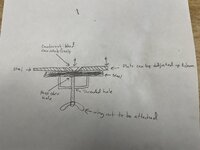
I will draw it. Give me a minute,,,
 
OP
L

loosanarrow

Active member
Joined
Jan 19, 2023
Messages
42
So the top plate can be loosened or tightened by turning the wing nut/countersunk screw assembly
 
OP
L

loosanarrow

Active member
Joined
Jan 19, 2023
Messages
42
I am sitting at desk at an elementary school, so they have paper and pencil to spare. But no ruler or drafting table in sight so that’s the best I can do freehand. I’m no artist.
 

cgrutt

Well-known member
Joined
Mar 4, 2016
Messages
8,152
I would have drilled straight through the nut first. Just directly into one of the flat sides.
Then install the nut on your screw, and use the hole in the nut as a drill guide to drill the screw. You can go in partially, leaving a blind hole, or drill completely through and out the opposite flat face of the nut. Then hammer in a roll pin or run a cotter pin through it.
Yep that would work too I was just thinking between the threads would be less noticeable as OP is apparently using a wing nut to turn and loosen whatever it is. I live in a pretty restrictive state and had to blind pin some rifle compensators to barrel threads we came in from side but not all the way through as you suggested. At least a few of the comps and some barrels were stainless no problem drilling small hole.
 
OP
L

loosanarrow

Active member
Joined
Jan 19, 2023
Messages
42
Also that drawing is not exactly right. The top plate has to be adjusted to below the surface of the bottom plate (it is small enough to go in a laser cut hole) so that is the reason for the bottom bracket with threaded hole and not just threading the bottom piece of steel
 

Spud McGee

Well-known member
Joined
Apr 11, 2022
Messages
405
I live in a pretty restrictive state and had to blind pin some rifle compensators to barrel threads we came in from side but not all the way through as you suggested.
Yep, I just did a pin and weld suppressor to avoid making it a 2-stamp gun. All you really need to do is dimple the barrel so the pin drops into it, and weld the pin and that keeps it from spinning.

I suggested drilling all the way through mostly out of simplicity. Its easier to whack a roll pin in than to fire up a tig torch. And its easier to remove a pin from a hole if it goes all the way through.
 

msharley

Well-known member
Joined
Sep 20, 2021
Messages
13,933
Location
Central Pennsylvania
My concern with loctitite in general is that these are not very snug fitting threads, and only a few threads on a 10-24 wing nut, and will be subjected to a lot of abuse and potentially years of intermittent submersion in water. Ideally it would be a one piece fastener, but I have not been able to locate anything like what I need.
I also considered some type of punch and hammer to smash the threads together, but again I am concerned that over years of using pliers and bumps and bangs, it could loosen.
Don't over think it.

The sleeve retainer lock tite.

Not enough?

Simply mash the head of the threads with a hammer or punch....

One good rap in the center with a center punch will swell the stud diameter sufficiently to prevent the nut from ever coming off.

(so glad we do not have an OUT OF CONTEXT thread on this forum...a fellow like PELICANPINES would have me almost embarrassed) :yikes:
 
To avoid these ads, REGISTER NOW!

yhprum

Well-known member
Joined
Jul 27, 2006
Messages
1,379
Location
Brisbane Australia
I have put 5 minute epoxy on the threads and tightened it. It holds. Years ago I used a two partLoctite thread restorer product that had some fine granules you mixed into the part b stuff. When you tightened The fastener the granules would crush and activate the epoxy. There was some type of mold release agent you applied to the threaded fastener so you could remove it.
 

PCustoms

Well-known member
Joined
Jul 23, 2011
Messages
22,199
Location
VT
high strength loctite

The other solutions aren't, practically, serviceable.

Still not sure what your overall application is, there may be a better way to do that joint. Have you tried barrel bolts?

 
OP
L

loosanarrow

Active member
Joined
Jan 19, 2023
Messages
42
It is just a matter of wanting a permanent fusing of the stainless wing nut on the end of a 10-24 stainless screw. Rough service, often underwater, sometimes even brackish or saltwater, and used by workers who are famous for abusing it in every way possible. Even if it were one piece some would probably be broken or damaged - so just the most strongest most permanentest it can be. If I could I would have it all be one piece, but that isn’t happening so I want the most permanent and corrosion resistant attachment I can get. I already ordered silver solder and black flux for stainless so I am going to give that a try first.
 

DGersic

Well-known member
Joined
Mar 12, 2017
Messages
6,258
Location
DeKalb, IL

So you’re building a wing headed bolt for a clamping mechanism? But it’ll work backwards, unless you’re using left handed threads. That would bug me. #10 is a pretty small and weak bolt size, not going to get much clamping force out of it.

Given that, I’d go for the welded option first. Solder (or brazed) second. Chemical adhesion would be way distant third. Peening the end isn’t going to work. It’ll stop the wing nut from coming off, but not from threading down toward the clamping U thing.
 

Stuart in MN

Well-known member
Joined
Sep 8, 2005
Messages
22,977
Location
Minneapolis
SS screws gall up on their own pretty easily - heat it up a little with a propane torch and it may be enough to fuse them together permanently.
 

bronuc

Member
Joined
Nov 17, 2016
Messages
21
Upset the thread (damage it) and then thread the wing nut on, should gall nicely, especially with 316.
 

CraigStu

Well-known member
Joined
May 22, 2014
Messages
4,009
Location
Blacksburg, Va
This is for a product OP will be selling and he needs it 100%. If the wingnut works loose he is in a world of hurt trying to figure how to get it fixed for the customer. I think the silver solder or TIG is going to be the best. I like the solder because it will look the best. I can tig that nut on easily, but 10-32 is small stuff so making a nice looking finish would be more difficult. OP I would get a couple pieces of SS sheet, maybe 6" x 6" and cut a 1" long slot into one side on each piece. Clamp one to a bench w/ the slot in the air. Slide the piece into it w/ the wing nut on top. Slide the other over lapping so you have a nothing but the wingnut to look at. This will help protect the rest of your product from the heat of the torch and reduce color change and the need for buffing etc.
 

no704

Well-known member
Joined
Apr 27, 2016
Messages
5,203
Counter sunk screw is a very bad choice for something that will need to rotate. Especially SS on SS Just drill a hole in the interface and bust off a 6-32 tap in it.
 
To avoid these ads, REGISTER NOW!
Top Bottom