To avoid these ads, REGISTER NOW!

Threaded blind hole in thin, soft stock

pendragon1998

Well-known member
Joined
Mar 24, 2012
Messages
3,733
Location
NE Georgia
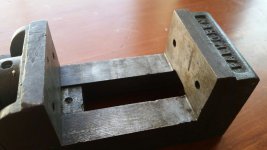
I am thinking of making some vise jaw pads that will need to have threaded blind holes (the screw enters the pad from the back). The material will be brass or aluminum - haven't decided - and will be either 3/16 or 1/4 inch thick. I want to leave about 1/16" of material at the bottom of the hole, so the hole will be either 1/8 or 3/16" deep, depending on the stock thickness.

Questions: is that hole depth sufficiently deep to securely engage the fasteners in the threads? Is a standard bottoming tap what I need to use?

I guess my other option is a through hole in the jaw pad with a countersink for a flat head on the interior of rhe pad and a nut on the outside. The holes through the jaws appear to have a counter sink on the outside for a fillister head screw going into the back of the pad, though. Weird way to do it.

Or can I just buy a set of Palmgren pads?

attachment.php


attachment.php
 

Attachments

  • 14862521472681.jpg
    14862521472681.jpg
    119.1 KB · Views: 419
  • 14862521472680.jpg
    14862521472680.jpg
    114.7 KB · Views: 416
Last edited:
To avoid these ads, REGISTER NOW!

racingtadpole

Well-known member
Joined
Dec 3, 2011
Messages
2,029
Location
The far side of crazy.. but sometimes Australia
If you make the jaws a bit thicker, say 5/16 or 3/8 so you can drill and tap as you describe with a bottoming tap. If you want thinner jaws like 1/8 get some 1/8 ally angle larger than the overhang you need, trim it to size and stick them on with double sided tape. Wont hold them forever, but its easy and replacing the tape isn't really a chore. I have a small vice at work that has its soft jaws attached like that.
 

OccupantRJ

Well-known member
Joined
May 15, 2009
Messages
10,906
Location
Eastern North Carolina
I do lots of this at work. If you want soft jaws go with a thicker material as mentioned previously to have more thread engagement. Barring this, through holes can be tapped if the resulting surface won't affect what you are doing. That would be no worse than countersunk bolts for attachment.

I make dedicated tooling, so sometimes I drill and tap into the sides of the vise for various attachments or accessories. Holes can also be drilled in your plate and a threaded stud can be brazed or silver soldered in to provide attachments. Often jaws have custom cavities machined into them to provide work holding capabilities for odd shaped parts. Magnets can be counterbored and bonded into the back of your plates to provide quick attachment also

The fixed jaw has a slight radius in the lower corner, so be sure to accomodate for that when you make your plates. These vises work excellent to hold small parts to feed through a bandsaw, as they are machined on the sides to allow for side oriented use.
 
Last edited:

PCustoms

Well-known member
Joined
Jul 23, 2011
Messages
22,186
Location
VT
What size bolt will you use?

There shouldn't be a lot of force on the threads, so as long as you get 2-3 to engage in the hole you should be fine. This could work with maybe yp to a 1/4-28, but obviously the larger you go the less engaged rhe thread would be.
 
To avoid these ads, REGISTER NOW!
OP
P

pendragon1998

Well-known member
Joined
Mar 24, 2012
Messages
3,733
Location
NE Georgia
If you make the jaws a bit thicker, say 5/16 or 3/8 so you can drill and tap as you describe with a bottoming tap. If you want thinner jaws like 1/8 get some 1/8 ally angle larger than the overhang you need, trim it to size and stick them on with double sided tape. Wont hold them forever, but its easy and replacing the tape isn't really a chore. I have a small vice at work that has its soft jaws attached like that.

Thicker probably won't work, since the vise only has a 3-1/8" travel (minus the jaws). I'm trying to retain as much capacity as possible.

I like the double sided tape idea. Once the vise is closed, I doubt the jaw pads will move, even if it's just tape holding them in place.


...through holes can be tapped if the resulting surface won't affect what you are doing. That would be no worse than countersunk bolts for attachment.

...Magnets can be counterbored and bonded into the back of your plates to provide quick attachment also

The fixed jaw has a slight radius in the lower corner, so be sure to accomodate for that when you make your plates.

Yes, I suppose threaded through-holes would be fine as long as the screws are short enough not to protrude.

Neodymium magnets are a good idea, provided I could get a decently flat-bottomed hole.

Thanks for the reminder about the radius.


What size bolt will you use?

I don't have the vise handy, but I think the existing holes are about 1/4" or 3/16"
 

EdT

Well-known member
Joined
Sep 21, 2010
Messages
1,104
Location
North Georgia
I hold aluminum soft jaws on my bench vise with rare earth magnets let into the back side. They hold pretty well and can be removed easily. They do attract steel chips and such which can be a problem depending on what you are doing.
 

WoodsTruck

Well-known member
Joined
Jan 12, 2013
Messages
1,019
If you are making the soft jaws, could you make them fold around the sides? In doing so, you could drill a 1/2" - 3/4" hole in each side flap to insert a round magnet. It would then have one on each side of each jaw. If it was a nice tight fit and all, you could then epoxy over the magnet to hold it in place, or just let the magnet float keep them from moving when opening the jaws.
 

matt_i

Well-known member
Joined
Mar 14, 2008
Messages
10,714
Location
SE Michigan
I would approach this in one of two ways.

1) use traditional alloy steel fasteners into tapped-thru-holes in the jaws, put them together then spend a little time grinding each end of the fastener back until its recessed slightly and won't contact the workpiece. You can think outside of the box here and use something like a #4-40 as it won't take much screw to hold the jaws in place. The benefit is you get more threads holding in the soft material.

2) make studs same as parent metal and plug weld or braze them to the thin jaw material. Then use nuts on the back side, aluminum nut on aluminum thread is not a good idea, high potential for galling, better yet use plated steel or brass nut.
 

kazlx

Well-known member
Joined
Oct 30, 2012
Messages
2,851
Location
Tustin, CA
Neodymium magnets are a good idea, provided I could get a decently flat-bottomed hole.

Thanks for the reminder about the radius.


I don't have the vise handy, but I think the existing holes are about 1/4" or 3/16"

Just plunge with a center cutting end mill.

If it was me, I would just drill and through tap. It's just a vise.
 
To avoid these ads, REGISTER NOW!
Top Bottom