I was thinking stressproof might be a good choice, for wear resistance.
-There's a couple of considerations for this steel. When wear resistance is needed I've always used hardened tool steel but that's doesn't mean I'm right either. As you're already aware there has to be a sacrificial component.
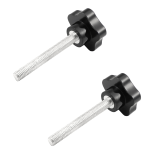
The knobs would wear out still, but those are easier for him to replace.
-If it's been decided that the knobs are to be periodically replaced then ok. I may not have the best answer for you but I'll take a shot at it.
How hard is it to tap 1144?
-That would depend upon whether you plan on using a cut tap or form tap. Formability for 1144 is one of the lesser aspects, mechanical properties show it has limited forming potential. That may be improved with opening the minimum diameter and going for a reduced percentage of thread. The type of lubricant used makes a difference too. Increasing the lubricity (Moly Dee vs. enriched coolant) helps but this all sounds a bit fiddly for limited one-off production in manual machines. I would expect using a good cut tap (OSG or equivalent) would be an easier process than a form tap.
I thought about durabar since it would "lubricate", but I don't know if it would stand up to repeated tightening/loosening.
-This is using hand knobs so I doubt there's a lot of stress loading happening here. Another aspect to consider is the environment this is subject to. Corrosion resistance and corrosion cracking for 1144 is listed as "Fair" so in the presence of acids/chlorides/alkaline it's not a very suitable choice.
-Wouldn't call you way off, might be overkill to some extent. Cost/availability are always considerations. I haven't worked with 1144 very much so I may have a limited opinion here. For tooling/fixture applications I make choices from:
1) What's readily available
2) Ease of machining
3) Will it function as it needs to
-For me that often means 4140 (PH or hardened later) for general work. Up in mechanical properties is 4340. Increased wear resistance calls for O-1 or A-2 but that's after heat treating (easy for these). At the top of the abrasion list for readily available steel is D-2 but I wouldn't recommend it unless needed, it's a PITA for some machining operations. How comfortable with heat treating are you? Something this small doesn't have to be sent out and can often be done at home provided you follow a few guidelines.
I have to order material regardless. I need to order some more 12L14 anyway, so I figure I may as well get the material for these reducers, too.
-A sacrificial component is required so pick the material best suited and something you'll want to use for later projects IMO. Stamp the remaining bar on the end to avoid mixing it with other steels, which happens all too often for small pieces.
Another thought I had was to use an acme thread, but I don't know if that is really a better choice.
-For the amount of clamping force (hand knobs) I can't see getting the benefit from an Acme thread, especially considering the additional trouble of making an Acme thread vs. a standard "V" thread. Acme threads are more for heavy loading, you don't have that here.
I would have to make all of the parts, then.
-So how often would you need to use an Acme tap to justify the cost of it? You could single-point the threads but have you ever done that for an Acme? It's fuuuuun, even more so for an internal thread.
Certainly, it would probably wear less, but I don't know if it would hold as well.
-Holding will be affected by vibration after the fixture clamps up for (presumed) machining. Fine threads are less susceptible to coming loose during vibration, that's why they're used in motorcycles a lot. Fine threads do increase clamping time if there's a lot of travel with the hand knobs for loading/unloading the fixture. Using fine threads will also affect availability of replacing the hand knobs. You have several factors to decide what threaded bushing material to use. We haven't even discussed the non-steel choices....