To avoid these ads, REGISTER NOW!

Thru-wall compressed air pipe

tom86951

Well-known member
Joined
May 14, 2005
Messages
155
Location
CA
I need to get air into the garage from the compressor that sits outside behind the garage. Need a little advice on the best way to do it. My thought was to get a 3/4" copper pipe with NPT threads on the ends and secure it to a stud in the wall, then use quick connect fittings on both ends to hook up the air.

-- does that sounds like an ok plan?

-- how can I secure the pipe to a stud so it can't turn -- I'll need to crank on the fittings to avoid leaks after all...

--Is a 3/4" NPT copper pipe adequate if I plan to use 3/4" RapidAir tubing inside the garage for the air? Can you get quick connect fittings that big?

--assuming I get a water filter/separator thing, does it matter if I put the pipe high or low on the wall?
 
To avoid these ads, REGISTER NOW!
OP
T

tom86951

Well-known member
Joined
May 14, 2005
Messages
155
Location
CA
I thought I didn't want steel pipe due to the possibility of introducing rust etc?

Not sure I follow the idea either way...? Weld the pipe to the plate and bolt the plate to the stud?


Edit: or are you thinking I drill a hole in the plate for the pipe, and insert the pipe through it perpendicular to the plate, and use the plate like a bulkhead flange?
 

DGersic

Well-known member
Joined
Mar 12, 2017
Messages
6,284
Location
DeKalb, IL
I thought I didn't want steel pipe due to the possibility of introducing rust etc?

Not sure I follow the idea either way...? Weld the pipe to the plate and bolt the plate to the stud?


Edit: or are you thinking I drill a hole in the plate for the pipe, and insert the pipe through it perpendicular to the plate, and use the plate like a bulkhead flange?


Dry pipe doesn’t rust. Wet pipe could eventually, but you should be filtering that anyway. A vertical drop with aT will handle it.

I was thinking weld the pipe to a 3.5” plate. Screw the plate to the face of the stud, so the pipe goes through the wall.


Sent from my iPad using The Garage Journal mobile app
 

ez-duzit

Well-known member
Joined
Jun 24, 2013
Messages
5,094
Location
Marina del Rey
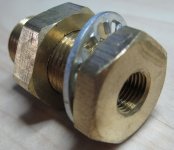
You want a bulkhead union. Photo shows flare, but others available.

J-BU-SOLIDWORKS-RENDER.jpg
 

PoorOwner

Well-known member
Joined
Feb 10, 2007
Messages
5,032
Location
CA
You can just use a union soldered to the NPT fitting so you can turn the NPT all you wanted first, secure the copper to the stud / stucco / inside then put the union together.

Once the copper run is strapped to studs securely, it really doesn't move around so you don't really need a flange. (that's how things come out of the walls for your faucets and toilets also, no bolted flanges on them) just need to put some silicone around the gap of the wall penetration.
 

sberry

Banned
Joined
Jun 18, 2005
Messages
35,747
Location
Brethren, Michigan
Just shove a ****** thru, tighten to one side and add what you want to the other, tighten it. As long as there it enough to grab with a pie wrench on one size its an easy deal. An anchor hanger may make it more work.
 
Last edited:

sberry

Banned
Joined
Jun 18, 2005
Messages
35,747
Location
Brethren, Michigan
Even shove a hyd hose thru the wall
Put a ball valve on the tank, screw 3/4 hose to it, follow it with a swivel once thru the wall, screw to manifold.
 

matt_i

Well-known member
Joined
Mar 14, 2008
Messages
10,725
Location
SE Michigan
So here's this...Get your Cu pipe, buy a 4" square piece of 16ga Cu flat stock on Ebay. Core a hole in the center that's a very close fit to the OD of the pipe, I would recommend using a drill, undersize, then dremel or file it, in an iterative process, cehcking it until it just fits. Now flux the pipe OD and the flat and soft-solder it just like a plumbing fitting.

You could also use bronze brazing rod but will need higher heat.

Now you have a rust-proof flange that will resist some amount of pipe torque. Best is to use the hex that's already formed onto the Cu male ******.

I would avoid quick connects as they cut the flow. Where you need a swiveling fitting to make up a like use JIC 37 degree fittings, Parker makes a line of these...look up "FTX" as one idea between a NPT-M and a JIC-Male fitting.
 

gmwelder86

Well-known member
Joined
Dec 8, 2010
Messages
463
Location
Oakdale , ca
If attaching directly to framing would suggest some of vibration dampening between pipe and framing or else it can echo thru the house.
 

sberry

Banned
Joined
Jun 18, 2005
Messages
35,747
Location
Brethren, Michigan
Or we could just redneck it: knock a hole in the wall and stick a hose through it. :)

You could, and it would work. But then again could work till he found an expensive bulkhead fitting from hydraulic store designed for an exotic purpose and a few more fittings to go with it.
Any plumber worth a pinch of **** would fit a ****** thru and caulk it. Or hose to a fitting.
 

greg13

Well-known member
Joined
Aug 2, 2018
Messages
497
Location
Weedsport, NY
I thought I didn't want steel pipe due to the possibility of introducing rust etc?

Not sure I follow the idea either way...? Weld the pipe to the plate and bolt the plate to the stud?


Edit: or are you thinking I drill a hole in the plate for the pipe, and insert the pipe through it perpendicular to the plate, and use the plate like a bulkhead flange?

How long do you plan on living? Under normal conditions the pipe will outlive your grand children.
 

DGersic

Well-known member
Joined
Mar 12, 2017
Messages
6,284
Location
DeKalb, IL
Let's see if we can come up with some more complicated ways to do this.


Buy a lathe. Learn to use lathe to turn square bar stock in to pipe. Lean to use lathe to cut pipe threads.

Buy a mill. Learn to use mill to cut a piece of steel to a rectangle shape, with countersink mounting holes. Add a U shaped groove across the piece, same as the OD of the pipe from the first step.

Buy a welder. Learn arc, MIG and TIG welding. TIG weld pipe to mounting plate. Post pictures on Weld ****.

I suppose that with the lathe, you could also make your own mounting screws, but that might be overkill.


Sent from my iPad using The Garage Journal mobile app
 
To avoid these ads, REGISTER NOW!

Cobra5150

Well-known member
Joined
Feb 2, 2008
Messages
1,953
Location
GA
This

Thru wall fitting

Or follow DG's advice above and the laws of physics are you only boundary
 

Attachments

  • Capture.JPG
    Capture.JPG
    36.8 KB · Views: 208
Last edited:

JerryB

Well-known member
Joined
Mar 22, 2007
Messages
132
Location
North Coast, CA
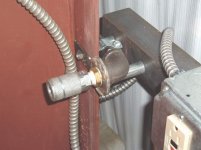
I wanted to put an outside air drop on the back of my hanger building to be able to service our cars & tractor tires without putting a hose out the window. Here is the title of a compressed air through the wall setup I found on the internet:

"Compressed Air Bulkhead Fitting Outside Wall of House"

Note: I have tried to paste the URL here, but can't get it to work. If interested, try Googling the name. The original site should come up.

It was originally designed to run air from inside to outside, but could be easily modified for the reverse. Just uses some OTS components, with the 1/2" NPT Lapp Brand Waterproof Skintop Cable Strain Relief being the only part not available at the local hardware stores. I got mine from an electrical component distributor.

I can imagine that larger components could be used if higher air volume is required.
 
Last edited:

DGersic

Well-known member
Joined
Mar 12, 2017
Messages
6,284
Location
DeKalb, IL
I wanted to put an outside air drop on the back of my hanger building to be able to service our cars & tractor tires without putting a hose out the window. Here is the title of a compressed air through the wall setup I found on the internet:

"Compressed Air Bulkhead Fitting Outside Wall of House"

Note: I have tried to paste the URL here, but can't get it to work. If interested, try Googling the name. The original site should come up.

It was originally designed to run air from inside to outside, but could be easily modified for the reverse. Just uses some OTS components, with the 1/2" NPT Lapp Brand Waterproof Skintop Cable Strain Relief being the only part not available at the local hardware stores. I got mine from an electrical component distributor.

I can imagine that larger components could be used if higher air volume is required.


https://www.instructables.com/id/Compressed-air-bulkhead-fitting-outside-wall-of-ho/


Sent from my iPad using The Garage Journal mobile app
 

CraigStu

Well-known member
Joined
May 22, 2014
Messages
4,017
Location
Blacksburg, Va
Don't over think this. Run 2-3 feet of rubber air line hose from the compressor to whatever pipe you want to use. This isolates the vibration and possible slight compressor movement from the rest of your piping on and through the wall. Use a couple of surface mount clamps to run a foot or two of your pipe on the outside wall. A 90 deg to a 5-6 inch ****** going through the wall, another 90 deg and then start running your inside pipe w/ more surface mount clamps. Silicone the hole to the ******.
 

BD1

Well-known member
Joined
Mar 18, 2007
Messages
4,602
Location
north side
A hydraulic hose might be the easiest solution. Farm and Fleet or Traction supply has them. Basic pipe threads .
 

sberry

Banned
Joined
Jun 18, 2005
Messages
35,747
Location
Brethren, Michigan
The reason I am a fan of the hyd hose scheme from the farm store is cost and reliability. It comes with the ends, super easy to connect a swivel or union.
Last 2 posts have the idea, simple common parts screwed together, pipe thru wall with some caulking. Ball valve is the first fitting off the comp, can shut the whole system down. In a small simple system it can be enough, in larger ones with long mains like a ball valve on hard pipe prior to any equipment, any hoses, filter and regulators.
I have a couple zones on 24/7, a couple rarely used with older equipment and hoses where I shut them off. Local valve makes it easy.
 

sberry

Banned
Joined
Jun 18, 2005
Messages
35,747
Location
Brethren, Michigan
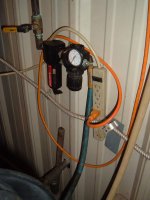
Valve ahead of unions.
 

Attachments

  • air 4.jpg
    air 4.jpg
    71.1 KB · Views: 152
  • air reggy.jpg
    air reggy.jpg
    67.7 KB · Views: 115
  • air reggie.jpg
    air reggie.jpg
    75.2 KB · Views: 121
  • air bracket.JPG
    air bracket.JPG
    50.9 KB · Views: 133

sberry

Banned
Joined
Jun 18, 2005
Messages
35,747
Location
Brethren, Michigan
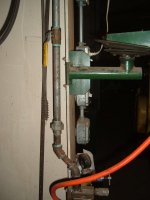
Valve ahead of unions. The last pic is a rare one, a hydrant. It has a hose reel connected to it. None of the normal use stuff requires a section of hose to be moved, The only user quick connect is at the tool. Guys never need to unhook sections of charged hose. All on reels or f ixxed whips.
 

nadogail

Well-known member
Joined
Jan 23, 2009
Messages
31,928
Location
Coronado, CA
The simple solution would be have an independent compressor on either side of the wall.

This would eliminate any concern about how to penetrate the wall.

How much more can we complicate this?
 

sberry

Banned
Joined
Jun 18, 2005
Messages
35,747
Location
Brethren, Michigan
He is on the right track for wanting to put it thru the wall, this is done all the time. It could be rather simple though.
I removed one in the last upgrade. Things changed, changed design and didn't need it anymore. But there are 5 penetrations as it is, 4 for water, 1 for air and pressure washer.
 
Last edited:

maralibis

Active member
Joined
Sep 12, 2014
Messages
32
Location
Fort Wayne, IN
I just actually did this last Summer

I striped the siding off the outside (just enough where I needed) and mounted a 2" floor flang to the outside wall.
then I ran 2inch PVC pipe from the floor flange to my compressor shack roughly 3ft i cut two doughnuts out of ply wood and attached to both ends of the 3ft PVC pipe and ran a copper pipe through the PVC pipe and thru the doughnuts into my garage.

so basically your running a small pipe thru a bigger pipe for rigidity, once it was done I carefully drilled some holes and injected the PVC with spray foam encasing the copper pipe in a ridged foam insulation

total cost about $18 copper pipe flange and PVC & foam insulation

NOTE: the compressor uses a rubber hose to connect to the copper pipe in the compressor shack
 
Last edited:

gearhead1

Well-known member
Joined
Oct 14, 2013
Messages
1,935
Location
NC

Attachments

  • E1142F0E-A744-4DEC-86AE-00E652AF48AB.jpg
    E1142F0E-A744-4DEC-86AE-00E652AF48AB.jpg
    91 KB · Views: 61
  • F0E95270-A19A-4B40-B000-A3B5F5EDDC67.jpg
    F0E95270-A19A-4B40-B000-A3B5F5EDDC67.jpg
    98.8 KB · Views: 86

afinepoint

Well-known member
Joined
Jul 16, 2024
Messages
197
Let's see if we can come up with some more complicated ways to do this.
Agree. It's a copper air line not a fuel line to a Falcon rocket. And how much torque do you plan on exerting? Some of these ideas are more complex than the air lines feeding important component at my power plant. My advice is always keep things simple as it's your time and money. Spend each wisely.
 

afinepoint

Well-known member
Joined
Jul 16, 2024
Messages
197
Couldn't resist commenting. Although I've got unstarted projects well beyond 6 years. They are generally just on a wish list. I pick them up and put them back as some new need or crisis appears.
 
To avoid these ads, REGISTER NOW!
Top Bottom