To avoid these ads, REGISTER NOW!

Tig welding aluminum

OP
A

Aquaticbob

Well-known member
Joined
Dec 3, 2013
Messages
488
Location
Seattle
Weldcraft Flex head torch . . . love em have two of em :D I replaced the cheap hose and cable as well but I had to make my own adapter for power and gas. Ebay is good spot to get all of it cheaper than a WS store.

How difficult was it to make the adapters for gas and power? I'm like an electrical noob so I don't like playing with that lol
 
To avoid these ads, REGISTER NOW!

youngnstudly

Well-known member
Joined
Apr 20, 2007
Messages
79
Location
The "Whine" country, CA
You need to turn your post flow UP! Try a minimum of 4 or 5 seconds of post flow (for now).

Also, make sure you do actually have one of the new flow meters that read in SCFH. Everything older than this year's model of regulator reads in LPM, NOT SCFH.

I would set your flow meter to the low side, around 12 SCFH (6 LPM), and START there while slowly working up to 20 SCFH each pass. You should see a difference somewhere in the that range.

Also, if you're getting "scummy" weld puddles that don't show an actual change between the solid base metal and the molten puddle, I would first try cleaning that base metal and filler rod REALLY GOOD! It probably has oil or grease/dirt on and your brush won't remove that stuff.

Wipe it AND your filler rod with Acetone continuously until you no longer see dirt and grease being pulled off the material/rod (onto your clean white rag).

Once again, the aluminum you have may or may not be weldable. Out of curiosity, what filler rod are you using? Run a bead with filler and show us what you end up with. Even if it looks like hell.

Andy
 

R.Anderson

Well-known member
Joined
May 26, 2012
Messages
906
Location
Wisconsin
You need to turn your post flow UP! Try a minimum of 4 or 5 seconds of post flow (for now).

Also, make sure you do actually have one of the new flow meters that read in SCFH. Everything older than this year's model of regulator reads in LPM, NOT SCFH.

I would set your flow meter to the low side, around 12 SCFH (6 LPM), and START there while slowly working up to 20 SCFH each pass. You should see a difference somewhere in the that range.

Also, if you're getting "scummy" weld puddles that don't show an actual change between the solid base metal and the molten puddle, I would first try cleaning that base metal and filler rod REALLY GOOD! It probably has oil or grease/dirt on and your brush won't remove that stuff.

Wipe it AND your filler rod with Acetone continuously until you no longer see dirt and grease being pulled off the material/rod (onto your clean white rag).

Once again, the aluminum you have may or may not be weldable. Out of curiosity, what filler rod are you using? Run a bead with filler and show us what you end up with. Even if it looks like hell.

Andy


Read the first post again "balls up into the cup" What does post flow have to do with that? :headscrat the black soot **** around the weld is burnt aluminum on the tungsten, contamination or no shielding gas not lack of post flow. Post flow is the last thing to worry about :lol: literally

First welds to do learning how to weld aluminum should be getting a good clean bead/pass without filler then move to adding filler just on a piece of flat no joint welding. This helps the person to learn how a good puddle looks on aluminum, too hot/cold and help hand coordination. But what is the fun in that :D But the main reason I say this is to take out the filler variable in this problem to find out whats going wrong. Once things go well then add filler to the welds that is what I would do in this situation.

I personally would start high and work down with the gas to find out how low of a flow I can have. 20 is not going screw up a weld like in the pictures but too low will. With this I play it by ear literally, you should hear the gas coming out of the nozzle if you don't not enough for sure, unless you have bad hearing.

If the aluminum came from a hardware store branded "Steelworks" it is 6063 and can be welded and I'll bet Aquaticbob is using 4043 filler and that is ok for 6063 aluminum.

How difficult was it to make the adapters for gas and power? I'm like an electrical noob so I don't like playing with that lol

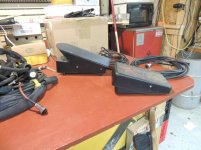
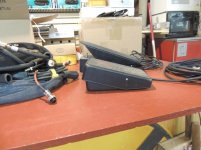
It was easy and very little electrical knowledge is required to make one. Here are some fresh pictures.

I cannibalize the original TIG torch's dinse plug and power cable and the gas fitting and hose. (you can buy the brass gas fittings that fit these machines on ebay only spot I found them) The part I made is a brass coupler with a electrical lug soldered on. brass hose barb soldered to the coupler with a small piece of brass pipe in between. Probably could of bought a threaded ****** but didn't want to make a run for just one ******. Radiator hose for the sheath part. There maybe chance someone sells something like this that will work, but three years ago when I needed it I could not find anything in my internet searches or my local WS stores.

The hose/cable carries the gas and the power.

The SSC pedal and factory pedal.
 

Attachments

  • DSCN7607.jpg
    DSCN7607.jpg
    140.8 KB · Views: 53
  • DSCN7608.jpg
    DSCN7608.jpg
    135.9 KB · Views: 43
  • DSCN7610.jpg
    DSCN7610.jpg
    136.3 KB · Views: 45
  • DSCN7612.jpg
    DSCN7612.jpg
    143.8 KB · Views: 41
  • DSCN7613.jpg
    DSCN7613.jpg
    139.8 KB · Views: 41
  • DSCN7614.jpg
    DSCN7614.jpg
    136.9 KB · Views: 43
Last edited:
OP
A

Aquaticbob

Well-known member
Joined
Dec 3, 2013
Messages
488
Location
Seattle
Thanks for the pictures! I'll be getting a flex head for sure so I'll make sure to use those pictures for some info. I'll be playing around with the regulator tomorrow morning. I'm thinking I'll be replacing it soon with a good CFH regulator.
 

youngnstudly

Well-known member
Joined
Apr 20, 2007
Messages
79
Location
The "Whine" country, CA
Read the first post again "balls up into the cup" What does post flow have to do with that? :headscrat the black soot **** around the weld is burnt aluminum on the tungsten, contamination or no shielding gas not lack of post flow. Post flow is the last thing to worry about :lol: literally

First welds to do learning how to weld aluminum should be getting a good clean bead/pass without filler then move to adding filler just on a piece of flat no joint welding. This helps the person to learn how a good puddle looks on aluminum, too hot/cold and help hand coordination. But what is the fun in that :D But the main reason I say this is to take out the filler variable in this problem to find out whats going wrong. Once things go well then add filler to the welds that is what I would do in this situation.

I personally would start high and work down with the gas to find out how low of a flow I can have. 20 is not going screw up a weld like in the pictures but too low will. With this I play it by ear literally, you should hear the gas coming out of the nozzle if you don't not enough for sure, unless you have bad hearing.

If the aluminum came from a hardware store branded "Steelworks" it is 6063 and can be welded and I'll bet Aquaticbob is using 4043 filler and that is ok for 6063 aluminum.

Try reading the updates that fall between the his post and your last post. :rolleyes: Aquaticbob has gotten numerous suggestions and adjusted his settings quite a few times since his first post. I don't need to read anything again, you need to read the other replies past the first post.

The fact the tungsten was balling up into the cup in his first post might have had a little something to do with the A/C balance being set to 75% Electrode POSITIVE, and nothing to do with post flow. The post flow was simply something I noticed in his most current pic of the face panel, and I knew it could easily be eliminated from the equation before he starts running beads later.

No where in his post does he mention using "Steelworks" material from a hardware store, or that he's using 4043 filler, so don't assume he is.

What he does mention is buying material from an "Industrial supply type store" instead of "HD or Lowes", so we have no idea what grade aluminum he bought or what grade aluminum they sold him, and neither does he.

It could be used or new "drop" from a previous sale for all we know. Not all industrial supply places sell "Steelworks" brand, especially large Industrial suppliers.

This is a place for helping and sharing. I'm contributing to help the OP out and offer simple suggestions to things he might be overlooking....Like the A/C balance being set to 75% electrode POSITIVE. I don't need some know-it-all like you treating me like some half-witted preschool retard, simply because you're high on yourself. Like you, this ain't my first time behind a welding helmet. :rolleyes2

Andy
 

R.Anderson

Well-known member
Joined
May 26, 2012
Messages
906
Location
Wisconsin
Try reading the updates that fall between the his post and your last post. :rolleyes: Aquaticbob has gotten numerous suggestions and adjusted his settings quite a few times since his first post. I don't need to read anything again, you need to read the other replies past the first post.

The fact the tungsten was balling up into the cup in his first post might have had a little something to do with the A/C balance being set to 75% Electrode POSITIVE, and nothing to do with post flow. The post flow was simply something I noticed in his most current pic of the face panel, and I knew it could easily be eliminated from the equation before he starts running beads later.

No where in his post does he mention using "Steelworks" material from a hardware store, or that he's using 4043 filler, so don't assume he is.

What he does mention is buying material from an "Industrial supply type store" instead of "HD or Lowes", so we have no idea what grade aluminum he bought or what grade aluminum they sold him, and neither does he.

It could be used or new "drop" from a previous sale for all we know. Not all industrial supply places sell "Steelworks" brand, especially large Industrial suppliers.

This is a place for helping and sharing. I'm contributing to help the OP out and offer simple suggestions to things he might be overlooking....Like the A/C balance being set to 75% electrode POSITIVE. I don't need some know-it-all like you treating me like some half-witted preschool retard, simply because you're high on yourself. Like you, this ain't my first time behind a welding helmet. :rolleyes2

Andy

Read it again buddy:

If the aluminum came from a hardware store branded "Steelworks" it is 6063 and can be welded and I'll bet Aquaticbob is using 4043 filler and that is ok for 6063 aluminum.

I was saying if and a bet is just a bet I was not assuming anything.

I have read through the postings several times and I did not see a post where adjusting ac balance corrected that problem. So if the problem was corrected and posted I stand corrected.

"I don't need some know-it-all like you treating me like some half-witted preschool retard, simply because you're high on yourself. Like you, this ain't my first time behind a welding helmet. :rolleyes2"

Cool your jets you got your pantyhose all in a bunch. No where in my post have I treated you like that and there is no need for you to be treating me that way now and I am no noob behind a hood.
 

bullnerd

Well-known member
Joined
Sep 17, 2012
Messages
5,690
Location
Jersey
"Make sure the tungsten collet is in the correct way."- good tip and very easy to do!

How about voltage to the machine? Do the light dim or flicker when you strike an arc?
 

Alta_Racer

Well-known member
Joined
Feb 1, 2013
Messages
100
Location
Red Deer AB Canada
OP
No matter how hard or long you clean alum, the oxidized layer is still there. You have to burn through it before you can melt the alum. It takes more than twice the temp to do this, once you are through it still takes a bit to get the puddle working real good.

Dont be so worried about a ball on the tungsten, it is supposed to be balled by most books, if you are using a sharp tungsten, it will be a nightmare as it will melt the tungsten into the puddle, and you have a real mess. Let it ball up, and carry on, get the arc figured, that is the key. Try adjusting settings yes, but also try the length of the arc. most times new to alum welding people have too much arc length. Work the length, work the heat, I recommend starting out balance and freq knobs at neutral, till you get heat and arc length figured.

It looks like as soon as you got in trouble you stopped. Forge ahead, the best defense is a good offense! You are not about to wreck anything but some scrap alum, and some consumables. Get the weld hot, work it around, dont care at all about pretty, just learn and get comfy, then start playing with your settings, then some filler, then maybe you can move on to sticking 2 pieces of alum together.

Hope this helps

Ron
 

Jason280

Well-known member
Joined
Mar 4, 2012
Messages
3,160
Are you sure you have good argon flow out of the torch?

As far as the aluminum goes, some grades simply won't weld worth a damn...7075 comes to mind. Make sure you have 6061 or similar, as it is a lot more responsive to welding. In fac, you are better off if you stick with marked aluminum pieces, that way you know what you are dealing with.
 
OP
A

Aquaticbob

Well-known member
Joined
Dec 3, 2013
Messages
488
Location
Seattle
1953878780d36e1eb89c033f09360661.jpg
93cfe2285b1920ecdb44efbfc875b77e.jpg


First coupon is all over 100 amps. 2nd coupon I had it at 70 amps and about 40% on the balance and got it to weld nice. I had a puddle in about 2 seconds and then I backed off a little on the pedal and got moving

Also, I had to turn my argon waaaaay up to weld. I still think I can go more
 
Last edited:

Tinner

Well-known member
Joined
Aug 31, 2013
Messages
1,101
Location
N.E. Wisconsin
You're getting somewhere now. As a beginner, it's going to be tough to get good beads on those small pieces of flat bar. You need to learn to start out hot to establish the puddle and back off the pedal as you go to keep a consistent bead width. Without a pedal, you need to accelerate your travel speed to compensate.

The small pieces heat up so fast once your puddle is going, that you never get a chance to weld at a steady heat or speed. Get some larger pieces to practice on, it will make life much simpler. At least cut your flat bar longer, even tack two together, side by side, so you have more mass to spread out the heat. Run a bead and let the piece cool between welds.

It takes a while to coordinate both hands and your foot. Be patient and get plenty of practice, it will improve.
 
OP
A

Aquaticbob

Well-known member
Joined
Dec 3, 2013
Messages
488
Location
Seattle
You're getting somewhere now. As a beginner, it's going to be tough to get good beads on those small pieces of flat bar. You need to learn to start out hot to establish the puddle and back off the pedal as you go to keep a consistent bead width. Without a pedal, you need to accelerate your travel speed to compensate.

The small pieces heat up so fast once your puddle is going, that you never get a chance to weld at a steady heat or speed. Get some larger pieces to practice on, it will make life much simpler. At least cut your flat bar longer, even tack two together, side by side, so you have more mass to spread out the heat. Run a bead and let the piece cool between welds.

It takes a while to coordinate both hands and your foot. Be patient and get plenty of practice, it will improve.

My plan was to tack the coupons all together to make one larger piece, just takes awhile. I think I need to get a square foot of 1/8" aluminum to really be able to practice :beer:
 

Tinner

Well-known member
Joined
Aug 31, 2013
Messages
1,101
Location
N.E. Wisconsin
4" X 6 or 8" coupons should be sufficient. You do want to have the experience of the aluminum heating up, just not as extreme as you have. If you can make decent welds on smaller parts, big ones will be no problem.

What type and size of rod are you using? You don't want too much angle on the torch, the front of the puddle gets too narrow and the rod wants to ball. Holding the rod closer to the torch will make it flow better. Farther away helps compensate for heat build up, or a rod that's a bit too small. Experiment with different distances.

When I was a pup, an old timer told me aluminum doesn't want to be welded, once you figure out why, it's easy. That statement contains a wealth of wisdom. I love aluminum welding and fabrication. I'd do nothing else if the opportunity was there.
 
OP
A

Aquaticbob

Well-known member
Joined
Dec 3, 2013
Messages
488
Location
Seattle
4" X 6 or 8" coupons should be sufficient. You do want to have the experience of the aluminum heating up, just not as extreme as you have. If you can make decent welds on smaller parts, big ones will be no problem.

What type and size of rod are you using? You don't want too much angle on the torch, the front of the puddle gets too narrow and the rod wants to ball. Holding the rod closer to the torch will make it flow better. Farther away helps compensate for heat build up, or a rod that's a bit too small. Experiment with different distances.

When I was a pup, an old timer told me aluminum doesn't want to be welded, once you figure out why, it's easy. That statement contains a wealth of wisdom. I love aluminum welding and fabrication. I'd do nothing else if the opportunity was there.

I have been getting the hang of it more and more. I have pretty much abandoned using those coupons until I get better at welding aluminum. I see the error in my ways of cutting them so small. This is exactly how I practiced MIG welding, obviously with steel coupons instead of aluminum. I ordered up 1 square foot of 3003 1/8" thick aluminum to do the TIG drill as suggested by Jody on welding tips and tricks. Hopefully that will be a much better platform for practicing :lol_hitti. His videos are so informative, glad he does them! I asked for a TIG finger for Christmas this year, no one got me one though because they thought it was a little weird :dunno:
 

PeteMoore

Well-known member
Joined
Jan 25, 2011
Messages
453
Location
N.Ireland
Thin aluminium can be a nightmare, in all honesty I prefer al over any steels when it comes to tig welding.

Large gas lens, #8 cup and 8lpm. 45 amps and moderate with pedal, 1/16 2% thoriated with 1/6 filler.

I cannot express enough how important it is to have everything clean, rubbed down and wiped with acetone prior to welding.

Also, practice as much as possible on thin material. The reason for this is that if you can control the puddle on 1/16 or thinner then everything is else just easy. Virtually everything I work on is 1/16 or 3/64 thickness. I used off cuts and cut them into coupons literally a couple of inches square and then went through all the various joint styles time and time again until I was happy.

Keep a notepad handy in the beginning, when you nail a weld, write down all the settings and what type of joint it was and anything worthy of note to remind you at a later stage. This just keeps your brain fresh with the relevant info, any changes you make to the settings you can then determine if they made the job any better or worse. Post-it's are good for this, because as you progress and realise the last note was okay, but the new settings are better, you simply bin the last one.
 

Attachments

  • 10620747_10202616203077463_8754329092115654075_n.jpg
    10620747_10202616203077463_8754329092115654075_n.jpg
    43.8 KB · Views: 117
  • 10888956_10203004250778413_7496598807081477985_n.jpg
    10888956_10203004250778413_7496598807081477985_n.jpg
    34.5 KB · Views: 122
  • 10891454_10203005975021518_74842009345509708_n.jpg
    10891454_10203005975021518_74842009345509708_n.jpg
    47.4 KB · Views: 123
Last edited:

PeteMoore

Well-known member
Joined
Jan 25, 2011
Messages
453
Location
N.Ireland
For steel practice, again, thin material was key to my learning experience.

Get a load of 4"x4" squares cut and do the cube challenge.

The last one I did with Mild Steel was almost completely fusion welded.
 

Attachments

  • 10350550_10202782343790877_8463227559474636361_n.jpg
    10350550_10202782343790877_8463227559474636361_n.jpg
    148 KB · Views: 116

shawnspeed

Well-known member
Joined
Sep 11, 2009
Messages
326
Also can not over emphasize the need for tack welds on thin material, steel or aluminum..it helps spread the heat transfer and help with distortion/warping, and a consistent bead...just my experience..Shawn
 
OP
A

Aquaticbob

Well-known member
Joined
Dec 3, 2013
Messages
488
Location
Seattle
Appreciate the tips guys! I was trying to tack the aluminum, but it would puddle on the edges of each coupon, and not fuse up in the middle. Not sure what the deal was, I had them clamped together pretty well. Tried decreasing arc length, increasing arc length, more amps, less amps, nothing seemed to be getting them to fuse. I didn't have that problem when I welded up my first couple coupons.

I have kind of transitioned to making a better welding table for myself as well. I currently weld on an old wood office desk, with some sort of steel grate flexible mat thing on top of it. Just got my shop opened up a couple months ago, and initially welding wasn't really going to be in the shop, but the city had a change of mind and let me have welders without a sprinkler system. So now I'm working on collecting up some steel for a big table
 
To avoid these ads, REGISTER NOW!

Jetfixr320

Well-known member
Joined
Nov 21, 2013
Messages
173
Also, What type of Aluminum are you trying to weld.

It looks like the stuff that is found at HD or Lowes.

If that is the case I will say that while I'm not sure what alloy it is that stuff welds like dog ****.

X2 The **** aluminum from the Big Box stores is scrap! I think thats your problem.
 
OP
A

Aquaticbob

Well-known member
Joined
Dec 3, 2013
Messages
488
Location
Seattle
X2 The **** aluminum from the Big Box stores is scrap! I think thats your problem.

I didn't get my aluminum from a big box store though. I'm not sure if it's the same stuff or not, since I haven't gone and looked, but the place I got it from is an industrial supply store. It very well could be the same, but I would lean towards it not. It's 6011 aluminum I believe, I had to piece some of the coupons together, but that's what was written on it.
 

buildyourown

Well-known member
Joined
Jan 8, 2010
Messages
185
Get yourself a gas lens and the biggest cup you can. This will drastically improve argon flow and let you run less gas and stick the electrode out further.
I also like to preheat anything above 1/4". And that's with a 300z welder. Otherwise it takes a bit to get going and you just sit there and get soot all over your work.
 
OP
A

Aquaticbob

Well-known member
Joined
Dec 3, 2013
Messages
488
Location
Seattle
Get yourself a gas lens and the biggest cup you can. This will drastically improve argon flow and let you run less gas and stick the electrode out further.
I also like to preheat anything above 1/4". And that's with a 300z welder. Otherwise it takes a bit to get going and you just sit there and get soot all over your work.

Now welding with a #7 cup with gas lens. Large improvement in the welds. I really needed more gas coverage from the first pictures. The #4 cup wasn't cutting it
 

shawnspeed

Well-known member
Joined
Sep 11, 2009
Messages
326
To get the tack puddles to join, i usually dab a little rod to break the surface tension, and then pull the arc to one side , normally the thicker side, and then slowly let off the pedal until the puddle solidifies without a pockmark ....pockmark/ pit/craters or whatever you want to call them are not good and are potential stress risers at the end of a weld..aluminum or steel...Shawn
 

youngnstudly

Well-known member
Joined
Apr 20, 2007
Messages
79
Location
The "Whine" country, CA
I'm glad to see things are going better for you now. If you're planning to weld aluminum (especially), you're going to want to only buy material from well known suppliers who can tell you exactly what grade of material they are selling you.

You can still weld "freebie" material that your neighbor (or whoever) gives you, but most of the time you have no way of knowing exactly what you're welding. If you don't know the base metal you're welding, filler rod selection can be tricky, and the end result can be less than expected.

I agree with thin material being difficult to weld for beginners, and if you need to preheat thicker material, I use a simple Hot plate that was purchased new for $15 off Amazon. A torch works in a pinch (or when you can't fit your material on the hot plate).

When tacking parts together (or even starting a bead on 1 pc), the second you see the puddle form (looks like chrome if everything is CLEAN w/ good gas coverage), start adding filler rod. If all hell breaks loose, you can always stop and clean/grind/wire brush things and restart.

In earlier posts I suggested adding filler and running a bead when you were having all the issues, mainly because adding clean filler can sometimes give you a cleaner basis to start your bead from. Just showing us your arc starts wasn't giving me enough info as to how many issues you had going on.

If you need to get better at adding filler or pinpointing your bead, don't be afraid to go back to practicing on steel. You should have better results there too with that weenie #4 cup out of the picture.:D

Andy
 
OP
A

Aquaticbob

Well-known member
Joined
Dec 3, 2013
Messages
488
Location
Seattle
You should have better results there too with that weenie #4 cup out of the picture.:D

Andy

The weenie #4 cup was causing some problems for sure. The #7 cup with gas lens has made things run a lot smoother. Once again, really appreciate the pointers! I've got some steel to weld up in T's and laps, and all once I get the chance to use my welders. I run a self service auto shop, so I have to supervise customers a lot, and weekends are my busiest days. That leads to a lot less hood time
 

youngnstudly

Well-known member
Joined
Apr 20, 2007
Messages
79
Location
The "Whine" country, CA
I only use the #4 cup for welding small projects or tacking up future projects after the tank pressure drops too low to provide a steady flow of Argon for critical projects. I HATE running out of Argon in the middle of a nice bead!

I don't know what your plans are for welding projects or how much quantity of metal you will need, but I just started buying 90% of my metal for projects from Amazon through their "Prime" membership during the last 2 years, and I really like it. You get FREE 2 day shipping for anything eligible, which is usually limited to 8' lengths of metal, but you could order 10 of them if you wanted to and the shipping is still FREE 2-day or less.

It works good for a hobbyist like me, especially since I no longer get to order 20' material from my previous employer and "piggyback" off the shop's existing order to avoid shipping expenses.

You can get nearly any material you need (tool steel, chromoly, aluminum, hot rolled, cold rolled, stainless, etc) in round tubing, square tubing, rectangular tubing, solid round/square stock, flat stock, angle, hex, etc from Amazon. My biggest gripe is the fact you really have to enter the correct terms into their search box to get the full list of suppliers.

Don't get me wrong, I like to support local business when I can. However, when they charge me incredibly high prices for material to begin with (only comes in 12-20' lengths), then charge me $10/torch cut and $14/saw cut (using a cheapy HF metal chop saw), AND I have to drive all the way over there and back in a truck that gets 8-10 MPG (40 mile trip), it makes me like the internet that much more.

Plus I don't even have to open the gates or leave the property and go out into the big, bad, chaotic world.:willy_nil I just sit by the door and wait for the big brown truck to drop off my metal. Inside good...outside BADDD!;)

Andy
 
OP
A

Aquaticbob

Well-known member
Joined
Dec 3, 2013
Messages
488
Location
Seattle
I only use the #4 cup for welding small projects or tacking up future projects after the tank pressure drops too low to provide a steady flow of Argon for critical projects. I HATE running out of Argon in the middle of a nice bead!

I don't know what your plans are for welding projects or how much quantity of metal you will need, but I just started buying 90% of my metal for projects from Amazon through their "Prime" membership during the last 2 years, and I really like it. You get FREE 2 day shipping for anything eligible, which is usually limited to 8' lengths of metal, but you could order 10 of them if you wanted to and the shipping is still FREE 2-day or less.

It works good for a hobbyist like me, especially since I no longer get to order 20' material from my previous employer and "piggyback" off the shop's existing order to avoid shipping expenses.

You can get nearly any material you need (tool steel, chromoly, aluminum, hot rolled, cold rolled, stainless, etc) in round tubing, square tubing, rectangular tubing, solid round/square stock, flat stock, angle, hex, etc from Amazon. My biggest gripe is the fact you really have to enter the correct terms into their search box to get the full list of suppliers.

Don't get me wrong, I like to support local business when I can. However, when they charge me incredibly high prices for material to begin with (only comes in 12-20' lengths), then charge me $10/torch cut and $14/saw cut (using a cheapy HF metal chop saw), AND I have to drive all the way over there and back in a truck that gets 8-10 MPG (40 mile trip), it makes me like the internet that much more.

Plus I don't even have to open the gates or leave the property and go out into the big, bad, chaotic world.:willy_nil I just sit by the door and wait for the big brown truck to drop off my metal. Inside good...outside BADDD!;)

Andy

Now this is something I did not know. I really like the sound of that! I'm going to be going on a shopping spree now :rocker:

I can set up a commercial account anywhere with my shop, but I haven't yet with the metal suppliers and I don't think they do deliveries for very cheap either. I just started getting my welding accounts set up

This week I am gonna build a portable table to move about the shop. As scary as it sounds, I'm about to add welding as a service I offer. :willy_nil

Edit: Any suggestions on how to find the metal that I'm looking for? Currently looking for some 2" square tubing, but the prices are like double my local places
 
Last edited:

youngnstudly

Well-known member
Joined
Apr 20, 2007
Messages
79
Location
The "Whine" country, CA
I find that the prices aren't always better per foot than local places, but in the scheme of things I can usually get a better deal using Amazon after all other costs are factored in (like the cost per cut if I only need 8 feet from a 20 foot stick, gas to drive over, etc).

Even just for home use the Amazon prime works for a lot of stuff that Ebay and other online places would charge high shipping prices for.

As for your square tubing, here is what I found it listed under: steel hollow rectangular bar. This is just one supplier off Amazon, you may find another place selling it cheaper:
http://www.amazon.com/dp/B0068UDRZ6/?tag=atomicindus08-20

WATCH THE PRICING CAREFULLY...Sometimes you can buy 84" of material cheaper than 24" of the same stuff, and the shipping is still free either way you go! Just make sure the part has the word "prime" by the price.

Andy
 
OP
A

Aquaticbob

Well-known member
Joined
Dec 3, 2013
Messages
488
Location
Seattle
I find that the prices aren't always better per foot than local places, but in the scheme of things I can usually get a better deal using Amazon after all other costs are factored in (like the cost per cut if I only need 8 feet from a 20 foot stick, gas to drive over, etc).

Even just for home use the Amazon prime works for a lot of stuff that Ebay and other online places would charge high shipping prices for.

As for your square tubing, here is what I found it listed under: steel hollow rectangular bar. This is just one supplier off Amazon, you may find another place selling it cheaper:
http://www.amazon.com/dp/B0068UDRZ6/?tag=atomicindus08-20

WATCH THE PRICING CAREFULLY...Sometimes you can buy 84" of material cheaper than 24" of the same stuff, and the shipping is still free either way you go! Just make sure the part has the word "prime" by the price.

Andy

Thanks for checking! I've been a prime user for quite a few years now. I will buy it from amazon on prime if it's available usually. If I can get it locally with little trouble though for a bit cheaper I usually spring for that. I'm about 15 minutes away from onlinemetals.com's seattle distribution site so that helps out quite a bit. Problem is I have 0 time to go there and pick stuff up
 

raceman17

Well-known member
Joined
Jul 3, 2012
Messages
118
Another option is do a search on the net for a local fabrication company. Give them a call one day and ask if you can come by and look in their scrap bin for some small pieces of aluminum. Tell them your wanting to get some to practice welding on. It has always worked for me and they just want a couple bucks to cover what they normally get for scrap.
 
OP
A

Aquaticbob

Well-known member
Joined
Dec 3, 2013
Messages
488
Location
Seattle
Another option is do a search on the net for a local fabrication company. Give them a call one day and ask if you can come by and look in their scrap bin for some small pieces of aluminum. Tell them your wanting to get some to practice welding on. It has always worked for me and they just want a couple bucks to cover what they normally get for scrap.


My shop is right next to a body shop. I snag whole body panels from them frequently. Just got a big hood out of the scrap pile a couple days ago. I usually go over there with a magnet and look for aluminum stuff
 
OP
A

Aquaticbob

Well-known member
Joined
Dec 3, 2013
Messages
488
Location
Seattle
ImageUploadedByTapatalk1421028152.852489.jpg

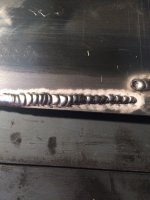
Finally had sometime to get a little practice in. Got a 1sq ft of 1/8" 3003. It's working, a lot better than the small coupons. It's still sort of popping really quickly, not sure what the reason for that is. I'm going to try and record it when I've got someone with me
 

ishiboo

Well-known member
Joined
Oct 27, 2010
Messages
9,481
Location
Oshkosh, WI
ImageUploadedByTapatalk1421028152.852489.jpg

Finally had sometime to get a little practice in. Got a 1sq ft of 1/8" 3003. It's working, a lot better than the small coupons. It's still sort of popping really quickly, not sure what the reason for that is. I'm going to try and record it when I've got someone with me

One suggestion... start out fusing two pieces together without filler. Then as you get your technique down, start adding filler metal.

Looks a heck of a lot better than when you started :thumbup:
 
OP
A

Aquaticbob

Well-known member
Joined
Dec 3, 2013
Messages
488
Location
Seattle
One suggestion... start out fusing two pieces together without filler. Then as you get your technique down, start adding filler metal.


Looks a heck of a lot better than when you started :thumbup:


Yeah, I'm gonna have to get some more pieces to fuse together. I got this piece to do to the "tig drill" that Jody suggests over at welding tips and tricks. I think I just need to learn to dial the settings in a bit more. I'm working on a welding table as well currently in my spare time. 5'x3'x3.5' tall
ImageUploadedByTapatalk1421035543.059702.jpg

Between my business, this table, and the group buy I'm working on I don't have much time to practice the TIG on aluminum
 

Tinner

Well-known member
Joined
Aug 31, 2013
Messages
1,101
Location
N.E. Wisconsin
You're making progress, be patient. Aluminum is different than steel. It takes time to overcome the habits of welding other metals.
 

buildyourown

Well-known member
Joined
Jan 8, 2010
Messages
185
ImageUploadedByTapatalk1421028152.852489.jpg

Finally had sometime to get a little practice in. Got a 1sq ft of 1/8" 3003. It's working, a lot better than the small coupons. It's still sort of popping really quickly, not sure what the reason for that is. I'm going to try and record it when I've got someone with me

Wait a bit longer before you start moving. You are a little bit cold just sitting on top. Is your welder turned all the way up? Popping could be a few things but make sure your ground is good and your electrode and collet are tight.
 
OP
A

Aquaticbob

Well-known member
Joined
Dec 3, 2013
Messages
488
Location
Seattle
You're making progress, be patient. Aluminum is different than steel. It takes time to overcome the habits of welding other metals.

Very much so. I just need more practice to get the hang of it. Holding the arc close has been the real trick. Sometimes I notice I dip in just the slightest bit and have to stop and re-grind

Wait a bit longer before you start moving. You are a little bit cold just sitting on top. Is your welder turned all the way up? Popping could be a few things but make sure your ground is good and your electrode and collet are tight.


Thanks for the tips, I'll get that puddle a bit bigger before getting going. Pretty sure my collet is good. I should work on my ground for sure though
 

Gerald O

Well-known member
Joined
Mar 5, 2013
Messages
1,884
Location
NC
Lots of problems in all these photos, but in general the amps are too low for the cold aluminum. I'd have set peak amps to about 130 amps on those 1/8" pieces. Black sooty contamination in earlier photos looks like poor/no gas coverage. 1st weld photo shows insufficient cleaning setting. Any chance those first coupons were anodized aluminum? Are you running that machine on 120 or 240? You'll probably need 240 for any decent results on aluminum.

I'm no expert, in fact I'm a total noob at TIG and welding aluminum. But I was making decent aluminum welds within the first couple inches of my first try at both. I don't get why everyone thinks this is so difficult. I did have a fair amount of experience with an OA torch on steels before that though. To me, TIG technique seems almost just like welding with a gas torch. The right settings, preparation, and material are key. A foot pedal is mandatory, I think, for a beginner.

The last photo is best but still a ****** weld (no offense). Way too cold at the start. No penetration and little fusion with the base. Rod technique looks promising though once you get the heat figured out. Cleaning setting looks a bit too much but not that far off.
It didn't start working till near the end once the metal got warmed up. Aluminum ***** a lot of heat when it's cold. Gotta pump up the amps and get it hot much quicker, then ease off on the pedal / move faster as it progresses. No point continuing with the bead if you don't get a good puddle going at the start.

One other point--vision. You've really got to have a good sharp view of the puddle area. Maintaining the correct puddle in aluminum requires constant adjustment and if you can't see it clearly you can't adjust. You need a helmet with adjustable shade to get the best contrast. Since I'm an old fart with poor vision, I had to put a cheater lens in my helmet to get a sharp view. And I've got to get my face right down in there close to the work.
 
Last edited:
To avoid these ads, REGISTER NOW!
Top Bottom