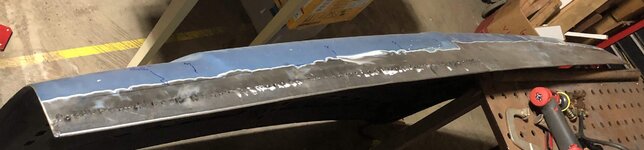
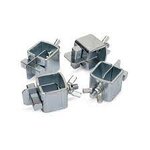
It's best if you can get behind the outer panel to back up with a dolly to allow planishing of the weld but that isn't always possible.
For those that are not accessible, if you are using MIG, I suggest doing a test panel or two or ten to get the welder's settings just right. I have found that a hotter faster weld that will provide 100% penetration will be a much stronger and better weld to grind and finish in the long run. Many times people think that because it is thin sheet metal then need to turn the welder down but that comes at a cost of improper penetration that can come back to bite you in the *** in the long run, especially when you try to knock the top of the weld down.
As for the process, I keep as tight a seam as possible and then hit the seam evenly so that the current that is being provided at the wire is split between the two panels. If you hit only one side, the current required to melt the wire will all be on that panel so it is best to split it. Once the spot weld is done, move an inch or so and repeat. I then come back and knock the top of the weld tack down with a 1/16" thick grinding/cutoff wheel to where it just barely stands proud of the parent material. Then tack again with a full penetration weld at the edge of the previous one advancing forward by half a tack diameter. Knock down with cutoff disc to just above proud and keep repeating until it is a solid weld then go back with a Roloc disc and blend. Be careful not to contact the parent material any more than necessary as this just thins the parent material as you are removing metal.
If you are using TIG, then I use a similar process but it may require a bit more bumping around with a hammer to keep the panels in alignment but the knocking down of the weld and then metal finishing will be the same.
Hope that all makes sense.
I show some examples of this on my son's WJ repair in my Projects 2.0 thread starting on page 175-176 where I had to remove some rusted metal from a couple of areas and weld in new metal before finishing and painting.
**I apologize, on edit, I looked in the body of the message whether you were referring to TIG or MIG but didn't see anything specific. I later noticed in the title that you were referring to TIG.
If I have access to the backside of the panel I really prefer to TIG weld the panels as the planishing makes a really nice quality finished product with very little grinding and metal removal. Plus it is easier to compensate for panel movement where it shrinks you can planish and stretch it back into shape.