To avoid these ads, REGISTER NOW!

TIG Welding Tungsten Selection

duwem

Well-known member
Joined
Aug 28, 2013
Messages
451
Location
Eastern WI
Back in the day when I learned to weld it was red for steel and stainless and green for aluminum.

I have recently been reading that invertor machines changed this.

Now I'm lost.

I weld steel, stainless steel and aluminum on my Miller Dynasty 200DX.

Seems like some of the new brews of tungsten are multi use, I'm fine buying the best for each material as its not that expensive to have a selection of each on hand. Of course last year I went and bought red and green in multiple sizes.

Thanks.
 
To avoid these ads, REGISTER NOW!

rlitman

Well-known member
Joined
Oct 18, 2010
Messages
24,591
Location
Long Island
Green (pure tungsten) isn't the right choice for anything (inverter, or not).

I use zirconated for aluminum, but lanthanated is a good all around choice too. Ceriated is supposed to be better for very low current use.
 

zmotorsports

ALLIANCE MEMBER
Joined
Oct 20, 2009
Messages
21,348
Location
Northern Utah
In my home shop on my Miller Dynasty 300DX I have used 2% Ceriated with good results for the first 8 or so years of having the Dynasty but then about 6 years ago switched over to 2% Lanthanated and in my opinion on an inverter machine that seems to be the cat's meow. The 2% Lanthanated will hold a tip a little better than the 2% Ceriated on pretty much the amperage ranges I deal with which are up to around 160-170 amps. I really don't do much above that so I cannot comment.
 

dr_clyde

Well-known member
Joined
Jan 7, 2009
Messages
6,433
Location
Holland, MI
I run 2% ceriated on everything with my inverter machines, I have a Dynasty 200DX and a Maxstar 161 STH for inverter tigs.

Miller tunes their inverter machines to run on 2% ceriated, and is what is shipped with their machines, at least according to my salesman, who is buddies with the local Miller rep.

You will really only notice a difference on arc starts and AC stability. The high frequency on a Dynasty is develped differently than on a Syncrowave or a Dialarc so the tungsten behaves differently on arc starts.

On AC, you'll really notice a difference on amperage capacity and the ability to keep shape. Thoriated will split and develop nodules on high amp AC, but will still work.

On transformer machines, Zirconated is the cats *** for AC, but doesn't arc start for **** on an inverter machine. I run it on my Syncrowave 350, and it runs beautifully on AC, but you put that in a Dynasty, and it runs like ****.

You can still use the thoriated, it will still work, but its not as optimal. I'd just use it up and replace as needed. Alternatively, you can sell it on ebay, lots of folks out there prefer it for DC on the older machines.

For the pure, I'd see if you can sell it on ebay to someone who doesn't know better or just use it around the shop for scribe points or something. Pretty worthless for welding.

I don't have a lot of experience with Lanthanated. I can't seem to tell a difference between it and Ceriated for what I do, so I just buy Ceriated. Never have any issues. I'm sure it works fine, and if that's what you can get, go for it.
 

Mike.ASC

Well-known member
Joined
Apr 21, 2010
Messages
880
Location
East coast
98% of my tig welding is on Aluminum and all I've ever used is 2% lanthanated with my HTP Invertig 221. I also use the same when I weld mild steel. It works fine for me so I've never been inclined to try anything else.
 

MoonRise

Well-known member
Joined
Nov 5, 2010
Messages
4,028
Location
NJ
Last edited:
OP
D

duwem

Well-known member
Joined
Aug 28, 2013
Messages
451
Location
Eastern WI
Lots of good info, still processing it all. Seems like another topic of discussion is do you want a point or a ball for a/c aluminum inverter welding. Some tungsten materials say will ball and some don’t.

What is “code quality” mean, really good like this is the best option for aluminum?
 
Last edited:

dr_clyde

Well-known member
Joined
Jan 7, 2009
Messages
6,433
Location
Holland, MI
Lots of good info, still processing it all. Seems like another topic of discussion is do you want a point or a ball for a/c aluminum inverter welding. Some tungsten materials say will ball and some don’t.

What is “code quality” mean, really good like this is the best option for aluminum?

Some welding procedures call for specific tungsten for welds to meet code. It all depends on the WPS and the code that the welds fall under.

I always start with a sharp point. The tungsten will take whatever shape it will depending on settings anyway.
 
OP
D

duwem

Well-known member
Joined
Aug 28, 2013
Messages
451
Location
Eastern WI
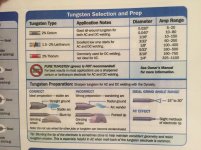
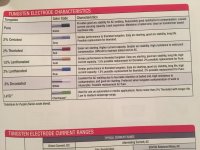
Some others I came across. First one is part of a 2 pager I came across recently basically a summary of all things Miller Dynasty, wish I had it 8 years ago!
Google “Dynasty Quick Reference”. 248988D

So far it’s looking like Lathanum (Blue) might be a good option for me? But wouldn’t want to use the same piece for aluminum as for steel/stainless to prevent contamination?
 

Attachments

  • 9A87660C-8E47-4BBB-8F0C-D67999730383.jpg
    9A87660C-8E47-4BBB-8F0C-D67999730383.jpg
    153.6 KB · Views: 100
  • 658A3D65-88D0-4B2E-A181-5E20CFFFC3D2.jpg
    658A3D65-88D0-4B2E-A181-5E20CFFFC3D2.jpg
    152.6 KB · Views: 88
Last edited:

dr_clyde

Well-known member
Joined
Jan 7, 2009
Messages
6,433
Location
Holland, MI
Some others I came across. First one is part of a 2 pager I came across recently basically a summary of all things Miller Dynasty, wish I had it 8 years ago!
Google “Dynasty Quick Reference”. 248988D

So far it’s looking like Lathanum (Blue) might be a good option for me? But wouldn’t want to use the same piece for aluminum as for steel/stainless to prevent contamination?

Just sharpen it in between metals and you're good to go. If it's clean, no worries about any contamination.
 

MP&C

Well-known member
Joined
Oct 21, 2009
Messages
4,401
Location
Leonardtown, MD
I've been using the purple band Rare Earth tungsten. Seems to tolerate heat better in the upper limits of the amperage range per diameter, and use it on steel, stainless, or aluminum.
 

DocsMachine

Well-known member
Joined
Sep 16, 2006
Messages
1,851
I've been using the purple band Rare Earth tungsten.

-This. It was suggested to me as a "do it all" type of tungsten, with better features, in some cases, than even Thoriated. Been using it on both mild steel and aluminum for a couple of years now (very light DIY shop stuff) and I'm very happy with it.

PDF doc on the purple.

Doc.
 
OP
D

duwem

Well-known member
Joined
Aug 28, 2013
Messages
451
Location
Eastern WI
Last edited:

dr_clyde

Well-known member
Joined
Jan 7, 2009
Messages
6,433
Location
Holland, MI
I would strongly encourage you to not buy house brands from Airgas. They are NOT a good value.

I get CK tungsten, and it is very reasonable.
 

stioc

Well-known member
Joined
May 2, 2005
Messages
1,317
Location
SoCal
I'm a newbie to TIG and I've been happy with these in both 1/16" and 3/32" then again I don't know any better.

https://www.amazon.com/gp/product/B013KZ2BIA/?tag=atomicindus08-20

I did get one red band (the stuff that'll kill you lol) with my old cheap ebay gas torch and a gray band one that came with the CK torch. I can't really tell any different but I like the above blue band ones.

Speaking of tungsten selection, what size do you guys mostly run? I find the arc is tight, more controlled and doesn't overheat the surrounding area when I use the 1/16" tungsten but the welds look more like MIG (not the stacked dimes look). I thought I was doing something wrong, then I switched to 3/32" and I started getting more TIG looking welds. Curious what size others are running for both the tungsten and filler rod. I'm mostly practicing on 1/8" steel.

47970119461_4770316a31_o.jpg
 

dr_clyde

Well-known member
Joined
Jan 7, 2009
Messages
6,433
Location
Holland, MI
3/32" will be fine for most applications on DC. I find 1/8" to be more durable when doing scratch start mobile work, as well as most aluminum welding. I use 1/16" occasionally, but only when dealing with little stuff.

I do have some .040" tungsten, but I don't like using it. Too small to handle effectively, only really useful on REALLY tiny stuff.
 

dr_clyde

Well-known member
Joined
Jan 7, 2009
Messages
6,433
Location
Holland, MI
Stioc, you will have much cleaner welds if you grind off that mill scale. That stuff is a pain in the **** to weld over.
 
To avoid these ads, REGISTER NOW!

stioc

Well-known member
Joined
May 2, 2005
Messages
1,317
Location
SoCal
3/32" will be fine for most applications on DC. I find 1/8" to be more durable when doing scratch start mobile work, as well as most aluminum welding. I use 1/16" occasionally, but only when dealing with little stuff.

I do have some .040" tungsten, but I don't like using it. Too small to handle effectively, only really useful on REALLY tiny stuff.

Stioc, you will have much cleaner welds if you grind off that mill scale. That stuff is a pain in the **** to weld over.

Thanks for the feedback on the size.
Yeah that mill scale is a pain in the **** to remove that's why I leave it on :lol_hitti Aluminum oxidation layer is even worse when trying to TIG over :wtf:
 

MoonRise

Well-known member
Joined
Nov 5, 2010
Messages
4,028
Location
NJ
pssst, Stioc, you weld metal.

Not metal oxides. Like the mill scale on steel, or the aluminum oxide layer on unprepped aluminum.

Some welding processes 'tolerate' a certain amount of non-metal. But guess what? GTAW tolerates the LEAST amount of non-metal.

Get your workpiece(s) down to bright shiny CLEAN metal, and then weld them.

btw, aluminum oxide melts at 3762F and aluminum alloys melt around 1250F (depending on which specific alloy, 6061 melts at 1085F and 5052 melts at 1125F).
 

stioc

Well-known member
Joined
May 2, 2005
Messages
1,317
Location
SoCal
pssst, Stioc, you weld metal.

Not metal oxides. Like the mill scale on steel, or the aluminum oxide layer on unprepped aluminum.

Some welding processes 'tolerate' a certain amount of non-metal. But guess what? GTAW tolerates the LEAST amount of non-metal.

Get your workpiece(s) down to bright shiny CLEAN metal, and then weld them.

btw, aluminum oxide melts at 3762F and aluminum alloys melt around 1250F (depending on which specific alloy, 6061 melts at 1085F and 5052 melts at 1125F).

Haha I agree, I was mostly joking. For actual welding I do grind it off but this was just some practice runs so I wiped the piece down with acetone and got going.
 

u3b3rg33k

Well-known member
Joined
Dec 18, 2017
Messages
4,047
Lanthanated ( 2% dark blue US color code or 1.5% gold US color code ) for general purpose usage or 2% ceriated ( orange US color code or grey Europe/Japan color code) for low amp usage.

Optional 1% zirconiated (brown US color code) for AC 'Code-quality' work.

Pure (green) - skip as an electrode

Thoriated (red) - skip as an electrode, works pretty well but radioactive vapors and dust.

https://www.arc-zone.com/pdf/SelectingTungsten.pdf

https://www.arc-zone.com/pdf/Tungsten_Electrodes.pdf
Thorium is barely radioactive and has a half-life of 14.05 billion years - longer than the universe is old. I asked an RSO about grinding it safely and he said to wear eye protection. Also mentioned that thorium is so common you're already exposed simply by living on earth.

the biggest risk of thorium is the dust catching fire. grinding it outdoors was recommended.
 

rlitman

Well-known member
Joined
Oct 18, 2010
Messages
24,591
Location
Long Island
Thorium is barely radioactive and has a half-life of 14.05 billion years - longer than the universe is old. I asked an RSO about grinding it safely and he said to wear eye protection. Also mentioned that thorium is so common you're already exposed simply by living on earth.

the biggest risk of thorium is the dust catching fire. grinding it outdoors was recommended.

The problem with thorium is that it is an alpha emitter. Slow alpha particles don't make it through your skin (let alone your clothing), so there's no risk to holding or even standing in the middle of a truckload of it.

However, if you inhale thorium dust, the alpha particles can wreak havoc on your lung tissue.

The topic has been discussed ad-nauseum, and the consensus is that the risk is minimal, but if it makes you feel better, wearing a respirator while grinding your thorium electrodes would eliminate the risk completely.

However, the price of lanthanated tungsten is so reasonable, and the performance is so good, that I don't see the reason to resort to thoriated.
 

stioc

Well-known member
Joined
May 2, 2005
Messages
1,317
Location
SoCal
Stios, do you like the welder?

Capt. Chrysler

In a word, yes I love the welder. For the price there's no other welder that I know of with all the features this has and it even comes with a real CK flex head torch. My take on it is that at its core it's the same Chinese welder as the ever popular Alpha (and may be even the Everlast) with a few more features than the Alpha. Cons, the always-on fan is loud and annoying on all these welders and the pedal isn't great but usable (you can buy a better pedal).

Thanks to @PoorOwner who pointed out to me that it also has/had no tax and free shipping on Amazon so it was actually cheaper for me than the Alpha. Definitely not going to be like a Miller but it far exceeds my skill level. As an aside I hear the HTP TIG is awesome but it was (like almost 3 times) more than my budget.

// end-thread-hijack // :)
 
OP
D

duwem

Well-known member
Joined
Aug 28, 2013
Messages
451
Location
Eastern WI
Bought some welding supplies and ended up with some Miller rare earth (aqua) 3/32 and 1/8” Use these on steel, stainless and aluminum? Any reason 2% lathanated (blue) would be better or worse!
 

Superbec

Well-known member
Joined
Sep 7, 2015
Messages
931
Location
Netherlands
Thorium is barely radioactive and has a half-life of 14.05 billion years - longer than the universe is old. I asked an RSO about grinding it safely and he said to wear eye protection. Also mentioned that thorium is so common you're already exposed simply by living on earth.

the biggest risk of thorium is the dust catching fire. grinding it outdoors was recommended.


it could be mother's milk , ceriated lanthanated and the newish "rare earth" are way better , there is not a single reason to use red , on any machine .

I prefer gold lanthanated , does everything, I used ceriated before but for high amps AC lanthanated is better, can handle about 20% amps at the same OD.
 

rlitman

Well-known member
Joined
Oct 18, 2010
Messages
24,591
Location
Long Island
Thorium is barely radioactive and has a half-life of 14.05 billion years...

I just want to correct this, as this statement is disingenuous at best.

Only the longest lived isotope of thorium has a half-life of 14.05 billion years, but assuming that is simple the half-life of thorium as a whole is a serious mischaracterization of thorium.

Read this: https://en.wikipedia.org/wiki/Thorium#Isotopes
Thirty radioisotopes have been characterised, which range in mass number from 209[23] to 238.[21] After 232Th, the most stable of them (with respective half-lives) are 230Th (75,380 years), 229Th (7,340 years), 228Th (1.92 years), 234Th (24.10 days), and 227Th (18.68 days). All of these isotopes occur in nature as trace radioisotopes due to their presence in the decay chains of 232Th, 235U, 238U...All of the remaining thorium isotopes have half-lives that are less than thirty days and the majority of these have half-lives that are less than ten minutes.

While "trace" amounts may not seem like much, it is these isotopes that are the cause of the easily detectable radiation from naturally occurring thorium. Now to be fair, only a small amount of thorium is even used in tungsten, but even so, due to the very dangerous nature of alpha emitters within the body, the risk of cancer due to inhaling dust containing thorium is quite real.

Keep in mind too that uranium-238 has a half-life of almost 4.5 billion years, and as an alpha emitter, it too is dangerous if inhaled. Nobody would suggest that dry grinding uranium glass without a respirator is a good idea. And here's something to think about:
For natural uranium, about 49% of its alpha rays are emitted by each of 238U atom, and also 49% by 234U (since the latter is formed from the former) and about 2.0% of them by the 235U. In other words, depleted uranium is not significantly less of an alpha emitter than natural uranium.
 
Last edited:

u3b3rg33k

Well-known member
Joined
Dec 18, 2017
Messages
4,047
I just want to correct this, as this statement is disingenuous at best.

Only the longest lived isotope of thorium has a half-life of 14.05 billion years, but assuming that is simple the half-life of thorium as a whole is a serious mischaracterization of thorium..
per your wiki link, 99.98% of Th has a 14.05 billion year half life, and 0.02% of Th has a 75,400 year half life. that means the trace amount is really trace.

uranium glass is up to 25% uranium by weight. Th doped Tungsten is only 2%.

I wasn't suggesting that you should go burn some rare Th isotopes as incense in your meditation room, only that there is no cause for extra FUD. we are not talking about radium paint brushes here.

Doesn't everyone wear a dust mask while welding/grinding?
 
Last edited:

Bigblue&Goldie

Well-known member
Joined
Mar 12, 2009
Messages
10,672
Location
AZ
Miller tunes their inverter machines to run on 2% ceriated, and is what is shipped with their machines, at least according to my salesman, who is buddies with the local Miller rep.

This is interesting. I have a Thermal Arc inverter (made by Sanrex) and it came with Lanthenated, so that's what I've always run. I wonder if they tune for a specific electrode like Miller? I've never tried anything else on my machine as there are other variables that likely have a bigger impact on my welding (namely me :spit:) at this point.
 

Onefastgsx

Well-known member
Joined
Nov 5, 2011
Messages
185
Location
Indiana
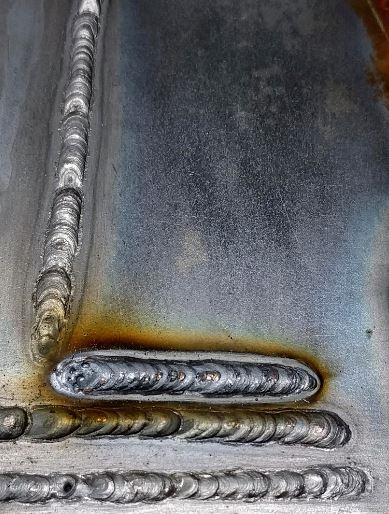
Could anyone suggest a good tungsten type for welding filling a hole) in a cast aluminum cylinder head? I have a projecting coming up where I will be filling a hole from a very butchered attempt to drill out a broken stud. I weld aluminum plate and stock regularly, but didnt know if there is a certain type that may work best on (dirty) cast aluminum.
It's an inverter based welder, I know that makes a difference
 

Attachments

  • 20190709_220038.jpg
    20190709_220038.jpg
    76 KB · Views: 36

thejimmy

Well-known member
Joined
Dec 5, 2016
Messages
165
Location
Clearwater FL.
I weld aluminum plate and stock regularly, but didnt know if there is a certain type that may work best on (dirty) cast aluminum.
It's an inverter based welder, I know that makes a difference

You're good to go...I presume you're either using ceriated, lanthanated or maybe some mix.
 
To avoid these ads, REGISTER NOW!
Top Bottom