To avoid these ads, REGISTER NOW!

Timber frame gable eve alignment

Wiebster

Well-known member
Joined
Jul 18, 2015
Messages
194
Location
Rapid City, Sd
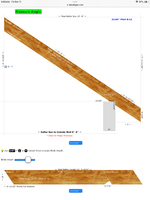
Hi guys, I’d be lost building this shop if it wasn’t for everyone‘s help on this forum. Today’s question is: how do I figure the post height on my timber frame entrance so my eves line up not only for aesthetics but so my gutter is continuous?
Some givens: both roofs are 8:12 pitch,
the gable entrance posts and all rafters are rough cut full dimension timbers,
the vertical posts and horizontal beams are 8x8 and will be 18’ apart to the outside
the rafters are 4x8
Some of my issues are: using 2x6 fascia on the main building and 4x8 timber on the timber frame, having this ridiculous high 24” energy heel on my main building trusses, timbers being to heavy to lift up to mock all this in place, timbers too expensive to screw up and start over. These pictures are all I have to help understand what I’m doing. Thanks guys!
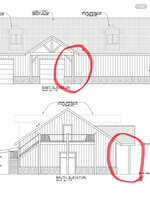
 

Attachments

  • IMG_0063.jpeg
    IMG_0063.jpeg
    1.1 MB · Views: 99
  • IMG_0061.png
    IMG_0061.png
    12.9 MB · Views: 98
  • IMG_0060.png
    IMG_0060.png
    1.2 MB · Views: 98
To avoid these ads, REGISTER NOW!

andyvh1959

Well-known member
Joined
Feb 15, 2020
Messages
2,598
Location
Green Bay WI
Isn't it just a matter of finding the height of the original top plate from the sill height? Then get the posts set high enough that you can trim the height to match the top plate height of the original framing? If the overhangs are the same and the pitch is the same for both roof sections the tails of the trusses can be trimmed to the aligned height of the original roof.
 

Natty Bumppo

Well-known member
Joined
Dec 8, 2019
Messages
368
Location
Savoy, MA
Can you just mock it up with 2x3's as stand in's for your posts? Without being on site I'm not sure if I am able to answer your question from the #'s you've given...but when I am raising a timber frame and I have a complicated issue I don't want to mess up I just do a mock up with cheap 2x4's or 2x3's and transfer all of the info to my timbers.
 
OP
W

Wiebster

Well-known member
Joined
Jul 18, 2015
Messages
194
Location
Rapid City, Sd
Isn't it just a matter of finding the height of the original top plate from the sill height? Then get the posts set high enough that you can trim the height to match the top plate height of the original framing? If the overhangs are the same and the pitch is the same for both roof sections the tails of the trusses can be trimmed to the aligned height of the original roof.
I just honestly don’t know. But I’m pretty sure it’s more complicated than that. If I were using the exact same dimensional lumber on both, I’d say yes, your idea should work. But my trusses have a 24” heel on them as you can see from the pictures. The top 2x4 chord comes down and I’m using a 2x6 as the sub fascia on the angled end of the 2x4 (this is all on the main roof). The timber frame will be using 4x8 rafters that sit on top of a horizontal beam perpendicular to to building. Things like the depth of the birds mouth, height of that horizontal beam, etc all affect the ultimate eve height of the second roof. I guess if I’m flexible with the length of the timber frame overhang, I could just let the rafter tails run long and cut the same height as my previously mentioned 2x6 subfascia. But if I’m way off I could end up with a 36” or a 12” overhang on my timber frame, which would look weird.
I’d like to mathematically get really close and then just cut tails to length to match. Even doing that might have some undesirable, not considered problems. Still open to trying about anything.
 
OP
W

Wiebster

Well-known member
Joined
Jul 18, 2015
Messages
194
Location
Rapid City, Sd
Can you just mock it up with 2x3's as stand in's for your posts? Without being on site I'm not sure if I am able to answer your question from the #'s you've given...but when I am raising a timber frame and I have a complicated issue I don't want to mess up I just do a mock up with cheap 2x4's or 2x3's and transfer all of the info to my timbers.
I just don’t see that working for me that well because of the lengths involved. Ripping down 2x10s to exactly 8” might be an (expensive) option. That way I would know exactly where to set the horizontal beam with a mock up of the 8” wide rafter, taking in the consideration of the birds mouth depth of cut and 24” overhang, and who knows what else. I’m custom welding the post based out of 1/4” thick plate. So I think I could stand up the main posts in those brackets leaving them long (lightly braced and plumb) then use the 2x material to mock up the rest. Plus end up with a nice pattern to trace the real rafters with. But I would still rather just do it mathematically with the pictures and dimensions I posted and see if I can get pretty close. If anyone has some strong trigonometry skills I think I could get really close without being 12’ up in the air.
 

firebirdparts

Well-known member
Joined
Jun 8, 2016
Messages
10,626
Location
Kingsport, TN
Establish a point of reference, like the floor, and measure up to something useful, like the bottom of the facia board. That's especially useful in this case Then just look at your third picture and draw your facia board on that third picture (correctly). Then on your picture you can see how much the end of your post is above the bottom of your facia board.

Your post is of course not being installed on the floor, so you have to recognize that some point on that post is level with the floor and that you are going to put that in the right place.

That's going to be a nice looking building.
 

Rusted Nut

Well-known member
Joined
Dec 11, 2022
Messages
1,810
Location
PNW
Your third pic shows a porch rafter with a bird’s mouth. Mock this up from a 2x12, piece of plywood etc… Align top edge of mock rafter with top edge of truss, mark truss at bird mouth. That mark is your porch top plate or beam height. Bottom of porch rafter tail will hang lower than truss tail, due to porch rafter being 12” vs 3 1/2” on your trusses.
 
OP
W

Wiebster

Well-known member
Joined
Jul 18, 2015
Messages
194
Location
Rapid City, Sd
Establish a point of reference, like the floor, and measure up to something useful, like the bottom of the facia board. That's especially useful in this case Then just look at your third picture and draw your facia board on that third picture (correctly). Then on your picture you can see how much the end of your post is above the bottom of your facia board.

Your post is of course not being installed on the floor, so you have to recognize that some point on that post is level with the floor and that you are going to put that in the right place.

That's going to be a nice looking building.
Thanks firebirdparts, you’ve actually helped me out quite a few times on this build, and I appreciate it a lot! I’m sort of following you on this one… I did have the 16” concrete piers poured at the same height as the floor so that may have been some dumb luck on my part. Drawing the fascia board on that third pic might help the gears start turning in my head but it’s not to any scale that I know of. But drawing the whole thing out to scale as mentioned might get me close enough. I appreciate you brain storming on this one!
 
OP
W

Wiebster

Well-known member
Joined
Jul 18, 2015
Messages
194
Location
Rapid City, Sd
Your third pic shows a porch rafter with a bird’s mouth. Mock this up from a 2x12, piece of plywood etc… Align top edge of mock rafter with top edge of truss, mark truss at bird mouth. That mark is your porch top plate or beam height. Bottom of porch rafter tail will hang lower than truss tail, due to porch rafter being 12” vs 3 1/2” on your trusses.
That is a good point for me to remember. The bottoms of my timber frame tails will be lower than the rest of the fascia due to bigger rafters than the main structure. Assuming the tops of the fascia are in the same plane. The shear size of this porch makes it difficult to mock up. The rafters are about 14’ long, they need a ridge beam to rest on which is really difficult to mock up….I watch a lot of YouTube and Instagram videos of these builders fabricating huge timber frame structures off site and I find it hard to believe they are not just using math and blueprints to build these things. They simply can’t mock them up off site. Thanks for helping me wrap my head around this topic. I can see some of this will have to somehow get mocked up with some kind of material.
 

archtimb

Well-known member
Joined
Jun 18, 2017
Messages
134
When I was still working with timbers, early on we would use a framing square to calculate this stuff. After 1986 I used CAD.
With that said, my preference would be that the fascias should NOT match. With the differential shrinkage between light framing and heavy timbers, even if you get them perfect now, later they will not align. You need to remember how shrinkage will effect finishes in a Timber Frame.
 

Wolley

Well-known member
Joined
Jun 24, 2022
Messages
420
Location
Maine
That's a pretty lame drawing they gave you to work with. If you're going to use a 4x8 for the facia on the timber portion (strange look) you need to figure that into you over hang and if you are going to rip an angle on the top. Any way the height above plate intersection with the top of the rafter vertically to the top of the overhang is the number you need. Looks like 16 inches is the number according to your sketch. You'll have to transfer that back to the wall to get the height.
 

Rusted Nut

Well-known member
Joined
Dec 11, 2022
Messages
1,810
Location
PNW
That is a good point for me to remember. The bottoms of my timber frame tails will be lower than the rest of the fascia due to bigger rafters than the main structure. Assuming the tops of the fascia are in the same plane. The shear size of this porch makes it difficult to mock up. The rafters are about 14’ long, they need a ridge beam to rest on which is really difficult to mock up….I watch a lot of YouTube and Instagram videos of these builders fabricating huge timber frame structures off site and I find it hard to believe they are not just using math and blueprints to build these things. They simply can’t mock them up off site. Thanks for helping me wrap my head around this topic. I can see some of this will have to somehow get mocked up with some kind of material.
You only need a 3' long piece with the bird mouth cut in for a mock up; just long enough to align the top of mock up to top of truss.
 

Joemctag

Well-known member
Joined
Aug 11, 2017
Messages
813
Location
Outside raleigh nc
If it were me, I’d do like firebirdparts says: get a bottom of sub-fascia reference. Then I’d find s wall or piece of plywood and draw the porch section full-scale, starting with sub-fascia, then your rafter going up at 8/12, then go in from your fascia and draw your post and beam at whatever they’re going to be, however you want your birdsmouth to be.
I work commercial construction and that’s what we’d do and that’s what an architect would do. Hope this helps.
Your drawing will show porch post and beam’s height above the bottom-of-fascia reference height.
 

Rusted Nut

Well-known member
Joined
Dec 11, 2022
Messages
1,810
Location
PNW
The other thing you can do, is raise the porch gable a foot or so above the main roof; so porch rafter tails are just above the main tails. Very common, and i think looks good. Like this… bad photo, but it’s the idea.IMG_0280.jpeg
 
Last edited:
OP
W

Wiebster

Well-known member
Joined
Jul 18, 2015
Messages
194
Location
Rapid City, Sd
When I was still working with timbers, early on we would use a framing square to calculate this stuff. After 1986 I used CAD.
With that said, my preference would be that the fascias should NOT match. With the differential shrinkage between light framing and heavy timbers, even if you get them perfect now, later they will not align. You need to remember how shrinkage will effect finishes in a Timber Frame.
You’re right, it is going to shrink. Not really sure how to accommodate for that though.
 
OP
W

Wiebster

Well-known member
Joined
Jul 18, 2015
Messages
194
Location
Rapid City, Sd
You only need a 3' long piece with the bird mouth cut in for a mock up; just long enough to align the top of mock up to top of truss.
Yeah, I realized that after I posted. I don’t need the ridge beam in place to mock up the rafter tail. Thanks for clarifying that.
 
To avoid these ads, REGISTER NOW!
OP
W

Wiebster

Well-known member
Joined
Jul 18, 2015
Messages
194
Location
Rapid City, Sd
That's a pretty lame drawing they gave you to work with. If you're going to use a 4x8 for the facia on the timber portion (strange look) you need to figure that into you over hang and if you are going to rip an angle on the top. Any way the height above plate intersection with the top of the rafter vertically to the top of the overhang is the number you need. Looks like 16 inches is the number according to your sketch. You'll have to transfer that back to the wall to get the height.
lol, that would be a strange fascia. I just meant the rafters were 4x8. I wasn’t planning on actually using a board for fascia (I don’t think) on the timber frame portion. But I need the top of the rafter tails to align with the main roof for ease of sheathing and gutters. Sorry for the confusion.
 
OP
W

Wiebster

Well-known member
Joined
Jul 18, 2015
Messages
194
Location
Rapid City, Sd
If it were me, I’d do like firebirdparts says: get a bottom of sub-fascia reference. Then I’d find s wall or piece of plywood and draw the porch section full-scale, starting with sub-fascia, then your rafter going up at 8/12, then go in from your fascia and draw your post and beam at whatever they’re going to be, however you want your birdsmouth to be.
I work commercial construction and that’s what we’d do and that’s what an architect would do. Hope this helps.
Your drawing will show porch post and beam’s height above the bottom-of-fascia reference height.
That’s probably the best thing to do. Just draw it out full scale. I just installed the subfloor upstairs so I have a huge flat blank slate to snap some lines on. Thanks for the suggestions.
 
OP
W

Wiebster

Well-known member
Joined
Jul 18, 2015
Messages
194
Location
Rapid City, Sd
The other thing you can do, is raise the porch gable a foot or so above the main roof; so porch rafter tails are just above the main tails. Very common, and i think looks good. Like this… bad photo, but it’s the idea.IMG_0280.jpeg
I thought about doing that and I would prefer it actually. But, I was trying to keep the rain gutters simplified because I have to trench for each downspout to get it under the driveway. I think raising that roof would involve two more downspouts but not sure. Thanks for the ideas!
 

andyvh1959

Well-known member
Joined
Feb 15, 2020
Messages
2,598
Location
Green Bay WI
That is a good point for me to remember. The bottoms of my timber frame tails will be lower than the rest of the fascia due to bigger rafters than the main structure.
I assume timber frame tails will be thicker than truss tails, so a bit harder to cut But if the timber frame tails are lower than the rest of the fascia, you can trim the bottom side of the timber frame tails horizontal to match the bottom edge of the 2x6 fascia boards. The bottom of the timber frame tails, or for that matter the tails themselves are only structural to hold whatever load (snow/ice etc) is on the overhang past the top plate.
 

Rusted Nut

Well-known member
Joined
Dec 11, 2022
Messages
1,810
Location
PNW
I thought about doing that and I would prefer it actually. But, I was trying to keep the rain gutters simplified because I have to trench for each downspout to get it under the driveway. I think raising that roof would involve two more downspouts but not sure. Thanks for the ideas!
If you raise porch roof, the porch gutters would just drain back to the main roof, no need for porch gutters.
 

archtimb

Well-known member
Joined
Jun 18, 2017
Messages
134
Or use a stub leader so the porch gutters drain into the main gutter.
I really think trying to align the eaves just for gutters is counterproductive. If like me you have any form of OCD, seeing the jacked gutters after everything else settles in would annoy me for the rest of my life.
I found the old adage of "don't try to match it. Accent it and make it a design element" to be the best course.
 
OP
W

Wiebster

Well-known member
Joined
Jul 18, 2015
Messages
194
Location
Rapid City, Sd
I assume timber frame tails will be thicker than truss tails, so a bit harder to cut But if the timber frame tails are lower than the rest of the fascia, you can trim the bottom side of the timber frame tails horizontal to match the bottom edge of the 2x6 fascia boards. The bottom of the timber frame tails, or for that matter the tails themselves are only structural to hold whatever load (snow/ice etc) is on the overhang past the top plate.
I thought about that too. Cut the tips off horizontally to match the 2x6 fascia. I think I will definitely do that and I have seen pics with that done and it looks good. Thanks Andy.
 
OP
W

Wiebster

Well-known member
Joined
Jul 18, 2015
Messages
194
Location
Rapid City, Sd
Or use a stub leader so the porch gutters drain into the main gutter.
I really think trying to align the eaves just for gutters is counterproductive. If like me you have any form of OCD, seeing the jacked gutters after everything else settles in would annoy me for the rest of my life.
I found the old adage of "don't try to match it. Accent it and make it a design element" to be the best course.
Yeah, maybe I should rethink this whole thing. Going higher with the timber frame solves my level eave problem but I think it must cause some roof flashing issues where the shingles of the main roof go up under the timber frame gable (Can’t quite picture the details there). Maybe let the roofers deal with that detail. I would also have to make sure my posts ( already purchased, drying, and slowly warping) are tall enough. Any suggestions as to how much higher than the main roof? 12”?
 

andyvh1959

Well-known member
Joined
Feb 15, 2020
Messages
2,598
Location
Green Bay WI
I thought about that too. Cut the tips off horizontally to match the 2x6 fascia. I think I will definitely do that and I have seen pics with that done and it looks good. Thanks Andy.
Actually, you'd have to trim the tails high enough to compensate for whatever you use for the soffit panels assuming you are enclosing the overhang from the fascia back to the finished exterior wall. If the original fascia and the part you are matching now have something like aluminum fascia panels with the flange on the bottom for the soffit panels you'll need to plan the tails to be higher to allow for the soffit panel thickness.
 
OP
W

Wiebster

Well-known member
Joined
Jul 18, 2015
Messages
194
Location
Rapid City, Sd
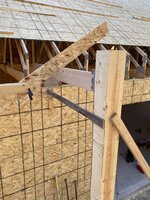
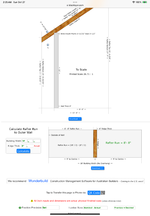
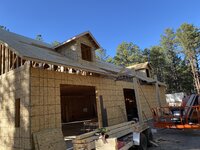
I don’t mean to beat this dead horse. But I’m now truly in the thick of framing this timber frame gable and I‘m hoping these pictures help you guys give me some more informed advice. The rafter calculator did end up giving me some very useful measurements but I’m still trying to wrap my head around the practical application of it.

I’ve decided to do my best to match the top of the two rafter planes and just let the timber frame tails run long. I’m using 11/16”extra height for eventual shrinkage in the beams and 1-1/2” T&G decking boards for sheathing. So in the pictures I’m using the ripped down 2x10 (8”) to simulate the horizontal beam. This is the one attached to the metal L bracket. The simulated rafter is the 8” wide osb piece clamped in place. This will be a 4x8 beam eventually. If I’m looking at this intersection of two roofs correctly, I think I need to lower the horizontal beam another 1 1/2” to accommodate for the T&G thickness. Would you agree? That will really leave the bottom of the timber rafter tails a lot lower than I’d like. You can see how much is already sticking below my sub fascia.

I’m thinking about not using fascia on the timber frame portion and just leave exposed rafter tails. Therefore not really needing to worry about matching up the bottoms of the tails/fascia at the intersection. Any thoughts or advice before I start cutting off my posts? Also any advice on how to continue the gable framing over the existing roof would be greatly appreciated too. I plan on switching to dimensional lumber once I get past the wall and over the main roof. Not sure how to tie the two together and also how to match the 5/8” osb roofing to the 1-1/2” T&G? I’m also planning to notch these short horizontal beams right at the posts to accommodate the long 18’ horizontal beam connecting the two posts. How deep do I dare notch for the 18’ to bear on the post and not weaken the short beams so I can extend them 2’ out past the front of the posts? I was planning on a 3” deep notch, leaving 5” of material.
In case you’re wondering, I’m using cured solid blocks (6x8s) in between the trusses on the top plate for the horizontal beams to rest on. I’ll then just continue to solid block on either side of the beam until it is pocketed into the opening and sheath around the beam. Thanks guys!
 

Attachments

  • IMG_1105.jpeg
    IMG_1105.jpeg
    1.1 MB · Views: 24
  • IMG_1108.jpeg
    IMG_1108.jpeg
    1.2 MB · Views: 19
  • IMG_0556.png
    IMG_0556.png
    482.6 KB · Views: 20
  • IMG_1113.jpeg
    IMG_1113.jpeg
    836.8 KB · Views: 21
  • IMG_1109.jpeg
    IMG_1109.jpeg
    927.1 KB · Views: 26

MongoTA

Well-known member
Joined
Mar 10, 2018
Messages
1,004
Location
CT
I'm a little late to the thread and I haven't read through to the end. And I haven't done timber frame! so yup, I probably should not post. But when I used to cut stick framed and we were aligning different pitches or roof planes that intersected at odd angles, we'd base everything off of height above plate.

I remember once cutting a roof and spinning my brain for a couple hours in the hot July sun trying to figure out something that seemed so simple yet I was brain fried. Called it quits. Came back the next morning and had everything figured out and was making sawdust within about 15 minutes.

Hope you get it figured.
 

Rusted Nut

Well-known member
Joined
Dec 11, 2022
Messages
1,810
Location
PNW
Will your porch beams be the same elevation (height) as the building top plate, or higher?

If porch beams are higher, then the porch rafter tails can be higher than the main tails. I can send a pic of this when it gets light out.

If porch beams are same elevation as the main top plate, and main truss top chords (rafters) are 2x4, and porch rafters are 8”; then the only way to have all your tails match would be to cut a 3 1/2” tail on the top portion of the porch rafter, and have the remainder of the porch rafter come down below on inside of the porch beams. In other words, top of all rafters (top truss chords) are at the same height.

But answer my first question here, and I’ll try help. I‘ve hand cut hundreds of rafters but a bit unclear on exactly what you’re doing.
 

Rusted Nut

Well-known member
Joined
Dec 11, 2022
Messages
1,810
Location
PNW
Here’s a photo of a porch roof higher than plane of the main roof. If you build it like this, then you don’t have to match the tails. Not everyone likes this look, up to you.

IMG_0587.jpeg
 
OP
W

Wiebster

Well-known member
Joined
Jul 18, 2015
Messages
194
Location
Rapid City, Sd
Will your porch beams be the same elevation (height) as the building top plate, or higher?

If porch beams are higher, then the porch rafter tails can be higher than the main tails. I can send a pic of this when it gets light out.

If porch beams are same elevation as the main top plate, and main truss top chords (rafters) are 2x4, and porch rafters are 8”; then the only way to have all your tails match would be to cut a 3 1/2” tail on the top portion of the porch rafter, and have the remainder of the porch rafter come down below on inside of the porch beams. In other words, top of all rafters (top truss chords) are at the same height.

But answer my first question here, and I’ll try help. I‘ve hand cut hundreds of rafters but a bit unclear on exactly what you’re doing.
LOL, I don’t know what I’m doing either. But I do know the beams will be higher than the top plate. My math using the rafter calculator comes out to the bottom of the beams being 6 1/2” higher than the top plate. That’s using the 1-1/2” sheathing and allowing for 11/16” shrinkage. But I don’t necessarily trust my math or more precisely trust that I’m not forgetting to account for something. I mainly want the two roofs to be in the same plane on the top of the fascia or decking. Bottom will be longer on the timber frame due to the 8” rafter depth, as you mentioned.
 
OP
W

Wiebster

Well-known member
Joined
Jul 18, 2015
Messages
194
Location
Rapid City, Sd
Here’s a photo of a porch roof higher than plane of the main roof. If you build it like this, then you don’t have to match the tails. Not everyone likes this look, up to you.

IMG_0587.jpeg
I considered that in response to earlier posts on this subject. But as usual, I took the more difficult route. I think if I can muster a close approximation of the two roofs joining in the same plane I will try to do that. Leaving exposed timber tails should give me more flexibility on not getting it perfect.
 
OP
W

Wiebster

Well-known member
Joined
Jul 18, 2015
Messages
194
Location
Rapid City, Sd
I'm a little late to the thread and I haven't read through to the end. And I haven't done timber frame! so yup, I probably should not post. But when I used to cut stick framed and we were aligning different pitches or roof planes that intersected at odd angles, we'd base everything off of height above plate.

I remember once cutting a roof and spinning my brain for a couple hours in the hot July sun trying to figure out something that seemed so simple yet I was brain fried. Called it quits. Came back the next morning and had everything figured out and was making sawdust within about 15 minutes.

Hope you get it figured.
I appreciate your input. My wife knows absolutely nothing about what I’m usually doing. But she’ll say something that sparks an idea in my misfiring brain. So any input is appreciated. I have burned many hours trying to come to a workable solution on this so I’m ready for any suggestions.
 
To avoid these ads, REGISTER NOW!
Top Bottom