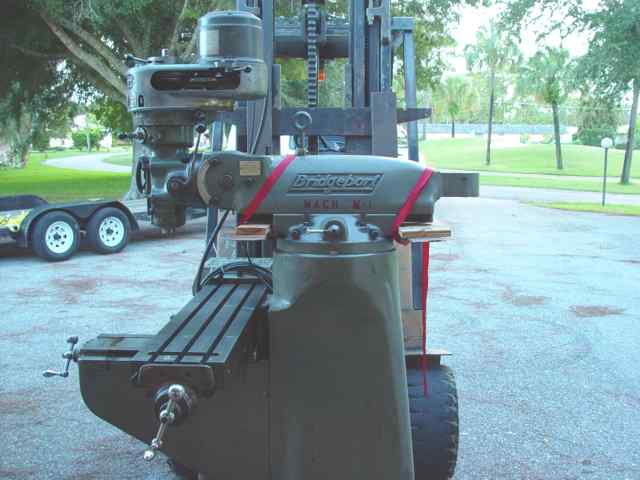
I would look for something like a Series I Bridgeport, or a Wells Index 747 or 847 machine. Parts are still available for those machines. Wells Index also offers a rebuilding, grinding, and spindle service for Bridgeport and Wells Index style machines.
What to look for on a turret mill? Well, exterior condition for starters. Are all the handles there? Anything missing, broken off, etc? Is the machine covered in a layer of Portland Cement dust, or grinding dust? Is it covered in rust? What's the owner say? Was he milling lightweight concrete on it last week, *before* cleaning it up for sale.

Next, look at the table. A little drill mark here or there is OK. If the table is full of holes, RUN away. Check the backlash on the X and Y axis. Properly adjusted, it should be within .015 or less. Less is better. Check the condition of the leadscrews. To do this, note the backlash at the center of the table and again at the extreme extent of travel. The difference in backlash is exactly equal to the wear on the flanks of the leadscrew. I wouldn't accept a machine with more than .003 - .005 variation. Leadscrew wear not only causes inaccurate positioning, but makes it difficult to adjust the leadscrew nut backlash. Adjusting it *just right* at the center of travel will leave the handwheel too tight to turn at either extreme.
After the table, look at the ways. Most Bridgeport machines came with Chrome ways on the knee and saddle, although some did not. Check to see if flaking is still present on the UNDERSIDE of the table and dovetail in the center of travel. The chrome wears much more slowly than the bare cast iron mating surface. If there's no flaking on the chrome side, the cast iron side is seriously worn. Have a look at the leadscrew and nut while you're under there, just for good measure. The ways should be well lubricated with way oil, which has the consistency of 90W gear oil. The zerks on the table are NOT for grease. If the machine has been greased, it will require complete disasembly to rectify.
Now, it's time for the fun part. Check the head. Start the machine at a mid speed range and allow the spindle to warm up for a few minutes. The spindle should be dead quiet, any sound other than a smooth whirr is trouble. Test the power downfeed in all three speeds to ensure it is operational. Once the spindle is warm, go to high belt direct. Again, the spindle should be quiet. Test the power feed again here. Move the quill up and down with the hand lever. Shut off the machine, switch to back gear, and start the machine again. The back gear should be quiet with no grinding or other noises.
If all checks OK, test the spindle taper, if possible. Bring along a piece of Scotch Brite, a 1/2" precision ground dowel pin, and a .0001 DTI and mag base and a GOOD 1/2" R8 collet. Scotch Brite the taper lightly to remove any dirt, goo, or rust. Then, set up your dowel pin in the collet and chinch the drawbar. With the machine in back gear and the lowest belt speed, place your DTI on the pin. The runout should be within .0002" or less. Less is better. If the reading is over .0005", check the taper, your collet, the dowel pin, etc for possble additive errors. The spindle taper should look almost pristine inside with no burrs, projections, wiped metal, etc.
That about covers it. Be sure to check the operation of any accessories that are mounted, like DRO's, power axis feeds, etc. You're unlikely to find a perfect machine, although they do pop up. I found a Series II Bridgeport (2.5 times the size of a Series I) recently. The machine was covered in ****, with latex porch paint flaking off most of the painted surfaces. However, geometrically it is brand new. The shop never used the machine, as they had a dozen Series I machines. It got used about once a month for 30 years do do a 1-off keyway. If you're willing to put in a little work, that's they type of machine I would look for. Mechanical stuff like fixing feeds, new way wipers, getting lubricators running and fixing vari-drive heads, etc is easy work. Even spindles aren't too bad with surgical cleanliness, careful assembly and attention to detail. However, geometery repair (scraping) is a LOT of work.
Series I machines are about 2,200 lbs +- You can move one in a 3/4 ton pickup truck with proper precautions. I suggest talking with your local forklift company about renting a forklift, unless you have one. To lift a Bridgeport, check the spider and column adapter bolts, then move the table to the column and invert the head. Move the ram back so you have about 6" of dovetail showing out the back of the ram adapter. Then, place a piece of 1/2" or so plywood scrap on each fork and lift from the underside of the dovetail. The plywood protects the ram dovetail and increases the coefficient of friction between the forks and ram. The machine will still be heavy towards the knee. Any 4,000lb forklift will be sufficient for this lift. Failing that, all Bridgeports have a 5/8 tapped hole in the ram for mounting a forged eye bolt at the CG.
You'll find the Series I serial number listing and history here:
http://www.lathes.co.uk/bridgeport/
Other advice:
If you've never run a mill before, don't be in a rush to buy the first one or two you see. Go out there and look at a couple, touch them, run them, talk about them. Explain to the owners that you're new and you'd like to look at their machine and talk with them about machining. They should respect that. Once you've seen a few machines, you'll be better able to judge condition and just what exactly you're looking for in a machine.
Have fun!