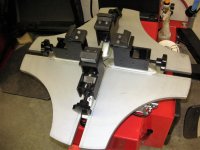
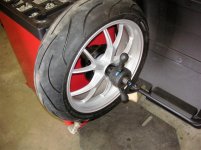
That was my first thought as well so I’ve checked numerous times from several sources to be sure I have the right style of weight for the rims I had an issue with and I believe I do. Not including the stick on style, I’ve worked primarily on rims that are MC and P style. The weights I got from Amazon are “zerint” and “Harzole” brand so maybe just avoid those?
I have been on the hunt for a rim type gauge to measure, but haven’t seen them come up on eBay yet. Next time I place an order for weights from a real distributor I’ll definitely get one.
I certainly welcome any tips on balancing as I quickly saw why the commercial grade machines come equipped with lasers to make it easy to identify where weights need to be installed.
You can eye ball it using the below as a reference:

There are also charts if the rims are
OEM:

The lasers do allow for placing the weights faster, but in the grand scheme of things dont do much; in most cases you're clipping the weights at exactly 12 oclock.
Most machines have a setting to select between these options. Placing weights as far out from center as possible is going to yield the least amount of weight needed.
Two tips from me:
Tip 1: When you spin the assembly, mark with chalk the 12 oclock position and weight requested where its initially telling you to place the weight.
Completely remove the wheel assembly, and then remount it.
When you respin it, it should indicate the same amount of weight needed in the same spot.
If its not exactly the same, you need to reconsider if you're using the correct cone, if the hold down is tight and even, or if the machine is for some reason malfunctioning.
Only once I've spun, marked and remounted x3 do I actually place any weight on the wheel.
Its not about getting the machine to show 0, its about getting the machine to show
repeatably regardless of how many times you mount and dismount the assembly. Only then should you try to get to 0.
The problem with most tire shops is that they slap the assembly on and never remount to recheck.
Tip 2: Remember that "calibration" is only insofar important in terms of the machine calculating how much weight to
recommend when it finds an inbalance. It has nothing to do with its ability to identify the inbalance.