To avoid these ads, REGISTER NOW!

Tire machine hydraulic issue

bd8134

Well-known member
Joined
Oct 16, 2008
Messages
219
Location
Franklin, MA
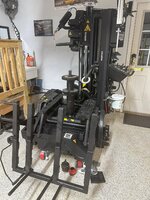
I have a Snap-on / John Beam tire changer which uses hydraulic cylinders for the bead breaking arms and center wheel clamp.
The hydraulic motor failed to start / turn and I sent the motor and pump away for testing / repair.
They repaired the motor and replaced the capacitor. I filled the oil reservoir with new equivalent recommended oil.
However, no hydraulic operations now work. On first start up the motor made some unusual noise and aerated the oil in the tank.
I have loosened a few of the hoses and oil certainly comes out.
I checked the solenoids and they seem to work.
All the hydraulic cylinders are dual acting type and I am thinking that air maybe needs to be purged or bleed.
No error appears on the display and the pneumatic and electric features all work.
Is there a special or recommended way to remove trapped air in the hydraulics of dual action cylinders. I do not see any bleed screws.
Thank you.
 
To avoid these ads, REGISTER NOW!

Torque&Recoil

Well-known member
Joined
Dec 13, 2015
Messages
424
Location
NE Ohio
I apologize in advance for stupid question, but are you sure that the motor/pump is hooked up correctly? Aerating the tank kinda sounds like the pump is pulling from the system, and dumping oil into the tank - opposite of what its' supposed to do. As others have posted - pictures or model # information would be helpful.
 
OP
B

bd8134

Well-known member
Joined
Oct 16, 2008
Messages
219
Location
Franklin, MA
Sounds like electric motor spinning a hydraulic pump to power the cylinders.
I believe that is what it is. I have attached some pictures.
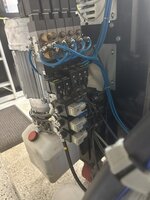
In image 5158.jpeg, the top solenoids are air which operate the wheel lifter and other arms, they work well.
The grey and black wiring connectors go to the hydraulic solenoids / cylinders.

The motor is connected correctly, there is an arrow with the direction the motor should spin.
 

Attachments

  • IMG_5157.jpeg
    IMG_5157.jpeg
    809.6 KB · Views: 13
  • IMG_5158.jpeg
    IMG_5158.jpeg
    528.5 KB · Views: 12
  • Tire machine serial tag.jpeg
    Tire machine serial tag.jpeg
    920.3 KB · Views: 13
  • IMG_5159.jpeg
    IMG_5159.jpeg
    1.1 MB · Views: 13
Last edited:

signcrafter

Well-known member
Joined
May 9, 2012
Messages
12,317
That thing looks crazy compared to my cheap tire machine.

Yes that is a hydraulic pump. I don't know a ton about hydraulics but I would think it needs the air bled out of the lines after unhooking them. Unless it self bleeds.
 

signcrafter

Well-known member
Joined
May 9, 2012
Messages
12,317
This is the service manual I found.
I just looked at your manual and there is no mention of any bleeding. Is the motor running when you try to actuate a cylinder? Can you hear it running? If not pull the motor but leave it wired and try. If motor is working then have to see if pump is working. The manual is very detailed and tells you how to do most of this stuff.
 
To avoid these ads, REGISTER NOW!

Firebrick43

Well-known member
Joined
May 12, 2015
Messages
13,974
Location
West central Indiana
The motor is connected correctly, there is an arrow with the direction the motor should spin.
The question is does it spin the correct direction. I worked on CNC machines for 16 years and replaced hundreds of pump motors. The first thing we did upon commissioning a new motor on a pump is bumping the motor with the contactor while a tail of a zip tie was inserted slightly into the fan housing grill. It will pull the tail in the direction that its turning without any damage or safety concern.

Looking out it wasn't reliable typically as spinning fan blades can cause optical illusions.
 

5ubtle

Well-known member
Joined
Jun 15, 2016
Messages
390
Location
Spartanburg, SC
Air will be bled from the hydraulics by running the cylinders back and forth a few time. It's like bleeding a power steering system, not like bleeding the brakes.
 

larry_g

Well-known member
Joined
Apr 28, 2007
Messages
16,863
Location
oregon
Any way to put a pressure gauge on the output of the pump to check pressures? It also sounds to me like the pump is turning wrong direction. I would assume that before reassembling things that you checked the filter in tank if there is one. I say that because I had a system like that stop working because of the inlet filter. I mixed the oils in it and it turned to cream.

lg
no neat sig line
 
OP
B

bd8134

Well-known member
Joined
Oct 16, 2008
Messages
219
Location
Franklin, MA
I will check the motor direction with the cable tie trick.
I did not want to run the motor / pump too long as the pump started to get noisy and I saw online about cavitation destroying pumps.
The lines at the cylinders are not the easiest to get access to. I did disconnect the line to the wheel clamp mechanism and oil did come there when the pump was activated. I also loosened a hose at the hydraulic solenoid and that came out pretty fast but the oil which came out was very aerated. Letting the oil stand allowed the air to dissipate. Both times the oil was the old oil.
I did not check at the time if the oil is the tank was aerated, I should have checked. I only saw aerated oil when I loosened the hose at the solenoid.
In the manual it mentions about the high pressures in the hydraulic system, I only have the regular automotive pressure gauges and I feel it might be dangerous attaching one of those gauges.
I also removed a solenoid block to see how that worked. There is a shuttle valve inside which opens and closes passages. Where the solenoid electrical coil is held on, there is a spring loaded plunger on the end that you can depress with a small screwdriver and move that plunger, which the electrical circuit does when energized. I disconnected the motor and tried each operation via the control panel to move the arms and clamp. I could feel each solenoid operate and I checked the plunger moved with a screwdriver resting on the end. I am pretty confident the electrical / solenoid part is working correctly.
When I received the motor back from repair, All 6 of those plungers were very hard to depress and were all the way out. The bottom pair of plungers were stuck and I did not want to force them. Loosening the hose (which goes to the wheel clamp) allowed those 2 plungers to move freely like the others above. Maybe these solenoids were all stuck up causing my issue.
When operating one of the levers, say the upper bead breaker, the motor starts and operates the associated solenoid. Release the lever and the motor continues to run for a short while.
I am considering adding a switch to the motor so I can operate it for a short while without the solenoids operating to bleed the pump and solenoid circuit. Then try just one circuit. Thoughts?
 

signcrafter

Well-known member
Joined
May 9, 2012
Messages
12,317
The aeration is probably from having the system open and air in it. Could also be the noises you heard. I would check that the motor is operating correctly and then run it to work the air out.
 

5ubtle

Well-known member
Joined
Jun 15, 2016
Messages
390
Location
Spartanburg, SC
... In the manual it mentions about the high pressures in the hydraulic system, I only have the regular automotive pressure gauges and I feel it might be dangerous attaching one of those gauges. ...
Your hydraulic pressures will be in the range of 1000-3000 psi. Get a new 5000 psi gauge.
Cavitation is an erosion process (i.e. it takes time). Don't be afraid to run the pump for a short time to clear out the air.
 
OP
B

bd8134

Well-known member
Joined
Oct 16, 2008
Messages
219
Location
Franklin, MA
I thought I would take it in stages. I wired up a pair of switches. One so I could run the motor / pump independently from the control levers and the other so the tire machine would go back to controlling the motor / pump and the valves. I first checked the motor was rotating the correct direction with the wire tie, it was. I left the cap off the oil reservoir and no cavitation / air bubbles and the pump sounded normal.
I put my test switch in normal / automatic mode and operated the lever to move the upper beadbreaker and it moved normally, nice. I moved it up and down as well as the lower beadbreaker and the wheel clamp. Everything worked, a small noise at full extent which was most likely air getting pushed out. I then moved the arms to the correct position for checking the oil level.
I would like to offer my gratitude for all the help you guys have offered and the suggestions. The dual action cylinders do not need to be separately bled of air, just go slow and take the cylinders through their range in stages. Not sure why it did not work when I first connected up the motor / pump, I did not get any movement. The last work I did was to disassemble one of the solenoid valves and I did feel that one or more could have been stuck in an open position. Not worried about it, it works so very happy.
A bit of story how I got this tire machine. A friend had bought a garage operation and shortly afterwards COVID hit and had a drastic lack of work and was bleeding money. He decided to close up shop and sell the equipment, that also did not go well. He tried for many months to get rid of tire machine and a really nice balancer, no one was interested and he asked if I would help him to scrap the tire machine and balancer as he had to vacate the premises. My garage is an ok size but those were big machines but I hate scrapping anything. I offered him quite a bit of money to help him out and shipped it home. I welded wheels on the bottom so I could move them out if necessary. Various issues, broken wires, pneumatic lines / leaks. It is completely overkill for me, only changed maybe 16 tires but being touchless and fact it clamps the wheel down by the center hole saves damaging rims. I had to completely rearrange my garage, wire in outlets etc.
 
To avoid these ads, REGISTER NOW!
Top Bottom