I was looking at two tire repair kits just to keep in the car. I am trying to decide between safety seal or a tech permacure kit. Anyone have experience with both or either one? Any opinions on which is better and lasting repair?


You are using an out of date browser. It may not display this or other websites correctly.
You should upgrade or use an alternative browser.
You should upgrade or use an alternative browser.
Tire Plug kits
- Thread starter JDtime
- Start date
rlitman
Well-known member
I've seen plastic handled tools break, driving the needle or reamer shaft into your hand. I'm only using metal T handle tire tools from now on (that includes safety seal, but there are others that fit this criteria). You need to lean pretty hard into tire plug tools.
The longer safety seal plugs are easier to install, but should only be used with their longer needles, which are easier to bend. I feel like it's a toss up as to which type is better.
The longer safety seal plugs are easier to install, but should only be used with their longer needles, which are easier to bend. I feel like it's a toss up as to which type is better.
Either is really a temporary fix.
The tire should be dismounted when able and a plug/patch used.
And yes, I know someone has a tire they patched in 1986 that's never leaked. BUT I've also seen ruined tires from the plug(s) coming out and it going flat.
The tire should be dismounted when able and a plug/patch used.
And yes, I know someone has a tire they patched in 1986 that's never leaked. BUT I've also seen ruined tires from the plug(s) coming out and it going flat.
Vercingetorix
Well-known member
I’ve read Discount Tire will not repair a puncture that has been previously plugged.
before you decide, have you looked at Nealey’s kits? They have been around for decades and are really good.
 www.nealeytirerepairkit.com
Home | Nealey Kool Tools
www.nealeytirerepairkit.com
My wife and I drive SUVs, but be get the car and pickup Safety-Seal sets. They can be used on any car or truck that you run across.I've seen plastic handled tools break, driving the needle or reamer shaft into your hand. I'm only using metal T handle tire tools from now on (that includes safety seal, but there are others that fit this criteria). You need to lean pretty hard into tire plug tools.
The longer safety seal plugs are easier to install, but should only be used with their longer needles, which are easier to bend. I feel like it's a toss up as to which type is better.
It was stated that they are a temporary fix, but I have driven on them for years. Over 30 years ago, I did some new residential construction. I got flat tires pretty regularly back then. I just used a Safety-Seal plug and a cigarette lighter powered compressor. Not one plug failed before the tire wore out.
IndyGarage
Well-known member
I've had about 75 tires since 1986 that I've plugged and never leaked. In fact, I can't ever remember having one leak. So honestly I think all the folks that don't want you to plug a tire are just Nervous Nellies.Either is really a temporary fix.
The tire should be dismounted when able and a plug/patch used.
And yes, I know someone has a tire they patched in 1986 that's never leaked. BUT I've also seen ruined tires from the plug(s) coming out and it going flat.
I generally try to use Safety seal because the tools that come in their kit are a little more sturdy, but I've used all manner of rope plugs and never had a problem with any of them.
I did not have good results from the Stop and Go tire plug kit that supposedly plugs the tire from the inside - about 50% failure rate on those.
If I'm not mistaken Discount Tire is in the business of selling tires - no surprise there. Breaking news: A furnace guy told me I needed a new furnace immediately - that was 23 years ago, and the last time his company entered my house...I’ve read Discount Tire will not repair a puncture that has been previously plugged.
aka Larry
Well-known member
If I'm not mistaken Discount Tire is in the business of selling tires - no surprise there. Breaking news: A furnace guy told me I needed a new furnace immediately - that was 23 years ago, and the last time his company entered my house...
Yep, when you're a hammer everything else is a nail...
I've had both plugs and patches. All held up fine for the remaining life of the tread.
I've had about 75 tires since 1986 that I've plugged and never leaked. In fact, I can't ever remember having one leak. So honestly I think all the folks that don't want you to plug a tire are just Nervous Nellies.
Not really. plugged tires regularly fail -- I used to run a garage where we repaired lots of tires, and I repaired lots of plugs that had failed and were leaking. Most were done by someone else, but I'm sure some were ones we (and I) did, properly, in pretty much perfect conditions. those aren't usually a big deal, but the other ways that plugged tires fail are. A tire that's driven flat or low on air can suffer damage to the sidewall and innerliner, which can happen in surprisingly short period of time, especially if it's driven at highway speed. Those can lead to blowouts, which are scary at best, kill people at worst, and can easily cause a lot more damage to the car that the price of a tire.
After our insurance company told us we had to stop plugging tires -- more precisely, they told us our liability coverage was void on tires not repaired according to RMA standards (which requires dismount, inspection, and both a plug and patch), I found that somewhere between a quarter and a third of the tires I would have plugged without a second thought failed the interior inspection because of damage to the innerliner. these were punctures like an obvious nail in the center of the tread, no visible damage or wear at the tread shoulder or sidewall. Yes, most of those tires would have gone the rest of their useful life without problem.
Vercingetorix
Well-known member
Discount Tire repairs flats for free whether purchased there or not.If I'm not mistaken Discount Tire is in the business of selling tires - no surprise there. Breaking news: A furnace guy told me I needed a new furnace immediately - that was 23 years ago, and the last time his company entered my house...


rlitman
Well-known member
I'll buck the trend and say that I've experienced one plug fall out (after thousands of miles), and two plugs leak through the plugged holes (also only after thousands of miles after plugging). In all three cases, an additional plug fixed the issue for the remaining life of the tire, and the problem was discovered through a very slow leak (needing to add air no more than once a week)....I've had both plugs and patches. All held up fine for the remaining life of the tread.
Still, plugs have worked very well for me, and with TPMS, it's pretty hard for a failed plug to lead to any real problems.
zimman
Well-known member
Make sure whatever kit you get has some rubber cement in with it. Or lube.
Zim
Zim
IndyGarage
Well-known member
I assume that if you didn't think a proper tire plug would hold, you wouldn't have done a lot of them. Sure, when you are doing thousands of them and repairing ones that were done with bad material or bad technique some of them are going to leak.Not really. plugged tires regularly fail -- I used to run a garage where we repaired lots of tires, and I repaired lots of plugs that had failed and were leaking. Most were done by someone else, but I'm sure some were ones we (and I) did, properly, in pretty much perfect conditions. those aren't usually a big deal, but the other ways that plugged tires fail are. A tire that's driven flat or low on air can suffer damage to the sidewall and innerliner, which can happen in surprisingly short period of time, especially if it's driven at highway speed. Those can lead to blowouts, which are scary at best, kill people at worst, and can easily cause a lot more damage to the car that the price of a tire.
After our insurance company told us we had to stop plugging tires -- more precisely, they told us our liability coverage was void on tires not repaired according to RMA standards (which requires dismount, inspection, and both a plug and patch), I found that somewhere between a quarter and a third of the tires I would have plugged without a second thought failed the interior inspection because of damage to the innerliner. these were punctures like an obvious nail in the center of the tread, no visible damage or wear at the tread shoulder or sidewall. Yes, most of those tires would have gone the rest of their useful life without problem.
What you are saying is the insurance company forced you to stop using them - likely because in a bad accident, people often sue anybody that could possibly be a cause of it - whether it is proven or not.
I assume that if you didn't think a proper tire plug would hold, you wouldn't have done a lot of them. Sure, when you are doing thousands of them and repairing ones that were done with bad material or bad technique some of them are going to leak.
What you are saying is the insurance company forced you to stop using them - likely because in a bad accident, people often sue anybody that could possibly be a cause of it - whether it is proven or not.
I'm pretty sure the case that triggered a lot of this was several people getting killed by a vehicle that lost control because a plugged tire blew out. If i remember right (and it's been 20 years, so...) the people killed were not in the vehicle with the bad tire, they were in one that got hit. The shop that did the work was found liable, and had a 7 figure judgement against them. One of things the lawyers made a big deal about was the repair wasn't done to the standards of the tire manufacturer, who very clearly said "don't use a plug". (At the time, all the major tire manufactures said "follow RMA bulletin X", which required a patch & plug.)
IndyGarage
Well-known member
Yeah, I'm sure you are correct.I'm pretty sure the case that triggered a lot of this was several people getting killed by a vehicle that lost control because a plugged tire blew out. If i remember right (and it's been 20 years, so...) the people killed were not in the vehicle with the bad tire, they were in one that got hit. The shop that did the work was found liable, and had a 7 figure judgement against them. One of things the lawyers made a big deal about was the repair wasn't done to the standards of the tire manufacturer, who very clearly said "don't use a plug". (At the time, all the major tire manufactures said "follow RMA bulletin X", which required a patch & plug.)
I don't know if it was proven that the plug caused the blowout or not - or what kind or quality of plug or quality of job of installing the plug was done - I'm betting that would be a hard thing to prove.
A tire store could be still be found liable if they had repaired it to the correct standards and/or they did any number of other wrong things when they installed the tire. I'm sure it was a terrible accident, but those kinds of things do happen on rare occasion and that's why you buy insurance.
Personally I think it's not smart to change something that works thousands or millions of times because one time there was a tragic accident - but insurance companies look at it like - "we're not paying out a multi million dollar claim for a $20 service".
Last edited:
Personally I think it's not smart to change something that works thousands or millions of times because one time there was a tragic accident - but insurance companies look at it like - "we're not paying out a multi million dollar claim for a $20 service".
It wasn't just one failure, though. I took a class on tire repair, which covered a lot more than just puncture repair, like section repair on ag tires, and prep for retread. The instructor was on one of the RMA committees that produces their technical docs.
One of the things he kept bringing up was that properly repaired tires have the same failure rate as unrepaired tires, while improperly repaired tires had a much higher failure rate.
WWheeler
Well-known member
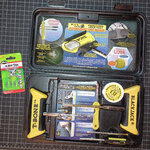
This is the kit I keep in my truck box. A Blackjack KT-340 Tire Repair Kit & a 4-way tool w/ valve cores

Bigblue&Goldie
Well-known member
This is the kit I keep in my truck box. A Blackjack KT-340 Tire Repair Kit & a 4-way tool w/ valve cores
Me too. 2 kits, one in the tow rig and one in the tool box. Nice kits for the money.
Nothing is more permanent than a temporary repair that works!Either is really a temporary fix.
IndyGarage
Well-known member
Well the results would depend highly on the definition of those terms "properly" and "improperly".It wasn't just one failure, though. I took a class on tire repair, which covered a lot more than just puncture repair, like section repair on ag tires, and prep for retread. The instructor was on one of the RMA committees that produces their technical docs.
One of the things he kept bringing up was that properly repaired tires have the same failure rate as unrepaired tires, while improperly repaired tires had a much higher failure rate.
It certainly does not surprise me that something with an "improper" repair fails at a much higher rate than something properly repaired.
I was trying to find some data on tire repairs - I found lots of opinions and not much actual data - I did find the article below which lists the following list of key factors contributing to a potentially dangerous road situation:
- Tire pressure (underinflation)
- Tire tread depth, as measured to the nearest 1/32”
- Previous tire damage, such as tread separation or partition tread separation
- Failure to use a tire pressure monitoring system (TPMS)
- Vehicle body type
- Overloading vehicles (something to watch for when packing to take off for a vacation)
- Distracted driving, particularly from mobile devices
Tire blowout statistics
joe_pinehill1
Well-known member
I'll offer a different view. Modern tires are so much better than 20 or 30 years ago. Growing up it seemed common to see someone changing a tire on the side of the road. (Automotive rubber parts in general are light years ahead in quality from 20 years ago; hoses tend not to develop leaks, belts tend not to snap if you do routine maintenance; along with so many cars having alloy wheels, that do not rust and less likely to leak at the bead) I think the last time I had to change a tire on a drive was about 20 years ago when I hit a water filled pot hole on a rainy night, the car in front of me and behind both hit the same hole and we all helped each other change to spares. But now it seems for me tires show signs of slow leaks that the TPMS triggers or you see the tire is low, even with a nail or screw in them. I fill it with air from my M12 Inflator or a gas station, and that buys enough time to get to a tire shop.
Rather than a plug kit, consider keeping a good quality inflator in each car. I bought an M12 for each of our cars and my two daughter's cars. The battery stays charged, I check it every 3 or 4 months. A good LiIon battery jumper is also good to keep in the car.
All of this is my opinion and YMMV.
Rather than a plug kit, consider keeping a good quality inflator in each car. I bought an M12 for each of our cars and my two daughter's cars. The battery stays charged, I check it every 3 or 4 months. A good LiIon battery jumper is also good to keep in the car.
All of this is my opinion and YMMV.
Last edited:
joe_pinehill1
Well-known member
If I'm on a long trip, I set the cruise at 65 and just pass the time. For me, that seems like the speed I could react to a blowout.Well the results would depend highly on the definition of those terms "properly" and "improperly".
It certainly does not surprise me that something with an "improper" repair fails at a much higher rate than something properly repaired.
I was trying to find some data on tire repairs - I found lots of opinions and not much actual data - I did find the article below which lists the following list of key factors contributing to a potentially dangerous road situation:
It also said that few people pay attention to the tire pressure on their vehicles and many have no idea what their TPMS is telling them.
- Tire pressure (underinflation)
- Tire tread depth, as measured to the nearest 1/32”
- Previous tire damage, such as tread separation or partition tread separation
- Failure to use a tire pressure monitoring system (TPMS)
- Vehicle body type
- Overloading vehicles (something to watch for when packing to take off for a vacation)
- Distracted driving, particularly from mobile devices
Tire blowout statistics
Ok, can we drop the yay/nay tire plug debate? OP want to use it in his vehicle for emergencies; he's not running a business. I've had multiple tires plugged over the years and never had a failure. Sure, for every 100 people that haven't had an issue, there's a few that have. But plugs were used for decades, with probably a 99% success rate. He is not going to dismount and patch a tire on the side of the road. So, let's focus on a plug kit recommendation? Or, since this is GJ, probably not...
I have a blackjack kit. I've used it a few times in emergencies. It works. As said, pick something with a quality handle. Read reviews. You'll see plenty of "the handle broke and the shank went thru my hand..."
I have a blackjack kit. I've used it a few times in emergencies. It works. As said, pick something with a quality handle. Read reviews. You'll see plenty of "the handle broke and the shank went thru my hand..."
Gangly
Well-known member

51dueller
Well-known member
The Blackjack's are nice as you can plug in the middle of winter. They can be lit on fire to aid in the vulcanizing process. Don't need to trim them shorter as they melt. Just blow it out once it is flush with the tread.
engineer2
Well-known member
Menards has kits on sale for $3. Probably good enough to get you to a tire store.

sparky 1971
Well-known member
I've never compared different kinds but I keep a slime branded kit on my service van. I currently have new tires with no plugs yet but the last tires had plugs in all four. One in each of the fronts, two in one rear and at least three, if not four in the other rear. I don't think I've ever had a leak, every time a tire has been low it was usually another effing roofing nail, sometimes a drywall screw. I also keep a M12 inflator behind the seat to top them off after plugging.
i have used both blackjack and safety seal, same kit really but blackjack has nicer tools over all. i use xtraseal brand plugs, they never leaked. Work car had crappy michelins onit and i was working for an auto salvage yard at the time for insurance inspections. talk about nails in tires, literally 1 every week or two. I had a cheap kit and those crappy walmart slime brand plugs failed, some leaked others failed pretty decently. used the better plugs..no issue. by the time i got new tires each tire had like 5-8 plugs in it i think..
powertrip
Well-known member
I am still looking for a kit without a crappy case that has the hinge wear out and rip. Something with latch closure and a pinned hinge.
WMichelsen
Well-known member
- Joined
- Nov 24, 2012
- Messages
- 64
Meh. Don't over think it.
This is the kit I've had in the back of my suv for 25 years. Small pack that easily tucks out of the way.
I did upgrade from $1.99 straight handles to $3.99 T-handles (totally worth it), and $0.49 for the blue bag.
I've been through 3 packs of plugs. Only ever had 1 fail, and that was a slow leak because the puncture was more of a 1/4" slice.
As for lube, a bit of spit works fine.
This is the kit I've had in the back of my suv for 25 years. Small pack that easily tucks out of the way.
I did upgrade from $1.99 straight handles to $3.99 T-handles (totally worth it), and $0.49 for the blue bag.
I've been through 3 packs of plugs. Only ever had 1 fail, and that was a slow leak because the puncture was more of a 1/4" slice.
As for lube, a bit of spit works fine.
Attachments

Last edited:
KnurledNut
Well-known member
Of the times I have been in an emergency setting I often had to put the spare tire on due to blowout, side puncture or gash. The times I have picked up a nail or screw I leave it in there until I can go get it dismounted and properly patched. I removed and Geocel'ed one screw back in place and drove a few hundred miles and it hardly lost any air. I have plugged a few in non-emergency settings like traveling mine roads that are notorious for all kinds of random industrial metal debris and sharp rocks. And I have plugged trailer tires.
I keep the Slime drill/ream/plug quick change shank bit set in my trouble kit and I always have at least an impact driver, flashlight and inflator with me. While the drill becomes the handle, the bits could also be used manually if needed. I keep a locking Wera T-handle in my kit for use with other bits but also for manual plug insertion. I do recommend getting better quality plugs as the ones that come with it are questionable.
I keep the Slime drill/ream/plug quick change shank bit set in my trouble kit and I always have at least an impact driver, flashlight and inflator with me. While the drill becomes the handle, the bits could also be used manually if needed. I keep a locking Wera T-handle in my kit for use with other bits but also for manual plug insertion. I do recommend getting better quality plugs as the ones that come with it are questionable.
Last edited:
WWheeler
Well-known member
As for lube, a bit of spit works fine.
This message brought to you by our sponsor ....

JoeMcGov
Well-known member
Sliding in here right at the end.
I have plugged, I think, four tires in the last seven years with highly economical Slime brand plug kits from Autozone. All have worked perfectly.
Before you flip out............I had one hold perfect for 40,000 miles until I bought new tires. I have had the benefit of plugging the tires and letting them sit and "cure" overnight before re-inflating.
And now a message from my lawyer >>> YMMV.
I have plugged, I think, four tires in the last seven years with highly economical Slime brand plug kits from Autozone. All have worked perfectly.
Before you flip out............I had one hold perfect for 40,000 miles until I bought new tires. I have had the benefit of plugging the tires and letting them sit and "cure" overnight before re-inflating.
And now a message from my lawyer >>> YMMV.
tiredoldironworker
Well-known member
- Joined
- Jun 14, 2024
- Messages
- 250
At work dealing with 12 to 24 ply tires on our rough terrain lifts and Skytraks we have never had a problem with Nealy or Safety Seal. They hold until the tire is absolutely worn out; which is the only time the boss replaces them.
What is the best 12v wheel balancer and tyre changer?So, let's focus on a plug kit recommendation? Or, since this is GJ, probably not...
Dakotadadv8
Well-known member
- Joined
- May 30, 2021
- Messages
- 1,522
Blackjack tire repair kit
I don't have a strong preference. A while back Walmart was dumping the Slime brand stuff so I picked up a number of kits for like $2 each. I put one in each car and I've used them, perhaps every other year. I've generally had good luck with the things. The worst case was when I had a 14 year old tire with a puncture right at the edge of the tread. I used two plugs in that tire to get it to hold air. Why would I do that? Well I had the replacement tires in the car and was taking them to my friend's garage where it would be off with the old, on with the new. I just needed that patch (and the crusty tires) to live for about 15 miles... a nervous 15 miles.
BTW, I also endorse the suggestion to keep a tire inflator in each car. Between the inflator and plug kit I've done well.
BTW, I also endorse the suggestion to keep a tire inflator in each car. Between the inflator and plug kit I've done well.
bob from indiana
Well-known member
I used a 30 Cal size plastic ammo can for my tire repair kit. I added a pair of nippers a wire cutter and a break off razor knife. It fits behind the seat of my single cab pickup.