To avoid these ads, REGISTER NOW!

Tire Pressure Gauge

Nineeightyone

Well-known member
Joined
Mar 21, 2018
Messages
393
Location
Pennsylvania
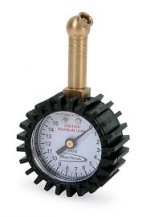
I recently began competing in autocross, and using a pen-style tire pressure gauge to check and decrease air pressure in my tires. It seems woefully inaccurate though, and at best I can guess what pressure is in the tire by taking several readings, and frankly, it *****.

There seems to be a better option in getting a dial-style tire pressure gauge, I'm seeing some that also have a button/release valve so that air can be released from the tire without removing the gauge, but it seems accuracy for these units can be all over the place.

So what's a relatively accurate gauge that won't break the bank? I'd ideally like one that's easy to read in bright day as well as at night (though this isn't super important), accurate (this is very important!), and has a valve/button built into the unit to relieve air pressure (most important of all to me!).
 
To avoid these ads, REGISTER NOW!

L5wolvesf

Well-known member
Joined
Dec 4, 2011
Messages
1,831
Location
Northern AZ
Joe's Racing has some pretty good looking ones that I would consider if needing another.

Good luck in the AutoX competition - that's Kinda where I get started. Smooth is fast.
 

jonshonda

Well-known member
Joined
Jul 17, 2017
Messages
4,736
Location
Wisconsin
I would get 3 or 4 pens and compare them on the same tire. Find one that seems most consistent and use it. Otherwise, I don't know that there is an affordable method to calibrate a pressure gauge.
 

LifeLongWNYer

Well-known member
Joined
Oct 23, 2013
Messages
1,231
Location
South of Rochester, NY
I was in the "motor pool" at a client site, and they had a relatively inexpensive way to check tire gauges. They had a 6" section of 2" Dia pipe mounted on the wall, and fed by a feed from their shop air system, but there was a pressure regulator feeding the air into the pipe. They had drilled and tapped two holes in the body of the pipe, one had a 6", silicon filled gauge threaded into it, the other had a standard tire valve.

The drivers adjusted the regulator for the pressure of the tires on their vehicle, then used their gauge to check the pressure in the pipe. When they checked theirs, they knew what the gauge should read.


.
 

sberry

Banned
Joined
Jun 18, 2005
Messages
35,747
Location
Brethren, Michigan
I check them on occasion, surprisingly some of the simple pens are as consistent as any. I have a couple masters I do comparisons with.
 

WittHay

Well-known member
Joined
Jan 6, 2016
Messages
2,157
Location
Surrey, BC Canada
I use a Mac dial gauge that goes to 60 lbs. Made in Taiwan seems ok. Also have a Blue-Point that goes to 15 lbs. Made in China but dont use it that often
 

Attachments

  • 20170907_100624.jpg
    20170907_100624.jpg
    142.1 KB · Views: 33
  • download (1).jpg
    download (1).jpg
    6.3 KB · Views: 33
To avoid these ads, REGISTER NOW!

engineer2

Well-known member
Joined
Dec 13, 2009
Messages
11,798
Location
Chicago burbs

6PTsocket

Well-known member
Joined
Mar 12, 2014
Messages
4,593
https://www.amazon.com/dp/B002PUTC0M/?tag=atomicindus08-20

This is the one I use, reasonable price and listing says its 0.1psi accurate resolution for TPMS. From using mine over a few months, it is very accurate.
There is a wide misunderstanding between resolution and accuracy. They are totally different. Resolution is the divisions on the gauge. Lets say 0.1 psi. Accuracy is how correct the reading is. It is ALWAYS several times worse than the resolution, maybe +or- 0.5psi. A better quality gauge with 0.2 psi resolution could concievably be more accurate than the 0.1psi one. Then there is how accuracy is stated. Is it % of the reading or % of full scale. The former is far more relavant but the later is often how it is stated. A 150 psi gauge with 1% of full scale accuracy could be off by 1.5 psi anywhere on the scale. At 150 psi that is good; at 30psi, not so great. As stated, it is hard for most of is to find an accurate reference. The TPMS standard is only +or- 2psi. More important is to just keep your tires evenly inflated with any half way decent gauge. Unless you have a nitrogen fill, tire pressure will change a lot with seasonal temperature changes in many parts of the Country.

Sent from my SM-G900V using Tapatalk
 

C.L S2000

Well-known member
Joined
May 3, 2017
Messages
180
Location
LB, CA
There is a wide misunderstanding between resolution and accuracy. They are totally different. Resolution is the divisions on the gauge. Lets say 0.1 psi. Accuracy is how correct the reading is. It is ALWAYS several times worse than the resolution, maybe +or- 0.5psi. A better quality gauge with 0.2 psi resolution could concievably be more accurate than the 0.1psi one. Then there is how accuracy is stated. Is it % of the reading or % of full scale. The former is far more relavant but the later is often how it is stated. A 150 psi gauge with 1% of full scale accuracy could be off by 1.5 psi anywhere on the scale. At 150 psi that is good; at 30psi, not so great. As stated, it is hard for most of is to find an accurate reference. The TPMS standard is only +or- 2psi. More important is to just keep your tires evenly inflated with any half way decent gauge. Unless you have a nitrogen fill, tire pressure will change a lot with seasonal temperature changes in many parts of the Country.

Sent from my SM-G900V using Tapatalk


But if you are going on your 1% scale for 30 psi, wouldn't the difference be 0.3psi ??? but never the less, you are correct with accuracy and resolution. I was simply stating what the Astro inflator advertises for resolution. I think on their website, they have accuracy of 0-58 psi +/- 1.2 psi. For me using it, I compared it to other (cheapy and expensive) inflators and its very accurate. And another thing to keep in mind as well for Nitrogen fills is that the Nitrogen fill levels need to at least be 95% pure Nitrogen to get the full benefits over regular air (which has 78% Nitrogen already). You don't want to know how many tire shops I have been to and asked if the machine has been serviced and the workers have no idea, but they are offering it.
 

engineer2

Well-known member
Joined
Dec 13, 2009
Messages
11,798
Location
Chicago burbs
Nitrogen follows the same gas laws as any other gas, but experience has shown it leaks out at a slightly lower rate. Nitrogen is also lower in moisture which helps. Of course moisture will permeate rubber anyhow, so not much to gain.

±1 psi is adequate for passenger car and truck tires. If racing, half a pound makes a handling difference. That means the gauge needs to be more accurate than 0.5 psi.
 
To avoid these ads, REGISTER NOW!
Top Bottom