To avoid these ads, REGISTER NOW!

Titebond 3

bluedog225

Well-known member
Joined
Jan 31, 2012
Messages
3,237
Location
Texas
I’m building a pair of 10’ pine workboat oars for my sea pearl.

Took an over an hour but I found a decent southern yellow pine board of Home Depot.

I thought I’d use Titebond instead of epoxy.

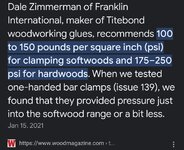
Titebond 3 wants 100-150 lbs clamping pressure. Fine.

How the heck am I supposed to know how much pressure I am applying?

Thanks

IMG_8620.jpeg
 
To avoid these ads, REGISTER NOW!

whateg01

Well-known member
Joined
Mar 13, 2006
Messages
11,183
Location
doo dah, kansas, usa
That's not pressure. Pressure is force per area. I've never measured the clamping force or pressure for any glue. Assuming a good clean joint, just look for consistent squeeze out. Most clamps I've ever used, I could only apply so much force anyway because of the style of handle, so that's how much I've applied.
 

Spud McGee

Well-known member
Joined
Apr 11, 2022
Messages
405
Yep, make sure the joint fits well before hand. Then cover every bit of the mating surface with a thin layer of glue. Roll it or smear it with something. Clamp it till you get glue squeezing out. You can never use too many clamps.

I have even resorted to laying full ammo cans on top of a couple boards to hold them in place.

It doesn't need to be precisely 100-150lb.
 

ColorMeOrange

Well-known member
Joined
Oct 11, 2023
Messages
62
So far the construction adhesive I used on my flag pole hasn't failed. Its directly exposed.

Good for glue sub outdoors.

And +1. Keep squeezing the clamps until you have adequate glue squeeze out. And adequate contact surface visually.
 

MikeC55

Well-known member
Joined
Nov 1, 2020
Messages
418
Location
CT
Hmmm, that is interesting.. One possibility might be to try and 'calibrate' your tightening force by using a suitable spring of known spring constant. When a spring is compressed, within its limits, the Force applied to compress the spring a certain amount, x, The equation for the force is F = k times x, where k is the spring constant in lbs per in (or N/cm, etc.). If you know the spring constant, clamp the spring and compress it say, 1/2". The force applied is spring constant 'k' times 1/2". You could try different compression distances and develop a feel for how tight you have to squeeze the clamp handle for a given force. Then, calculate the surface area of your glue joint. Pressure is Force / area, so if you want 150 lb/sq in, the force you need to apply is 150 lb/sq in times the area of glue joint in sq inches. The tricky part is how do you figure the effective surface area for each clamp if using multiple clamps?
 

ColorMeOrange

Well-known member
Joined
Oct 11, 2023
Messages
62
A single wheel scale with two 2x4's and two clamps would get you close to feeling out a precise number. Who has that type of scale on hand is a better question.
 
To avoid these ads, REGISTER NOW!

Shiftless

Well-known member
Joined
Mar 9, 2014
Messages
14,444
Location
East Bay SFO
Like ez-duzit said, epoxy is a better choice
I use Titebond 3 for cabinet making but if I was fabricating an oar, I would go for the best glue available.
 

ez-duzit

Well-known member
Joined
Jun 24, 2013
Messages
5,094
Location
Marina del Rey
Like ez-duzit said, epoxy is a better choice
I use Titebond 3 for cabinet making but if I was fabricating an oar, I would go for the best glue available.
To choose Titebond, which requires pressure, and decide against epoxy, which requires no pressure, and then worry about having enough pressure... well, shows a serious lack of grasp of the situation.
 

LopezBart

Well-known member
Joined
Oct 13, 2023
Messages
2,514
Location
Lopez Island, WA
Someone else was curious so they did a test: https://woodbin.com/doc/how-waterproof-is-titebond-iii/

Seems just fine for oars, which don't spend much time immersed in water. The manufacturer does say not to use it below the waterline, so it's not a substitute for epoxy, of course. Remember that wood expands when it absorbs water - something people who use epoxy but don't coat everything find out with long-term immersion. This expansion is at right angles to the grain, so gluing similar wood w/ parallel grain is better than grain at 90 degrees. This is also why exterior ply needs really waterproof glue.

I use titebond III, thinned, to coat cotton rope insulation ("lagging") on my steam boat "Rainbow". This forms a hard, apparently waterproof, surface that looks traditional and looks nice and glossy with white Rustoleum oil paint.
 

wssix99

Well-known member
Joined
Mar 2, 2011
Messages
5,155
Location
Chicago, IL
Interesting. They are working on a built in gage to show how much force the clamp is providing but then you’d have to calculate how many sq inches each clamp was clamping to really accurately know what the actual psi was on the glue joint, or am I over thinking this?

PSI is pressure. Pounds is force. You don't need to do the PSI conversion.

Theoretically, a clamp manufacturer (knowing the properties of the materials in the clamp) could create a bolt-style clamping mechanism and provide torque translations to clamping force also.
 

whateg01

Well-known member
Joined
Mar 13, 2006
Messages
11,183
Location
doo dah, kansas, usa
PSI is pressure. Pounds is force. You don't need to do the PSI conversion.

Theoretically, a clamp manufacturer (knowing the properties of the materials in the clamp) could create a bolt-style clamping mechanism and provide torque translations to clamping force also.
Well, if the value you have is force, then yeah you kinda do need to do a calculation to get pressure. If I was gluing a part together that has 1/16 of a square inch, say 1/4"*1/4", and I apply 150 lbf to the joint, I bet bad things happen to it.

Screenshot_20231111_132142_Chrome.jpg
 

johnre

Well-known member
Joined
Dec 1, 2016
Messages
1,040
Location
Portland, OR
As others have stated, apply it uniformly, spread it out with a silicone brush, and clamp to the point that you see even ooze-out.

I use Jorgenson clamps for gluing, and it is important to get the jaws parallel beforehand - so a dry test-fit is absolutely necessary. Once you have assurance the fit is good, back off each handle the same number of turns, do the glue up, and the clamps are then all set up to apply them evenly.

And a good test of how well the joint holds is to shave off 1/16" or so off of an edge with a table saw, then bend this piece in an arc until it breaks. If glued correctly, it will always break in the wood fiber, not in the glued joint.
 
Last edited:

niget2002

Well-known member
Joined
Oct 2, 2012
Messages
11,112
Location
Josephine, TX
The Irwin light duty quick clamps I recently bought says they can only provide up to 140 lbs of clamping force my assumption is that if I don't break my clamp, then I'm applying pretty closet to the right amount.
 
OP
B

bluedog225

Well-known member
Joined
Jan 31, 2012
Messages
3,237
Location
Texas
Yes. Epoxy is the right choice. Was hoping not to have to buy any more of that stuff.

The only thing I’m going to glue is the “ears” on the blade.

The original oars, circa 1995, were done with a draw knife, spoke shave, and epoxy.

I’ve got no fancy wood working equipment so the mating surfaces are rough. I’ve cut the shafts with a skill saw. Was planning on glueing the factory edges as they are straight enough.

I’ll varnish them ( except for the handles).

Any water resistant glue with good gap filling properties would probably do.

IMG_8625.jpegIMG_8624.jpeg

IMG_8626.jpeg
 

MikeC55

Well-known member
Joined
Nov 1, 2020
Messages
418
Location
CT
What about Gorilla polyurethane glue? Supposed to be waterproof although I never used it for full immersion.
 

Hank11

Well-known member
Joined
Aug 19, 2019
Messages
1,137
Location
Tennessee
Leave the yellow glue, buy the epoxy.
(The Godfather)


Seriously, without a means to produce a good fit, most any standard wood glue is going to fail. Your plans for fitting, clamping and glueing scream for epoxy. If you want to make really good long lasting oars, cover with 4-6 oz. glass and epoxy. Fair smooth, add another coat, fair smooth and then paint with outdoor poly or paint.
 

ColorMeOrange

Well-known member
Joined
Oct 11, 2023
Messages
62
If non water resistant glues and wood swelling is a concern. Will 3 or 4 coats of a polyurethane not alleviate potential problems on both points?

Although oars get a fair bit of abuse during normal usage. ie scraping along bottom and contacting rocks. If the poly gets scratched off that can somewhat reduce its effectiveness in the area.

Keep it simple no longer applies :).

If reliability is foremost. Or perhaps they would be see a fair bit of white water for example. I might further beef them up with a few extra long screws in opposite directions. Countersink the heads.

I found some 10" wood screws on the weekend that would cover the span of the paddle portions. Pre drilling the pilot holes would take a little creativity to get them straight. Completely doable though.
 
Last edited:
To avoid these ads, REGISTER NOW!
Top Bottom