To avoid these ads, REGISTER NOW!

To construct workbench into wall studs or not?

tuner4life

Well-known member
Joined
Aug 24, 2011
Messages
266
Location
Indiana
This sounds like a simple question, but I've been known to overthink things.

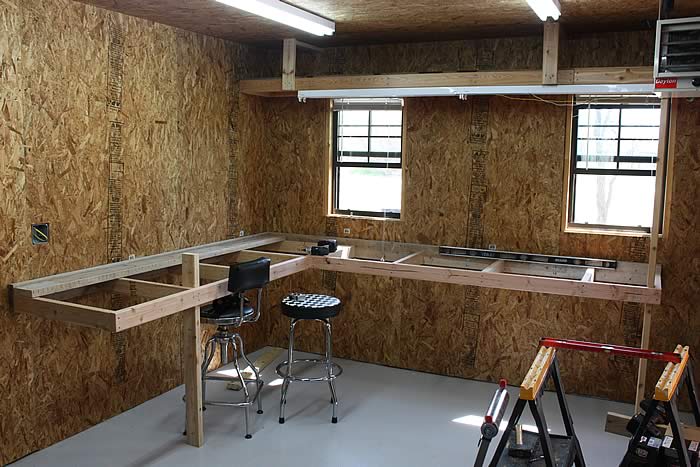
I am working on framing in a section of the wall in my 30x40 pole barn. (The plan is to finish 1-2 a year and eventually I'll have the whole thing done). Anyways, the first section seen here is going to have my main workbench on it.


I have the stud wall built and mounted in position. It is anchored to the main posts of the barn as well as a few L-brackets in the middle of the studs mounted to the wood girts to hold everything straight.

The next step is to plan out construction of the workbench. It's going to span the entire section of wall (just short of 8'). It's going to be 38" high and 20"-22" deep. The construction is going to be pretty standard 4"x4" legs with 2x4 frame and a thick plywood top covered in (hopefully) stainless.

I have enough 4x4 to make 6 posts (3 front and 3 rear) if I wanted to make it a stand-along workbench, but this is going to be permanently positioned, so i want to attach it to the wall.

I am a little concerned that if I have it mounted to the wall, I may cause damage to the wall or framing of the building if I get out of hand with a vice and leverage.. Is that an irrational fear? :headscrat

Now the main questions..

If I do affix the workbench to the wall, what would be the ideal method of doing so? I want it to be as strong as possible, but not sure if I anchor too solid to the wall of I risk damage to the building if a combination of a vice, leverage, and beer are involved.

My ideas:

-Build the framing of the bench right into the wall. The back legs would be internal to the wall and not visible once the plywood is put on the wall. I think this would look the cleanest (less framing underneath), but would be the hardest to build and god forbid if I ever have to move any part of it!

-The next idea I had was to frame the anchor points into the wall similar to above, but all 6 legs would be external to the wall and there would be 5 or so sections of 2x4 protruding from the wall about 4-5" that the bench could be lag bolted to. This should still be very strong and firmly anchored to the wall, but would be removable if needed down the road.

-The last idea would be to build the bench 100% freestanding and just wood-screw it through the wall into the studs in several spots to hold it in place.. This seems like it wouldn't be overbuilt enough for my OCD, but I'm really not sure.

So.. Of those ideas, which would be the best and why? Any other ideas that I haven't thought of yet? I can build about anything, just not sure the best design or something like that.
 
Last edited:
To avoid these ads, REGISTER NOW!

doublearon98

Well-known member
Joined
Oct 7, 2017
Messages
676
Location
Hamton, Arkansas
Cover that section of the wall with osb so you dont ruin your foam insulation especially if you plan to ever grind metal on the bench. Build it freestanding then screw it into the studs. I'd also make me a bottom shelf to sit stuff on and you screw that part into the studs also.

Sent from my SM-G930V using Tapatalk
 

MFolks

Well-known member
Joined
Feb 3, 2013
Messages
1,045
Location
Springfield Mo.
I got a 6 foot Grizzly top, and built a bench to hold it out of 2X4's with 6 wheels and a brake, so I can move the bench around. A hutch creates more space for tools and other items,doubled 2X4's make up the legs.
 

tboy

Well-known member
Joined
May 23, 2013
Messages
149
Location
Central Ohio
I think you are over-estimating the forces you can apply with the vise.

I would finish out the wall as is, then create a workbench and screw it into the studs through your finished wall (will it be drywall?). I like to not have anything on the floor, so I would attach legs at a 45 degree angle that attach back to the wall that support the front. I've built a similar bench and been pretty happy with it, but I did not have a vise affixed. I've had a vise on my free-standing hand me down kitchen cabinets for a while they are not attached to anything but each other, and I've never felt like I could pick them up or move them. I suppose the more weight you add to your bench the sturdier it will be for the vice, and the wall you built should be able to handle it.
 
OP
T

tuner4life

Well-known member
Joined
Aug 24, 2011
Messages
266
Location
Indiana
Ok thanks for the advice!

The wall is going to be filled with r13 and then a vapor barrier. Then 7/16 plywood on the studs covered by white FRP shower paneling. Should be easy to clean and nice and bright.

I am leaning now towards my idea#2. Making the bench basically freestanding, but having a few "framed in" mounts protruding out a few inches so I can easily lag bolt the bench to the wall, or remove it quickly/easily.

Thanks!
 
Last edited:

JABgj

Well-known member
Joined
Nov 11, 2013
Messages
542
Location
So. California
Finish the wall and build the bench freestanding and attach it to the wall and the floor. It may never move again, but if you want to re-arrange your shop, it will be a lot easier.
 
OP
T

tuner4life

Well-known member
Joined
Aug 24, 2011
Messages
266
Location
Indiana
On a similar topic, what if anything would you use on the bottom of the 4x4 posts where they contact the cement. My floor is very level in that area so I don't need adjustable leveling. Most of the benches I see on this forum are just bare 4x4 on the concrete. I don't anticipate water on the floor as this is in the back of the shop, however, there may be the occasional fluid spill. Should I just liberally paint the bottoms to seal them and call it good? Or is there a protective cap or something better?

Again, probably overthinking things.
 

tarmy

Well-known member
Joined
May 28, 2014
Messages
4,672
Location
Nor Cal
This is built in. I finished the walls with 5/8” plywood so I could screw a bunch of things to it. I framed it with backer 2x8 in the attachment areas for the top and lower shelf. Made sure wiring was deep into cavity as well.

I beat hell out of things...love it attached...
C0C2B536-3A02-4498-98D3-85F4A50563A1.jpg
E069DDD2-207E-4336-A2E0-FD1BAD81B495.jpg
 

doublearon98

Well-known member
Joined
Oct 7, 2017
Messages
676
Location
Hamton, Arkansas
On a similar topic, what if anything would you use on the bottom of the 4x4 posts where they contact the cement. My floor is very level in that area so I don't need adjustable leveling. Most of the benches I see on this forum are just bare 4x4 on the concrete. I don't anticipate water on the floor as this is in the back of the shop, however, there may be the occasional fluid spill. Should I just liberally paint the bottoms to seal them and call it good? Or is there a protective cap or something better?

Again, probably overthinking things.
I wouldn't worry about it, especially if they are treated.

Sent from my SM-G930V using Tapatalk
 

JABgj

Well-known member
Joined
Nov 11, 2013
Messages
542
Location
So. California
If you paint the bottom of the legs, there is a chance the paint will stick to the floor. You could use a wide foot to keep things in place, absorb shock and give it a finished look.
 

niget2002

Well-known member
Joined
Oct 2, 2012
Messages
11,123
Location
Josephine, TX
On a similar topic, what if anything would you use on the bottom of the 4x4 posts where they contact the cement. My floor is very level in that area so I don't need adjustable leveling. Most of the benches I see on this forum are just bare 4x4 on the concrete. I don't anticipate water on the floor as this is in the back of the shop, however, there may be the occasional fluid spill. Should I just liberally paint the bottoms to seal them and call it good? Or is there a protective cap or something better?

Again, probably overthinking things.

Get some buckets big enough for the posts to sit in. Fill them with Thompson's water seal and let the legs soak in it over night. The ends of the wood will wick up however much fluid they can soak in.
 
OP
T

tuner4life

Well-known member
Joined
Aug 24, 2011
Messages
266
Location
Indiana
Get some buckets big enough for the posts to sit in. Fill them with Thompson's water seal and let the legs soak in it over night. The ends of the wood will wick up however much fluid they can soak in.

That sounds like a great idea!
 

driftpin

Well-known member
Joined
Dec 22, 2016
Messages
11,229
Location
Miami-Dade/Broward Co. Florida
You could use some pieces of composite on the bottom to elevate the wood after you treat it, something 1" thick should be enough to keep all but a flood from wicking up the wood.

I also am of the 'fasten it to the studs' thinking, or install a ledger in the partition wall, for something easy to locate/fasten to.
 

Stuart in MN

Well-known member
Joined
Sep 8, 2005
Messages
23,088
Location
Minneapolis
I think I'd just lag bolt the back rail of the workbench into the studs, rather than adding any mounts that stick out through your plywood wall covering. It should be plenty sturdy, and then if you rearrange the area in the future you won't have anything sticking out in the way.
 

BFBOB

Well-known member
Joined
Sep 20, 2011
Messages
5,073
I bolted horizontal supports for my bench onto the studs, then bolted diagonals to the extended support at the top and the stud at the bottom. A couple of SYP 2x12's and a 2x6 and the bench was done. Very sturdy, and no obstructions.
 
To avoid these ads, REGISTER NOW!

FTG-05

Well-known member
Joined
Oct 11, 2012
Messages
1,530
Location
TN
I think I'd just lag bolt the back rail of the workbench into the studs, rather than adding any mounts that stick out through your plywood wall covering. It should be plenty sturdy, and then if you rearrange the area in the future you won't have anything sticking out in the way.

This. I've done this a number of times with various benches; they've all held well.

Be warned: These benches then could be considered "part of the building structure" so if and when you sell, the bench could with the house/shop.

In my old house, I had four work benches, all were screwed into the studs. When it was time to sell, I unscrewed three of them to uncouple them structurally (and contractually) from the house and left the fourth. The new owners love this bench (plus the little man cave it resides in).

Good luck!
 

fourjeepin

Well-known member
Joined
Feb 12, 2011
Messages
3,658
Location
Atlanta, GA
On a similar topic, what if anything would you use on the bottom of the 4x4 posts where they contact the cement. My floor is very level in that area so I don't need adjustable leveling. Most of the benches I see on this forum are just bare 4x4 on the concrete. I don't anticipate water on the floor as this is in the back of the shop, however, there may be the occasional fluid spill. Should I just liberally paint the bottoms to seal them and call it good? Or is there a protective cap or something better?

Again, probably overthinking things.

I used a few of the Simpson brackets to bolt the legs to the floor. I didn’t do this at my previous house and lifted the bench a few times with the vise. New house has a much smaller bench but it doesn’t even wiggle bolted to the wall and the floor.
 

techieman33

Well-known member
Joined
Jun 18, 2018
Messages
1,096
Location
Kansas
I used a few of the Simpson brackets to bolt the legs to the floor. I didn’t do this at my previous house and lifted the bench a few times with the vise. New house has a much smaller bench but it doesn’t even wiggle bolted to the wall and the floor.

Attaching to the floor would be my preference as well. Or go into the floor with the front legs, and the wall at the back of the bench.
 

HenryAZ

MEMBER EMERITUS
Joined
Sep 18, 2012
Messages
1,054
Location
South Congress AZ
I prefer my main workbench to be free standing, on locking casters, so I can work all around it. Another bench, my reloading bench, is secured to the studs with two angle irons into the top and the studs. It is also well weighted down well with a supply of extra bullets on the bottom shelf. Any kind of "wiggle" in the reloading process causes powder to spill from shells that are charged with powder but not yet to the bullet seating station.
 

CraigStu

Well-known member
Joined
May 22, 2014
Messages
4,026
Location
Blacksburg, Va
I think I'd just lag bolt the back rail of the workbench into the studs, rather than adding any mounts that stick out through your plywood wall covering. It should be plenty sturdy, and then if you rearrange the area in the future you won't have anything sticking out in the way.
I agree. All you save on not having the rear legs is a couple of 4x4s.
 

Colin Len

Well-known member
Joined
Jan 30, 2013
Messages
1,233
Location
Long Beach CA
Finish the wall and build the bench freestanding and attach it to the wall and the floor. It may never move again, but if you want to re-arrange your shop, it will be a lot easier.
This is 100% the way to go, IMO. If you ever want to move or modify the bench you'll be pissed you have to open up the walls and then finish them again. I got into this situation with an OLD bench in my garage. Ripping it out was a lot harder than expected because it was attached to the studs. And, then once the bench was out I had open framing in that area and finished walls everywhere else where the bench wasn't. Complete pain in the *** which caused my project to take longer and cost more.
 

Falcon67

Well-known member
Joined
Jun 11, 2009
Messages
18,371
Location
Merkel, TX
I used OSB as interior wall covering and the main bench is secured to the wall and studs with lag bolts. It ain't moving. The work room is designed around it, not it around the room. I don't like benches that move or wiggle - if I need a mobile bench, I'd build one.

Bench3.jpg


Bench5.jpg


Bench9.jpg
 

ckucia

Well-known member
Joined
Sep 23, 2008
Messages
370
Location
West Virginia
I think how you plan on using the bench will drive some of the decision.

In my case, I have one I built 15 years ago. 4x7, heavy, four large posts, about waist high, lagged to the wall. This is where my vise is. I do my general heavy, dirty work here. Cutting, beating, heavy stuff. Lower height means I have good leverage, but I have to stand in front of it. I've had engines and transmissions on there and it's seen plenty of beating, cutting, welding and burning.

Also now have two 2x8 benches on the walls with 45 degree supports. High enough I can sit at them with a stool. These are for lighter work like assembly, troubleshooting. Easy to clean under, or find something dropped. One will probably end up with bench power tools mounted.

Then I've added a desk for things like soldering and precision work.

The big bench was all I had for years and I just cleaned and reshuffled as necessary to adapt to various uses. You can make a heavy duty bench work as a light duty/assembly/power tool bench. It's a lot harder to do the reverse.
 

NUTTSGT

Super Moderator
Staff member
Joined
Sep 14, 2009
Messages
50,912
Location
Northern Central Ohio
I used PT 4x4s for the posts of my bench. I have no concern that anything will happen to them in my lifetime.

I built my workbench attached to the wall as it's part of the layout I wanted. I left pat of mine open for storage underneath or leg room to sit at. There is a section I enclosed for fastener storage. If you want to scroll through a few pages and look at some pics, the bench build starts on page 8 on my Garage Refurb thread.. . . just ignore the humor drama on page 8.

https://www.garagejournal.com/forum/showthread.php?t=75024&page=8
 

kbs2244

Well-known member
Joined
Nov 11, 2006
Messages
14,065
I think work benches are the most overbuilt things a DIY guy builds.
Just finish you wall and 10d nail a horizonal 2x4 to it as a support for the back of the top.
(Your multi layer covering will need pilot holes.)

You can support the front edge with your 4x4 legs or use tboy's idea of 45 degree angles down and back to the floor/wall joint.
I have done it that way and liked the way there was nothing to kick as I walked back and forth.

Since I use the under bench space as a parking spot for my roll around work tables the lack of front legs to maneuver around is nice.

I doubt you could afford a vise that would allow you put the force into it needed to damage such a bench.
 

lateapex911

Member
Joined
Dec 1, 2010
Messages
8
Location
Behind my house....
I think work benches are the most overbuilt things a DIY guy builds.
Just finish you wall and 10d nail a horizonal 2x4 to it as a support for the back of the top.
(Your multi layer covering will need pilot holes.)

You can support the front edge with your 4x4 legs or use tboy's idea of 45 degree angles down and back to the floor/wall joint.
I have done it that way and liked the way there was nothing to kick as I walked back and forth.

Since I use the under bench space as a parking spot for my roll around work tables the lack of front legs to maneuver around is nice.

I doubt you could afford a vise that would allow you put the force into it needed to damage such a bench.

Agree.

KISS. Keep it simple.....
Build the frame, lag the back rail to the studs, soup.
I'm another that wants legs (And everything) off the floor...easier sweeping.
(But then I don't believe in open shelves...cabinets for me..I make too much dust.)
 
OP
T

tuner4life

Well-known member
Joined
Aug 24, 2011
Messages
266
Location
Indiana
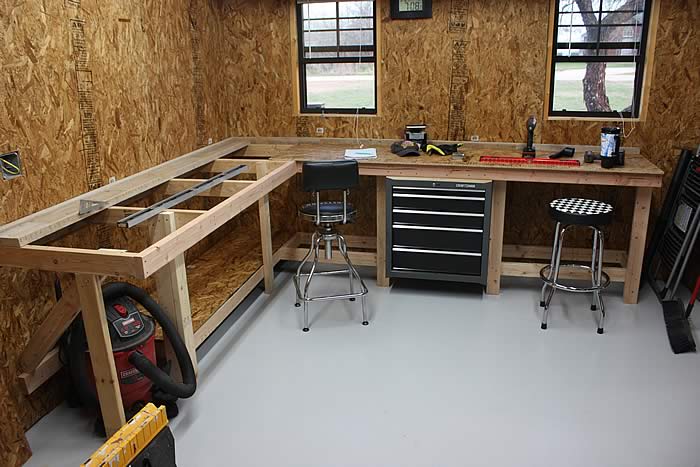
Thanks for all the input everyone! I decided to build it freestanding and will be lag-bolting it to the studs once the wall is finished. It's going to be super heavy, but on the off-chance that I do ever want to move it, I think it'll be nice to be able to do so.

Still undecided on the top surface but the framing is basically done.

 
To avoid these ads, REGISTER NOW!
Top Bottom