Guys!
The wall is done!
I busted my **** to get things finished off by this weekend. A good friend of mine needed some work done on his truck, and was coming in from out of town to have me do it for him. I wanted to have the use of air tools to work on it, which meant I really wanted the hose reel up. That meant I needed to finish the wall. So when he arrived I enlisted his help. I had him stain the remainder of the paneling while I went to work sanding the last few pieces and getting the rest on the wall. It went a lot faster thanks to his gracious participation. It took us a few hours, but before I knew it the wall was finished!

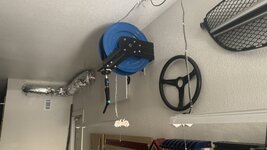
The next step was getting the hose reel up. If you remember, I bought a 50-foot HF hose reel back in October. I've also been slowly gathering parts for the air system, including a filter, leader hoses, and fittings. You'll see in the previous photo I got a little over-exuberant and put up the reel prior to taking the photo. Whoops.
The reel is located just about dead-center of the building and as tight to the ceiling as I dared go. This gives me a lot of flexibility in using it. I can even use it outside the building if I need to.

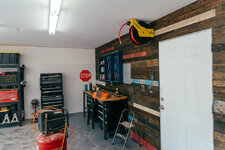
With the reel mounted, I could get to work on the plumbing from the compressor to the reel. I wanted this setup to be simple, robust, and have the smallest number of connections that I could reasonably make. My original plan was to start on the north wall, run about 18 inches, make a 90-degree turn to the east wall, another 90 up from there to the ceiling, the another 90 along the east wall to the filter, then to the hose reel. Unfortunately, my measurements were off. I didn't have enough piping to miss my future cabinets if I had any pipe along the north wall. So instead I cut that section out and moved the whole assembly tighter to the bench. Now I have plenty of clearance around the future cabinets.
Relocating the vise has already come in handy!
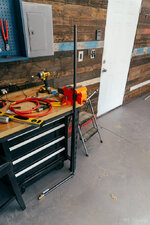
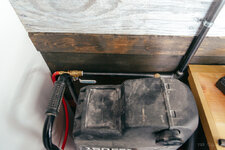
I started with a ball valve and 1/4" NPT adapter for my leader hose, then made the necessary turns to get it above the bench. I went with 1/2" black iron pipe because it's inexpensive, durable, and will help cool the air before the filter. It also fits the aesthetic I'm aiming for. I got all of the pieces from pipe-decor.com, which is quite a bit cheaper than getting parts from the local Lowe's or Home Depot, and it's a little nicer quality too. Still fully capable of handling the pressure as well. The only downside is the longest stretch you can buy from them is 72 inches, so I had to use a coupler to get the necessary extra length to reach the reel.
The entire thing was assembled on the bench prior to hanging it on the wall, then we lined it up and used 1/2" conduit clamps to secure it to the wall. The clamps worked really well, but I do need some larger ones to secure the ball valve and the filter. Once the assembly was on the wall, I attached the leader hose to the filter and ran it to the hose reel.
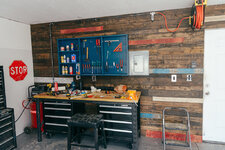
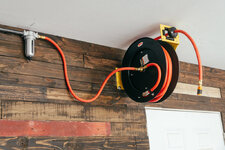
With that done, I added the new fittings at either end. I went with
@Stedlin for these, and I'm so glad I did! Excellent quality and hooking/unhooking tools is a breeze! Plus the Quietplug male fittings really cut down on that big
**** when you disconnect a tool. They're a minor things that make a really big difference.

I hooked up the compressor and opened the bell valve, and what do you know! No leaks! Huzzah!
Now that all that was done, we cleaned the shop thoroughly. All the tools were put away, the floor was swept and vacuumed, and the new air hose helped clear the dust off everything. What a difference this all made. I really think that the overall feel of the workshop is starting to come together now how I imagined it would be. Plenty more to do, but It's definitely coming together.

Anyway, enough admiring! Let's get to work!
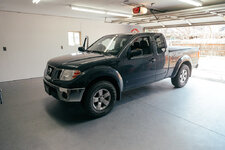
Here is our weekend project, a 2nd generation Nissan Frontier 4x4. My friend bought this truck on my recommendation about a year ago.
 WARNING: DERAILMENT
As some background, I owned a 2005 Frontier for just about six years and did an extensive amount of work on/to it. Suspension, bumper, lighting, winch, onboard air compressor, storage, the lot. I built my first auxiliary electrical system on this truck. I did plenty of repairs and upgrades, getting very familiar with the platform. We also took it to a lot of really amazing places.


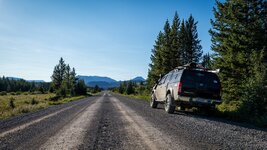
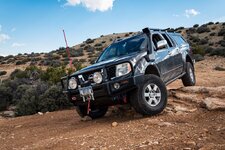

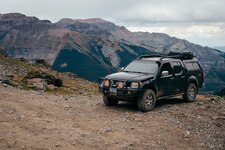
Fun little trip down memory lane.
Anyway, with all my experience on the truck I offered to do the necessary work. It needed new ball joints, and the shocks were badly worn. To replace the ball joints, he opted to just replace all four control arms, as the bushings were likely past it and replacing the control arms is actually simpler than doing ball joints. That's the theory anyway...
Since that work was getting done anyway and he wanted a little more ground clearance for our hunting trips, I suggested replacing the suspension with an Old Man Emu kit, which would raise the truck about 1.5", allow for heavier loads, and improve the ride. He got the parts and drove in from Helena, about four hours away, on Friday night after work.
We got going on Saturday morning by finishing the shop wall (thanks Graham!), then pulled the truck in and were able to start work on it after lunch. What I did not remember was that despite the low mileage, Graham's truck is rusty. It came out of Ontario, Canada, and after 70k miles of that environment, it was a little worse for wear. As such, what I thought was going to be a long afternoon project ended up becoming a two-day ordeal.
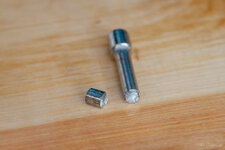
Here's a good indicator of how the weekend went:
But I'm getting ahead of myself.
We started by getting the front jacked up and on stands. From there, we removed the wheels and started in on removing the shock/spring assembly. From there, we could swap each control arm, swap over the old shock hardware, then reassemble and realign. Then we could move on to the rear.
The front shock assembly is held in by four fasteners. Three 14mm nuts at the top and one 19mm bolt/nut combo on the bottom. I went after the top nuts first and was
shocked (buh-dum-tss) by the effort required to remove them. They're torqued to 58 ft-lbs, but I was struggling to remove them at all with my 18-inch ratchet. Some penetrating oil and heat helped, but they were still an absolute bear to remove. Once I had the top nuts taken off, I shifted to the bottom of the shock. The 19mm bolt is somewhat famous for being a pain to remove, but this was something else. I ended up shearing off that 3/8 extension on it. I tried a 1/2 ratchet. Nope. Penetrating oil. Nope. Fire. Nope.
Okay, new plan.
We stopped off at Harbor Freight so I could get a 24-inch breaker bar, then over to Ace to get a 6-point socket as the nut was trying to round off. Again, fire! Nope. Penetrating oil! Nope. Smack it with a hammer! Nope. Impact! Nope. Big breaker bar! Nope.
Damn.
This wouldn't be such a big issue, but the lower bolts cannot be destroyed. They have a shoulder on them that eliminates the play between the bushing and bolt, so a regular hardware store replacement isn't a great option. It will allow just enough slop for the suspension to make noise and behave strangely, as all that weight of the front end is on those two bolts.
We switched gears to think about the problem, and Graham worked on removing the two large bolts holding the lower control arm to the frame while I worked on freeing the lower ball joint to detach the control arm from the spindle. During this process, I discovered the lower ball joint could not be removed from the spindle unless the CV shaft was removed, so we had to also pop the upper ball joint and suspend the spindle with a bungee cord.
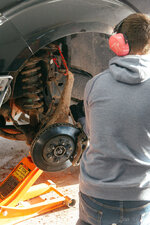
Right. With the CV out of the way, I attempted to finally remove the lower shock bolt. No joy after several minutes of heaving, swearing, and shouting. We decided that the only real way forward was to drop the LCA with the shock attached and try to remove the bolt while it was on the bench. Great, two minutes later I freed the lower ball joint. Now all that's left is to pop the LCA frame bolts out and pull the arm out.
Problem: the LCA bolts were seized. Stuck. Affixed.
Rust-welded. The rust had caused the bolts to essentially bond to the inner sleeve of the bushings, meaning we could not remove them. And thus could not remove the control arms. Awesome. The good news here is that we have replacement LCA bolts. Since the truck was being lifted, we had alignment bolts that needed to go in, so the old ones didn't need to be reused, and we weren't reusing the LCAs. So we did the only sensible thing we could do.
We broke out the sawzall. But not before making a run to Ace Hardware to pick up one of these nasty SOBs.
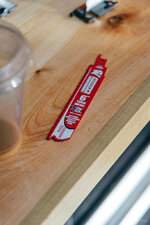
This was one of the more unpleasant tasks I've had to do on a vehicle, but we made it happen and by the end of the night, we had this on the bench.
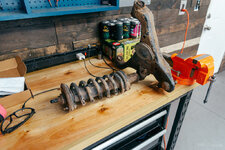
You can see in this photo the stack of payment I received for this job. That, and a bottle of Woodford Reserve.
By the end of day 1, I was joking with Graham that it may not have been sufficient.
To be continued...


 ) - it's just bolted on, so it's a 10 minute job, and will save you $50 and an hour's work putting on a new hose in a few years time.