To avoid these ads, REGISTER NOW!

Tool battery size and interchangeability

Tynee

Well-known member
Joined
Sep 19, 2016
Messages
979
Location
In the Heart of the Bluegrass
Good morning. AEAdam said something in another thread that triggered a question that's always bothered me. Do most battery tool brands: Makita, Milwaukee, Bosch, Dewalt, Rigid, and Ryobi principally, really design their tools to work with every battery they sell? In other words, within a given platform, will the impact driver and the track saw really both perform to their best performance, regardless of what battery you put on them? Just because it will physically snap on to the tool doesn't really seem to indicate you'll be able to accomplish a given task with the higher demand tools. It seems like the only difference should be run time, but he and I both feel like that's not true with all brands.

An example: if I'm cutting with my track saw and my 8ah battery dies, I want to be able to pull the 2ah off my impact driver that's hanging off my tool belt already and keep cutting. AEAdam and I contend that you can do this with some brands and not with others. Some brands, you'll only get a partial cut out of a fully charged 2ah battery on the track saw while other brands seem to soldier on. The entire time I've owned my battery tools, I've felt like the circ saw was basically useless. Is that because I bought the wrong brand and the circ saw really is junk in my brand, is it because there's something wrong with my specific tool, or is it because I haven't sprung for the gigantic lump of battery that never comes in any of the combo packs?

@AEAdam, feel free to chime in here...
 
To avoid these ads, REGISTER NOW!

dnschmidt

Well-known member
Joined
Oct 3, 2014
Messages
7,260
Location
Phoenix, AZ
2A-hr packs will not power a high demand load from any brand that I know of. 2 A-hr packs are for small impacts and drills not circular saws. Now a 1.7 A-hr stacked lithium Powerstack Dewalt battery might be able to make a cut or two because of the high discharge rate possible with stacked lithium but these aren't going to be able to last very long. The giant lump of a battery is there for a reason. It's unreasonable to expect what is normally a 15A corded power tool to be able to be powered by an undersized battery. For this application a 6 A-hr Forge battery is my bare bones lower limit with the 8 A-hr Forge being preferred on my Milwaukee saws.
 

Pexto

Well-known member
Joined
May 5, 2018
Messages
637
+1 to what @dnschmidt said.

It boils down to how much current the battery can provide. The lower-capacity batteries generally have only a single set of cells in series. A small 18V battery will have 5 individual batteries in series, so the maximum current draw is the same as what one individual battery (often an 18650) can provide.

Somewhat larger battery packs have 10 individual cells; two sets of five (5S2P). So the maximum current draw is twice that of the smaller battery pack.

In addition, the larger packs will have larger individual cells (like a 21700) which can support higher current draw. The net result is that a 6Ah pack might be able to provide about 3 times the current that a 2Ah pack provides.

On some tools (like 1/4" impacts) it doesn't matter much. But for some tool it matters a lot. My little 12" Dewalt chainsaw will cut decently with a 4 or 5 Ah battery. But if I use a 6Ah or better yet 8Ah, it cuts noticeably faster. Same thing with my 7 1/4" circular saw and miter saw.

The electronics in the tool and battery have some effect on this as well. I can't speak for any brand other than Dewalt, but some of the tools will start shutting down if the battery can't provide enough current. With my circular saw in particular, if a smaller battery starts running a little low (roughly half-capacity), the saw will cut fine for a second or two and then stop completely. It's the electronics in the saw that are shutting the saw off. When that happens I can take the battery off the saw and continue to use it just fine with a drill or impact.
 

david3921

Well-known member
Joined
Apr 22, 2014
Messages
427
Location
Wyoming, Michigan
Torque Test Channel does a really good job of showing tool performance based on battery size. They'll even put a better battery from a different brand with an adapter to show what's possible.
 

WildBill

ALLIANCE MEMBER
Joined
Aug 20, 2021
Messages
1,976
Location
PNW
I notice this a lot on my Ryobi and Milwaukee tools, for whatever reason not as bad on my Makita stuff. Obviously a skillsaw isn't going to run as long on a smaller capacity battery, but it doesn't seem to also drastically reduce the power on my Makita stuff like it does on the other two.
 

finn

Well-known member
Joined
Mar 27, 2005
Messages
16,179
Location
The UP, God's country
TF you doing buying 2AH batteries?
My wife hung new blinds in the guest bedroom this morning.

Remove six screws.

drill three new pilot holes

install six screws

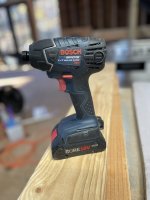
She did it with a little 12 v Bosch driver. Probably a 1.5 or 2 Ah
battery. Maybe less.

I didn’t realize I was obligated to tell her she was supposed to to be using the M18 with the four pound 8AH battery.

Sorry boss. I’ll do better next time.

Seriously, I always choose the smallest, lightest battery that will do the job. Run time doesn’t mean much to me most of the time.
 

johnre

Well-known member
Joined
Dec 1, 2016
Messages
1,040
Location
Portland, OR
I always choose the smallest, lightest battery that will do the job. Run time doesn’t mean much to me most of the time.
For something like a drill or 1/4" impact driver, I agree - I don't like the bulk or mass of, say, a 5 Ah battery. It's too heavy to carry around, and a liability in confined spaces.

But there are a finite number of charge / discharge cycles in a given battery pack, on top of what others here have already said about capacity and run time. Use too small a pack, and you be constantly swapping batteries and shortening their life.
 

finn

Well-known member
Joined
Mar 27, 2005
Messages
16,179
Location
The UP, God's country
For something like a drill or 1/4" impact driver, I agree - I don't like the bulk or mass of, say, a 5 Ah battery. It's too heavy to carry around, and a liability in confined spaces.

But there are a finite number of charge / discharge cycles in a given battery pack, on top of what others here have already said about capacity and run time. Use too small a pack, and you be constantly swapping batteries and shortening their life.
The small batteries are pretty cheap, so it’s a wash.

I can’t recall replacing any lithium batteries, and I probably have six or more platforms. That wasn’t true with the old NiCads, though.
 

subroc

Well-known member
Joined
Apr 22, 2017
Messages
779
Location
Dover, NH
Good morning. AEAdam said something in another thread that triggered a question that's always bothered me. Do most battery tool brands: Makita, Milwaukee, Bosch, Dewalt, Rigid, and Ryobi principally, really design their tools to work with every battery they sell? In other words, within a given platform, will the impact driver and the track saw really both perform to their best performance, regardless of what battery you put on them? Just because it will physically snap on to the tool doesn't really seem to indicate you'll be able to accomplish a given task with the higher demand tools. It seems like the only difference should be run time, but he and I both feel like that's not true with all brands.

An example: if I'm cutting with my track saw and my 8ah battery dies, I want to be able to pull the 2ah off my impact driver that's hanging off my tool belt already and keep cutting. AEAdam and I contend that you can do this with some brands and not with others. Some brands, you'll only get a partial cut out of a fully charged 2ah battery on the track saw while other brands seem to soldier on. The entire time I've owned my battery tools, I've felt like the circ saw was basically useless. Is that because I bought the wrong brand and the circ saw really is junk in my brand, is it because there's something wrong with my specific tool, or is it because I haven't sprung for the gigantic lump of battery that never comes in any of the combo packs?

@AEAdam, feel free to chime in here...

In what way is your battery powered circular saw "basically useless"? What kind of work makes it useless? What make/model saw?

You can find all kinds of cut tests for circular caws on YouTube that demonstrated how many cuts a saws will make with a given battery. Both (brushed and brushless) Dewalt 6-1/2 as well as Dewalt 7-1/4 saws can easily be found there.

I have not found them to be useless. Truth is, as a DIYer,I like the performance I get from my circular saws.
 

AEAdam

Well-known member
Joined
May 27, 2023
Messages
2,703
Location
SE PA
My Bosch 18v tools are now all 10yrs old and have seen hard use. The batteries are also 10yrs old and have been in unheated space and used yr round.

I suspect when my tools were designed, there weren’t high amphr batteries around. So I’m telling you all my Bosch 18v tools run fine with 1.5 amp batteries. I don’t know why. I don’t understand how batteries work.

I think, like impact guns, the last 10yrs, manufacturers have made cordless tools more and more powerful, and maybe those high hp motors need bigger batteries?

example: if I’m cutting a thick tough material, I assume my old 18v circ saw would bog down. But if I’m cutting plywood all day, and my saw can do it with a 1.5 battery, I don’t think a more powerful saw will perform as well with a 1.5 battery. I assume it’s because the higher hp motor in the newer saws requires a bigger battery?

I said it at the time and I’ll say it again: manufacturers are using these extreme tasks and hp specs to get the upper hand in marketing, when the reality is users don’t need the extra power. A carpenter isn’t ripping 2” thick kiln dried oak all day with his cordless circ saw. My saws mostly see 2X softwoods and 1/2“ & 3/4” Osb. I like being able to run all my tools with the same small batteries.

The context of my original remarks was, manufacturers try to sell us their tools on specs they created (like run time or hp). And one tries to up the other. But those aren’t necessarily attributes users need. But many people don’t know what they need. So maybe they read an article or watch a tool review. And the tool reviewer just reviews the manufacturers claims.

For practical carpentry, being able to run every single tool off the same small battery pack is a huge advantage. My guess is, this isn’t possible with Milwaukee, who focus on higher power tools. It might be possible with Bosch or Makita
 
To avoid these ads, REGISTER NOW!

mike93lx

ALLIANCE MEMBER
Joined
Dec 9, 2013
Messages
37,336
Location
Richmond, VA
TF you doing buying 2AH batteries?
I use my 2ah batteries far more than any of my 4-8ah batteries, mainly because I use my drills and small impacts more than my circ saw, recip saw, router and big impact wrench

If an impact is hanging off my pocket or belt while going up and down a ladder or moving around a building, I'll gladly take the lighter weight
 

Firebrick43

Well-known member
Joined
May 12, 2015
Messages
13,971
Location
West central Indiana
My M18 7 1/4” fuel saw in thick lumber will have more power with a 9 or 12 ah battery on the last cut before the battery shuts down for recharge than a fresh 5ah battery will just off the charger. You can feel how drastic the difference is when cutting stair stringers or (3) sheets of 5/8 osb gang ripped.
 
OP
T

Tynee

Well-known member
Joined
Sep 19, 2016
Messages
979
Location
In the Heart of the Bluegrass
In what way is your battery powered circular saw "basically useless"? What kind of work makes it useless? What make/model saw?

You can find all kinds of cut tests for circular caws on YouTube that demonstrated how many cuts a saws will make with a given battery. Both (brushed and brushless) Dewalt 6-1/2 as well as Dewalt 7-1/4 saws can easily be found there.

I have not found them to be useless. Truth is, as a DIYer,I like the performance I get from my circular saws.
Basically useless as in, it won't make a full cross cut through a pine 2x4, it won't break down sheets of 1/2" plywood, etc.

It's an older Rigid. Note here that I'm not claiming all battery circ saws are useless, I've used dewalt and milwaukee that ran great. I'm just saying MINE has never been a tool I could rely on. That's all beside the point of this post, though. I really just wanted to see some discussion on whether some tool brands tried to be sure that all their tools would run on the smaller batteries, and others wanted you to buy their $200+ high-end batteries to run higher demand tools
 

theoldwizard1

Well-known member
Joined
Feb 22, 2011
Messages
43,073
Location
SE MI
My wife hung new blinds in the guest bedroom this morning.

Remove six screws.

drill three new pilot holes

install six screws

She did it with a little 12 v Bosch driver. Probably a 1.5 or 2 Ah
battery. Maybe less.
This is why I have an M12 non-Fuel 3/8" drill and an M12 driver in the laundry room !
 

sk farmer

Well-known member
Joined
Mar 4, 2009
Messages
5,550
Location
nd
in full transparency, i own and use mostly 20v max dewalt. i have saws, drills, impacts, grinders, inflaters, vacuums, blowers trimmers, you get the idea. i own and use. 1.7 power stacks, 2 ah, 3 ah compact, 4, 5 and 6 ah full size batteries.

all batteries will power all tools and do it sufficiently to finish a job. there is no doubt that certain tools require more power and smaller batteries will drain faster or may have less power but they will certainly run them. i am more of the camp that if a smaller lighter battery will do the job that is what i grab.

i will almost always use a large battery on my string trimmer for 2 reasons. i feel it balances the weight better and i don't want to walk a couple hundred yards back to the shop if i run out of juice on the far end of the yard. on the other end, i rarely use a large battery on some of my more compact tools. they are lighter and smaller for a reason, why use a massive battery?

i also have a few dewalt 12v tools. for most tasks they are sufficent and are actually a joy to use. they are either in the house or at the lake. who wants to stand on top of an 8 foot step ladder mounting a light fixture with a huge tool and a battery the size of a cement block over your head or leaning over a balcony?
 

AEAdam

Well-known member
Joined
May 27, 2023
Messages
2,703
Location
SE PA
I use my 2ah batteries far more than any of my 4-8ah batteries, mainly because I use my drills and small impacts more than my circ saw, recip saw, router and big impact wrench

If an impact is hanging off my pocket or belt while going up and down a ladder or moving around a building, I'll gladly take the lighter weight
EXACTLY. THANK YOU. And when the saw I am using craps out, I can yank the battery off my impactor and carry on as before.

If a tool was designed to really only run on, say, 3 or 4 ahr batteries, and your drill drivers all run on 2, what is the advantage of having them all the same brand?

I don’t want 3 or 4 amp hr batteries on my drill drivers because they are heavy and clunky and catch on stuff. Exception: Bosch CORE batteries that are nearly as small as 1.5 amp, but deliver 3 amp.

Again, the tool selection criteria, the key requirements, are not more power and longer lasting batteries. Those are nice. But balance, small batteries, truly interchangeable batteries are all more important to many of us.

IMG_8683.jpeg

Correction: The CORE batteries are 4amphr. Even better.
 
Last edited:

Sal Bandini

Well-known member
Joined
Aug 30, 2012
Messages
989
RC hobbyists are familiar with C ratings of batteries. That is what you are seeing with high current tools working better with higher capacity batteries versus lower capacity.

All things being equal an 8Ah battery will have greater current flow than a 2Ah battery.
 

MongoTA

Well-known member
Joined
Mar 10, 2018
Messages
990
Location
CT
Some batteries lose a bit of their capacity after years of charging cycles. I can't speak to all brands, I only have Dewalt 20v and FLEX20 batteries, and Milwaukee 12/18v. Those two brands work well for me, I've never noticed a reduction in the performance of any of my batteries, and I've had some for well over a decade. There could be some creep, but I have never popped a fully charged battery on a tool and thought it was inadequate.

You're aware it makes sense to match the battery capacity to the tool. You're also aware that battery weight can be an issue. So sure, a drill/driver/impact? A tool like that can run on a smaller 2Ah and be happy. If I try to run my circular saw or angle grinder on it, something where it it running continuously versus intermittantly? I'll get some action, but I fully anticipate the battery will draw down sooner rather than later.

Pushing a cut where the motoro bogs down? That'll run the battery down as well.

My circ saw will run on a 2Ah battery, and it'll cut splendidly well, but not for long. My impact driver will run for several days on a 6Ah battery.

I have a mix of batteries, and if I'm on the road and only have one backup battery, it'll be a larger battery versus a smaller one. I know the larger can run any tool well, though it might be more bulky and heavier.
 

sk farmer

Well-known member
Joined
Mar 4, 2009
Messages
5,550
Location
nd
i wont argue that a larger battery will run longer and have more "juice".


but at the end of the day. if your the battery will do the jo at hand, do you really need a larger battery.


if i am running an impact driver or impact wrench and a 2 or 3 ah battery will get you til coffee breek or noon. is there an advantage to running a larger , heavier battery all day.


9 of 10 times if the smaller ones gets the job done, i prefer it.
 

GeoBruin

Well-known member
Joined
May 5, 2018
Messages
3,732
This particular discussion, unlike some here, can really be boiled down to the math.

The Instantaneous power (watts) a battery can deliver is a function of the voltage (volts) and the current (amps). If the battery has a low charge (low voltage), the watts will be limited. This is the easiest one to understand.

High current demand will result in voltage sag, which will also effectively lower the voltage, and result in lower power. But, how much voltage sags under load depends on several things, which makes it harder to understand. Ultimately, the battery pack's internal resistance will dictate how much voltage will sag under load. That, in turn, can depend on the number of cells in parallel vs series as described by others (more cells in parallel for a given voltage means lower resistance), but it can also depend on other factors like the resistance of the tabs connecting the cells (larger tabs mean lower resistance, tabless designs have even lower resistance) or the battery chemistry (NMC, LCO, LiFePO4, etc.)

In short batteries with chemistries that support higher discharge rates, other features like tabless construction, or simply packs with a larger number of cells in parallel will sag less under load, resulting in higher power delivery capability.

All that said, different manufacturers also have different safety mechanism built in to their batteries, the tools themselves, or both, which can affect the perceived performance. If the tool or battery shuts down when voltage drops below a certain threshold, that will effectively limit how much power a battery can deliver. Similarly, if a tool or battery shuts down above a certain temperature threshold, that will be a limiting factor. Since the heat generated is a function of resistance, this can be traced back to the discussion above.

The sum of all these factors will dictate the total perceived power of a given tool/battery combo. A circular saw placing a large current demand on a single stack battery pack will result in a voltage sag, which will result in lower felt power. One brand may permit a lower cut off voltage, allowing you to experience more of that performance degredation while another may shut off at a higher voltage, resulting in a sense that it was still delivering more power up until the point it "died".
 
Last edited:
To avoid these ads, REGISTER NOW!
Top Bottom