To avoid these ads, REGISTER NOW!

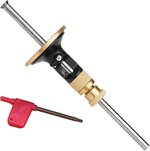
Tool for marking holes from edge of material.

To avoid these ads, REGISTER NOW!

neophyte

Well-known member
Joined
Apr 23, 2012
Messages
9,812
Location
Pennsylvannia
The old fashion method would be to use a marking gauge, or hermaphrodite caliper, to mark a line from the edge,
And then, to use a set of dividers to mark even spaces along the first line.
 

Attachments

  • IMG_3752.png
    IMG_3752.png
    1.4 MB · Views: 43
  • IMG_3751.png
    IMG_3751.png
    1.4 MB · Views: 28

RoninB4

Well-known member
Joined
Jul 22, 2020
Messages
3,627
Location
Under My House
It might help to define what you'll use this on/for. A large part of what would be best for you is the expected level of accuracy, Is it for woodworking or metal?. Is the hole for a wood screw, a clearance hole, a geometric detail, a dowel pin, or a critical location? Not trying to be overly fussy here, it's just that each of those examples I listed call for a different level of accuracy or a different method to ensure success in the operation.

As an example, I wouldn't try to layout two dowel pin holes on different plates and expect them to line up well. However, if I clamp both plates together I can put dowel pin holes anywhere (drill in assembly) and expect good alignment even by using a drill press.

Example 2, if edges of two different plates need to be flush I might leave a little extra on one to be trimmed off after assembly rather than trying to be dead accurate from a finished edge.

My default answer about layout tools is use a calculator (center of hole distance), a good ruler (scale), and a scriber. For inside corners I'll sometimes use an adjustable parallel after compensating for scribed line thickness. More info from the OP would net a better answer.
 
OP
R

rattle_snake

Well-known member
Joined
Jun 25, 2015
Messages
5,245
Location
Chandler, AZ
Mostly metal. I often want a series of holes centered on a 1" flat bar, for example. So 1/2" in from the edge. Or a corner, 1/2" in from both sides. Use a sharpy or a punch to mark center.
 
OP
R

rattle_snake

Well-known member
Joined
Jun 25, 2015
Messages
5,245
Location
Chandler, AZ

RoninB4

Well-known member
Joined
Jul 22, 2020
Messages
3,627
Location
Under My House
Mostly metal. I often want a series of holes centered on a 1" flat bar, for example. So 1/2" in from the edge. Or a corner, 1/2" in from both sides. Use a sharpy or a punch to mark center.
-I bought a cheap 6 inch dial height gauge like this a long time ago for lay-out work like that. It has a carbide edge that can last for decades if used carefully. A magic marker, a surface plate, and a light touch makes clear scribed lines quickly that are more reliable than most other methods. It's faster and more accurate than a combination square.

1727293917615.png
 

niget2002

Well-known member
Joined
Oct 2, 2012
Messages
11,269
Location
Josephine, TX
I use combination squares quite a bit. Adjust the ruler part for the distance from edge, then hold the marking tool to the edge of the ruler as I slide it down the length of the material. Then I use a tape measure to mark the regular distances along that line.

They work well for most of my work. There's many many more much accurate methods that I've also used when needed. Calipers, etc.


cannuck

Well-known member
Joined
Nov 30, 2021
Messages
4,663
Location
Rural SK
I use the notch conveniently placed at the end of the rule on every machinists layout square. Coat workpiece with layout blue, set depth on scale of rule, slide square along edge with scribe parked in the notch. If flat bar, do a line (SCRBIED line - I don't do drugs) from each side to validate layout.
 
OP
R

rattle_snake

Well-known member
Joined
Jun 25, 2015
Messages
5,245
Location
Chandler, AZ
shopping
 
To avoid these ads, REGISTER NOW!

RTM

Well-known member
Joined
May 13, 2019
Messages
13,269
Location
SF Bay Area
The old fashion method would be to use...., hermaphrodite caliper, to mark a line from the edge,
And then, to use a set of dividers to mark even spaces along the first line.
So, ignorant question, how does one ensure the hermaphrodite caliper stays even? Does one trace exactly on the top edge of the plate, count on the flat spot on the leg staying square, or ??

Thanks
 

lilredex

Well-known member
Joined
Apr 29, 2006
Messages
5,956
Location
Toronto
Make one, if this fits the bill.
 

Attachments

  • Edge Scriber - Marking Gauge.jpg
    Edge Scriber - Marking Gauge.jpg
    477 KB · Views: 30

neophyte

Well-known member
Joined
Apr 23, 2012
Messages
9,812
Location
Pennsylvannia
So, ignorant question, how does one ensure the hermaphrodite caliper stays even? Does one trace exactly on the top edge of the plate, count on the flat spot on the leg staying square, or ??

Thanks
Use of a hermaphrodite caliper to scribe a line parallel to an edge is not “idiot proof”.
It’s best done on straight or gently curved edges, and requires practice.
In theory, the scribed line can be “too shallow” in relation to the edge, but never “too deep”, as long as the non-scribing leg is on the edge being scribed.
Technically, you could just scribe a bunch of arches from the edge, and connect them with a ruler, but that is more of a pain in the ***.
Arches from the edge can be used to check you didn’t skew the caliper when scribing, and make the line too shallow.
 

cvairwerks

Well-known member
Joined
Aug 12, 2016
Messages
7,266
Location
Within hearing distance of Texas Motor Speedway
A machinist square, scribe, a flexible rule and layout dye is the easiest. With quite a bit of practice, you can hold the scribe between your thumb and index finger and use your 2nd finger as an edge guide and pull a very good, parallel line to the edge. Used to pull rivet lines by marking end rivet locations and using this technique with a china marker on bulkheads and panels. For the ones that couldn't do it, a screw compass and marker worked as well.
 

speed bump

Well-known member
Joined
May 28, 2008
Messages
6,317
Location
Butte Montana
I use a square for marking offset lines, set to the offset you want and pull a line.

For sheet metal I have a scriber.

You can also buy speed squares with slots for a marking device.
 

bugnut

ALLIANCE MEMBER
Joined
Jul 14, 2012
Messages
4,014
Location
Central Ohio
Couple items come to mind.
We used white dressmakers elastic about an inch wide with marks equally spaced for laying out holes on sheet metal. The stretch allows for equidistant spacing. Do not recall the accuracy but it worked.
Second was a 4r ruler 1" wide with a precision hole at centerline of the 1" mark. Hole was 1/16" so a transfer punch placed in hole could be set at any variable edge distance. This worked very well but was not jig borer accurate.

I like the black tool in your image.
 

danielbuck

Well-known member
Joined
Apr 15, 2014
Messages
934
I slide a small combo square along the edge while holding a fine tipped marker (or sometimes scribbe). then if I need evenly spaced holes, use a rivet spacer/fan/thing
 
To avoid these ads, REGISTER NOW!
Top Bottom