To avoid these ads, REGISTER NOW!

Tools on Casters

rodwerkz

Well-known member
Joined
Apr 3, 2006
Messages
46
Location
bayonne nj
I just finished a build up of a HF based bead roller. I would like to make it movable but HATE tools on casters. Especially tools that you "work" like a sheet metal tool. They always end up moving on you when you try to work with them. At the very least they rock or shake.

I know alot of the english wheel folks build caster legs which you essentially screw down when you want to move the machine. Essentially the machine sits on it's base when the casters are not down. An e-wheel is a machine where you absolutely cannot tolerate any machine movement.

I was thinking of these two possible solutions:
1. Put not swivel casters on the back of the machine and have the front rest right on the ground. you would essentially move it by lifting the front of the machine up a bit and then dragging it on the rear casters.
2. Use stem type swivel casters. The 4" variety can be had with a 1/2-13 stud that is aproxmiately 1 1/2" long. I figured i could weld a nut onto my machine base. thread in the caster and then weld a nut onto the stem end. you could then raise the machine on the stem caster by screwing it down by about a half an inch.

What do you guys think? I'd love to see pics of some alternative solutions.
I don't want to put a whole log of fab or money into this contraption if possible.
 
To avoid these ads, REGISTER NOW!

Ign

Well-known member
Joined
Jul 7, 2006
Messages
12,769
Location
Butte Peak ND
My contractor who put up my shop (steel) has a sweet workbench in his shop. He built a hinged mechanism which levers down wheels, thus lifting the bench at the same time of course. IIRC it drops two wheels, then you go to the other side to drop the other two (a mechanism which dropped all 4 at once would be impressive but arguably not worth the effort). Of course this'll take a bit of engineering to get the lengths and pivot points right, but it could be determined. The advantage is that it's largely tool-less: lever down, lock in place, roll around, unlock and drop it to the ground.

Just what does your bead roller look like? I just figured out the best way to move my workbench is to slide my newly acquired pallet jack under it (basically same concept as I described above but self contained).
 
OP
R

rodwerkz

Well-known member
Joined
Apr 3, 2006
Messages
46
Location
bayonne nj
Hi there - A pivot assembly like that would be pretty cool but would take a bit of work and figuring...

I don't have a picture of mine but it is a similar buildup to the ones in this link. It doesn't have a power feed at this point. The upper portion weights about 150lbs. The whole machine probably weights 300.

http://www.metalmeet.com/forum/showthread.php?t=6692
 

Rickster

Well-known member
Joined
Jun 26, 2005
Messages
6,218
Location
SE PA
Instead of making each piece of shop equipment mobile, why not build or adapt a single cart/dolly that could move all the pieces. Maybe with a bottle jack that could raise up a notched 4-point bracket and then lift various pieces off the floor so the could be repositioned for work/storage and still have the stability of no casters.
 

TEXACMAN

Well-known member
Joined
Feb 6, 2006
Messages
284
Location
Mount Pleasant Texas
:thumbup: I have a motorcycle jack that I bought at Sears around $100 , I am going to put a couple cross braces in the center of my workbench to help move it when I want . Maybe it would work on other stationary tools?
 

jvo

Well-known member
Joined
Mar 1, 2005
Messages
51
Location
Lethbridge, AB Canada
I built my e-wheel with solid castors mounted on the back of the back legs. Built a small dolly out of half a skateboard that my kid broke in two many years ago, that I couldn't bear to throw away. The front leg (its 3 legged) has a small plate on the front of it with a hole in the front. The dolly has a pin on the front of it that engages this hole. I roll the dolly up to the front of the e-wheel leg, lift the 3 foot long handle, so as to engage the pin on the dolly into the hole on the front of the leg. Push handle down, which lifts up the front leg, and pull it around the shop wherever I need it. The back legs sit solidly on the floor also, till lifted. My floot isn't painted, and if it were, the back legs would scratch it slightly, as they drag occasionally because the floor has some low spots in it. If I didn't want the back legs to drag, I would make the rear caster mounting brackets longer, which would raise the back legs off the floor more when the front leg was lifted. There are some pictures of this contraption on the MetalMeet site in the e-wheel section.

I thought about doing the screw down legs, but I'm basically lazy and if it takes too much screwing around, I know I would never move the e-wheel to clean behind it. I can move mine in a few seconds.
 
To avoid these ads, REGISTER NOW!

66RICH

Well-known member
Joined
Feb 28, 2006
Messages
79
Location
Portage, IN
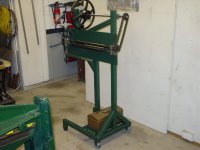
I use fixed castors in the rear, and rubber feet in the front. I
use an extendable arm to lift, and steer it when needed. It
is very stable while in use.
Good luck, Rich

check out the metal meet site, great info!
 

Attachments

  • beadone.JPG
    beadone.JPG
    42.7 KB · Views: 154
  • beadfour.JPG
    beadfour.JPG
    35.5 KB · Views: 78

Mike F

Well-known member
Joined
Jan 28, 2006
Messages
197
Location
Long Island, NY
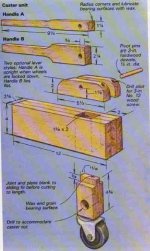
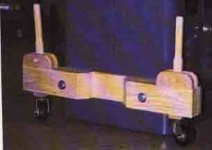
When I initially got my contractors saw, I bought one of the mobile bases for it, which had 2 non-rotating wheels and 2 rotating wheels with locks. http://www.htcproductsinc.com/mb.htmlIt was not as stable as I would like. Well, I have since built a large cabinet that stands on the floor, but I needed to make it mobile, so I came up with (or read somewhere about ) this system. As you can see, it is simply a 2 1/2" board with heavy duty casters mounted on it. I drilled a hole where the arrow is to allow a piece of pipe to fit in and act as a lever. Pushing down on the pipe extends the wheels and raises the cabinet off the floor by an amount determined by where you attach the hinges on to the cabinet side. In the wheels up position, a simple hook and eye can keep the casters against the table. To keep the wheels in the down position, I simple rotate the brace perpendicular to the board with the casters. Works very well. Another option is to fabricate retractable wheels as shown in the other photos. These also work well, though I don't have any pics of them in use.
 

Attachments

  • tablesaw wheels.jpg
    tablesaw wheels.jpg
    30.5 KB · Views: 71
  • retractable casters.jpg
    retractable casters.jpg
    47.5 KB · Views: 88
  • more casters.jpg
    more casters.jpg
    27.1 KB · Views: 73
Last edited:
OP
R

rodwerkz

Well-known member
Joined
Apr 3, 2006
Messages
46
Location
bayonne nj
66RICH said:
I use fixed castors in the rear, and rubber feet in the front. I
use an extendable arm to lift, and steer it when needed. It
is very stable while in use.
Good luck, Rich

check out the metal meet site, great info!

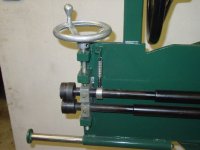
that's exactly what i was considering with the fixed rear casters. I'm glad to hear it worked out for you. I'm going to do it.

by the way i love the way you reversed the handweel to put it closer to the workpiece. That is one of the challenges i was having with mine. Mind if i steel your idea :). Great build-up!!

Yeah metal meet rules. Any of you folks who haven't checked it definitely should, tons of great info on tools and metal working.
 

66RICH

Well-known member
Joined
Feb 28, 2006
Messages
79
Location
Portage, IN
Rodwerkz, feel free to use any idea's you see, that's why the pics are
posted. Post your pic's when done!
Good luck, Rich
 

Sack

Well-known member
Joined
Nov 22, 2006
Messages
228
Location
north central nj
If it's not too heavy of a tool, put fixed castors on the side of the tool, but real low to the ground, as if the machine had to be tipped over to wheel around. Then when need to move it, do so by tipping it 30-40 degrees over and move it like a hand truck. Just a thought - works for some of my stuff.
 

Will H

Well-known member
Joined
Aug 23, 2005
Messages
46
Location
Metro Detroit, MI
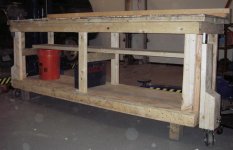
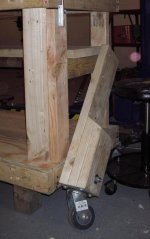
I've been looking for something along these lines for my workbench. I tried a hinged design, but the 2x6 faceboard split when I tried to pivot the casters into place and lift the bench. So here's what I came up with:

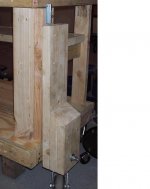
Casters on the back, fixed legs on the front of the bench. Then for the "retractable" front casters, I screwed 2x6s together to make the end big enough to mount the casters. Then bolted a piece of 1/2" threaded rod to the bench frame as the pivot. Used a nylock nut and some fender washers to snug up the wheel-leg assembly, but not tighten. There is a piece of 1/2" copper pipe inside the wheel-leg to keep the hole from enlarging too much. When the wheel-leg is pivoted upright, it lifts the front of the bench. Barrel locks hold it upright while moving. Release the barrel locks and the wheel-leg tips over and drops the bench on the fixed legs. Basically a simplified trailer tongue jack with a nicer caster.

The bench is pretty solid. If you push on it too much it will slide a bit, so I'm thinking of adding some door stops underneath, along the back. Then I'll use some small cables routed to the bench front to release and hold them up, since I won't actually be able to get to them.
 

Attachments

  • smaller_workbench_1.JPG
    smaller_workbench_1.JPG
    46.1 KB · Views: 28
  • smaller_workbench_2.JPG
    smaller_workbench_2.JPG
    31.6 KB · Views: 30
  • smaller_workbench_3.JPG
    smaller_workbench_3.JPG
    26.5 KB · Views: 23
  • smaller_workbench_4.jpg
    smaller_workbench_4.jpg
    34.3 KB · Views: 37
To avoid these ads, REGISTER NOW!
Top Bottom