I've got a few options right now and I'm not sure which to go with. There's an Emerson made Craftsman 150 for sale in really good condition and there's a Delta 17" floor model with table adjuster and foot pedal attachments that is in really good condition. Which would you pick?


You are using an out of date browser. It may not display this or other websites correctly.
You should upgrade or use an alternative browser.
You should upgrade or use an alternative browser.
Top 5 Used Drill presses?
- Thread starter SB440R/T
- Start date
Depending on the age, the Delta.I've got a few options right now and I'm not sure which to go with. There's an Emerson made Craftsman 150 for sale in really good condition and there's a Delta 17" floor model with table adjuster and foot pedal attachments that is in really good condition. Which would you pick?
1950's would be my guess. I'd buy that one in a heartbeat. Looks all original and with the super scarce foot pedal (although the pedal isn't that useful IMHO). Looks like an original Delta repulsion motor.Here it is. Any idea what the age is?
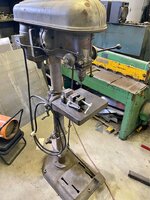
Last edited:
How much precision - consistency is required for your projects?
I get that having a quality nice machine-tool is great though match the use for the task. One of the local shops uses a bunch of off the shelf stock Ryobi benchtop 8" presses in their assembly room. That shocked me as I was expecting something a bit nicer than PRC tools when their CNC machines cost big$.
My 14" Jet runs well though a buddy's has plenty of runout.
I get that having a quality nice machine-tool is great though match the use for the task. One of the local shops uses a bunch of off the shelf stock Ryobi benchtop 8" presses in their assembly room. That shocked me as I was expecting something a bit nicer than PRC tools when their CNC machines cost big$.
My 14" Jet runs well though a buddy's has plenty of runout.
redmondjp
Well-known member
Well, like always, it depends! I would bet that the 17" Delta probably has a lower minimum speed than the Craftsman does. If you are drilling large holes in thick metal, you want very slow speeds so this could matter to you. For wood, it's not as important.I've got a few options right now and I'm not sure which to go with. There's an Emerson made Craftsman 150 for sale in really good condition and there's a Delta 17" floor model with table adjuster and foot pedal attachments that is in really good condition. Which would you pick?
I disagree. There are four types.there only two type of drill press. 1) those made in twainn 2) and everything else
it doesnt matter which one you get in the " everything else" section
1. Old USA machinists/industrial DP's. 17" and bigger.
2. Old USA homeowners/wood workers DP's. Usually 15"
3. Taiwan 15-17"
4. China
That's also about the order I'd look for. Those Taiwan machines were pretty well made, there are a gazillion out there and they're affordable. (much better than Chinese IMHO)
slowtwitch73
Well-known member
I have that DP... great toolHere it is. Any idea what the age is?
mslim
Well-known member
Get the Delta. No question about it.
dutchgray
Well-known member

Arboga gear head 2' radial arm drill.
Just about the perfect light industrial drill.
driftpin
Well-known member
I had a Delta DP220 I bought at a thrift store, I think I paid about $80. It looked quite a bit like porkls DP in post #44. On the bottom of the table was a late 1944 date. I ended up selling it when I bought a new Craftsman 17" w/3 pulleys, 215-2720 speeds. I did use it awhile, but the Craftsman was more range in speeds and a larger depth. I'm guessing the Craftsman is about 15 y.o. now.
seber
Well-known member
If I could find that Delta in this area it would be mine in a heartbeat.
That looks good. Post some pics when you get it home.Thank you guys for the info. I don't need anything incredibly precise but I will from time to time down the road. I think I'll pick up this Delta and call it good. I love GJ.

MBfreak
MEMBER EMERITUS
From thread copy
Edit again, if you can find an Arboga geared head drill, they are very nice.
Yes , they do not come better than ARBOGA.
Especially if you can find the one which has a 200 mm pillar, crank for height adjustment, adjustable head +-60 degrees and an lash free XY table.
And a clamping collet for milling.
Been looking for one for 30 years. Managed to rent one for a guitar build but NOT FOR SALE.
Like hens teeth
Ola
Edit again, if you can find an Arboga geared head drill, they are very nice.
Yes , they do not come better than ARBOGA.
Especially if you can find the one which has a 200 mm pillar, crank for height adjustment, adjustable head +-60 degrees and an lash free XY table.
And a clamping collet for milling.
Been looking for one for 30 years. Managed to rent one for a guitar build but NOT FOR SALE.
Like hens teeth
Ola
milkovich
Well-known member
The only issue with this list is the speeds and the fact that there were some real junky US made homeowner DPs. Most of the large Taiwan 12-16 speed machines will go down to 2-250 rpm or so which is much better than many wood working DPs. Another plus with the "Universal Taiwan Drill Press" is the MT2 taper, so you may already have Jacobs chucks for them in the drawer somewhere which is handy. So between the 2 and 3, there is a lot of "buyer beware."I disagree. There are four types.
1. Old USA machinists/industrial DP's. 17" and bigger.
2. Old USA homeowners/wood workers DP's. Usually 15"
3. Taiwan 15-17"
4. China
That's also about the order I'd look for. Those Taiwan machines were pretty well made, there are a gazillion out there and they're affordable. (much better than Chinese IMHO)
dr_clyde
Well-known member
What an odd statement. Why would you lump so many different brands and styles of tool into just "Taiwan made" and "everything else"??there only two type of drill press. 1) those made in twainn 2) and everything else
it doesnt matter which one you get in the " everything else" section
Taiwan has made some fantastic tools and some terrible tools. The same can be said for every other country on earth. COO can be a factor in determining quality, but it is by FAR not the ONLY factor.
dr_clyde
Well-known member
Some general thoughts on shopping for a drill press. I am biased toward metalworking drills, as they are much more demanding on the drill than wood working. Most of this will apply to wood and metal, but much more so metal.
When shopping for a drill press, you need to consider the following criteria.
1. Work to be performed. This is BY FAR the most important factor in choosing a drill. This dictates size, range of speed, horsepower, spindle size/type, etc. A drill designed for small holes in wood will not be useful if you want to drill large holes in steel.
2. Geared head or belt drive? Each have their advantages, but geared head is almost always preferred for torque and power, belts for speed.
3. Space requirements. A Carlton radial will almost always be a better drill for large holes in steel, but most guys can't fit one in their shops. Sometimes a bench model is all that will fit.
4. Budget. If you can't afford it, it doesn't matter how nice it is.
5. Availability. Some of us can't spend an eternity shopping estate sales and need one you can by at the store.
6. Build quality/COO/branding. For example, I would have a hard time owning any sort of Jet equipment, even if it was free. Utter garbage.
Answer these questions and then you can determine what drill press you should buy.
Personally, I own a 20" Solberga gear head and a 8/36 LUX radial. These both do what I need to do.
Some factors to consider.
A drill is NOT a milling machine. DO NOT buy one thinking you will mill slots. It is a bad idea and will almost always end in failure, either breaking the cutter, damaging the work, or damaging the spindle. Just be cause you CAN doesn't mean you SHOULD. The common XY table is for work positioning, not to turn your drill press into a milling machine.
Spindle type is going to vary, but almost always it is preferred to get a Morse taper spindle. The Morse taper is by far the most common of the self locking tapers that is easily released and is easy to get tooling for a drill. Chucks, drills, tapping heads and lots of various cutters like reamers are available in the Morse taper. Try to find one with a #3, it's the most versatile amongst machine tools. This allows you to quickly and easily change out chucks or drills without using special tooling like chuck separation wedges. All you need is the removal drift and a hammer. Jacobs taper spindles are common, but you can't easily change chucks and makes it hard to drive larger tools.
Reverse can be a handy feature, being able to do operations like tapping or using LH drills on stuck bolts is a cool feature. Sometimes you need to spin stuff CCW and CW. Useful, but not as required as some guys will make it sound like. If you've got a mess of tapping to do, look into a clutched tapping head, they are SO handy for threading.
Good work holding will make a world of difference. Get a good vise and learn how to fixture your work to make it stable. Lots of time the optimal settings for speed and feed are assuming a rigid setup and will chatter like a ***** if you are free floating a plate on the table. Tee slots in the table, float lock style vises, or fixtures make it much easier to get good holes. I use Cardinal Speed Vises and Kurt vises on my drills.
A good chuck can turn a seemingly mediocre or frustrating to use drill press into a much more serviceable machine. I ONLY use high quality chucks on my machines and it can make the difference between a pleasure to use machine or a lot of ruined drill bits. I use NOS or refurbished Jacobs Ball Bearing Superchucks and Albrecht keyless chucks for most of my work. New Jacobs Superchucks are not USA made and aren't as nice, but still serviceable. Rohm is also a great option. Being able to trust the chuck is tight and not slipping is a huge deal. I like to chain the chuck key right to the machine so it doesn't wander off.
Drill using the correct speeds and feeds, and use the right lubricants. Drilling and tapping fluid is essential for most work in metal, and you really should use the right stuff. Machine coolant aka soluble oil is also excellent for drilling if you have a way to contain it or pump it. It makes a mess, but is very much worth it on big drills or jobs where lots of heat or operations make the oily stuff too messy. Machinery's Handbook and numerous online calculators will help determine feeds and speeds. I would wager most guys are running too slow on most drills under 1/2" in steel. Remember, these settings are for IDEAL conditions, and you rarely have that on a drill press. That said, don't be that guy running a 1/4" drill at 80 rpm because "you run it slow in steel". Recommended SFM in mild steel is around 100 SFM, and if you use the manufacturer's recommended speeds and feeds, you should be running a 1/4" HSS drill at 1527 RPM and .002-.006 IPR feed. You NEED good, rigid work holding and coolant to run these feeds and speeds. If you don't have both, you need to slow it down or you'll burn up your drills. Keeping the drill cool is more important than just about anything else in drilling in steel. Personally, I would run at a speed that generates nice chips and keeps the drill cool, then worry about optimizing for tool life. You want to drill good holes first, preserve your tools second, then make the holes efficiently third.
Use good drills. High quality drills will make a huge difference in your ability to do good work. Keep them sharp, burr free on the shanks and don't let them get bent, chipped or overheated. I use CTD Magnum drills for most of my work, but companies like Guhring, Precision Twist Drill, Triumph, CleLine or other legacy makers will all do fine. Don't buy drills from the home center if you can avoid it. Those are intended to be used on wood or other less difficult materials and won't hold up. Standard 118° split point for 95% of work. HSS, no need to worry about coating. If you need coatings, you'll know it.
Good luck and happy drilling.
When shopping for a drill press, you need to consider the following criteria.
1. Work to be performed. This is BY FAR the most important factor in choosing a drill. This dictates size, range of speed, horsepower, spindle size/type, etc. A drill designed for small holes in wood will not be useful if you want to drill large holes in steel.
2. Geared head or belt drive? Each have their advantages, but geared head is almost always preferred for torque and power, belts for speed.
3. Space requirements. A Carlton radial will almost always be a better drill for large holes in steel, but most guys can't fit one in their shops. Sometimes a bench model is all that will fit.
4. Budget. If you can't afford it, it doesn't matter how nice it is.
5. Availability. Some of us can't spend an eternity shopping estate sales and need one you can by at the store.
6. Build quality/COO/branding. For example, I would have a hard time owning any sort of Jet equipment, even if it was free. Utter garbage.
Answer these questions and then you can determine what drill press you should buy.
Personally, I own a 20" Solberga gear head and a 8/36 LUX radial. These both do what I need to do.
Some factors to consider.
A drill is NOT a milling machine. DO NOT buy one thinking you will mill slots. It is a bad idea and will almost always end in failure, either breaking the cutter, damaging the work, or damaging the spindle. Just be cause you CAN doesn't mean you SHOULD. The common XY table is for work positioning, not to turn your drill press into a milling machine.
Spindle type is going to vary, but almost always it is preferred to get a Morse taper spindle. The Morse taper is by far the most common of the self locking tapers that is easily released and is easy to get tooling for a drill. Chucks, drills, tapping heads and lots of various cutters like reamers are available in the Morse taper. Try to find one with a #3, it's the most versatile amongst machine tools. This allows you to quickly and easily change out chucks or drills without using special tooling like chuck separation wedges. All you need is the removal drift and a hammer. Jacobs taper spindles are common, but you can't easily change chucks and makes it hard to drive larger tools.
Reverse can be a handy feature, being able to do operations like tapping or using LH drills on stuck bolts is a cool feature. Sometimes you need to spin stuff CCW and CW. Useful, but not as required as some guys will make it sound like. If you've got a mess of tapping to do, look into a clutched tapping head, they are SO handy for threading.
Good work holding will make a world of difference. Get a good vise and learn how to fixture your work to make it stable. Lots of time the optimal settings for speed and feed are assuming a rigid setup and will chatter like a ***** if you are free floating a plate on the table. Tee slots in the table, float lock style vises, or fixtures make it much easier to get good holes. I use Cardinal Speed Vises and Kurt vises on my drills.
A good chuck can turn a seemingly mediocre or frustrating to use drill press into a much more serviceable machine. I ONLY use high quality chucks on my machines and it can make the difference between a pleasure to use machine or a lot of ruined drill bits. I use NOS or refurbished Jacobs Ball Bearing Superchucks and Albrecht keyless chucks for most of my work. New Jacobs Superchucks are not USA made and aren't as nice, but still serviceable. Rohm is also a great option. Being able to trust the chuck is tight and not slipping is a huge deal. I like to chain the chuck key right to the machine so it doesn't wander off.
Drill using the correct speeds and feeds, and use the right lubricants. Drilling and tapping fluid is essential for most work in metal, and you really should use the right stuff. Machine coolant aka soluble oil is also excellent for drilling if you have a way to contain it or pump it. It makes a mess, but is very much worth it on big drills or jobs where lots of heat or operations make the oily stuff too messy. Machinery's Handbook and numerous online calculators will help determine feeds and speeds. I would wager most guys are running too slow on most drills under 1/2" in steel. Remember, these settings are for IDEAL conditions, and you rarely have that on a drill press. That said, don't be that guy running a 1/4" drill at 80 rpm because "you run it slow in steel". Recommended SFM in mild steel is around 100 SFM, and if you use the manufacturer's recommended speeds and feeds, you should be running a 1/4" HSS drill at 1527 RPM and .002-.006 IPR feed. You NEED good, rigid work holding and coolant to run these feeds and speeds. If you don't have both, you need to slow it down or you'll burn up your drills. Keeping the drill cool is more important than just about anything else in drilling in steel. Personally, I would run at a speed that generates nice chips and keeps the drill cool, then worry about optimizing for tool life. You want to drill good holes first, preserve your tools second, then make the holes efficiently third.
Use good drills. High quality drills will make a huge difference in your ability to do good work. Keep them sharp, burr free on the shanks and don't let them get bent, chipped or overheated. I use CTD Magnum drills for most of my work, but companies like Guhring, Precision Twist Drill, Triumph, CleLine or other legacy makers will all do fine. Don't buy drills from the home center if you can avoid it. Those are intended to be used on wood or other less difficult materials and won't hold up. Standard 118° split point for 95% of work. HSS, no need to worry about coating. If you need coatings, you'll know it.
Good luck and happy drilling.
dutchgray
Well-known member
Talking about coated drills, I have hundreds of them I got in a lot of scrap tooling, because you can't sharpen a coated drill without destroying the coating, the machine shop they come from just bins them if they have any damage or have done the proven number of cycles on the CNC machines.
I don't care about the coating, a quick re sharpen and I get a top quality HSS drill for almost nothing.
I don't care about the coating, a quick re sharpen and I get a top quality HSS drill for almost nothing.
dr_clyde
Well-known member
To be fair, you can get drills re-coated but it’s usually not worth the cost due to how cheap drills are vs the cost to send out and re-sharpen and re-coat.Talking about coated drills, I have hundreds of them I got in a lot of scrap tooling, because you can't sharpen a coated drill without destroying the coating, the machine shop they come from just bins them if they have any damage or have done the proven number of cycles on the CNC machines.
I don't care about the coating, a quick re sharpen and I get a top quality HSS drill for almost nothing.
Twist drills are a consumable. When they’ve done their job, scrap ‘em and get new ones.
It costs me more in labor to sharpen small drills vs the cost of a new drill up to a certain size, so we just replace them when they’re done for.
Home shops don’t have to worry about paying for labor, but it does have a cost. Would you rather be working on the project or the tooling? Only you can answer that for yourself.
dutchgray
Well-known member
About a third of them I use as they come to be honest, the smaller sizes I only keep the ones that look good, those are cheap to buy so I don't sharpen anyway. I get them up to about 15mm, alot of stub length, spotting drill, lot of carbide drills also.To be fair, you can get drills re-coated but it’s usually not worth the cost due to how cheap drills are vs the cost to send out and re-sharpen and re-coat.
Twist drills are a consumable. When they’ve done their job, scrap ‘em and get new ones.
It costs me more in labor to sharpen small drills vs the cost of a new drill up to a certain size, so we just replace them when they’re done for.
Home shops don’t have to worry about paying for labor, but it does have a cost. Would you rather be working on the project or the tooling? Only you can answer that for yourself.
Last batch had 4 brand new 19mm morse taper shank, 4 flute core drills in the crate, which was about 50lbs mostly drills, some taps, some carbide milling cutters.
Many get used in a cordless drill, which is the most sure fire way to ruin the drills from a good quality drill index.
Regarding the time versus cost issue, I already spend pretty much all my disposable income on machine tooling as it is and I have a drill bit grinding machine so a decent sharpening is quick and easy if needed.
It would be different if it wasn't a hobby and was generating income.
garagesapien
Well-known member
- Joined
- Jul 13, 2022
- Messages
- 143
I came across this discussion on sought-after vintage drill presses. Many of us are captivated by these vintage tools not only for their quality and craftsmanship but also for their striking retro design, some times little over the top. In my opinion, brands like Craftsman, Walker-Turner, and Rockwell/Delta stand out with their dramatic, oversized headpieces. While Clausing and other high-end drill presses boast superior quality, they often lack the captivating styling elements that draw us to these vintage machines. see the attached picture, I think I want a either Craftsman or Walker-Turner drill press like that, are they good for day to day usage at home garage setting?
Attachments

Nutria
Well-known member
My answer would be 'yes,' depending on how much precision you need. You may need to do a little extra work sourcing parts for the Walker-Turner, but the parts are out there, and the bearings are spendy but available, as noted in earlier posts.While Clausing and other high-end drill presses boast superior quality, they often lack the captivating styling elements that draw us to these vintage machines. see the attached picture, I think I want a either Craftsman or Walker-Turner drill press like that, are they good for day to day usage at home garage setting?
My current drill press is a Walker-Turner 900 with a slow speed attachment. It's been more than fine for both woodworking and basic metal work, and the older Craftsman machines should be similar or perhaps not quite as solid. The W-T is a real pleasure to use, and I use it about every other day. You should probably look elsewhere though if you wanted to do serious machining, but in that case you'd probably have a mill anyway.
Last edited:
garagesapien
Well-known member
- Joined
- Jul 13, 2022
- Messages
- 143
Thank you for the reply. I am using it mainly for light metal work such as restoring old toolsMy answer would be 'yes,' depending on how much precision you need. You may need to do a little extra work sourcing parts for the Walker-Turner, but the parts are out there, and the bearings are spendy but available, as noted in earlier posts.
My current drill press is a Walker-Turner 900 with a slow speed attachment. It's been more than fine for both woodworking and basic metal work, and the older Craftsman machines should be similar or perhaps not quite as solid. The W-T is a real pleasure to use, and I use it about every other day. You should probably look elsewhere though if you wanted to do serious machining, but in that case you'd probably have a mill anyway.
. Where can you source parts like bearings for these units . Just google or are there known or dedicated sites?Nutria
Well-known member
>>Thank you for the reply. I am using it mainly for light metal work such as restoring old tools . Where can you source parts like bearings for these units . Just google or are there known or dedicated sites?
**************
I've gotten bearings from Walker Turner Service Machinery, LLC (I'll pm you contact info). A pretty decent stream of W-T parts show up on the big auction site, sometimes at surprisingly good prices, sometimes not so good. Also, the classifieds (BOYD) forum at owwm.org can be a source, and owwm is a great source of information on these old machines in general.
If drilling metal will be a primary use for your machine, you should consider one with a slow speed attachment (really just an extra pulley) or be ready to source one later, and they tend to cost $200 or more. I would personally avoid using my W-T drill press for anything that involves bearing side-loading, for instance sanding drums or wire wheels.
. Where can you source parts like bearings for these units . Just google or are there known or dedicated sites?**************
I've gotten bearings from Walker Turner Service Machinery, LLC (I'll pm you contact info). A pretty decent stream of W-T parts show up on the big auction site, sometimes at surprisingly good prices, sometimes not so good. Also, the classifieds (BOYD) forum at owwm.org can be a source, and owwm is a great source of information on these old machines in general.
If drilling metal will be a primary use for your machine, you should consider one with a slow speed attachment (really just an extra pulley) or be ready to source one later, and they tend to cost $200 or more. I would personally avoid using my W-T drill press for anything that involves bearing side-loading, for instance sanding drums or wire wheels.
garagesapien
Well-known member
- Joined
- Jul 13, 2022
- Messages
- 143
Thanks again. so do you mean some of these units come/sell with slow speed attachments?>>Thank you for the reply. I am using it mainly for light metal work such as restoring old tools
**************
I've gotten bearings from Walker Turner Service Machinery, LLC (I'll pm you contact info). A pretty decent stream of W-T parts show up on the big auction site, sometimes at surprisingly good prices, sometimes not so good. Also, the classifieds (BOYD) forum at owwm.org can be a source, and owwm is a great source of information on these old machines in general.
If drilling metal will be a primary use for your machine, you should consider one with a slow speed attachment (really just an extra pulley) or be ready to source one later, and they tend to cost $200 or more. I would personally avoid using my W-T drill press for anything that involves bearing side-loading, for instance sanding drums or wire wheels.
Nutria
Well-known member
I think that slow speed attachments were original options on most of the old machines that we tend to encounter on the used market. But perhaps only one in 20 or 30 will come with a slow speed attachment that was added at purchase, or later, purchased after-market, or cobbled together by a previous owner. All can work well. I believe that one member here at GJ sells slow-speed systems that he produces. You can add that capability one way or other.Thanks again. so do you mean some of these units come/sell with slow speed attachments?
garagesapien
Well-known member
- Joined
- Jul 13, 2022
- Messages
- 143
thank you!!I think that slow speed attachments were original options on most of the old machines that we tend to encounter on the used market. But perhaps only one in 20 or 30 will come with a slow speed attachment that was added at purchase, or later, purchased after-market, or cobbled together by a previous owner. All can work well. I believe that one member here at GJ sells slow-speed systems that he produces. You can add that capability one way or other.