To avoid these ads, REGISTER NOW!

Top Coat for Full Flake Epoxy

Majeztic

Active member
Joined
Aug 31, 2007
Messages
41
We just finished applying a full flake epoxy coating to my shop floor. It's 2130 sq ft of floor area. My supplier sent 6 gallons of 1-part urethane top coat and assured me that one coat is all that is required. I marked out 355 sq ft sections so I knew how far to spread each gallon. I started applying the topcoat and it did not spread very far at all. The roller was running dry after about an 8' long pass. I only got about 60% of the first section done with one gallon and I was spreading it really thin too.

I ended up coating just the equipment closet and the finishing room because I was concerned about lap marks if I end in the middle of the big room when I run out of material. Total square footage for the equipment closet and the finishing room is 530 sq ft or 25% of the total floor area. I used about 2-1/4 gallons of material.

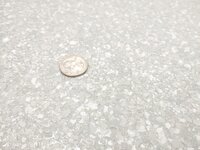
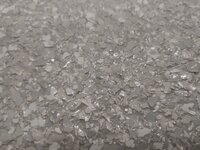
The floor finish is really rough and textured and doesn't appear to be suitable for use so it needs at least another coat. Would one more coat be sufficient?

Another concern is that I added the anti-slip to the topcoat because I was told that it only needed one coat. Should I add the anti-slip to the second coat? If so, when I get to the big room, should I add anti-slip to both coats to keep everything consistent?
20231029_074854.jpg
 
To avoid these ads, REGISTER NOW!

FJ4FUN

Well-known member
Joined
Jul 28, 2014
Messages
620
Location
NorCal
For full broadcast of flake, at a minimum, we would specify TWO 5.625gal coats of our hybrid-urethane clear with traction additive applied to the last coat. The first coat acts as the flood coat. When broadcasting flake to full rejection the flake layer will create countless tiny pockets of air which will act as a sponge and absorb a good quantity of whatever you apply after. The second coat is what we rely on to fully encapsulate the coating system assuring abrasion resistance and, more importantly, proper chemical resistance. Using two relatively thin urethane coats will produce a very stippled final finish. To avoid this or when planning on a second full broadcast of flakes (it happens...) we specify a 10mil (16gal for 2130sf) flood coat of our DecoFX 1110 clear epoxy as the flood coat followed by a single coat of the hybrid-urethane.

Depending on the solids content of the one part urethane they supplied you with you are only getting just over 4mil DFT coverage over 2130sf. One coat is in no way sufficient. It may have worked based on the original qty of flake that they provided you but not for a full rejection broadcast. As a point of reference the thickness of the clear coat you have in your 530sf closet and finishing room would come in at just over 7mils (again, depending on solids content) and it is just barely covering.

At this point you should also be keeping an eye on the product's recoat window, both the body coat that is currently uncoated and the urethane if you intend to add another coat.... If you were a contractor and had passed the recommended recoat window, you'd have no choice but to carefully sand (degloss) the whole floor with 150grit sanding screens before applying subsequent coats. from a DIY perspective, understanding that budgets are involved and you accept full responsibility for the outcome, I'd say #1 avoid any chance of introducing contaminants onto your floor i.e. walking onto the floor wearing your street shoes. #2 just prior to applying the next coat scrub the entire floor well with new microfiber mops and denatured alcohol (or MEK if you can get it. Of course paying close attention to PPE, ventilation and spark/flame concerns...) just prior to applying the new coat. If it fish eyes on you you'll just have to live with it as is or revert to sanding and re-applying the urethane.

Finally, Traction additive only goes into the final coat.
 
OP
M

Majeztic

Active member
Joined
Aug 31, 2007
Messages
41
Thanks for your detailed response, Alpha Garage.

I got the second topcoat on in the two smaller rooms and it took a total of 4 gallons; so your calculation of 16 gallons is spot on. I was able to get the 2nd coat on within the recoat window. I left the big room uncoated. I am now outside the recoat window for the epoxy base coat. I would assume that the scraping action when knocking down the flake would rough it up enough to promote adhesion. Is it really necessary to sand the flakes prior to topcoating?

Now I have two coats, each with the anti-slip additive in them. If I do the big room and only put the anti-slip in the final coat, would there be an obvious difference between them?
 

Armorpoxy

Well-known member
Joined
Aug 18, 2013
Messages
3,731
Location
NJ
Hi did you scrape or sand these flecks down before top coating? This is a very important step on a full broadcast Due to the edges of the overlapping flecks.

Normally since topcoat is a thin layer it won’t do much to correct floor issues so we would recommend renting a floor sander and sanding this down, then acetone or alcohol wipe, then another layer of topcoat with small size nonskid like our Armorgrop.
 
OP
M

Majeztic

Active member
Joined
Aug 31, 2007
Messages
41
Hi did you scrape or sand these flecks down before top coating? This is a very important step on a full broadcast Due to the edges of the overlapping flecks.

Normally since topcoat is a thin layer it won’t do much to correct floor issues so we would recommend renting a floor sander and sanding this down, then acetone or alcohol wipe, then another layer of topcoat with small size nonskid like our Armorgrop.
This was scraped fairly aggressively in four directions.
 

Armorpoxy

Well-known member
Joined
Aug 18, 2013
Messages
3,731
Location
NJ
From the photos it looks like it could use a sanding. It’s rougher than our Installion Division would allow before topcoating.

We don’t think additional topcoat will do much to correct this so best to sand it and then topcoat in our opinion.
 

FJ4FUN

Well-known member
Joined
Jul 28, 2014
Messages
620
Location
NorCal
Given the recoat window time frame for absolute peace of mind and best possible cosmetic outcome I'd give it all a good sanding. Vacuum, alcohol wipe, and apply another clear coat w/ traction additive. Don't get carried away sanding in the main uncoated floor area, you may have to get at it a little more in the coated areas. Sanding the uncoated main floor should let you get by with a single topcoat application.
 
OP
M

Majeztic

Active member
Joined
Aug 31, 2007
Messages
41
I have a 9" electric drywall sander with variable speed between 800 and 1200 rpm and some 180 grit mesh sanding screens. Will that work?
 
To avoid these ads, REGISTER NOW!

Armorpoxy

Well-known member
Joined
Aug 18, 2013
Messages
3,731
Location
NJ
It should work ok. Just take your time. Vacuum well and alcohol or acetone wipe before re topcoat.
 

FJ4FUN

Well-known member
Joined
Jul 28, 2014
Messages
620
Location
NorCal
It won't take much, it looks like you did a thorough job scraping. You're almost there..... (y)
 
OP
M

Majeztic

Active member
Joined
Aug 31, 2007
Messages
41
It should work ok. Just take your time. Vacuum well and alcohol or acetone wipe before re topcoat.
Are you talking about sanding just the areas that haven't yet been topcoated or are you saying to also sand and re-topcoat the areas that have already been topcoated?
 

Armorpoxy

Well-known member
Joined
Aug 18, 2013
Messages
3,731
Location
NJ
We would sand the entire floor to knock down the edges uniformly. Then topcoat.
 

FJ4FUN

Well-known member
Joined
Jul 28, 2014
Messages
620
Location
NorCal
The best, most uniform result would be attained by sanding the whole floor. #1 to knock down, smooth it all out. #2 eliminate any recoat window concerns. If you choose to just coat the uncoated areas you will have a noticeably different surface texture.
 

Garageinteriors

New member
Joined
Oct 30, 2023
Messages
2
Location
austin Texas
what is the solid percentage on the single component ? most single components are quite thin. (60% solids or less). imho these are not good for a mid coat. since you've already gone down with it.. I concur with AG. sand down completely and add an additional coat.. a swing machine with a nice 120 grit screen should do it just fine ( rent at HD or rental store.).. make sure you vacuum and wipe down with denatured alcohol before re-coating.
 
OP
M

Majeztic

Active member
Joined
Aug 31, 2007
Messages
41
what is the solid percentage on the single component ? most single components are quite thin. (60% solids or less). imho these are not good for a mid coat. since you've already gone down with it.. I concur with AG. sand down completely and add an additional coat.. a swing machine with a nice 120 grit screen should do it just fine ( rent at HD or rental store.).. make sure you vacuum and wipe down with denatured alcohol before re-coating.
It's 60% or 65% solids
 
To avoid these ads, REGISTER NOW!
Top Bottom