To avoid these ads, REGISTER NOW!

Top Plate Insulation

westracing01

Active member
Joined
Nov 14, 2014
Messages
37
Location
New Milford, CT
I posted this in my garage build thread, but since I'm messing with this now and I didn't get an answer, I figure it was lack of traffic.

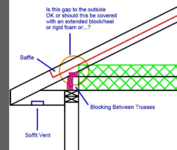
When the garage was built, contractor placed the blocking at the edge of the top plate to be flush with the studs (see image.) Not a big deal since there was no ceiling or insulation or anything going in. Now, I realize that this is blocking off any potential insulation from covering the top plate and I'm wondering if I need to really deal with that or if the gap (orange circle) isn't a big deal.

I've read the top plate must be covered, I've seen rigid foam in there, I've read where you can stuff some R48 batt material in there, etc. What says the collective wisdom? I'm more concerned with air blowing directly on the batts if that is left open.

Whatever solution, it must be able to be accomplished from inside and without removing the existing blocking. I've thought of trying to glue rigid foam on the outward facing part of the blocking, covering the top plate. I've thought of putting a 1/2" piece of ply fixed to the truss and then stuffing that with insulation or spray foam. Just not sure. Open to suggestions.

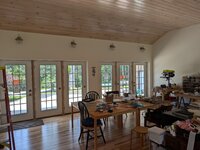
This is a detached garage. No current heat or cooling. Soffit vents and ridge vent. Baffles are almost installed (10 more to do.) Ceiling is going to be 1" T&G pine and I'll insulate as I go. No rush on this. Doing it more because I can, not because I have to. Want to put the ceiling in so I figured I might as well insulate the ceiling while I'm doing it.

Insulation.jpg
 
To avoid these ads, REGISTER NOW!

adsinnott1

Well-known member
Joined
Feb 16, 2021
Messages
134
Location
Kentucky
I would not go through any trouble to insulate at the top plate. Run the batt up to the block and then insulate the wall. Most door headers are uninsulated...
 

larry4406

Well-known member
Joined
Jan 27, 2006
Messages
19,100
Location
Northern Virginia
Our new houses we insulate to top of outside wall. So that blocking is in the wrong place my opinion. I would not pass inspection.

Shouldn’t need the blocking assuming your trusses are 16 or 24” o/c.
 
OP
W

westracing01

Active member
Joined
Nov 14, 2014
Messages
37
Location
New Milford, CT
May cut some strips of 1.5" xps foam 3.5" wide and foam it to the outside of the blocking and another to the top?

That's basically what I was thinking.

Our new houses we insulate to top of outside wall. So that blocking is in the wrong place my opinion. I would not pass inspection.

Shouldn’t need the blocking assuming your trusses are 16 or 24” o/c.

24" OC trusses. Passed inspection without issue in CT.
 

Innovate1

Well-known member
Joined
Jul 28, 2014
Messages
4,285
Location
Illinois near St. Louis, Missouri
The insulation on the back side helps. I doubt the piece on the top does anything and would skip it. Air sealing the ceiling and around the edges is as important as the insulation. If you think you might ever heat or cool it I would put up some plastic sheeting before the ceiling and seal around the edges.
 
OP
W

westracing01

Active member
Joined
Nov 14, 2014
Messages
37
Location
New Milford, CT
You misunderstood - the presence of your blocking precludes proper insulation above the wall, and would not pass insulation inspection.

Blocking is irrelevant for framing inspection.

Got it, totally misunderstood what you meant. Thank you!

OK, thanks boys. This gives me a better direction of what to try. I have a few ideas I'll play around with and see what works the best.
 

PoorUB

Well-known member
Joined
Mar 29, 2021
Messages
11,622
Location
Fargo, ND
IMO, the blocking is done improperly. Two seconds of searching the internet shows the insulation "dam" on the outside of the wall so there is insulation over the top plate. Many show cardboard stapled in place and going up to insulation roof baffle.

Now, the question arises, "Should I do anything about it?" At this point, maybe stuff some foam board outside of the blocking, but unless you ensure it is tight, it won't matter.
 
To avoid these ads, REGISTER NOW!

mm08822

Well-known member
Joined
Jan 13, 2012
Messages
5,881
Location
NJ
X2 on the foam board on outside of nailer. Just use adhesive to attach after dry fitting.

I have to ask, How tight will the rest of the building be to make this really matter?
 

larry4406

Well-known member
Joined
Jan 27, 2006
Messages
19,100
Location
Northern Virginia
That depends- blocking will be required in some cases to support sheathing and may be required for fire blocking or draft stopping. These are all inspected with the framing where we work.
The specific blocking he showed does neither of these functions - fire blocking or draft stopping.
 

billconner

Well-known member
Joined
Jul 20, 2021
Messages
6,948
Location
Thousand Islands NYS
It seems the people who write the codes believe that area is important.

"Where Section N1102.1.3 requires R-49 insulation in the ceiling or attic, installing R-38 insulation over 100 percent of the ceiling or attic area requiring insulation shall satisfy the requirement for R-49 insulation wherever the full height of uncompressed R-38 insulation extends over the wall top plate at the eaves. "

I solved it in a building without energy heels in the trusses by a sort of soffit, so I kept 20" right to exterior wall sheathing with sloped soffit paralleling roof pitch.
 

Attachments

  • PXL_20240730_164224940_copy_2040x1536.jpg
    PXL_20240730_164224940_copy_2040x1536.jpg
    601.5 KB · Views: 9
OP
W

westracing01

Active member
Joined
Nov 14, 2014
Messages
37
Location
New Milford, CT
X2 on the foam board on outside of nailer. Just use adhesive to attach after dry fitting.

I have to ask, How tight will the rest of the building be to make this really matter?

That's the plan. I'm going to fart around with it and see if I get something I like.

The second question, not very.

I agree the blocking isn't right. I never found a single image of any installed the way mine is, but that's the story of my life. LOL. The goal here is to make it as right as possible given what's there.

Code wants R-49 up there... That's not happening. Hell, I might not even insulate it. Been there going on 4 years now and hasn't been a problem. I just wanted to put in what I needed while I have easy access incase I ever did decide to insulate.
 
OP
W

westracing01

Active member
Joined
Nov 14, 2014
Messages
37
Location
New Milford, CT
My post might not have been clear but quoted the IRC and it lets you reduce the R49 tot R38 if it goes to exterior sheathing.

Oh no, I understood. I looked up the local building code. Technically, they're using the 2021 IBC, which does callout as you said that R38 can be used if it runs to the exterior sheeting/covers the top plate.

However there is an amendment somewhere in the CT Regs that calls out R49 without any such R38 provision.

All that said... This won't be getting inspected, so that's not a big concern. I just don't want to do anything that will cause a problem down the road.

This is a detached, unheated garage. This doesn't need to stay 60 during the winter or 75 during the summer. Unless it drops to 5 outside in the winter, in which case I'm not going out there anyway, even uninsulated it's been decent at 30 or so. If I can make it a little more comfortable, great. If not, at least when I put the ceiling in I will have everything in place should I decide to insulate later.

I have an idea I'm going to try with the solid foam and see how it works out.
 

duneslider

Well-known member
Joined
Jan 20, 2013
Messages
2,247
Location
Riverton, Utah
This is a detached garage? You don't "have" to insulate a detached garage. If you are choosing to insulate it then you can do whatever you want and there is no "code" for an unoccupied detached garage. Even if this was a connected garage it isn't living space so it doesn't have to be insulated at all. If you choose to insulate then you can do whatever you feel you want to do.

I am not sure what all the code talk is about, or wouldn't pass inspection, or anything else. Generally, garages aren't being built to meet high energy standards. That doesn't mean you can't, or shouldn't, or don't but to expect a contractor to do it in a way that would meet those standards without explicitly telling them that is what you want, I wouldn't expect them to do that. It's like me being upset they only fire taped my garage because that's all they were told to do and that's all I paid them to do, even though someday I want it fully finished.

Now, if you plan to fully finish and insulate this garage the blocking isn't in the best place but still at the end of the day, how much does that really matter? If it does matter to you that is fine and there are things you can do. I am willing to bet that in a garage you would never notice that your top plate wasn't insulated...
 
OP
W

westracing01

Active member
Joined
Nov 14, 2014
Messages
37
Location
New Milford, CT
If you're heating and/or cooling it - installing a heat pump or whatever - pretty sure IRC insulation requirements apply most places. Attached or detached.

Not really sure. What I've been able to find either specifically calls out specs for living space above or doesn't mention it at all. That would imply that attached or detached doesn't matter, but since it was built specifically as unfinished no one seemed to mind.

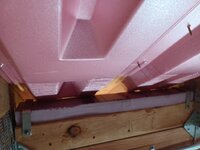
The reason I asked originally is because due to the placement of the blocking, unless I get really creative (which I started doing yesterday but it's really more work than it's worth if I don't have to) there will be a small gap under the baffle that would allow air a direct line to any insulation I place in the ceiling. The question was whether that was bad or if it wasn't anything to worry about. The primary question of whether it's bad or not is from a moisture stand point and mold generation.

After messing about with it yesterday, the solution offered in Post #5 is what I'm going to go with. I don't plan to glue though, as I will use mechanical fastening for the insulation block on the "backside" of the blocker. Possible adhesive used on the top insulation block but we'll see.

EDIT: See picture. I just threw this together this morning but this is what I'm thinking.

20250512_105017.jpg
 
Last edited:

billconner

Well-known member
Joined
Jul 20, 2021
Messages
6,948
Location
Thousand Islands NYS
It seems like a reasonable solution. Only from a big picture view, I can see carrying the full R39 over top plate to exterior sheathing would be more likely to lessen chance of ice dams. In your area near the water along with climate warming, I doubt you'll have a real problem.
 
To avoid these ads, REGISTER NOW!
Top Bottom