To avoid these ads, REGISTER NOW!

Top Plates causing roof sagging

Nate.s

New member
Joined
May 11, 2019
Messages
1
Location
East coast
Hi All,

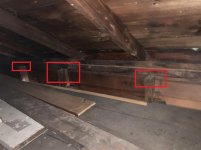
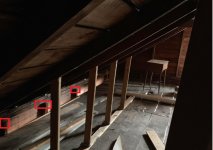
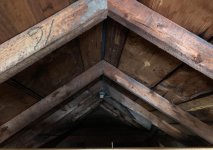
I have a two story, two car garage built in late 40's that has a sagging roof. It appears the top plates are causing the sag. There is no ridge beam but the rafters are still connected at the peak.

I realize the best approach would be a new roof but I'm trying to hold off on that for a few years. The walls appear to be fine except at the top where they are bowing.

I have placed temporary supports that align with steel building columns beneath.

I'm planning on jacking the roof and then adding collar ties and trusses.

I've had a few contractors take a look and none have seen this happen before. Has anyone here experienced this?

Is there a way to pull the top plates back in? (I've seen on people mention on here to use a come along, turnbuckle, chain but that work in this case?)
Should I jack the roof, add new top plate, then sister the rafters?

Thanks for any feedback!


Edit to added a picture of the ridge.
 

Attachments

  • top-plate-1.jpg
    top-plate-1.jpg
    140 KB · Views: 397
  • top-plate-2.jpg
    top-plate-2.jpg
    94.7 KB · Views: 417
  • top-plate-3.jpg
    top-plate-3.jpg
    95.8 KB · Views: 375
  • top-plate-4.jpg
    top-plate-4.jpg
    93.3 KB · Views: 357
  • outer.jpg
    outer.jpg
    78.1 KB · Views: 354
  • Ridge.jpg
    Ridge.jpg
    124.7 KB · Views: 290
Last edited:
To avoid these ads, REGISTER NOW!

readhead

Well-known member
Joined
Dec 8, 2012
Messages
6,175
Location
Durango, Co.
The top plates are not the problem. How is the attic floor supported? Some pictures from below would help. The simple answer is that the walls need to be pulled together and stabilized.
 

James-W

Well-known member
Joined
Feb 3, 2013
Messages
12,432
Location
Southeastern Wisconsin
From the pictures it looks like you have some rotten wood in the roof as well. It would be a prudent idea to address that issue at the same time as you repair the sagging roof. I know you said you would like to wait a few years to replace the roof, but if I were you I would take a very good look at the roof and assess just how much damage there is. It is quite possible after very close examination you will find it more advantageous to replace the entire roof now rather than spend money fixing it temporarily for now and then replacing it in a few years down the road. It is just a thought, if it is out of the question then just ignore what I said.
 

JRC3

Well-known member
Joined
Jun 30, 2014
Messages
12,481
Location
Southwestern OH
That needs rafter ties and way more than collar ties. As you mention I'd slowly pull it back with turnbuckles or something along the same lines...And then add rafter tires. As I recall you should jack/adjust lumber more than 1/4" per week. You have a ways to go...Might take a long time, even longer than 1/4" per week...Like a year. IDK.

Is there a ridge beam? If so, that added studding "trussing" on the attic floor joist is just gonna project the weight of that floor to the rafters and ridge bean if there's any weight on the "attic" floor...Unless you're jacking that added studding with those posts underneath. Yeah, A pic below might help. I', no framing guy or anything, just thinking.
 

starquestMM

Well-known member
Joined
Jan 7, 2013
Messages
1,072
Location
JC, Missouri
You might be able to pull that back in, but this whole situation is VERY dangerous at this point. That temp bracing might actually be making this whole thing worse unfortunately.

Please treat this whole thing like its about to kill you.
 

wrenchguy

Well-known member
Joined
Sep 22, 2011
Messages
4,697
Location
NW Indiana
The top plates are rolling off the studs?
Attic floor framing/joist tied alongside wall studs below top plates? Somewhat similar to balloon framing back in the day.
Rafter fastening to plate holding good, resulting with plates breaking loose.

I ain't seen it b4 either, I can see roof sag at ridge/peak happening with the heavy *** snow fall u guys get.

Leave it with ur temp supports till u remove shingles with sheeting. Then jack/rework framing from attic floor & sheeting from above. When doing this temp beams will have to be placed under attic joist so u can jack up peak. Frame in a permanent undemount ridge, ur gonna need it to jack to. Upper and lower collar/rafter ties will keep it solid. Sooner better here.
 

Pluribus

Well-known member
Joined
Dec 16, 2012
Messages
2,143
Location
Skagit County, WA
Without seeing the center, I'm guessing you have a ridge board and not a supported ridge beam, which would be typical for that era. There are likely problems at a few locations. Looking at the exterior pictures, it appears there might be multiple layers of shingles on the roof. Is that the case?

Your top plates may not be properly nailed either, but I'm guessing that's just a symptom for the other things that are likely going on. What's the ridge look like? A banana?

If I were in your shoes, I might take a chance and try to shore it up with some rafter ties, say on every other rafter pair, and then work on diagnosing what's really going on there. Those knee braces you added are pretty much cosmetic. As starquestMM said, treat it like it's about to kill you, as that looks sketchy AF. If you go up there, have someone nearby to be ready to call for help.
 

matt_i

Well-known member
Joined
Mar 14, 2008
Messages
10,725
Location
SE Michigan
If I read the pics correctly the top plates are being lifted off the studs (gaps showing nail shanks). I would say this is exactly as above, the spreading load of the "triangular" structure ofthe roof is causing this, the gaps are caused by the very minimum friction of the nails into end-grain of the vertical studs.

Pulling together is good, the main problem is getting the proper attachment to the wood so you don't just pull out a chunk. Usually a steel plate would be involved with multiple fasteners (I like the GRK-RSS structural screw) and then an attachment where an aircraft cable/wire rope would be used with a turnbuckle. Typical U-bolt cable clamps could be used and the "don't saddle a dead horse" to get it oriented properly.

I would recommend that you attempt to just stabilize this until you can afford to tear off the entire roof, re-truss, re-sheet and re-roof. Being able to pull the entire structure back into "good" alignment seems very low at this point unless you threw a bunch of money at it, and imo those funds would be better spent saving for the re-construction project.
 

red61cj5

Well-known member
Joined
Mar 31, 2016
Messages
3,739
Location
West Virginia
Are the rafters not pocket cut at all? Looks like just sat on the wall and toe nailed? I've never seen a top plate roll back like that, If enough of it lets go it'll blow the wall out, or maybe in depending on how strong the roof structure is.
 

ScottsGT

Well-known member
Joined
Jan 1, 2014
Messages
4,883
Location
Lake Wateree, SC
If nothing else, cables and turnbuckles would help prevent it from falling in. Might need to jack up the center while pulling in on the sides, but I'm no structural engineer or a contractor. All just a WAG. Be careful! Full size Jenga game here.
 

wrenchguy

Well-known member
Joined
Sep 22, 2011
Messages
4,697
Location
NW Indiana
No ridge board and no seat cut on the rafters, somewhat common when using 2x4's and board sheeting. Visually the sag at the ridge line is equal to the bow the fasica board and wall displays. Did a tree fall on the roof? The nails seen look shiny as if shocked some how.

u ask about sistering the rafters... are they sagging? Can't imagine they ain't. You can't jack each 1 straight and sister because it'll fracture b4 u get it straight. You can sister each 1 after everything else is squared away. This will give u a flat roof when sheeted. 2 me take it off, straighten, keep the walls parallel, frame new roof.
 
Last edited:

Bretny

Well-known member
Joined
Jul 31, 2017
Messages
3,918
Location
Dutchess county NY
I would say your wall is bowing in/out by the looks of it. Old rotting wood could be the cause. Not the top plates though. There really not made to be load bearing anyway.
 

Homerr

Well-known member
Joined
Mar 16, 2012
Messages
379
Location
Seattle, WA
How many layers of asphalt shingles are on this roof?

It almost looks like it could be 3-4 layers. I think reducing the weight post-haste, even down to a blue tarp, would be in order. But I am even hesitant to suggest getting up on the roof do do that work.

Is this two story plus the attic shown in the pics? Or is it one story plus the attic?
 
To avoid these ads, REGISTER NOW!

NUTTSGT

Super Moderator
Staff member
Joined
Sep 14, 2009
Messages
50,884
Location
Northern Central Ohio
The back of our house was framed similar to this. I was going to rip it off and put new rafters in but decided not to at the time. I'm curious as to how much sag is showing in the ridge when looking from outside.

Since ours didn't have a ridge pole/beam, I added one. I cut the end of the raters out where they met. . . . 3/4" off each one for a total of 1.5 inches to fit the new ridge pole.

Before I started cutting, I added a knee wall on each side to support the weight, something that appears to have already been done in your attic space. However, I used a top plate on the knee wall to help spread the weight between the short studs. Your studs are fastened directly to the rafter itself.

I only put in a few collar ties, they were more or less to hold new ridgepole in place while I installed it. Once I was done, I just left them in place. I did this back in 2004 and I don't think it has moved since. Granted you can see some sagging in the ridge/roof, I believe it's more cosmetic as I have ripped of the battens, shakes and standing seam that was on it. I replaced it with 1/2" OSB (with clips) and shingles.
 

Homerr

Well-known member
Joined
Mar 16, 2012
Messages
379
Location
Seattle, WA
I would add: collar ties will be one of the last steps if you repair this, if even used.

If you really want to repair I would suggest roughly this order:

1. Get EVERYTHING out of the structure.
2. Rip all the shingles off and tarp.
3. Set up 3 (vertical) jacking stations on the slab down the center under the ridge (with the gable ends the space is divided in to fifths), these will raise a ridge beam in to place. The middle of the roof needs to go up. Get a properly sized ridge beam in place, cut an opening in the gable to get it in there.
4. Set up at least 3 come alongs spanning the width that engage a sizable piece of steel outside the top plates under the eaves, something like a 3"x5" angle, that will pull the center back inward as the roof goes up.
5. Add anchor bolts from the bottom plate to the concrete foundation.
6. Strap the hell out of these ridge and top plate connections and use SDS screws so you can unscrew and reset when the jacking is done. Diagonally brace the lower walls inside. Add diagonal cable bracing temporarily to the garage door openings.
7. Add 3 diagonal come alongs from newely anchored bottom plate at foundation to opposite side top plate to bring the garage space back in check. If there is actually a full second story (not attic) do this up here as well.
8. Take a couple of months to SLOWLY jack this thing back in to place. Get the building back to square and the roof center jacked up to where it needs to be vertically.
9. Now properly brace the structure: reset straps and diagonal bracing; sheath the roof with plywood; add other Simpson connectors as needed; sheath the interior walls with plywood. Pour footing for ridge beam support and add posts.
10. Re-roof.
11. Remove all temporary bracing.
12. Wonder why you didn't knock the whole thing down and build a proper structure.
 
Last edited:

Falcon67

Well-known member
Joined
Jun 11, 2009
Messages
18,371
Location
Merkel, TX
Collar ties are to help keep the rafters up against the ridge to resist wind lift. They do zero work to prevent rafter tail spread. Most places don't even require them anymore.
 

rcbk00

Well-known member
Joined
Sep 10, 2018
Messages
107
Location
NJ
From what I can see in your pictures, your problem seems pretty straight forward. None of the rafters appear to be notched where they sit on the top plate (this notch is called a birdsmouth where I'm from). Since they're only in contact with the plate on the top outside corner, they're probably toenailed once on each side of the rafter there. This in itself is not a problem.

Your problem lies with the fact that the attic floor joists are attached to the wall studs and not sitting on the top plate. Had they been located on the top plate, they could have been fastened to the bottoms of the rafters. This would have prevented the roof from sagging. Ideally, your roof framing should be built like a triangle- the rafters are the angled parts of the triangle and your attic floor joists should be the bottom part of the triangle holding the lower ends of the rafters together.

In your case, with the attic floor joists being attached to the studs, you've lost the bottom part of the triangle, and the rafters are trying to slide off the top corner of the plate. Because your walls are being held together by your attic floor joists, they probably haven't moved much. However, your top plate isn't held down very well (nails into endgrain don't have much holding power), which is why they're rolling outward off the top of the studs.

The fix here isn't particularly complicated, but it will require a decent amount of labor and materials. If it were my building, I would remove some of the attic floorboards (leaving the attic floor joists in place), and install a beam under the roof ridge. This beam should be at least a double 2x12 and possibly more. The beam should be supported from below and not hanging on the rafters in any way. You don't want to put any more load on them than they already have.

Once the beam is in place, slowly jack it up with your jacks placed on the garage floor (not the attic floor). You'll need to use posts between the jacks and the ridge beam. Jack slowly. It will take days, possibly weeks, to jack it up fully without cracking anything. Once the roof is back to where it should be, you need to either leave the ridge beam in place permanently (this would now be called a structural ridge), or connect the bottoms of the rafters with new attic floor joists that sit on the top plates.

Obviously, this is the simplified version- you should definitely connect with an experienced carpenter or an engineer. They would be able to tell you all the specifics your job requires (type of lumber and hardware needed, nailing schedule, how to tie the tops of the rafters together before installing a beam, etc.). However, it might just be easier to rip everything off and reframe the roof. Your level of skill, as well as the time and money you have available, are the determining factors in making that decision.
 
Last edited:

ScottsGT

Well-known member
Joined
Jan 1, 2014
Messages
4,883
Location
Lake Wateree, SC
I would add: collar ties will be one of the last steps if you repair this, if even used.

If you really want to repair I would suggest roughly this order:

1. Get EVERYTHING out of the structure.
2. Rip all the shingles off and tarp.
3. Set up 3 (vertical) jacking stations on the slab down the center under the ridge (with the gable ends the space is divided in to fifths), these will raise a ridge beam in to place. The middle of the roof needs to go up. Get a properly sized ridge beam in place, cut an opening in the gable to get it in there.
4. Set up at least 3 come alongs spanning the width that engage a sizable piece of steel outside the top plates under the eaves, something like a 3"x5" angle, that will pull the center back inward as the roof goes up.
5. Add anchor bolts from the bottom plate to the concrete foundation.
6. Strap the hell out of these ridge and top plate connections and use SDS screws so you can unscrew and reset when the jacking is done. Diagonally brace the lower walls inside. Add diagonal cable bracing temporarily to the garage door openings.
7. Add 3 diagonal come alongs from newely anchored bottom plate at foundation to opposite side top plate to bring the garage space back in check. If there is actually a full second story (not attic) do this up here as well.
8. Take a couple of months to SLOWLY jack this thing back in to place. Get the building back to square and the roof center jacked up to where it needs to be vertically.
9. Now properly brace the structure: reset straps and diagonal bracing; sheath the roof with plywood; add other Simpson connectors as needed; sheath the interior walls with plywood. Pour footing for ridge beam support and add posts.
10. Re-roof.
11. Remove all temporary bracing.
12. Wonder why you didn't knock the whole thing down and build a proper structure.

Well spelled out!

Or simply bulldoze and start over. :lol_hitti All kidding aside, above sounds like a very safe plan of attack.
 

scottydosnntkno

Well-known member
Joined
Aug 8, 2010
Messages
670
It’s largely due to the stick framed roof and no birds mouths on the rafters.

Honestly, it’ll be cheaper to knock it down and start over. If you already have a presumably good slab, there’s always people advertising 24x24 2 car garages for $13-16000. By the time you do a new roof, repair all the rot, and fix the structural issues you’d be in it the same amount of money
 

Bert_

Well-known member
Joined
Dec 24, 2016
Messages
9,706
Location
NW Iowa
This would be tough to pull back where it needs to be. You could probably stabilize it by adding rafter ties directly above the top plate and nailed to the rafter. Would need to be a single board from one end to the other or have substantial overlap. I'm not going to guess at the details. It wouldn't be straight but it should stop it from moving.

Decide what your plans are and pencil out some costs.
 
Last edited:

16sierra

Member
Joined
May 20, 2019
Messages
8
Location
Iowa
From what I can see in your pictures, your problem seems pretty straight forward. None of the rafters appear to be notched where they sit on the top plate (this notch is called a birdsmouth where I'm from). Since they're only in contact with the plate on the top outside corner, they're probably toenailed once on each side of the rafter there. This in itself is not a problem.

Your problem lies with the fact that the attic floor joists are attached to the wall studs and not sitting on the top plate. Had they been located on the top plate, they could have been fastened to the bottoms of the rafters. This would have prevented the roof from sagging. Ideally, your roof framing should be built like a triangle- the rafters are the angled parts of the triangle and your attic floor joists should be the bottom part of the triangle holding the lower ends of the rafters together.

In your case, with the attic floor joists being attached to the studs, you've lost the bottom part of the triangle, and the rafters are trying to slide off the top corner of the plate. Because your walls are being held together by your attic floor joists, they probably haven't moved much. However, your top plate isn't held down very well (nails into endgrain don't have much holding power), which is why they're rolling outward off the top of the studs.

The fix here isn't particularly complicated, but it will require a decent amount of labor and materials. If it were my building, I would remove some of the attic floorboards (leaving the attic floor joists in place), and install a beam under the roof ridge. This beam should be at least a double 2x12 and possibly more. The beam should be supported from below and not hanging on the rafters in any way. You don't want to put any more load on them than they already have.

Once the beam is in place, slowly jack it up with your jacks placed on the garage floor (not the attic floor). You'll need to use posts between the jacks and the ridge beam. Jack slowly. It will take days, possibly weeks, to jack it up fully without cracking anything. Once the roof is back to where it should be, you need to either leave the ridge beam in place permanently (this would now be called a structural ridge), or connect the bottoms of the rafters with new attic floor joists that sit on the top plates.

Obviously, this is the simplified version- you should definitely connect with an experienced carpenter or an engineer. They would be able to tell you all the specifics your job requires (type of lumber and hardware needed, nailing schedule, how to tie the tops of the rafters together before installing a beam, etc.). However, it might just be easier to rip everything off and reframe the roof. Your level of skill, as well as the time and money you have available, are the determining factors in making that decision.

This is my take on the problem as well. ceiling joists should sit on the top plate to both better support the ceiling and to allow them to be nailed to the rafters.
 
Last edited:

James-W

Well-known member
Joined
Feb 3, 2013
Messages
12,432
Location
Southeastern Wisconsin
To the opening poster, I have taken another look at the pictures you posted and I showed them to a buddy of mine who has done a lot of building. We agree that the roof should be replaced if you want to save the building long term, BUT, it makes sense to do it only if the rest of the building is in really good condition and it meets your needs. If the rest of the building isn't i n good condition, or if the building isn't really going to meets your needs now and in the immediate future, then to spend a bunch of money on fixing up the roof is not really in your best financial interest.

I mean, to repair the roof properly the old roof needs to come off, the walls need to be straightened up, new engineered trusses need to be installed, new sheathing put on and new shingles along with an ice shield and felt paper. This is not a cheap project, but a necessary one if you want to do the job so that it will last a long time.

Surely there are ways to do this on the cheap, patch it up to get you by for a little while, but is that really what you want? If you want something that is strong and solid and will hold up for a very long time, then it will cost you a sizable chunk of change.

I realize it is easy for me to sit here at my computer and tell you how to spend your money. I don't mean to be doing that, but you did ask about the roof and what to do about it. So my opinion is, if you like the building, if it meets your needs, and the rest of it is in real good condition, then I think it would pay to replace the roof.

However, I think it is important to keep in mind here that since you said the building was put up in the 40's (let's just say 1945) this building is 74 years old. It is not surprising if there were quite a bit of rotten wood. A leak here, a leak there, and over the years the wood starts to rot. I would check that whole building over with a fine tooth comb before doing anything.
 

Pluribus

Well-known member
Joined
Dec 16, 2012
Messages
2,143
Location
Skagit County, WA
Link to article that discusses (with pictures!) rafter ties and collar ties and what they do.

https://www.finehomebuilding.com/2013/11/07/how-it-works-collar-and-rafter-ties

"Rafter ties resist the forces caused by gravity loads that would otherwise cause the roof to pancake and push out the sidewalls." Rafter ties are what OP doesn't have. Also, note that collar ties are specified per the article to be there to hold the ridge together in wind uplift, not what's going on here.

While there should be birds mouths on the rafters, a birds mouth wouldn't save that structure on its own. The rafters (or most of them) appear to be well enough fastened to the top plate that they're rolling the top plate and pushing out/bowing the wall. If they were simply sliding off the top plate, the wall wouldn't be bowed. If I'm misinterpreting the photo of the exterior and the wall isn't bowing, then even if some of the rafters are disconnected from the top plate and sliding, it's still doing that because there's no rafter tie to keep them from spreading.

Are there nail holes in the outer ends of the rafters where there might have been some rafter ties in the past? Maybe someone removed them to put in the lowered ceiling tied to the wall studs instead to make more storage space height. Regardless, it survived for a while, but the buildup of roofing layers and their weight seems to be killing it off.

My prior recommendation to add some rafter ties is just to shore it up until you can really fix it, as a rafter tie won't pull it back into position. Wanted to clarify that I meant to (hopefully) keep it from collapsing.

Good luck & be careful!
 

buzzworth

Well-known member
Joined
Oct 22, 2007
Messages
936
Location
Louisville, KY
I had the same problem with a garage built in the 30's. We used 3/4 all thread rod with large washers on each end and pulled it back in line while jacking the ridge. Once back in place, we put in collar ties and left the rods in place.
We did this 22 years ago and it has held up fine.
I had 2 contractors tell me to knock it down and start with a new garage. We wanted to keep the old one because it fit the house and property.
I'll see if I can find some pics of the repair when we did it.
 

dfiler2

Well-known member
Joined
Dec 15, 2014
Messages
2,858
Location
NW Minnesota
A birds mouth in the rafter tails would not have done anything to prevent what is happening. As Pluribus and Buzzworth said the top plate are being pulled off the walls because the weight of the roof is pushing out and the walls are not moving as much because the floor joists are holding the walls together. The solution is to pull the rafters back together while jacking up on the ridge, then install rafter ties. IMO, the building is worth saving.
 
To avoid these ads, REGISTER NOW!
Top Bottom