
Placeholder17
Well-known member
I picked up a torque screwdriver from the dregs of a garage sale. It seems to be an original concept with custom bits, since the model number is actually still sold but the newer versions and every vintage model on Ebay uses hex shank bits.
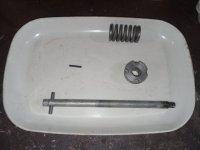
This one is labeled patent pending and uses T-head bits. It came with a little Bakelite stand with hex head and socket bits. There was a little bit of dried grease inside, but after disassembly and cleaning I loaded up all moving parts with grease.
Interestingly, there is a needle bearing in the center of the bore. However, the rest of the bore is either oversized or horribly worn, since the haft wobbles and has about a 1/32" annulus around it. I think it was just an oversized bore because both shaft and bore are steel and this would never have spun quickly enough to wear the bore.
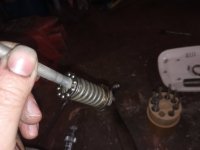
The ratcheting mechanism is pretty neat. There are 4 bearing balls in a spring-loading retaining ring at the very end of 4 grooves inside handle. When torque is exceeded, the rotating pin the the shaft overcomes the spring and force the balls into the grooves.
There is no means of retaining the bits axially in the "chuck". Before I ground off the rust, it actually helped keep them in place, but once cleaned up they just slide out.
Leaving aside the torque control capability, the hex bits have been so handy for adjusting set screws hidden under bench mounted tool assembles at awkward locations. You can also use modern hex-shank bits just by sticking them in the matching socket bit.
This one is labeled patent pending and uses T-head bits. It came with a little Bakelite stand with hex head and socket bits. There was a little bit of dried grease inside, but after disassembly and cleaning I loaded up all moving parts with grease.
Interestingly, there is a needle bearing in the center of the bore. However, the rest of the bore is either oversized or horribly worn, since the haft wobbles and has about a 1/32" annulus around it. I think it was just an oversized bore because both shaft and bore are steel and this would never have spun quickly enough to wear the bore.
The ratcheting mechanism is pretty neat. There are 4 bearing balls in a spring-loading retaining ring at the very end of 4 grooves inside handle. When torque is exceeded, the rotating pin the the shaft overcomes the spring and force the balls into the grooves.
There is no means of retaining the bits axially in the "chuck". Before I ground off the rust, it actually helped keep them in place, but once cleaned up they just slide out.
Leaving aside the torque control capability, the hex bits have been so handy for adjusting set screws hidden under bench mounted tool assembles at awkward locations. You can also use modern hex-shank bits just by sticking them in the matching socket bit.
Attachments
-
 IMG_20251222_153541204.jpg625.9 KB · Views: 11
 -
 IMG_20251222_155050667.jpg487.3 KB · Views: 10
 -
 IMG_20251222_155054794.jpg322.3 KB · Views: 7
 -
 IMG_20251222_162028468.jpg491.7 KB · Views: 6
 -
 IMG_20251222_163007931.jpg564.7 KB · Views: 6
 -
 IMG_20251222_154554868.jpg498.3 KB · Views: 6
 -
 IMG_20251222_155124052.jpg540.4 KB · Views: 6
 -
 IMG_20251222_160219298.jpg496 KB · Views: 6
 -
 IMG_20251222_160222611.jpg688.5 KB · Views: 6
 -
 IMG_20251222_153525698.jpg1.1 MB · Views: 8
Last edited:


