joe_pinehill1
Well-known member
How often do you have your wrench calibrated? Not just checking with another wrench, but have a local test lab calibrate it?

This is pretty much the answer. If you are working at a company, they should have specs as to how often to calibrate. If you own your own business and are trying to come up with your own specs, start with annually. If you only do your own work, never.Obviously depends on what you are doing. For shade tree mechanics doing non-engine, misc repairs, never is a reasonable answer.
If by local test lab, you mean my workshop equipped with a big vise, calibrated olympic bumper weights, and some high test fishing line, I do it for fun once every couple yearsHow often do you have your wrench calibrated? Not just checking with another wrench, but have a local test lab calibrate it?


Click Style:
The actual "Click" from a wrench is considered a "Cycle" of that wrench. Most manufacturers recommend click-style torque wrench calibration after 5000-to-7000 cycles.
For most customers, this means you should calibrate and test torque wrenches every 12 months.
Unless your building F22's who the hell does 6,000 clicks a year. I don't do 6,000 clicks in a decade and I use torque wrenches on most bolts and nuts. That's 6.000 bolts or nuts tightened every year. I use to build engines, and still do once in awhile, and I don't think I've torqued 6.000 bolts in my lifetime.From the Team Torque web site:
Torque Wrench Calibration & Repair Service Center | Team Torque Inc.
Team Torque offers professional calibration and repair services for your torque wrenches. Find out more about our services and send in your tools to our center.www.teamtorque.com
You may have an obsession... but today was your day to shine.I check the calibration on mine every time before I use them. I have 3 calibration testers so I can test from 5 inch lbs to 250 fl lbs. I have never had one of my torque wrenches need to be recalibrated in the last 20 years and I have about 90 torque wrenches. Over the years I have purchased many used torque wrenches for very little money. When I get them I test the calibration and adjust if necessary. Sometimes they need parts replaced also, but when I get done rebuilding and adjusting they are +/- 2% from 20% to 100% of the full range of the wrench.
That only 300 cars lug nuts.Unless your building F22's who the hell does 6,000 clicks a year. I don't do 6,000 clicks in a decade and I use torque wrenches on most bolts and nuts. That's 6.000 bolts or nuts tightened every year. I use to build engines, and still do once in awhile, and I don't think I've torqued 6.000 bolts in my lifetime.
I worked in R&D and not at a tire shop. Every tire shop here in Phoenix uses split beam wrenches which are far less sensitive than the so called "micrometer type."That only 300 cars lug nuts.
If a shop does 10 cars a day, thats only 30 days.
Yet, PI and CDI recommend re-calibration every 6 months regardless of the style of wrench or amount of use.I worked in R&D and not at a tire shop. Every tire shop here in Phoenix uses split beam wrenches which are far less sensitive than the so called "micrometer type."
I seriously doubt that this ever happens. I don't even theoretically know how a split beam goes out of calibration. What parts wear out? I'm pretty sure that Discount Tire doesn't have some dude going to their hundreds of stores calibrating their PI torque wrenches on a regular basis.Yet, PI and CDI recommend re-calibration every 6 months regardless of the style of wrench or amount of use.
Not saying I agree with this. Just their documentation.
Totally agree.I seriously doubt that this ever happens. I don't even theoretically know how a split beam goes out of calibration. What parts wear out? I'm pretty sure that Discount Tire doesn't have some dude going to their hundreds of stores calibrating their PI torque wrenches on a regular basis.

Not that I know of, I had my SO click sent out with the truck just because and the calibration charge was on me.do auto mechanic shops require their mechanics to have their torque wrenches calibrated on any kind of schedule? If so, who covers the cost?
I seriously doubt that this ever happens. I don't even theoretically know how a split beam goes out of calibration. What parts wear out? I'm pretty sure that Discount Tire doesn't have some dude going to their hundreds of stores calibrating their PI torque wrenches on a regular basis.
6000 clicks is not 6000 fasteners, if you're properly exercising the wrench before each use. I suppose it'd be close, though.Unless your building F22's who the hell does 6,000 clicks a year. I don't do 6,000 clicks in a decade and I use torque wrenches on most bolts and nuts. That's 6.000 bolts or nuts tightened every year. I use to build engines, and still do once in awhile, and I don't think I've torqued 6.000 bolts in my lifetime.
An UN-calibrated torque wrench may not even be as accurate as the user. A "false security" potentially leading to failure if a person trusts a tool that could be wildly out-of-spec.A calibrated torque wrench is only as accurate as the user.
And that's why torque to yield is the answer. Torque is such an indirect measurement that it approaches meaninglessness for all the reasons you mentioned. It is one of the reasons ARP insists that you use their bolt/stud lube. Torque to yield is based on bolt stretch which is easily calculated. There are so many threads per inch I want to stretch the bolt 0.010 of an inch and that corresponds to 90 degrees of turn. We have been measuring connecting rod bolts this way forever in the racing world as that's one of the few places where we can get on both sides of the bolt. I have an ARP dial indicator gauge for just this purpose.It depends upon the quality of the tool, the use of the tool and the user of the tool.
What so many users forget is say building engines, the Shop Manual gives a torque range. Whether a used fastner was cleaned, how it was cleaned, how it was lubricated or not lubricated are likely to be the variables rather than the torque wrench calibration.
On newer engines, one-use-torque-to-yield-angle make the torque wrench calibration moot.
jack vines
hey, it clicked. Must be right.And the torque lug nut thing at tire shops is BS. I have been to a tire shop for a tire swap and could hear the monkeys hammer the lugs on and then use the torque to spec and then have to go home and in some cases use a cheater bar on a breaker bar to loosen them and tighten properly.
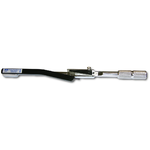
Agree 100% except you mean torque angles. TTY is different. It’s where you torque beyond the elastic limits of a bolt. This is done to produce preload that doesn’t go away with high pressures and thermal cycles, most typically in head bolts.And that's why torque to yield is the answer. Torque is such an indirect measurement that it approaches meaninglessness for all the reasons you mentioned. It is one of the reasons ARP insists that you use their bolt/stud lube. Torque to yield is based on bolt stretch which is easily calculated. There are so many threads per inch I want to stretch the bolt 0.010 of an inch and that corresponds to 90 degrees of turn. We have been measuring connecting rod bolts this way forever in the racing world as that's one of the few places where we can get on both sides of the bolt. I have an ARP dial indicator gauge for just this purpose.