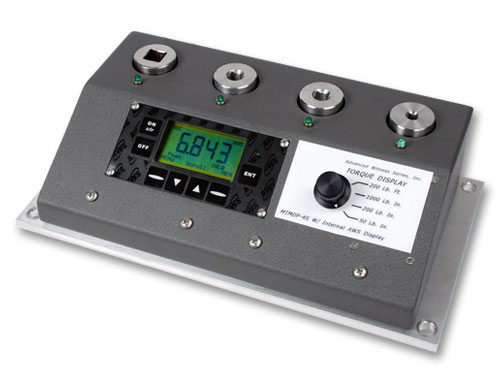
This is a very timely thread! I just bought one of the 1/2" Quinn digital adapters a few weeks ago to calibrate / adjust several torque wrenches I have knocking around here. This was prompted by having the handle on one of their cheap Pittsburgh torque wrenches disassemble itself on me a few months ago as I tried backing it off. I got it back together, but just guessed at the tension adjustment.
I'm very impressed by it's ease of use, as well as it's apparent accuracy. It came with a 3 point inspection report, claiming errors of about 1.1%, .03% and .6% at 20%, 50% and 100% of scale. I double checked that it wasn't complete BS by hanging a 50lb weight off a breaker bar at 1ft. It registered 50.0 ft-lbs, so I'm pretty confident it's accurate to within at least a ft-lb at that point.
I was able to adjust that cheap Pittsburgh wrench to read within ~2% across the range. (It's still a pretty ****** feeling wrench to use, but it's surprisingly accurate. ) I was also pleasantly surprised to see that a very nice Norbar Pro 340 wrench was pretty much spot on, and only read about 0.5% low almost across the range. It also showed that an old Matco (1980's??) 250 ft-lb model was about 10 ft-lbs low, pretty much across the range. (Probably stored wound up at some point). It took turning down an 11/16" socket to a very thin wall to get the handle off, but after a couple of tries, I was able to get it within about 2% across the range, and about 1% from 100-200 ft-lbs. It seemed have a bit bigger variation click to click than either the Norbar or cheap Pittsburg, but was still within about 3-4% including the outliers.
Finally, I was also able to adjust and calibrate a recently purchased vintage Snap-on split beam 50-250 ft-lb torque wrench. (Clearly I don't need it, but I'd never seen one in person, and was intrigued by the prospect of quick, easy torque setting, not needing to unwind it between uses, and maybe the flex head would come in handy.) Initially, I was disappointed to find it was about 5% low towards the top of the range, but almost 15% low towards the bottom of the range :-O. There isn't any adjustment information online that I was able to find, other than an old reference to a repair manual from the folks at Precision Instruments, Inc that at one point was posted to Dropbox. (But has since been deleted). (They were the ones that made them for Snap-On, at least until 2003 according to their site). I did find a few videos that mentioned the adjustment being via a small set screw (2mm hex) in a plug about half way down the beam. Adjusting this did let me fix the upper end of the scale, but it remained extremely non-linear, with the bottom end of the scale still being way off.
I noticed that the adjuster screw was offset in a small ~3/8" threaded plug, that had two small holes for some sort of pin spanner to adjust. I was able to find an illustration in a Tekton split beam manual, that showed a similar adjuster working by pushing against a small spring loaded lever to finely adjust the position of what looked like a trigger sear allowing the second beam to break free and snap against the inside of the housing when enough torque was applied. I reasoned that this offset must be intentional, and likely related to the non-linearity I was seeing. By rotating the plug that contains the adjuster screw, you can adjust the lateral position of the pivot point between the "sear", and the spring on the other end of the lever over about 1/4" of travel. It took 10-15 tries to get it just right, as rotating the plug also effects the adjustment screw "depth" due to the plug's thread pitch, but I was eventually able to get it within 1-2% over the whole range. The plug is very stiff, and clearly not intended to be easily adjusted. I found that turning a stout pair of snap ring pliers in the holes, using an adjustable end wrench against the prongs worked pretty well without ruining anything.
I'll try to put a post up with pictures and better instructions tomorrow in the hopes it helps someone in the future.


 shop.snapon.com

 . Ok, I get your point, but we're talking about home use; if a wrench closely agrees with a tester, I think that's good enough for most of us to say, "it's good"; this was simply not cost feasible for a DIYer to do 10+ years ago.