To avoid these ads, REGISTER NOW!

Torque wrench minimum 'clicking' threshold?

Michael_in_DE

Well-known member
Joined
May 11, 2017
Messages
1,012
Location
Wilmington, DE
This is not another 'how to store a Torque wrench' thread.

This is about the actual usage. So I have been told and have seen where if you have, say a 5-75 ft-lb Torque wrench and you try to use it for the 5 ft-lbs it will not actually make the clicking sound/feel. So in other words the TW does not work as designed for the very low end of it's range?

Does anyone know at what range the clicking actually starts?
 
To avoid these ads, REGISTER NOW!

Wakefield

Well-known member
Joined
Aug 26, 2010
Messages
5,132
Location
Arlington VA (but would like to get out to country
My old Craftsman 1/2" drive clicker doesn't always click at really close to the minimum setting but exercising it by making it click on "righty tighty" seems to help it click in the "lefty loosey" direction
there should still be a bit of freed motion at the point that the click should have occurred
better to use the lower capacity 3/8" drive one for torques much below half of the capacity of the bigger one

Have a lower capacity inch pound one for using on Briggs/Tecumseh engines and such,best not to trust the big torque wrenches on those things in my opinion
75 ft. lb. one maybe shouldn't be trusted at,say,less than 20 ft. lbs. even if the scale goes down lower
 

Wrench97

Well-known member
Joined
Jun 23, 2018
Messages
12,107
Location
Southeastern Pa
Even the high dollar wrenches will not always click at the lowest setting, but you can feel the head give or move over break point.
 

ObnoxiousFumes

Well-known member
Joined
May 22, 2023
Messages
1,503
Location
Southwest Sask
Sometimes it just clicks so faintly you don’t notice, have to pay close attention and listen carefully. But I agree they probably shouldn’t be relied on for accurate torque readings when set that low.
 

Komet

Well-known member
Joined
Apr 27, 2022
Messages
287
Location
WA
It's subtle on the low end, especially on the in. lbs. units. You have to feel for the slight give of the handle. If the wrench is brand new, try getting it to click at a few different positions 20-30 times and then go back and try a light click. My Pittsburgh torque wrench needed a little breaking in that way.
 

dnschmidt

Well-known member
Joined
Oct 3, 2014
Messages
7,279
Location
Phoenix, AZ
Most noticeable on the split beam (Precision Instruments) type of torque wrench. These can be so faint on the low end that you'll barely hear it in particular if you've ever gone to a WHO concert.
 

Schurkey

Well-known member
Joined
Oct 27, 2011
Messages
2,369
Location
The Seasonally Frozen Wastelands
Cram a nice, long extension between torque wrench and socket. Makes the clicking noise louder.

I have zero issue with using a torque wrench at the top of it's rated torque. The problems are at the low-end. Industry standard was the useful range was from 20%--100% of the max rated torque. Plenty of manufacturers are now selling torque wrenches that go from 10% to 100%, and I'm VERY suspicious of them.
 

visionguru

Well-known member
Joined
Jan 2, 2017
Messages
1,233
Location
Chicago
So in other words the TW does not work as designed for the very low end of it's range? Does anyone know at what range the clicking actually starts?
No, TW "clicks" in the full range. The problem is that people have different sensitivity and experience. A faint "click" can be easily missed.

TW is basically an adjustable, calibrated spring. Nothing complicated or fancy. At the lowest setting, the spring is the longest, has the lowest tension, thus produces the faintest "click".

Click type TW requires the user to feel the "click" and stop. Even if the "click" is felt and you don't stop quickly, you will over torque the fastener. The key is to go slow when reaching the specified torque. If you are not using TW everyday, exercising and getting used to the faint clicks before actually torquing the fastener helps too.

Electronic torque wrenches are way better in terms of reducing user error.
 
Last edited:

cherokee

Well-known member
Joined
Mar 2, 2010
Messages
980
Location
Kansas City MO
My rule of thumb has always been you want it in the middle of the range, plus it gives me a reason to buy another toy.....err tool.

And if my wife ever reads this, See I told you so.
 

finn

Well-known member
Joined
Mar 27, 2005
Messages
16,260
Location
The UP, God's country
Torque wrench accuracy is usually quoted as a percentage of full scale reading. That means that a torque wrench that reads up to 200 ft lb, will be accurate to within 4 foot lbs. Not very accurate if you are using it to tighten a fastener to five foot lbs. The actual value will be somewhere between four and nine ft lbs in that case.
 

PBCampbell

Well-known member
Joined
Feb 2, 2009
Messages
871
Location
WV
Torque wrenches have long and I mean loooonnnng been 20-100% of scale for stated accuracy and that goes back to deflecting beam type wrenches. It's only been since electronic torque wrenches utilizing strain gauges that we've seen 10-100% of scale wrenches. More to answer the original question with a spring type (micrometer) Torque wrench it's the reactionary force of the spring that makes the click (more or less), less force (lower setting) means less force to make sound.
 

MarcSeattle

Well-known member
Joined
Mar 25, 2010
Messages
575
Location
Seattle
There are new designs that are more accurate at the extremes of the range. I recently bought a Hazet 5122-2CT 40–200Nm torque wrench and the calibration sheet shows it averaging only 0.2Nm off at 40Nm, 2.0Nm off at 120Nm, and 2.5 Nm off at 200Nm (five test pulls at each level).
 
To avoid these ads, REGISTER NOW!

ronkz650

Well-known member
Joined
Oct 29, 2022
Messages
220
Location
Denver, CO
Click type, not reliable below 20% of range, and the click can be missed as mentioned. I have among many, many, a 5-75 ft/lb Craftsman from 1982, and a CDI 5-75 ft/lb from 2011. Both you can barely feel the click at 5 ft/lb, but the Craftsman is dead on accurate, while the CDI is like 40% off, but both are fine from the recommended range of 15-75, and you will feel the click fine there.
 

The Critic

Well-known member
Joined
Aug 18, 2008
Messages
675
Location
CA
Click type, not reliable below 20% of range, and the click can be missed as mentioned. I have among many, many, a 5-75 ft/lb Craftsman from 1982, and a CDI 5-75 ft/lb from 2011. Both you can barely feel the click at 5 ft/lb, but the Craftsman is dead on accurate, while the CDI is like 40% off, but both are fine from the recommended range of 15-75, and you will feel the click fine there.
One of the reasons why I went with the newest TechAngles. They're accurate between 5-19% of their published range, but at 4% instead of 2%.

1685030678493.jpeg
 

boom_bap

Well-known member
Joined
Feb 29, 2020
Messages
614
Location
Idaho
Most torque wrenches range is only listed in 20-100% of their range.

IE 50-250
20 - 100
10 - 50
40-200
30-150

just take 20 percent of the max and thats your bottom end (which is already where they normally limit them)..

i don't think the end user needs to care or worry about it, just use what is listed on the wrench.
 

MarcSeattle

Well-known member
Joined
Mar 25, 2010
Messages
575
Location
Seattle
Click type, not reliable below 20% of range, and the click can be missed as mentioned. I have among many, many, a 5-75 ft/lb Craftsman from 1982, and a CDI 5-75 ft/lb from 2011. Both you can barely feel the click at 5 ft/lb, but the Craftsman is dead on accurate, while the CDI is like 40% off, but both are fine from the recommended range of 15-75, and you will feel the click fine there.

Same for me. My torque wrenches had been in use for a long time. Having better accuracy and having the use of the full range were two of the reasons I upgraded to new ones.
 

FredWanaker

Well-known member
Joined
Mar 27, 2021
Messages
1,470
Location
NorCal
I send mine to Team Torque https://www.teamtorque.com/ . They send them back with a calibration test. The grease in clicker handles sometimes hardens and that causes them not to click. I sent one off to another lab who had it for months, they sent it back to me in pieces in a box with a note that it was unrepairable. I cleaned and lubed everything, and put it back together. It appeared to work fine. Sent it to Team Torque just to be safe, they cleaned and calibrated it again. It is still with me. I cringe at all the folks I know who tossed out good torque wrenches when they stopped clicking. They were easily repairable and inexpensive if you send them to the correct place. I also check them occasionally with a beam wrench to see if they are still close. Beam wrenches hold their general calibration forever unless they are mistreated.
 

The Critic

Well-known member
Joined
Aug 18, 2008
Messages
675
Location
CA
I send mine to Team Torque https://www.teamtorque.com/ . They send them back with a calibration test. The grease in clicker handles sometimes hardens and that causes them not to click. I sent one off to another lab who had it for months, they sent it back to me in pieces in a box with a note that it was unrepairable. I cleaned and lubed everything, and put it back together. It appeared to work fine. Sent it to Team Torque just to be safe, they cleaned and calibrated it again. It is still with me. I cringe at all the folks I know who tossed out good torque wrenches when they stopped clicking. They were easily repairable and inexpensive if you send them to the correct place. I also check them occasionally with a beam wrench to see if they are still close. Beam wrenches hold their general calibration forever unless they are mistreated.
Team Torque attempted to "fix" a torque wrench that had gone fubar after a friend borrowed. I got it back and it still did weird stuff - not clicking when you expected it to, plus other issues.

I sent it to Snap-On and they ended up rebuilding the entire unit for their flat-rate fee.
 

usa#1

Well-known member
Joined
Jul 30, 2008
Messages
391
I've found the easiest way to get a feel for the torque wrench at low end values is to clamp a bolt in a vise (bolt threads between vise jaws) and "practice" applying torque to the bolt until you get a good feel for the way your torque wrench works. As others have said, a lot of times you won't hear a distinctive click for low end values.
 

visionguru

Well-known member
Joined
Jan 2, 2017
Messages
1,233
Location
Chicago
One of the reasons why I went with the newest TechAngles. They're accurate between 5-19% of their published range, but at 4% instead of 2%.
....`
(y) Nice that you found that page.
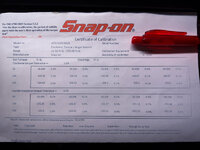
In reality, TechAngle is way better than 2%. For example, here is the the certificate of my ATECH3F250,
PSX_20230527_163250.jpg
Accuracy 0.25%, with the worst case error of 0.3%. My 3/8" and 1/4" Techangles are all less than 1%.
 

Sumboodie

Well-known member
Joined
Mar 20, 2021
Messages
10,697
Location
AK
(y) Nice that you found that page.
In reality, TechAngle is way better than 2%. For example, here is the the certificate of my ATECH3F250,
PSX_20230527_163250.jpg
Accuracy 0.25%, with the worst case error of 0.3%. My 3/8" and 1/4" Techangles are all less than 1%.

We used to get those calibrations and PMEL would cross it out and put the actual numbers.

Got so bad if we needed 5 Snap On torque wrenches we'd order 10 and hope 5 would pass.
Craftsman, the cheap $80 or whatever ones, somehow almost always passed.

Most of our had to hold +/- 5%, so 100 lb ft could be 95-105
 

Hannahranga

Well-known member
Joined
Mar 8, 2023
Messages
213
Yeah it's kinda annoying sometimes. I've used a big norbar break back torque wrench and they're really obvious you've hit the torque value cos the handle pivots like 30 degrees (plus it gets much easier), it's a shame that style only seems to be available in large and even larger.
 
To avoid these ads, REGISTER NOW!
Top Bottom