To avoid these ads, REGISTER NOW!

Torque Wrench Recommendations

guy48065

Well-known member
Joined
Aug 12, 2012
Messages
637
Location
Calibration Lab
...With a click type, you have no idea exactly when it's going to "click". And when it does, you don't know by how much you went over...

You miss the point that the click is produced by the mechanism "breaking" at the setpoint so it can't overtorque unless you're extremely sloppy and power right on through the several degrees of let-off.

A good mechanic will get spot-on repeatable results from either type. I see newbs trying to "beat the clock" and jerking their spendy Techangle and getting a red light every fastener. Inexcusable. I promise you an experienced tech with a calibrated $10 HF clicker will get more repeatable results than some kid who thinks his digital makes up for bad technique.

(And before you say it...yes...Experience + Techwrench = Perfection)
 
To avoid these ads, REGISTER NOW!

T45

Well-known member
Joined
Nov 20, 2014
Messages
3,250
You miss the point that the click is produced by the mechanism "breaking" at the setpoint so it can't overtorque unless you're extremely sloppy and power right on through the several degrees of let-off.

Just to clarify one point, this is technically a bit of an oversimplification--you can still mis-torque if you start from a position between 80% and 99% of target torque and don't know what you are doing and proceed as normal, because the phystics of bolt sticktion.
 

decaf

Well-known member
Joined
Jan 14, 2011
Messages
514
Location
Stockholm, SWEDEN
http://www.amazon.com/dp/B00MOSYZ6G/?tag=atomicindus08-20

Made by Norbar, you can´t go wrong with that...check them up, they know what they are doing...

Pretty cool history of Norbar:

How Norbar was born – from wartime need to universal demand: Established in 1942, the "North Bar Tool Company" became the first company in Britain to commercially manufacture torque wrenches. The initial demand was driven by the need for the gasket-less cylinder head of the Rolls Royce Merlin engine to be accurately tightened. Bill Brodey and his partner Ernest Thornitt obtained a licence from Britain's wartime Government to begin manufacture of torque wrenches and Norbar was born.
 
Last edited:

L.Cheapo

Well-known member
Joined
Oct 23, 2014
Messages
5,881
You miss the point that the click is produced by the mechanism "breaking" at the setpoint so it can't overtorque unless you're extremely sloppy and power right on through the several degrees of let-off.

A good mechanic will get spot-on repeatable results from either type. I see newbs trying to "beat the clock" and jerking their spendy Techangle and getting a red light every fastener. Inexcusable. I promise you an experienced tech with a calibrated $10 HF clicker will get more repeatable results than some kid who thinks his digital makes up for bad technique.

(And before you say it...yes...Experience + Techwrench = Perfection)

I'll agree...misuse of any tool by a tool will give poor results. When I have to tighten the gland nut on my ACVWs to 253ftlbs, there's a significant amount of effort involved. It's nice to see the progression of torque on the Techangle to know when it's coming.

I bought a Techangle because the handle on my rarely used and extremely well cared for USA Craftsman click type split. The friction ring on the handle broke years ago. After using this...there's no going back. :beer:
 

Fcvapor05

Well-known member
Joined
May 4, 2014
Messages
1,079
Thank you, Sir. I stand corrected..... and I am very glad that I was wrong! :)

No worries mate.

The misconception that you fell victim to is a common one. It's not your fault, it's the fault of Chinese manufacturers who have no interest in acting ethically.
 

Wakefield

Well-known member
Joined
Aug 26, 2010
Messages
5,132
Location
Arlington VA (but would like to get out to country
The REAL 'CE' mark is a certification that a product meets european standards and is safe for sale in the European Union.

https://en.wikipedia.org/wiki/CE_marking

"CE" originated as an abbreviation of Conformité Européenne, meaning European Conformity",

A few years ago Chinese companies began using a very similar (but not identical) marking in a blatant attempt to try and push product in Europe that wasn't safety tested to European standards.

This is obviously confusing, but it's the fault of Chinese companies deliberately misleading people, not of Snap-On or Proto or anyone else who makes tools. The CE mark on a Snap-On techwrench, for example, represents European conformity, NOT 'China Export'. Snap-on torque wrenches are made in the USA.

Diagram of 'European Conformity' and 'China Export' stamps next to each other:

CE_Marks_lrg.jpg


The difference is slight, but noticeable.

Keep in mind that the penalties for a company selling non-rated products in Europe is EXTREMELY stiff. If you see a CE mark on a tool or other item from a known, reputable manufacturer, odds are very good that it's a legitimate European conformity mark. If you see a similar mark on an el-cheapo tool or appliance, proceed with caution.

Thank you! :yikes:
 

48548

Well-known member
Joined
May 14, 2008
Messages
4,015
Location
Phoenix
Dammit I bought the defective model.... I never had an issue with the end cap... I paid 390$ in march 2011. I got it new, but didn't know they made a new model. I wonder if it would be worth upgrading....


IMG_4826.jpg


IMG_4825.jpg


IMG_4828.jpg
 

guy48065

Well-known member
Joined
Aug 12, 2012
Messages
637
Location
Calibration Lab
"Worth it"? All you'll be out is the time they will be in possession of the tool. It won't cost anything--even if they have to replace the entire plastic handle & electronics (cap no longer available for discontinued original handle style).
 

Adam.C

Banned
Joined
Jan 29, 2013
Messages
1,490
"Worth it"? All you'll be out is the time they will be in possession of the tool. It won't cost anything--even if they have to replace the entire plastic handle & electronics (cap no longer available for discontinued original handle style).

Negative. 2 year warranty on these. You can pay $70 or so to have it recalibrated. If you have the old end cap (which was truly defective) they will replace the entire handle with the new version of that style. But they won't turn a red techwrench into a gray techangle or a new black techangle.
 

48548

Well-known member
Joined
May 14, 2008
Messages
4,015
Location
Phoenix
I haven't had any issues with it and have only used it about 10 times. I guess it isn't worth buying a new one to get the new features. Just ***** you spend 390$ and now they have a new version. Hell I guess that was 5 years ago, what did I expect. Next year will be the new dual 120 teeth or something like that.
 

Adam.C

Banned
Joined
Jan 29, 2013
Messages
1,490
Dammit I bought the defective model.... I never had an issue with the end cap... I paid 390$ in march 2011. I got it new, but didn't know they made a new model. I wonder if it would be worth upgrading....


http://s421.photobucket.com/user/48548/media/toolbox 03-2011/IMG_4827.jpg.html


IMG_4825.jpg

That's the wrench I have and its darned fine. It has the upgraded end cap.

Not sure if they made it with a Dual 80 head or not. Mine is 32 tooth, which is noticeably clunky after using all Dual 80 ratchets. The new model is definitely Dual 80.

As far as I can tell, the new model has an improved ergonomic grip, larger display (which is nice), lights indicating you are getting close to the target torque, and more unit conversions. Pretty sure it carries the same part number as ours does.

The really new models have colored handles and black chrome heads and are even cooler looking. But I'm not motivated to trade up for looks. The display could be a big deal for some people however.

I would look for gray handled models on ebay for those who are looking for a decent torq wrench. I bought my 1/2" for about $100. The 3/8" was much less - like $40 bought as non working. I sent it to Snap On for "calibration" and I got back a new handle on a fully calibrated tool for $70 (so a little over $110).
 
Last edited:

48548

Well-known member
Joined
May 14, 2008
Messages
4,015
Location
Phoenix
Used sounds like the way to go. When I got mine list was 515, but I got it new from a dealer for 390. What was I smoking back then? I should have bought a used one. The new one has a b on the model. This one is a dual80, that was why I bought it, I wanted to upgrade from my 936 splitbeam to a better tooth count and gain the angle part.
 

Bluejoe

Well-known member
Joined
Feb 29, 2016
Messages
212
Ok what is Snapon digital torque ? split beam what makes it tick inside as far as mechanism just curious ?
 

Adam.C

Banned
Joined
Jan 29, 2013
Messages
1,490
You miss the point that the click is produced by the mechanism "breaking" at the setpoint so it can't overtorque unless you're extremely sloppy and power right on through the several degrees of let-off.

A good mechanic will get spot-on repeatable results from either type.

This isn't true at all. Snap On researched torque wrench usage and found that most of us overtorque with clickers. Industry research was conducted with similar findings. It's not always a big deal, but clickers overtorque.

Skill plays a huge part, but to be fair, much of that has to do with joint prep.

Forget who mentioned it, but every YouTube video I've seen with a HF wrench and a calibrator shows they are way off.
 

Adam.C

Banned
Joined
Jan 29, 2013
Messages
1,490
Ok what is Snapon digital torque ? split beam what makes it tick inside as far as mechanism just curious ?

Digital snappies are strain gages, not mechanical devices. They do not click or release, they vibrate like an Xbox controller.
 
Last edited:

L.Cheapo

Well-known member
Joined
Oct 23, 2014
Messages
5,881
That's the wrench I have and its darned fine. It has the upgraded end cap.

Not sure if they made it with a Dual 80 head or not. Mine is 32 tooth, which is noticeably clunky after using all Dual 80 ratchets. The new model is definitely Dual 80.

As far as I can tell, the new model has an improved ergonomic grip, larger display (which is nice), lights indicating you are getting close to the target torque, and more unit conversions. Pretty sure it carries the same part number as ours does.

The really new models have colored handles and black chrome heads and are even cooler looking. But I'm not motivated to trade up for looks. The display could be a big deal for some people however.

I would look for gray handled models on ebay for those who are looking for a decent torq wrench. I bought my 1/2" for about $100. The 3/8" was much less - like $40 bought as non working. I sent it to Snap On for "calibration" and I got back a new handle on a fully calibrated tool for $70 (so a little over $110).
The only difference in the part number is the last letter...the one I have and posted earlier is a "B" while the gray handled one is an "A".
 

bmwpowere36m3

Well-known member
Joined
Nov 8, 2012
Messages
1,125
This isn't true at all. Snap On researched torque wrench usage and found that most of us overtorque with clickers. Industry research was conducted with similar findings. It's not always a big deal, but clickers overtorque.

Skill plays a huge part, but to be fair, much of that has to do with joint prep.

Forget who mentioned it, but every YouTube video I've seen with a HF wrench and a calibrator shows they are way off.

Which isn't much skill… slow and steady and don't start or stop near the target torque. If you follow that… you'll be hard pressed to over-torque, unless you don't stop after the wrench "breaks".

The techangle certainly has advantages… accuracy, range, adjustable units and angle feature, but buzzing/chirping at specified torque I don't believe is one of them. Different, yes.
 

loveblacktea

Banned
Joined
May 3, 2016
Messages
10
Location
Brooklyn
:rocker:I have HANS torque wrench, Made in Taiwan. how do you think? I do not have enough money to get Nobar but I think this torque wrench is good enough. CDI? Never used it and I do not think I can afford it.
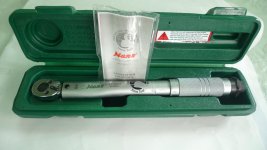
Hazet, Stahlwille or Gedore, do not even try them.
So my best choice can be made in Taiwan products
 

Attachments

  • 2170NM-0.jpg
    2170NM-0.jpg
    143.7 KB · Views: 26
To avoid these ads, REGISTER NOW!

Adam.C

Banned
Joined
Jan 29, 2013
Messages
1,490
Which isn't much skill… slow and steady and don't start or stop near the target torque. If you follow that… you'll be hard pressed to over-torque, unless you don't stop after the wrench "breaks".

The techangle certainly has advantages… accuracy, range, adjustable units and angle feature, but buzzing/chirping at specified torque I don't believe is one of them. Different, yes.

The buzzing chirping is part of a patented early warning system. That's what makes the digital wrenches better. With a clicker, you never know when you are about to reach your target torque. Guys pull into the click. We are meant to stop just as the wrench begins to release, long before it clicks.

If you haven't had the opportunity, spend some time with a selection of torque wrenches and a calibrator. If you don't think you will get that opportunity, listen to those of us who have. I could do better with a clicker now. But the accuracy comparison isn't close.

I hasten to add- torqueing the fastener isn't the end goal. The end goal is stretching the fastener, preloading the joint. So using the torque wrench correctly, and accurately is maybe 25% of the job.

Here are a couple more clicker tips:

1) Clickers must be stored at 0, not loose, but 0. Otherwise their springs take a set and give false readings (typically low). Not sure why loose is bad.
2) If you haven't used it in a while, you need to exercise your clicker at the target torque 5 times or so to get the workings moving, break up any corrosion that may have occurred since last usage. Digital wrenches have no mechanical workings so this is not necessary for them.
3) If you use your wrench above 80% of its range, you need to recalibrate every 5000 cycles. At mid range you only need to recal 20,000 cycles. So if recals are a concern, buy both a 3/8 and a 1/2" and use them up to mid range or so. Don't use your 3/8" wrench for lugs etc. True for all torque wrenches.
4) You have to hold the wrench exactly where you are meant to hold it. And compensate for the flex head angle.
 
Last edited:

bmwpowere36m3

Well-known member
Joined
Nov 8, 2012
Messages
1,125
The buzzing chirping is part of a patented early warning system. That's what makes the digital wrenches better. With a clicker, you never know when you are about to reach your target torque. Guys pull into the click. We are meant to stop just as the wrench begins to release, long before it clicks.

If you haven't had the opportunity, spend some time with a selection of torque wrenches and a calibrator. If you don't think you will get that opportunity, listen to those of us who have. I could do better with a clicker now. But the accuracy comparison isn't close.

I hasten to add- torqueing the fastener isn't the end goal. The end goal is stretching the fastener, preloading the joint. So using the torque wrench correctly, and accurately is maybe 25% of the job.

Here are a couple more clicker tips:

1) Clickers must be stored at 0, not loose, but 0. Otherwise their springs take a set and give false readings (typically low). Not sure why loose is bad.
2) If you haven't used it in a while, you need to exercise your clicker at the target torque 5 times or so to get the workings moving, break up any corrosion that may have occurred since last usage. Digital wrenches have no mechanical workings so this is not necessary for them.
3) If you use your wrench above 80% of its range, you need to recalibrate every 5000 cycles. At mid range you only need to recal 20,000 cycles. So if recals are a concern, buy both a 3/8 and a 1/2" and use them up to mid range or so. Don't use your 3/8" wrench for lugs etc. True for all torque wrenches.
4) You have to hold the wrench exactly where you are meant to hold it. And compensate for the flex head angle.

I can't speak for everyone and their needs... but in the shop, I don't use a torque wrench all that often (automotive work). By hand works 99% of the time. I think my father only pulls his torque wrench for head bolts.

At home I tend to use it all little more (OCDness). The whole process of bolt tension/preload by torque is inaccurate to start with... so I struggle with a tool that's maybe a little more accurate, in an "inaccurate" application (clean vs. dirty fasteners, coatings, thread-locker, lubricants, etc...).

If bolt tension is that "critical" then is should be measured directly.... like the bolt gauges for rods that measure stretch. Or simply a move to TTY hardware with takes the guess work out, is more accurate at the expense of disposable hardware.
 

dnschmidt

Well-known member
Joined
Oct 3, 2014
Messages
7,265
Location
Phoenix, AZ
TTY is clearly going to be the future. Torque is a non-direct measurement. With torque to yield you know the thread pitch, you know how many degrees it takes to stretch the bolt so many thousands of an inch. Torque really tells you very little and frankly that's why so few mechanics routinely use a torque wrench.
 

PBCampbell

Well-known member
Joined
Feb 2, 2009
Messages
871
Location
WV
Possible TTY will be the future, but only because it will increase the bottom line for car manufacturers, not because of necessity or utility. God forbid they find a way to put microchips in bolts, lol.
 

Mr. T

Well-known member
Joined
Sep 4, 2013
Messages
636
Location
Central PA
I'll give another vote for CDI. At work I have 3/8, 1/2, and 3/4. A big plus, other than price is that they come with a calibration cert.
 

Adam.C

Banned
Joined
Jan 29, 2013
Messages
1,490
TTY and TA are technically different. To be precise, this conversation is about torque angle. Most or all TTY fasteners get there via TA, but there are TAs showing up in areas where the fasteners are not TTY (suspensions).

The key is, the variation in preload caused by friction is so significant, measuring torque alone is no longer a responsible approach for safety critical hardware.

So.....if you are thinking about buying a torque wrench, regardless if you intend to rebuild engines or not, you need to figure out how you will accurately turn angles.
 

dnschmidt

Well-known member
Joined
Oct 3, 2014
Messages
7,265
Location
Phoenix, AZ
Adam, you're right. I sell very high quality torque wrenches with angle made by Eclatorq but I don't really push them as I don't feel that's the way to go. Use a torque wrench to set the pre-torque and use a digital angle gauge on a ratchet or breaker bar to get the angle. The digital angle gauges give you so much more flexibility as they can be used on short ratchets, wrenches, line wrenches or damn near anything that's magnetic. I sell the Eclatorq model of the digital angle gauge but the Brown Line Metalworks one works great too. I just think this is the better way to go.
 

Mooky

Well-known member
Joined
Jul 6, 2014
Messages
257
Location
PA
Possible TTY will be the future, but only because it will increase the bottom line for car manufacturers, not because of necessity or utility. God forbid they find a way to put microchips in bolts, lol.

They do. Embedded ultrasonic transducers to measure fastener elongation. As mentioned, torque is an inferred measure of clamping force.

Typically used with hydraulic tensioning tools in aerospace, nuclear, and petrochemicals equipment. The fasteners used in automotive applications are small in comparison, but the technology is advancing.
 

bmwpowere36m3

Well-known member
Joined
Nov 8, 2012
Messages
1,125
They do. Embedded ultrasonic transducers to measure fastener elongation. As mentioned, torque is an inferred measure of clamping force.

Typically used with hydraulic tensioning tools in aerospace, nuclear, and petrochemicals equipment. The fasteners used in automotive applications are small in comparison, but the technology is advancing.

True... but the question is there a need. Like the need for an electronic (strain-based) torque wrench.

At work we build military and commercial helicopters... if something is preloaded, its via torque (certified/calibrated and new MIL hardware).
 

Fcvapor05

Well-known member
Joined
May 4, 2014
Messages
1,079
If bolt tension is that "critical" then is should be measured directly.... like the bolt gauges for rods that measure stretch. Or simply a move to TTY hardware with takes the guess work out, is more accurate at the expense of disposable hardware.

The dirty secret is that there just aren't very many mission-critical fasteners in a car. Head bolts, rod bolts, cap bolts, flywheel/flexplate bolts, and a few suspension parts. Fasteners for most every other location on the car are most often chosen based on lowest cost, or using a less-than-ideal size because the ideal size isn't used anywhere else, or whatever.

Notice that all of those 'mission critical' bolts are, on any modern car, highly likely to be single-use TTY bolts.
 

guy48065

Well-known member
Joined
Aug 12, 2012
Messages
637
Location
Calibration Lab
Scrapped another electronic torque wrench today. This time it wasn't electronic failure--it was a bolt got dropped and it hit the wrench right in the middle of the display window and cracked the LCD.
Never seen anything more than a nick on a clicker.

Another downside to consider is if you stop using an E-wrench for several seconds (light a cig, answer an email...) the tool may turn off. If you don't notice the little display is blank you can pull way past the setting and damage both the part and the wrench.

All this needs to be considered before plunking down $400 hard-earneds.
 

country83

Well-known member
Joined
May 28, 2009
Messages
504
Here are a couple more clicker tips:

1) Clickers must be stored at 0, not loose, but 0. Otherwise their springs take a set and give false readings (typically low). Not sure why loose is bad.
2) If you haven't used it in a while, you need to exercise your clicker at the target torque 5 times or so to get the workings moving, break up any corrosion that may have occurred since last usage. Digital wrenches have no mechanical workings so this is not necessary for them.
3) If you use your wrench above 80% of its range, you need to recalibrate every 5000 cycles. At mid range you only need to recal 20,000 cycles. So if recals are a concern, buy both a 3/8 and a 1/2" and use them up to mid range or so. Don't use your 3/8" wrench for lugs etc. True for all torque wrenches.
4) You have to hold the wrench exactly where you are meant to hold it. And compensate for the flex head angle.

1) Wrong. Micrometer torque wrenches need to be stored at the lowest marking on the scale, typically 20% of full scale. Many do not have 0. If you unwind it too far, the parts inside can get loose and fall out of place, affecting calibration.
2) Technically you're supposed to exercise electronic ones too, but I've never seen a difference between exercised and non.
3) Never heard that one. Probably depends on manufacturer's instructions more than anything.
4) Don't worry about the flex head if it has one, it's not enough flex to significantly alter the readings.
 

T45

Well-known member
Joined
Nov 20, 2014
Messages
3,250
There is debate about how much to backoff a spring, I don't think even that point is fully settled. The main point being to take stress off the spring so it doesn't set. Then there is some confusion about what the right level of decompression , and invariably the variety of engineering designs probably means ther best answer for one is not the same for others. I wouldn't back the spring out beyond zero ('all the way out') tho.

Somewhere between zero and 20% is probably fine; and if you worry about stuff like this but are too cheap to pay for an annual inspection/calibration you should seriously consider a different design. Clickers are really only a convenience, and they have lots of annoying features that are expensive and time consuming to deal with to keep calibration. There is something to be said for beam, split beam, dials and etc because of this.
 

guy48065

Well-known member
Joined
Aug 12, 2012
Messages
637
Location
Calibration Lab
Clickers are really only a convenience, and they have lots of annoying features that are expensive and time consuming to deal with to keep calibration. There is something to be said for beam, split beam, dials and etc because of this.
Annoying features like a screw, handle, spring? Are you serious? A split beam or a dial-type are much harder to adjust, harder to disassemble, more fragile.
Clickers are so popular because they are very accurate, repeatable, rugged, simple, easy to maintain, and cheap.

When a clicker set to 200 "breaks" it drops off to around 150 and the handle moves about 10 decrees. If you constantly have trouble powering right past the let-off, you have a serious problem with technique that a split beam or a dial will only make worse.
 

Badger Rob

Member
Joined
Dec 23, 2014
Messages
14
Location
Madison, WI
After reading recommendations on this board I own 3 CDI torque wrenches. They replaced a couple of craftsman units. I have been very happy with them.
 
To avoid these ads, REGISTER NOW!
Top Bottom