To avoid these ads, REGISTER NOW!

Torquing with impact sockets

IDidntDoIt

Well-known member
Joined
Jan 5, 2012
Messages
54
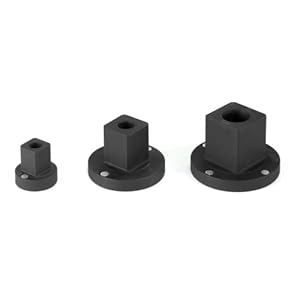
For torquing hub nuts (say 30mm) would it be okay to use impact socket, or a 3/4'' socket with an impact adapter from 1/2'' drive (1/2'' torque wrench)? Would it provide an accurate reading? I'm torquing up to 200 ft lbs so I'm not so sure that any flex from an impact socket is going to throw off the accuracy more than 10 ft lbs, but I just wanted to make sure.
 
To avoid these ads, REGISTER NOW!

G1GRANDEUR

Well-known member
Joined
Aug 22, 2009
Messages
2,094
I don't think it's going to be a problem. Though I'd skip the adapter if possible.
 
OP
I

IDidntDoIt

Well-known member
Joined
Jan 5, 2012
Messages
54
Cool thanks. I guess I'll need to buy a 30mm 1/2'' drive socket to avoid using the adapter.
 

Alchymist

Well-known member
Joined
Mar 1, 2009
Messages
4,423
Location
Central PA
Neither the socket nor an adapter should throw off the reading - the wrench will continue to apply torque to the train until the setting is reached, and the only thing resisting the torque is the fastener.
 

diesel research

Well-known member
Joined
Sep 12, 2010
Messages
5,440
Location
gulf coast, TEXAS
Neither the adapter nor the impact socket are going to cause you any amount of issues under normal circumstances.

There is this myth that impact sockets are significantly "softer" or more flexible. That is not how they should be thought of. Instead, think of them more like a pyrex baking dish vs a wine glass.

I do prefer grey pneumatic adapters though.

31XBNCX-WaL._SL500_AA300_.jpg
 

G1GRANDEUR

Well-known member
Joined
Aug 22, 2009
Messages
2,094
Actually every attachment to ratchet will throw off the reading. It's best not to add anything between socket and ratchet for precision reading. But we are talking about hub nut, so no big deal. :thumbup:
 

diesel research

Well-known member
Joined
Sep 12, 2010
Messages
5,440
Location
gulf coast, TEXAS
Actually every attachment to ratchet will throw off the reading. It's best not to add anything between socket and ratchet for precision reading. But we are talking about hub nut, so no big deal. :thumbup:


That applies mostly for impacts, where each square drive absorbs shock impulses. Unless he is hammering on his torque wrench or experiencing torsional twisting of any significant amount, he isn't going to have issues.

One could argue the theoreticals that there is always some torsional twisting, but the socket and single square drive also experience that. Even more important factor is frictional inconsistencies of the thread itself, and it's torsional twisting.

The bolt is going to twist before the attachment does, or else you have some junk tools or incorrectly sized.
 

Spam16v

Well-known member
Joined
Oct 31, 2010
Messages
368
Location
B-low NY
torque spec on a hub nut is typically tight as hell.... Do not lose any sleep tool-polisher style.
 
To avoid these ads, REGISTER NOW!

Boiler

Well-known member
Joined
Nov 20, 2009
Messages
1,967
Location
Indiana
Adapters don't affect torque as long as the torque wrench is acting in a plane perpendicular to the fastener and the drive of the torque wrench shares an axis with the fastener. Torque angle will be affected by twisting adapters and extensions however
 

larry_g

Well-known member
Joined
Apr 28, 2007
Messages
16,891
Location
oregon
Adding additional torque to the input will be transfered to the opposite end of the shaft or the output. Remember the lesson in physics that for every force there is an equal and opposite force. When motion stops and everything is in equalibrium the torque in = torque out. So all torque that is applied to the torque wrench is seen at the load. No torque is lost in the adapters or extensions or anything else between the torque wrench and the nut or bolt. You may loose motion as the adapters wind up and energy lost as heat if you want to measure it but when all input motion is stopped what ever the torque wrench is indicating is being applied to the fastener.

lg
no neat sig line
 

PSYKO_Inc

Well-known member
Joined
Oct 23, 2010
Messages
565
Location
Fairfield, CA
As far as I know, the only difference between impact sockets and chrome sockets are the lack of chrome plating (could flake off), and thicker walls to prevent cracking. If anything, the impact socket should flex less than the chrome socket. Either way, socket flex wouldn't make enough of a difference to even worry about, considering that calibrated torque wrenches are generally only calibrated to +/-3% anyway.
 

joeswamp

Well-known member
Joined
Jul 25, 2007
Messages
2,418
Location
Massachusetts
Socket or adapter flex doesn't matter. You're applying torque to one end of a flexible adapter, no matter how much it flexes it's going to apply the exact same torque out the other end.

The situation is analogous to a spring sitting on top of a bathroom scale. If I put a 100lb weight on top of the spring, the bathroom scale is still going to register 100lbs, no matter how much the spring deflects.
 
Last edited:
To avoid these ads, REGISTER NOW!
Top Bottom