To avoid these ads, REGISTER NOW!

Torsion Spring Adjustment tools...?

Paultergeist

Active member
Joined
May 30, 2013
Messages
42
Location
Lemon Grove, CA
Greetings,

I am soon to embark on an attempt to adjust my torsion spring on my garage door. It is a fairly new garage door (about 3 years old, very low use) and my understanding is that a new-ish spring may need to be re-adjusted as the new metal relaxes following initial installation. The door has gotten "heavier" to open; it was never re-adjusted beyond the initial installation.

My question is regarding the metal rods used to adjust the torsion spring: I have read that 1/2 inch mild steel rod is the preferred tool -- I am wondering if there is a more specialized tool for this application? I don't have much experience buying generic steel rod -- not sure if this is a common hardware store type of item? Any ideas as far as acquiring the appropriate metal rods to use for this application would be appreciated.

Thanks.
 
To avoid these ads, REGISTER NOW!

Falcon67

Well-known member
Joined
Jun 11, 2009
Messages
18,371
Location
Merkel, TX
36" of 1/2 steel rod from Lowes, cut in half. I put a could of 16 penny nails in the header and they stay there for later use.
 

upndown

Well-known member
Joined
Dec 5, 2010
Messages
3,107
Location
Desert Hills/Peeples Valley AZ.
Rebar being a somewhat soft material can tend to bend as you're winding the spring. Especially if it's the wrong size! Just about the time your hands up there to tighten the set screws, the bar slips out :shocking: Not a good thing.
 
Joined
Aug 23, 2014
Messages
10
Rebar being a somewhat soft material can tend to bend as you're winding the spring. Especially if it's the wrong size! Just about the time your hands up there to tighten the set screws, the bar slips out :shocking: Not a good thing.

Seriously? :headscrat Have you ever bent rebar? Rebar is no more 'soft' than it is 'hard'. The stuff holds up just about every concrete bridge in the USA and is typically manufactured in grades 40, 60, and 75. The properties of grade 40 are very similar to A36 steel and it is probably higher strength that that china **** steel from home cheapo. From a strength perspective I wouldn't hesitate to use rebar for a second. It would be more than adequate to wind a torsion spring. With that being said I would not use it because it's not smooth. Could deform the hole and is not good on the hands.

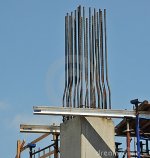
If you were to use an undersize rebar sure it could bend, just like an undersize A36 hot rolled steel rod could also.
 

s10xtremist

Well-known member
Joined
Aug 29, 2013
Messages
131
Location
State Capitol Raceway, LA
Don't forget to slightly stretch the spring after you wind it and before you tighten the set screws. Stretch it just enough so that the bulk of it sags a little. Stretch it too much and it gets a slight corkscrew shape to it when the door is down. This just puts extra stress on the coils which will shorten the life of the spring. With one rod still in the winding cone, you **** it at an angle so that the cone is crooked on the shaft. This makes the cone bind and not slip on the shaft. Using the other rod, tap the rod about 3" from where it goes into the cone to knock the cone over, stretching the spring. BTW, I use a 7/16" 12-point deep well socket on a 1/4" drive ratchet for the set screws.
 

upndown

Well-known member
Joined
Dec 5, 2010
Messages
3,107
Location
Desert Hills/Peeples Valley AZ.
Seriously? :headscrat Have you ever bent rebar? Rebar is no more 'soft' than it is 'hard'. The stuff holds up just about every concrete bridge in the USA and is typically manufactured in grades 40, 60, and 75. The properties of grade 40 are very similar to A36 steel and it is probably higher strength that that china **** steel from home cheapo. From a strength perspective I wouldn't hesitate to use rebar for a second. It would be more than adequate to wind a torsion spring. With that being said I would not use it because it's not smooth. Could deform the hole and is not good on the hands.

If you were to use an undersize rebar sure it could bend, just like an undersize A36 hot rolled steel rod could also.

Nope! I never have, but I don't use rebar to wind springs! I am impressed with your knowledge of rebar, but we're not building bridges here, are we? I guess all the Horror stories I've heard over the last 35+ years must be wrong.:dunno:
 

Dcampbell98xj

Well-known member
Joined
May 8, 2014
Messages
80
Don't over tighten the set screws. You don't need to pierce the shaft, snug the set scre by hand and then tighten about 1 - 1 1/2 turn. Also with the door closed put a vise grip on the shaft to hold tension on the cables so they do not slip off the drums. If you have 2 springs that step is not important in that case put a vise grip over one of the rollers so when you add tension the door can't fly up and knock you off the ladder
 

C G

Well-known member
Joined
May 13, 2007
Messages
285
Location
Monroe, Washington
Hmmm, Ive used rebar on three garage doors now. Never even considered it would bend. Seems crazy stout to me. One thing though when I did this I made everyone clear outta the garage ... just in case =)
 

xyster101

Well-known member
Joined
Jul 3, 2013
Messages
640
Location
Upstate NY
My 1/2" steel bars bent. I was scared $hitless when it happened because I had the springs wound 7 times and there was no way to change to different bars at that point. It worked out, but I think I need to re tighten them a half turn. I don't want to do it.
 

nickm1024cobra

Well-known member
Joined
May 1, 2010
Messages
62
Location
Chicago Suburbs, IL
I can tell you that the majority of accidents happen when people use the wrong tool. Some manufacturers use 7/16, some 1/2'. When homeowners use the wrong size or god forbid a long screwdriver bad things happen. Make sure you have a nice tight fit. I also recommend painting the rod with a paint marker, white out, etc after inserting it. This way, when you are winding you can tell that it is fully seated and don't risk catching it in the face. Hope that helps.
 

wssix99

Well-known member
Joined
Mar 2, 2011
Messages
5,156
Location
Chicago, IL
Seriously? :headscrat Have you ever bent rebar? Rebar is no more 'soft' than it is 'hard'. The stuff holds up just about every concrete bridge in the USA and is typically manufactured in grades 40, 60, and 75.

I just built a concrete house and worked with tons of the stuff. It is very ductile and we bent it and cut it with hand tools.

Rebar in reinforced concrete is used as a tension member and those ratings you cite are strengths if you pull the bar in tension along its length. Rebar in concrete might as well be wire rope, and in pre/post-tensioned structures, it is.

Using rebar to wind springs is extremely dangerous. The larger the spring/force, the greater the danger and likelihood that the bar could bend or shear.

IMO - Given what is risked here, (cost of door, trip to hospital, face transplant, etc.) its worth the extra money to get a purpose built tool - or even borrow one. There are also hexagonal versions with round ends that improve your grip on the tool.
 
Last edited:
OP
P

Paultergeist

Active member
Joined
May 30, 2013
Messages
42
Location
Lemon Grove, CA
Garage Door Round Winding Bars (Pair) $12.95

1/2" to 7/16" Basic Round Stock Winding Bars - 18" Long - 2 bars Included

http://www.garagedoornation.com/products/round-winding-bars-pair

Thanks very much for this link.....exactly what I was looking for.....

I am going to look around my local area a bit more before I resort to ordering on-line, but my local HD/Lowes stores do not seem to be as focused on these sort of materials. If I strike out locally, I'll pull the trigger on ordering these.

Thank you very much for the helpful link.
 
OP
P

Paultergeist

Active member
Joined
May 30, 2013
Messages
42
Location
Lemon Grove, CA
Don't over tighten the set screws. You don't need to pierce the shaft, snug the set scre by hand and then tighten about 1 - 1 1/2 turn. Also with the door closed put a vise grip on the shaft to hold tension on the cables so they do not slip off the drums. If you have 2 springs that step is not important in that case put a vise grip over one of the rollers so when you add tension the door can't fly up and knock you off the ladder

Understood.......thank you for the helpful thoughts. Now that you call my attention to it, that one set screw is the only thing holding that spring tension once it is set, is it not? I can see why people might be prone to over-tightening it.

Thanks -- to everyone -- for the very helpful replies. I can assure everyone that I am taking my time with this (reading, on-line, etc), WILL be using appropriate tools for this job, and I intend to be just as careful and thoughtful as I can when I do this.
 
To avoid these ads, REGISTER NOW!
Joined
Aug 23, 2014
Messages
10
Rebar in reinforced concrete is used as a tension member and those ratings you cite are strengths if you pull the bar in tension along its length. Rebar in concrete might as well be wire rope, and in pre/post-tensioned structures, it is.

Um not exactly true. Guess this column reinforced with 'wire rope' is destined for collapse. Reinforced concrete structures are very complex designs. Not all pieces are stressed as stated above. Steel properties are steel properties. Stresses are then calculated based on the type and magnitude of the applied load(s).
There is no significant difference between rebar and home cheapo round bar stock other than the external shape. Nothing worse than people spreading 'knowledge' that is incorrect.
 

Attachments

  • image.jpg
    image.jpg
    62.8 KB · Views: 20

Big Bad Dad

Well-known member
Joined
Jan 31, 2010
Messages
2,665
Location
Southwest/ Central Va.
Wow, lots of opinions here. How hard do you guys have to wind your springs? When I built my garage, I bought two 1/2" x 14 inch grade 5 bolts to wind my springs with. Left them stuck in the door header for possible future use. Haven't needed them yet after 13 years!
 

12ozd

Well-known member
Joined
Apr 6, 2012
Messages
808
Location
at the kegerator
I want to see someone take a piece of 1/2" rebar, put it in a vise and bend it by hand.
(A garage door spring uses a whole lot less force to wind)
 

c39er

Well-known member
Joined
Mar 23, 2008
Messages
1,662
Location
Seattle, Washington
I used 1/2" wood dowels when I re-adjusted my door spring.
Please don't try this if you have not done it before. Only to be done by a pro!
 

NUTTSGT

Super Moderator
Staff member
Joined
Sep 14, 2009
Messages
50,864
Location
Northern Central Ohio
I want to see someone take a piece of 1/2" rebar, put it in a vise and bend it by hand.
(A garage door spring uses a whole lot less force to wind)

I bent some 1/2" rebar, it wasn't exactly a cakewalk. I've seen rebar used more than once.

Personally I could care less what type of metal rod you use to wind springs, you need to pay attention to what you are doing as any rod could slip out while in process and cause you to have a bad day.
 

s10xtremist

Well-known member
Joined
Aug 29, 2013
Messages
131
Location
State Capitol Raceway, LA
Now that you call my attention to it, that one set screw is the only thing holding that spring tension once it is set, is it not? I can see why people might be prone to over-tightening it.

There should be two st screws, 90º apart. As stated, you don't want to tighten the set screws so much that you squash the shaft. This weakens it. You just need the set screws to lightly dig into the surface.
 

dslabuda

Well-known member
Joined
Sep 9, 2009
Messages
253
Location
NW Indiana
Is this talk of rebar vs steel rod going to be the next great GJ debate?

I'll just say man up and use your pinky fingers to wind it. :)

Sent from my SAMSUNG-SM-N900A using Tapatalk 4
 
Joined
Aug 23, 2014
Messages
10
I used 1/2" wood dowels when I re-adjusted my door spring.
Please don't try this if you have not done it before. Only to be done by a pro!


LOL, I was going to suggest that might be possible with oak dowels but figured it would have set the sharks off on a feeding frenzy.......
 

dclassical

Well-known member
Joined
Sep 25, 2008
Messages
1,130
If PVC pipe is good enough for compressed air it should work for a torsion spring. I am JOKING (just to make it clear).
 

wssix99

Well-known member
Joined
Mar 2, 2011
Messages
5,156
Location
Chicago, IL
Reinforced concrete structures are very complex designs.

This is very correct. Reinforced concrete is a very hard thing for a lay person to understand.


Guess this column reinforced with 'wire rope' is destined for collapse.

Rebar does have some compressive strength, but in most common applications its an insignificant contribution to the overall strength. In the picture you posted above, the rebar is there to keep the column strong in bending. (From wind loads or floor loads not centered on the column.) That is why the rebar is on the far edges of the column. If you could get wire rope to lock in to the concrete matrix the same as solid rebar and if it would stand straight by itself during a pour, you could certainly use wire rope in a reinforced concrete column.


There is no significant difference between rebar and home cheapo round bar stock other than the external shape.

There definitely is. A key difference is the modulus of elacticity and it explains why rebar will bend more readily than the carbon steel needed for spring winding. You can read all about it:
- http://en.wikipedia.org/wiki/Elastic_modulus
- http://www.engineersedge.com/manufacturing_spec/properties_of_metals_strength.htm


Nothing worse than people spreading 'knowledge' that is incorrect.

The only thing worse than that is people who spread incorrect information (that they can't back up) on the internet that is in areas beyond their education and can hurt people.


The good news is that the bar stock on the shelf at Home Depot is probably adequate for this. Just go for that and pass up the rebar.
 

Dcampbell98xj

Well-known member
Joined
May 8, 2014
Messages
80
The set screws are the only thing holding the spring tension but there are two and it's a clamping effect. If you pierce the tube it looses it's strength. It will also cause the tube to mushroom and then any adjustment later will be a real pain because the spring will not be able to rotate on the shaft. Once the spring has been adjusted lightly tap the spring out wards for a very slight sag. Will keep the spring from binding up and making popping sounds. A residential door should not have enough tension on the springs to bend rebar. A commercial door 16'wide by 12' height is a different story. Figure one full turn for every foot the door is tall.then at the end add 3/4 of a turn. 7' high= 7-3/4 turns. Draw a line on the spring, chalk or paint or crayon. Then wind the spring. Makes it easy to keep track.
 
Joined
Aug 23, 2014
Messages
10
There definitely is. A key difference is the modulus of elacticity [sic] and it explains why rebar will bend more readily than the carbon steel needed for spring winding. You can read all about it:
- http://en.wikipedia.org/wiki/Elastic_modulus
- http://www.engineersedge.com/manufacturing_spec/properties_of_metals_strength.htm

Thank you for pointing out that the modulus of elasticity (E) for rebar is 29x10**6 psi and the modulus of elasticity (E) for A36 hot rolled steel is 29x10**6 psi. For reference or comparison purposes you may want to look up lead. Young's modulus for lead is 2.0x10**6psi.

OMG there was not one reference to rebar bending more easily than carbon steel in EITHER article. There is nothing worse than a wanna be engineer reading things on the internet. :lol_hitti
 
Last edited:
Joined
Aug 23, 2014
Messages
10
I want to see someone take a piece of 1/2" rebar, put it in a vise and bend it by hand.
(A garage door spring uses a whole lot less force to wind)

You won't see it because it won't happen unless the guy is a 400 pound monster with a bench seriously bolted to the floor. It's amazing how many here will insist that rebar is inadequate and will bend in this application yet not one of them actually worked with rebar or has any engineering knowledge. :headshake
 

c39er

Well-known member
Joined
Mar 23, 2008
Messages
1,662
Location
Seattle, Washington
Thank you for pointing out that the modulus of elasticity (E) for rebar is 29x10**6 psi and the modulus of elasticity (E) for A36 hot rolled steel is 29x10**6 psi. For reference or comparison purposes you may want to look up lead. Young's modulus for lead is 2.0x10**6psi.

OMG there was not one reference to rebar bending more easily than carbon steel in EITHER article. There is nothing worse than a wanna be engineer reading things on the internet. :lol_hitti

This ought to scare the OP!
I thought we were talking about winding a door spring-not engineering class!!!:bounce:
 

wssix99

Well-known member
Joined
Mar 2, 2011
Messages
5,156
Location
Chicago, IL
Thank you for pointing out that the modulus of elasticity (E) for rebar is 29x10**6 psi and the modulus of elasticity (E) for A36 hot rolled steel is 29x10**6 psi. For reference or comparison purposes you may want to look up lead. Young's modulus for lead is 2.0x10**6psi.

OMG there was not one reference to rebar bending more easily than carbon steel in EITHER article. There is nothing worse than a wanna be engineer reading things on the internet. :lol_hitti

You are right on that point. I got malleability and ductility confused with each other. (and read the wrong values for rebar) Rebar and cold rolled steel have the same ductility. Thank you for making sure we get the correct technical information here. (My metallurgy is obviously "rusty.")

I do think it's important that that we not loose sight of the OP's very good decision here to get the proper bar for the job.

Asserting that rebar is safe and adequate for this job remains to be unsound and hazardous advice. The rebar can bend easier (it may not break) which could allow the spring to move when one wants it to hold steady.)

Normally, when a new member shows up to this site and starts posting unsupported "fact," I take it as gospel. But having recently bent rebar with my own hands... and having tried unsuccessfully to bend cold rolled steel of a similar size - I'm pretty sure this the folks talking about rebar being bendable are correct.

With a little more caffeine this morning, I think I have malleability and ductility straight now. It looks like malleability is the property in play here. (Are there any metallurgists in the house? Is this correct?) Rebar is a hot rolled steel, as opposed to cold rolled steel, which should be used for spring winding: http://midcitysteel.com/materials-101-hot-rolled-steel-vs-cold-rolled-steel/
 
Last edited:

LB-1911

ALLIANCE MEMBER
Joined
Sep 24, 2011
Messages
5,742
Location
Northwestern Il.
This ought to scare the OP!
I thought we were talking about winding a door spring-not engineering class!!!:bounce:

The OP is good to go. (Post #20)

Thanks -- to everyone -- for the very helpful replies. I can assure everyone that I am taking my time with this (reading, on-line, etc), WILL be using appropriate tools for this job, and I intend to be just as careful and thoughtful as I can when I do this.
 
Last edited:

30cal

Well-known member
Joined
Aug 6, 2013
Messages
286
Location
Illinois
This place is like the Andy Griffith show...Barney sets Gomer straight on
"malleability and ductility" and "modulus of elacticity" but doesn't know how to spell "lose". The man just wants to adjust his door,it's kinda funny in a Mayberry layperson sort of way..
 
Last edited:
To avoid these ads, REGISTER NOW!
Top Bottom