OK, after all my stubborn resistance, I have ordered a Makita corded track saw with a 55" track. It appears there is no blade included. For immediate use I will be ripping oak and pine. Along the way I will be using it for sheet goods for furniture and cabinets. It is a 6 1/2" saw. Can I hear suggestions please? Bear in mind that, in the outset, I'm not opposed to some sort of combination blade to get myself more acquainted with the saw. I likely won't buy top notch out of the gate unless you savvy, experience users tell me otherwise. Thanks in advance.


You are using an out of date browser. It may not display this or other websites correctly.
You should upgrade or use an alternative browser.
You should upgrade or use an alternative browser.
track saw blade recommendation
- Thread starter lardy1
- Start date
alinc100
Well-known member
What has you believing there is no blade included? I haven't gotten much use from mine but I did buy 3 blades via Ebay, CMT brand, various tooth counts which should last me quite awhile. This was the seller: https://www.ebay.com/itm/1544259561...uid=uL822xmETtG&widget_ver=artemis&media=COPY. We have (recently) used a dewalt track saw and blade combo at work but we were cutting 2" thick felt panels. I didn't see a big visual difference in the blade, it was IIRC $60-70 at a local tool store , making my $25 blades on eBay seem like a bargain. CMT blades and bits have worked well in the past for me.
Careful!CMT Orange for me. Those are my blades of choice.
Tracksaws need really specific blades. Like other blades, tracksaw blades come in different thicknesses. You would think if you put a thick blade on, run it down the track and cut the splinter guard, when you switch to a thin blade, there would be a gap that would lessen the effect/benefit of the splinter guard/strip. This is partially true.
Since the arbor the blade indexes against is on the same side as the track's splinter guard, thinner or thicker blades don't matter. The thickness of the blade grows toward the waste. The edge of the saw blade will always be in line with the arbor. Problem is, blades' teeth have "set". So the toothed edge is thicker than the center of the blade that banks against the arbor.
SO! The answer is, you want Makita tracksaw blades which are very good, leave a very good finish and, despite being different thicknesses, all have the exact same set (.012" per side). I would choose the 60T thicker blade since power won't be a problem for your corded saw. It will cut slower in thicker wood. The thinner 48T is something you might want to switch to later.
I believe Makita blades are made by Japanese blade maker Tenryu and are excellent.
FWIW, I have the Milwaukee cordless saw and I don't like the blades. I sorta can't switch without screwing up my track. Also limited by my riving knife which you don't have. If I was doing it again, I would have picked Makita.
Last edited:
jar944
Well-known member
Tenryu.
The 28t general purpose blade works well enough for solid and ply.
The 28t general purpose blade works well enough for solid and ply.
Numerator2142
Well-known member
- Joined
- Sep 16, 2023
- Messages
- 59
Your saw should come with a gen purpose blade.
I got bit by the "frequently bought together" and picked up a 6.5" Diablo ultra fine. If you're paying attention you know that's 5/8" arbor blade...
Turns out you can use the arbor washer (MAKITA 224594-3 - INNER FLANGE 35 XSL05) from their circular saws to adapt to the 6.5" blades to 5/8" because the actual shaft is 5/8.
I got bit by the "frequently bought together" and picked up a 6.5" Diablo ultra fine. If you're paying attention you know that's 5/8" arbor blade...
Turns out you can use the arbor washer (MAKITA 224594-3 - INNER FLANGE 35 XSL05) from their circular saws to adapt to the 6.5" blades to 5/8" because the actual shaft is 5/8.
Voi
Well-known member
I use the Oshlun 48 tooth blade for plywood. I have used it to rip Cottonwood and Elm. Best guess is I'd want something more rip oriented for oak. I have no doubt the Oshlun could handle it but there would be some edge cleanup for sure.
I truly appreciate the input. I am semi-experienced (worked in a cabinet shop and have a home shop) but have resisted the track saw. Now that barrier is broken I'll be learning as I go so I want to avoid pitfalls by listening to others. So..... another question. Should I just buy an additional 55" track like the one it comes with and use proper Makita connectors or will I be sorry I didn't spend the cash for the 110"?
Voi
Well-known member
I truly appreciate the input. I am semi-experienced (worked in a cabinet shop and have a home shop) but have resisted the track saw. Now that barrier is broken I'll be learning as I go so I want to avoid pitfalls by listening to others. So..... another question. Should I just buy an additional 55" track like the one it comes with and use proper Makita connectors or will I be sorry I didn't spend the cash for the 110"?
I do prefer the 110" track for long rips. But I got mine steeply discounted and ended up with a straight one. Many reports of slight curves in the longer tracks.
With that said, I do also have two, 55" tracks and the Makita connectors and do use that when doing a long rip at my cabin or other locations where I don't want to transport the long track.
I have heard the TSO connectors are better but do not have any experience with them. I do have the TSO right angle cross cut stop (or whatever it is called) and it is fantastic so I'm sure their connectors are also great.
Numerator2142
Well-known member
- Joined
- Sep 16, 2023
- Messages
- 59
I don't have the long track, but the 2 55's with the connector work ok. You might want a straight edge to do fine alignment because there's a little bit of play.
Check your rails for straightness though. 1 of 2 of my 55's was bad, but easy enough return/replace from HD.
Check your rails for straightness though. 1 of 2 of my 55's was bad, but easy enough return/replace from HD.
jar944
Well-known member
Your saw should come with a gen purpose blade.
The stock 48t blade (B-07353) isn't very good at ripping Harwood. It's really a plywood/crosscut blade.
Downwindtracker 2
Well-known member
The connectors are pretty good,. The way they are designed they spread instead of grub screwing into the aluminum. Of course when joining you will have to check with a straight edge. At least I had to.
I have couple of 55" tracks . it came with one,and the second 55" with connectors was cheaper than the single long track.
I kinda wish I had a loose 39", it would be handy for 24" wide plywood.
I have couple of 55" tracks . it came with one,and the second 55" with connectors was cheaper than the single long track.
I kinda wish I had a loose 39", it would be handy for 24" wide plywood.
mike93lx
ALLIANCE MEMBER
I use an oshlun in my saw. Has worked well for the general purpose stuff I do, but I'm not ripping hardwoods with it
Mr onetwo
Well-known member
If you have a decent table or cabinet saw why, in heavens name would you use a track saw to rip hardwood.Probably the worst thing to ask this type of saw to do IMHO.The 48T blade it comes with does a magnificent job breaking down birch plywood and such.Makita makes really great saw blades. I have one on my Dewalt table saw...which I use to rip hardwood by the way.
mike93lx
ALLIANCE MEMBER
Its a great way to get a straight edge and then move to the table saw. Especially if the edge is particularly gnarlyIf you have a decent table or cabinet saw why, in heavens name would you use a track saw to rip hardwood.Probably the worst thing to ask this type of saw to do IMHO.The 48T blade it comes with does a magnificent job breaking down birch plywood and such.Makita makes really great saw blades. I have one on my Dewalt table saw...which I use to rip hardwood by the way.
Mr onetwo
Well-known member
I hadn't thought of that Mike...I do it on the table saw with a jig.
In use, you need a work area big enough for the entirety of the track regardless of the length of cut. You want good support also, across the width of the track. So if you have a 30” cut, you need to support the whole 110” of the long track.I do prefer the 110" track for long rips. But I got mine steeply discounted and ended up with a straight one. Many reports of slight curves in the longer tracks.
With that said, I do also have two, 55" tracks and the Makita connectors and do use that when doing a long rip at my cabin or other locations where I don't want to transport the long track.
I have heard the TSO connectors are better but do not have any experience with them. I do have the TSO right angle cross cut stop (or whatever it is called) and it is fantastic so I'm sure their connectors are also great.
So, if you rip a lot of plywood, like laying subfloor, the long track is convenient. For everyone else, I think you must have a 55” to cut plywood to length. If you are making kitchen cabinets, you may not need anything else. I find the 31” helpful on its own and also connected to the 55” for trimming doors. In a perfect world, I’d own all three lengths of track. Instead I own 2, 55” and 1, 31”.
Its a great way to get a straight edge and then move to the table saw. Especially if the edge is particularly gnarly
I second this. Placing the track lets you really see exactly what you are removing for the straight line cut.
Seth
Straight edging raw material is actually my main purpose for buying a track saw. I have no problem at all cutting sheet goods on a table saw. I've done it for years. But getting a straight edge is sometimes a challenge without a long bed jointer. Hopefully it was worth the 700 dollar plus investment. lol
mike93lx
ALLIANCE MEMBER
If you need to use longer than 55 regularly, I think you'll regret not getting the 110, assuming you have storage for it.
They aren't hard to connect, but you have to check for straight and tighten the connectors, plus there's a chance for lippage to hang up the saw.
I rarely need more than 55, so I have a pair, but every time I connect them, I think about buying a 110
They aren't hard to connect, but you have to check for straight and tighten the connectors, plus there's a chance for lippage to hang up the saw.
I rarely need more than 55, so I have a pair, but every time I connect them, I think about buying a 110
alinc100
Well-known member
I bought the TSO connectors as well as the Powertec 55" rails. I have not had an occasion to use them yet. lardy1 I see you are in MI , I am in Dearborn if you'd like to try the set-up and we could put it though a few tests.
 www.ustoolandfastener.com
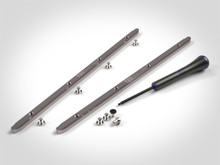
TSO GRC-12 Self-Aligning Guide Rail Connectors (61-415 A)
The first Self-Alighning Guide Rail Connector for Festool FS Series, Makita and Triton track saw guide rails. The GRC-12 Next Gen is completely self-contained and self-aligning. Simply slide the GRC-12 into your guide rail T-slots and firmly tighten the set screws - then you’re done.
www.ustoolandfastener.com
Straight edging raw material is actually my main purpose for buying a track saw. I have no problem at all cutting sheet goods on a table saw. I've done it for years. But getting a straight edge is sometimes a challenge without a long bed jointer. Hopefully it was worth the 700 dollar plus investment. lol
When I say straight edge I don't mean jointed edge. You can get a jointed edge with a track saw if the board is truly flat . However the track and thus the saw will follow any contours on the board surface.
I do use the track saw to joint long edges by placing the two board edges that will be glued against each other, clamping them down so that nothing moves, then place the track to split the kerf onto both boards. This way you are guaranteed a matching / mating edge cut on the board edges. Sometimes it takes two passes to remove enough to close a wider gap. You need to use the 48 / fine blade to joint even though it is the wrong blade for rip cuts. The other blade types will not be smooth enough.
I think you will find that you rarely cut plywood on the table saw once you try a track saw for that job.
Seth
Hijacking my own thread here but picking you guys brains as I do it. For a straight edge, I typically use either a clamping jig to run against the fence for an initial straight side. I then run that edge on my router table set up as a jointer to get the edge square and flat. What I hope to replace is the clamping jig which holds the workpiece up off the table so there's always chatter and movement. I'm hoping that using the track saw will eliminate all that awkward **** I'm doing on the table saw to get that initial straight side. I'm not at all opposedto having to run that again through the router table/jointer setup to get the edge better.
I'm thinking the track saw will actually give a better edge than the table saw. I can already glue up panels without doing anything after the table saw so I think I will gain there too. As for sheet goods, I'm not sure. I'm so table saw oriented after my years in the cabinet shop that I'm having trouble envisioning moving that track all the time for repetitive cuts. Having good infeed and outfeed really does make a ton of difference. I understand why people with space constraints prefer the track saw. Time will tell.
Again....appreciate all the good feedback. There are some very knowledgable people in here that share their knowledge freely and I truly do appreciate that.

I'm thinking the track saw will actually give a better edge than the table saw. I can already glue up panels without doing anything after the table saw so I think I will gain there too. As for sheet goods, I'm not sure. I'm so table saw oriented after my years in the cabinet shop that I'm having trouble envisioning moving that track all the time for repetitive cuts. Having good infeed and outfeed really does make a ton of difference. I understand why people with space constraints prefer the track saw. Time will tell.
Again....appreciate all the good feedback. There are some very knowledgable people in here that share their knowledge freely and I truly do appreciate that.
Voi
Well-known member
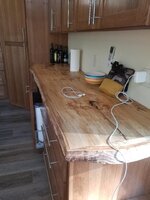
I have only "jointed" one glue up with my track saw. I had to do a single tapered glue up to make this Cottonwood slab deep enough for my cabin countertop. I was concerned it wouldn't be a flush enough cut but it has held up for years. It experiences probably 100 degree temperature changes each year so I was worried about expansion/contraction effecting a less than perfect joint.
Angled joint runs from off the picture in the lower right to underneath about the third wine bottle from the wall.
I also had a badly cupped piece of elm that presented a couple of problems for my plan to turn into a corner bench. First, I was going to lose too much thickness by planing the cup out. I also only had enough length to wrap the corner so I had to cut the miter and flip the fall off piece to match the miter.
So the glue up was going to be the face with the cup facing up and the opposite side of the miter with the cup facing down.
I decided to cut the miter with my track saw on location and was very meticulous at laying out the cut. I knew I had a good chance of screwing things up. But the miter came out fine.
I next used my track saw to make relief cuts on the sides facing down, which gave me enough flexibility to bend the sections flat.
I then clamped old levels onto the panels until they were flat and filled the relief cuts with epoxy. Once the epoxy cured I left the clamped on levels in place and used Kreg HD pocket holes and screws to secure and glue the miter.
So the miter on this bench was cut with a track saw while the slab was still badly cupped. I did no extra prep to the edges before glue up other than basic sanding. I'm happy how it came out.
Pictures before finishing.


Angled joint runs from off the picture in the lower right to underneath about the third wine bottle from the wall.
I also had a badly cupped piece of elm that presented a couple of problems for my plan to turn into a corner bench. First, I was going to lose too much thickness by planing the cup out. I also only had enough length to wrap the corner so I had to cut the miter and flip the fall off piece to match the miter.
So the glue up was going to be the face with the cup facing up and the opposite side of the miter with the cup facing down.
I decided to cut the miter with my track saw on location and was very meticulous at laying out the cut. I knew I had a good chance of screwing things up. But the miter came out fine.
I next used my track saw to make relief cuts on the sides facing down, which gave me enough flexibility to bend the sections flat.
I then clamped old levels onto the panels until they were flat and filled the relief cuts with epoxy. Once the epoxy cured I left the clamped on levels in place and used Kreg HD pocket holes and screws to secure and glue the miter.
So the miter on this bench was cut with a track saw while the slab was still badly cupped. I did no extra prep to the edges before glue up other than basic sanding. I'm happy how it came out.
Pictures before finishing.
I have the Kreg Track Saw with two 62" tracks. I use the joiners for them when needed. I check across the joint with a 4' level. Haven't had a problem but I'm pretty new to the track saw. So far, I love using it.
Wrestling 4x8 sheets is not something I want to do anymore. My last project was with 3/4" melamine and the track saw was fantastic. Since I'm still getting used to it, I did buy the clamps to hold the track. Just don't have the trust level in the gripping surface for a long cut yet.
Wrestling 4x8 sheets is not something I want to do anymore. My last project was with 3/4" melamine and the track saw was fantastic. Since I'm still getting used to it, I did buy the clamps to hold the track. Just don't have the trust level in the gripping surface for a long cut yet.