To avoid these ads, REGISTER NOW!

Track Saw, Edge Guide Or Both?

Renegade1LI

Well-known member
Joined
Mar 11, 2018
Messages
4,997
Location
long island ny
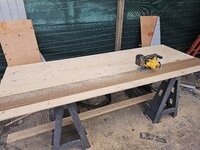
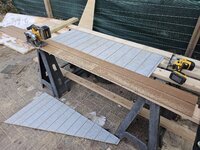
Having been an early adapter of track saws I thought I would never use an edge guide again. I went from a corded to cordless track saw for portability but it's just so easy to keep and use some masonite edge guides. I guess it's kinda like pneumatic vs battery on a smaller scale, l love the accuracy of the track saw but the cheap and easy masonite guides with a cordless saw work almost a good.

I doubt I'll take a chance breaking down a 100$ sheet of ply with just an edge guide but for most other work where you want a straight cut I'll grab the edge guides.
 

Attachments

  • 20241227_135830.jpg
    20241227_135830.jpg
    1.6 MB · Views: 101
  • 20241227_130441.jpg
    20241227_130441.jpg
    1.7 MB · Views: 100
To avoid these ads, REGISTER NOW!

AEAdam

Well-known member
Joined
May 27, 2023
Messages
2,793
Location
SE PA
If you have 8’ of track, I can’t imagine why you’d keep using Masonite. I use a small, light 18v Bosch saw for a ton of cross cuts using a speed square as a guide.

My little Bosch circ saw, CS-180, originally had track for it. Worked really well, but wasn’t a plunge saw. I think plunging cordless tracksaws are pretty amazing,
 

ez-duzit

Well-known member
Joined
Jun 24, 2013
Messages
5,104
Location
Marina del Rey
...l love the accuracy of the track saw but the cheap and easy masonite guides with a cordless saw work almost a good...
No possible way. You must be using it wrong.

The (Festool) track saw has a nonslip track that does not require clamping. That track has a replaceable synthetic edge to prevent splintering of the workpiece. The track captures the saw so that it cannot veer away from the intended cut line; this enables precision plunge cuts anywhere along the cut line. Your Masonite guide does none of this.
 

tarbellb

Well-known member
Joined
Apr 17, 2011
Messages
5,776
Location
Oregon
No possible way. You must be using it wrong.

The (Festool) track saw has a nonslip track that does not require clamping. That track has a replaceable synthetic edge to prevent splintering of the workpiece. The track captures the saw so that it cannot veer away from the intended cut line; this enables precision plunge cuts anywhere along the cut line. Your Masonite guide does none of this.

You can get damn near the same cut quality with the shooting board, technique and blades are the biggest variable

Agree that the track saw offers better chances of achieving the best results tho
--
What I think the OP is gearing up for are less critical cuts that still require a straight line, (see pics of siding)

Track saws came from European interior carpenters where a single sheet of 20mm hardwood veneered sheet with full edge exposure has multiple critical cuts. We have just adopted them to basic sheets due to ease and price point dropping.
 
OP
R

Renegade1LI

Well-known member
Joined
Mar 11, 2018
Messages
4,997
Location
long island ny
No possible way. You must be using it wrong.

The (Festool) track saw has a nonslip track that does not require clamping. That track has a replaceable synthetic edge to prevent splintering of the workpiece. The track captures the saw so that it cannot veer away from the intended cut line; this enables precision plunge cuts anywhere along the cut line. Your Masonite guide does none of this.
I agree, the track saw gives excellent cuts and I use it mostly in the shop. My point was with a good blade and guide i get very good cuts and don't have to drag the track saw and track around for non critical work, but still want good cuts. I feel like a track saw can get banged up easier than a saw and guide. Was just curious what others do in the field, I find even framing there are times an accurate cut is needed.
 

Firebrick43

Well-known member
Joined
May 12, 2015
Messages
14,183
Location
West central Indiana
I agree, the track saw gives excellent cuts and I use it mostly in the shop. My point was with a good blade and guide i get very good cuts and don't have to drag the track saw and track around for non critical work, but still want good cuts. I feel like a track saw can get banged up easier than a saw and guide. Was just curious what others do in the field, I find even framing there are times an accurate cut is needed.
An edge guide on long cuts needs to be held against the fence on the guide where a track you can release, reposition and restart without any issue to either side of the cut.

The track saw has antikick back safety.

The track saw has a riving knife for safety in a pinch

The Track saw has plunging to start/stop a cut safely

The edge guide will get beat up just the same as an aluminum track but will be cheaper. But who doesn't take care of their tools? I have had mine for 8 years now and cut 1000's of feet without damaging a track.
 

neophyte

Well-known member
Joined
Apr 23, 2012
Messages
9,776
Location
Pennsylvannia
A track saw may be capable of way more precision than a circular saw with a masonite guide, but it is not a complete miracle.

The tracks may have anti-slip strips on the bottom, but they definitely can slip on the right/wrong naterials, or it they get dusty, or if the piece being cut isn’t completely flat.
This is the reason the Festool and Mafell (and clone systems), tracks have methods for clamping the track in place, to prevent the track from shifting on critical cuts.
Mafell even makes the “Aerofix” track, that uses vacuum suction to prevent the track from shifting.

As far as kickback goes, it’s fully possible to get kickback with a track saw.
Wood the isn’t held or positioned flat, can cause the black to tilt during cutting, causing kickback, as can a sawcut kerf closing on the blade, and both possibilities are way more likely with the blades (50+/- tooth) usually sold as standard with most track saws.
There is, or at least was, a video on youtube of a German? Woodworker, who’s hand got cut during a kickback incident with a Festool track saw.
Other users have had the Festool saws kickback, and slice into the aluminum tracks.
As for riving knives, not all tracksaws have these.
This includes the Festool TS60, as well as some Mafell saws.
The TS60 does have a special anti kickback system though.

It should be pointed out, that not all “track saws” are the Festool or Mafell plunging type.
Some “track saws”, are just circular saws that have bases designed so that they can be used on the aluminum guide tracks, if necessary, for extra precision.
Festool even made one or more models of saw without the plunge feature years ago, although I’m not sure if they ever sold the model/s in the USA.
Hilti made a tracksaw that I don’t believe had a plunge feature, but which used Festool tracks, and multiple current Hilti circular saws can be used with the hilti aluminum saw track system even though the saws don’t plunge.

Since most tracksaws have a spring loaded base that you push the saw blade down and thru, in the event of kickback, the base usually pops out to cover the blade once the saw is off the cutting surface, providing extra safety, however, this only works well if your hands are not in the way during the seconds after the kickback incident.

Another thing to point out, is that the spring loaded tracksaws, like the Festool TS and former ATF saws, don’t work well as saws pff the track, and should really not be used without a track, or at least without a surface guiding the saws.
The Festool HK and HKC models, and some Mafell models, are a different hybrid design that can safely be used off travk, but the standard Festool plunge tracksaws, are not really safe to use off track.

I don’t want to completely dismiss the tracksaw advantages, since tracksaws can be very precise, clean, and safe, but getting the extra precision from the tracksaws, requires nit only spending three times as much or more for the decent tracksaw, it also requires a bunch of extra accessories, which are usually proprietary, and which can easily push the cost a grand or more higher.
 

Firebrick43

Well-known member
Joined
May 12, 2015
Messages
14,183
Location
West central Indiana
A track saw may be capable of way more precision than a circular saw with a masonite guide, but it is not a complete miracle.

The tracks may have anti-slip strips on the bottom, but they definitely can slip on the right/wrong naterials, or it they get dusty, or if the piece being cut isn’t completely flat.
This is the reason the Festool and Mafell (and clone systems), tracks have methods for clamping the track in place, to prevent the track from shifting on critical cuts.
Mafell even makes the “Aerofix” track, that uses vacuum suction to prevent the track from shifting.

As far as kickback goes, it’s fully possible to get kickback with a track saw.
Wood the isn’t held or positioned flat, can cause the black to tilt during cutting, causing kickback, as can a sawcut kerf closing on the blade, and both possibilities are way more likely with the blades (50+/- tooth) usually sold as standard with most track saws.
Most The kerf cant "close on the blade" if the correct blade is used and the riving knife is used as intended.
There is, or at least was, a video on youtube of a German? Woodworker, who’s hand got cut during a kickback incident with a Festool track saw.
Link? All the video's of festool kickback I have seen are due to not starting on the track fully.
Other users have had the Festool saws kickback, and slice into the aluminum tracks.
As for riving knives, not all tracksaws have these.
Most do, the TS60 is one of the few that doesn't
This includes the Festool TS60, as well as some Mafell saws.
The TS60 does have a special anti kickback system though.
The dewalt and kreg both also have antikickback pawls that engage the track.
I don’t want to completely dismiss the tracksaw advantages, since tracksaws can be very precise, clean, and safe, but getting the extra precision from the tracksaws, requires nit only spending three times as much or more for the decent tracksaw, it also requires a bunch of extra accessories, which are usually proprietary, and which can easily push the cost a grand or more higher.
What? Other than two clamps my dewalt has required no other accessories to use it?:headscrat There are a lot of accessories such as squares and repeaters but in no way are "required" to use the saw?

And your pointing out safety lapses and misuse of a product. A circular saw and a Masonite guide has NONE of those safety features to mitigate kickback. What is a finger worth?
 

Hakeem

Well-known member
Joined
Jan 22, 2024
Messages
1,278
Location
Chicago
They can be used in all sorts of creative applications. Two I’ve seen personally are for cutting decking boards to the exact same length (install with overhang, and then use the track saw to quickly and easily get a perfect edge). Another one was during the installation of vinyl siding. The siding was installed long so that the pieces extended into the doorway and then the track was mounted vertically and the saw used to cut the pieces off in situ

Beyond these specialty applications I don’t really see them get used much. 90% of the time the table saw is setup and there’s someone to help handle the material so the track saw isn’t much help.
 
Last edited:

neophyte

Well-known member
Joined
Apr 23, 2012
Messages
9,776
Location
Pennsylvannia
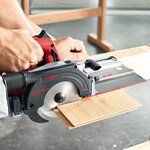
I do wish that some more manufacturers would come out with an affordable version of this little number:
IMG_1574.jpeg

A 4-1/2” saw with a ~14” track for quick crosscuts would be really handy.
This is one of the saws designed to be used as both a tracksaw, and as a regular circular saw, as well as having the ability to use tracks that attach to the base and can be set to use as a hand held miter saw.
The Festool HK saws essentially copied the design.
 

neophyte

Well-known member
Joined
Apr 23, 2012
Messages
9,776
Location
Pennsylvannia
Most The kerf cant "close on the blade" if the correct blade is used and the riving knife is used as intended.

Link? All the video's of festool kickback I have seen are due to not starting on the track fully.

Most do, the TS60 is one of the few that doesn't

The dewalt and kreg both also have antikickback pawls that engage the track.

What? Other than two clamps my dewalt has required no other accessories to use it?:headscrat There are a lot of accessories such as squares and repeaters but in no way are "required" to use the saw?

And your pointing out safety lapses and misuse of a product. A circular saw and a Masonite guide has NONE of those safety features to mitigate kickback. What is a finger worth?
“The kerf can’t close up on the blade, IF the correct blade is used, AND the riving knife is used as intended”
-Rining knives can be used or set up incorrectly, or an incorrect riving knife can be used (the riving knife thickness has to be made for the blades plate thickness), and on dome saws, the riving knives don’t retract, meaning the riving knife can’t be used for plunge cuts.

I’ll see if I can find the video, but it’s been a while.

I haven’t used either the Kreg or the Dewalt saws.

The squares, and parallel guide setups may not be required, but they’re sort of needed, to get the maximum precision, quickness, and repeatability, with the saws that can use the Festool track system.
Different length track are also needed, because using a longer track that overhangs a work piece too much, can cause the track to bend, making the tracks less precise, and more importantly, leading to a much higher likelihood of saw kickback.
Longer tracks are also better for longer cuts, even though it is possibly to attach tracks together, although that would require purchasing one or more track connectors, and then tacking the tome to connect and more importantly, align the tracks.
Also, Festool has a habit of selling the saws with tracks that are just a bit too short for cuts across standard dimensions.
Another issue is blade cost.
Blades for track saws are usually “weird” metric dimension blades, that are way less available in the USA, and therefore way more expensive.
There are cheaper options, but most are brands one will never of heard of, or ones that are less expensive than the Festool branded blades, but which are still expensive.
With a USA standard 7-1/4” saw, blades are readoly available at any home center or hardware store, usually in a variety of tooth counts, and from manufacturers or brands that produce quality blades, and the price is routinely $20 or less.
For safety reasons, a saw should really be used with a lower tooth count blade than what is supplied, unless you are using the saw to cut thinner flooring.

I’be used regular circular saws and track saws.
The blades, and the motor power, and the general weight of regular circular saws, plus the blades the saws are usually outfitted with, all seem to help mitigate kickback, although judging by OSHA reports, kickback still routinely happens.
Tracksawsdo have potential extra safety features, but way too many people think track saws are the “perfectly safe” option, and get close to implying tracksaws will eliminate safety issues.
This is far from the case.
 

neophyte

Well-known member
Joined
Apr 23, 2012
Messages
9,776
Location
Pennsylvannia
This isn’t the video I was referring to in my first post.
The guy talks about kickback incidents both he and a friend have had, and shows a couple different gouges in his track from separate kickback incidents.
(Gouges like this occasionally get mentioned over on the Festool Forum)
The plunge saw he has is a Festo AT65, which predates Festo changing their name to Festool, and which is likely 20-25 years old at this point.


Another video showing a kickback incident. No blood.


Another non ****** video showing a kickback incident.


This guy was doing the proper thing, keeping his one hand completely away from the saw, but he also didn’t clamp the guide rail.
If ghe top of the wood being cut is not completely flat, a tracksaw will tilt slightly while cutting, and kickback is definitely possible.

Here, this is the video I mentioned in my original post.
There are even ****** pics.


jar944

Well-known member
Joined
Jul 26, 2010
Messages
5,955
Location
Northern VA
I just grab a track, or snap/draw a line if it's a regular circular saw.

Having to store a separate track would irritate me, I'd much prefer saw shoe/plate that can ride on the tracksaw track.

As for a riving knife, the makita doesn't have one, and frankly I'm not sure why one is needed. The only "kickback" and its not a kickback as defined is over plunging into a cut where you effectively climb cut. Thr track stop will prevent that, not a riving knife.
 

Firebrick43

Well-known member
Joined
May 12, 2015
Messages
14,183
Location
West central Indiana
This isn’t the video I was referring to in my first post.
The guy talks about kickback incidents both he and a friend have had, and shows a couple different gouges in his track from separate kickback incidents.
(Gouges like this occasionally get mentioned over on the Festool Forum)
The plunge saw he has is a Festo AT65, which predates Festo changing their name to Festool, and which is likely 20-25 years old at this point.


Another video showing a kickback incident. No blood.


Another non ****** video showing a kickback incident.
Really? When people talk about track saws its usually to cut panels. Those of us that use them for smaller pieces use a proper table with rail hinge or similar and a fence. That is the equivalent of cutting crosscuts on a table saw free hand without a mitre fence. Unlike a kickback on a table saw the piece is going to shoot away from you and no injury will occur if you are holding the saw correctly.

This guy was doing the proper thing, keeping his one hand completely away from the saw, but he also didn’t clamp the guide rail.
If ghe top of the wood being cut is not completely flat, a tracksaw will tilt slightly while cutting, and kickback is definitely possible.
This isn't the proper way? Both hands should be on the saw. We should forgive him because he has only one arm. But again, he started the saw admittedly to far back on the track because his track was to short.

Screenshot 2024-12-29 132124.png
https://www.festoolusa.com/-/media/...ownloads/manuals/703959_003_ts_55_req_usa.pdf

page 8

Here, this is the video I mentioned in my original post.
There are even ****** pics.

Violated same part of the users manual.
Any power tool can be dangerous, but a track saw in comparison is very safe to other methods if you just keep your hands on the tool, in addition to being accurate and nearly dust free.

A standard circular saw by very nature of the always exposed blade will be much more dangerous in a kick back

As for a riving knife, the makita doesn't have one, and frankly I'm not sure why one is needed. The only "kickback" and its not a kickback as defined is over plunging into a cut where you effectively climb cut. Thr track stop will prevent that, not a riving knife.
Dewalt has reverse stops built into the track riding plate so a separate stop isn't needed and the riving knife retracts on a plunge. The place where I have found the riving knife to be indispensable is laying/cutting out boards from rough sawn lumber. I either use my chainsaw mill or have a guy with a large woodmizer band saw plain saw the logs and then air dry for several years.

Because of the trees I am cutting there is a lot of wild grain. Sometimes this splits and checks and usable sections are rarely aligned so they can be cut out by a table saw. So I use my tracksaw a lot to cut out the rough boards and straight edge at least one side of the board before planing and jointing. When I did this before buying my tracksaw I used a skill 77. While heavy enough to mitigate kickback you could smell and feel the tension in the rough cut boards pinching the blade, even stalling it a few times.

With the track saw you just feel the drag sometimes due to the tension drag on the knife itself. Knife probably isn't necessary if just cutting well supported sheet goods.
 

jar944

Well-known member
Joined
Jul 26, 2010
Messages
5,955
Location
Northern VA
Dewalt has reverse stops built into the track riding plate so a separate stop isn't needed and the riving knife retracts on a plunge. The place where I have found the riving knife to be indispensable is laying/cutting out boards from rough sawn lumber. I either use my chainsaw mill or have a guy with a large woodmizer band saw plain saw the logs and then air dry for several years.

Because of the trees I am cutting there is a lot of wild grain. Sometimes this splits and checks and usable sections are rarely aligned so they can be cut out by a table saw. So I use my tracksaw a lot to cut out the rough boards and straight edge at least one side of the board before planing and jointing. When I did this before buying my tracksaw I used a skill 77. While heavy enough to mitigate kickback you could smell and feel the tension in the rough cut boards pinching the blade, even stalling it a few times.

With the track saw you just feel the drag sometimes due to the tension drag on the knife itself. Knife probably isn't necessary if just cutting well supported sheet goods.

Before I got my slider I used my track saw extensively for straight line ripping rough lumber and slabs up to 3" thick. (Cut from both sides) I've never experienced pinching, (and having no riving knife) though I'm not generally cutting boards with wild grain.
 
To avoid these ads, REGISTER NOW!

neophyte

Well-known member
Joined
Apr 23, 2012
Messages
9,776
Location
Pennsylvannia
Really? When people talk about track saws its usually to cut panels. Those of us that use them for smaller pieces use a proper table with rail hinge or similar and a fence. That is the equivalent of cutting crosscuts on a table saw free hand without a mitre fence. Unlike a kickback on a table saw the piece is going to shoot away from you and no injury will occur if you are holding the saw correctly.

This isn't the proper way? Both hands should be on the saw. We should forgive him because he has only one arm. But again, he started the saw admittedly to far back on the track because his track was to short.

Screenshot 2024-12-29 132124.png
https://www.festoolusa.com/-/media/...ownloads/manuals/703959_003_ts_55_req_usa.pdf

page 8


Violated same part of the users manual.
Any power tool can be dangerous, but a track saw in comparison is very safe to other methods if you just keep your hands on the tool, in addition to being accurate and nearly dust free.

A standard circular saw by very nature of the always exposed blade will be much more dangerous in a kick back


Dewalt has reverse stops built into the track riding plate so a separate stop isn't needed and the riving knife retracts on a plunge. The place where I have found the riving knife to be indispensable is laying/cutting out boards from rough sawn lumber. I either use my chainsaw mill or have a guy with a large woodmizer band saw plain saw the logs and then air dry for several years.

Because of the trees I am cutting there is a lot of wild grain. Sometimes this splits and checks and usable sections are rarely aligned so they can be cut out by a table saw. So I use my tracksaw a lot to cut out the rough boards and straight edge at least one side of the board before planing and jointing. When I did this before buying my tracksaw I used a skill 77. While heavy enough to mitigate kickback you could smell and feel the tension in the rough cut boards pinching the blade, even stalling it a few times.

With the track saw you just feel the drag sometimes due to the tension drag on the knife itself. Knife probably isn't necessary if just cutting well supported sheet goods.
This us one of the official Festool Demo guys.
Notice how he uses both hands ?


Firebrick43

Well-known member
Joined
May 12, 2015
Messages
14,183
Location
West central Indiana
This us one of the official Festool Demo guys.
Notice how he uses both hands ?

I can't make people do the right thing? The guy is off kilter in the head. The manual, as well as dewalt/makita/mafell all talk about 2 hands.

Do you need screen shots of all their owners manual saying to hold the saw with both hands?

He probably is doing it as with both hands he would be blocking the camera. Not really a good excuse in my mind. It could have been shown with better camera work but he was terrified with the camera man being closer than 6'.

He does show and 20:20 about having enough track at the start.
 

jar944

Well-known member
Joined
Jul 26, 2010
Messages
5,955
Location
Northern VA
I've never used both hands with a track saw. It would be incredibly awkward. Its usually in my left hand and I'm standing and walking to the right of the track.
 

IRQVET

Well-known member
Joined
Jun 29, 2015
Messages
1,188
Location
Forgotten Coast (FL)
Been fantasizing about a track saw as of late, cause even with a guide, I can't cut a straight line in plywood with my Skilsaw if my life depended on it.
 

AEAdam

Well-known member
Joined
May 27, 2023
Messages
2,793
Location
SE PA
This us one of the official Festool Demo guys.
Notice how he uses both hands ?

He used both hands in the beginning of the video because it looked like he was cutting an under bevel and needed to balance the saw. These saws tip out past the edge of the track, which makes them tipsy (but it's an awesome feature). If you watched the rest of the video you would see him cutting one handed (24:00 ish) just like all the rest of us with actual experience using these saws do.

Track saws are WAY better than an edge guide and plunging saws are far superior to non-plunging. I have and use both regularly. I've cut both hard and soft woods, cPVC, Boral, and all sorts of sheet goods. The track saw is really the superior tool for general carpentry in my opinion.

Talk about tool safety and raising awareness that prevents injuries is always smart, but for crying out loud have some common sense.
 

AEAdam

Well-known member
Joined
May 27, 2023
Messages
2,793
Location
SE PA
Been fantasizing about a track saw as of late, cause even with a guide, I can't cut a straight line in plywood with my Skilsaw if my life depended on it.
Step 1: Replace the blade and adjust the saw correctly. I like the Diablo blades. I have a fine toothed one (40T?) on my Bosch corded circ saw. I'm building stairs and was using it to cut stringers in SYP 2X12s. The Makita blades are made by Tenryu and are also excellent.

Couple observations: The 40T blade leaves a paint ready surface finish. Very smooth (not furniture smooth, but smooth enough for house paint). The 40T blade also throws very fine dust that hangs in the air for an hour. Could also be the weather/static. Last, I rarely use my corded circ saw anymore since I typically choose 18V. The corded saw cuts faster but doesn't have a brake and takes a little while to stop. I leave it in the kerf until it stops spinning. Safer for me and less chance of splintering the cut, as I pull a spinning blade out of it.
 

Bob Peach

Well-known member
Joined
Apr 23, 2007
Messages
134
Location
Cape Cod ,Ma
I have a Makita track saw and both sizes of tracks. One of the best tools in the sign shop. We break down a lot of sheet goods. I hardly ever use the panel saw anymore. Don`t miss using home made edge guides and clamps.
 

neophyte

Well-known member
Joined
Apr 23, 2012
Messages
9,776
Location
Pennsylvannia
He used both hands in the beginning of the video because it looked like he was cutting an under bevel and needed to balance the saw. These saws tip out past the edge of the track, which makes them tipsy (but it's an awesome feature). If you watched the rest of the video you would see him cutting one handed (24:00 ish) just like all the rest of us with actual experience using these saws do.

Track saws are WAY better than an edge guide and plunging saws are far superior to non-plunging. I have and use both regularly. I've cut both hard and soft woods, cPVC, Boral, and all sorts of sheet goods. The track saw is really the superior tool for general carpentry in my opinion.

Talk about tool safety and raising awareness that prevents injuries is always smart, but for crying out loud have some common sense.
Plunging saws, with the exception of the Mafell type, which works as both, and the Festool HK saws, are not “the superior circular saw type”.
These saws, mostly based on the original Festool spring loaded design, are almost exclusively designed to be used on the track system, and should not be used free hand to follow a line, like with a regular circular saw.
There are exceptions to the “only use with a track rule, mostly involving running the saw against a straight edge, or for use for certain types of plunge cuts, such as use as a door jamb saw, or running a cut right next to a wall or floor.

Track saws are a way more convenient saw for cutting sheet goods and plywood.
For cutting smaller trim, or short flooring, it’s way easier to use a track saw with a table system like the Festool MFT, but then you have way more to transport, and the price basically doubles.
For a regular circular saw, there are jogs like the Kreg Crosscut station, that can do miter cuts for a way cheaper price.
Personally, I woild prefer it if there were more options like the Festool HK saw (which may have been discontinued except for the HKC cordless version), or the Mafell K ir KSS series saws, dince these allow use as a plunging track saw, and as a regular hand held circular saw, and the Mafess KSS and Festool HK saws also have the built in miter base system to allow precise miter cutting on timber with the attachable base system.
 

Steve_P

Well-known member
Joined
Sep 15, 2010
Messages
5,185
A track saw can cause injuries like any power tool; but they've got to be 1000X safer than a table saw, especially used by one person. I own neither, but no tool has surprised me with more "oh ****, WTF?" moments per use than a table saw, even with two people.
 

neophyte

Well-known member
Joined
Apr 23, 2012
Messages
9,776
Location
Pennsylvannia
A track saw can cause injuries like any power tool; but they've got to be 1000X safer than a table saw, especially used by one person. I own neither, but no tool has surprised me with more "oh ****, WTF?" moments per use than a table saw, even with two people.
Way more people get injured, or even killed, using circular saws, than tablesaws, according to OSHA injury reports.
Circular saw injuries involve amputating or slicing fingers or hands, just like tablesaw injuries,
BUT ALSO routinely involve incidents were people slice thru their legs, including thru their Femoral Arteries, either due to kickback, or because they rested the piece bring cut, on their leg.
Other times circular saws are used for awkward cuts, including cuts on walks, and the saw kicks back into the users chest Or head or throat, potentially severing something like the Carotid Artery.
While a person can get killed by a tablesaw, other than just thru blood loss from a hand injury, the likelihood is much less than a fatal injury with a circular saw.
Fatal tablesaw injuries are much more likely to be from a kickback injury slamming a workpiece into the chest in the wrong place.
 

Hakeem

Well-known member
Joined
Jan 22, 2024
Messages
1,278
Location
Chicago
Way more people get injured, or even killed, using circular saws, than tablesaws, according to OSHA injury reports.
Circular saw injuries involve amputating or slicing fingers or hands, just like tablesaw injuries,
BUT ALSO routinely involve incidents were people slice thru their legs, including thru their Femoral Arteries, either due to kickback, or because they rested the piece bring cut, on their leg.
Other times circular saws are used for awkward cuts, including cuts on walks, and the saw kicks back into the users chest Or head or throat, potentially severing something like the Carotid Artery.
While a person can get killed by a tablesaw, other than just thru blood loss from a hand injury, the likelihood is much less than a fatal injury with a circular saw.
Fatal tablesaw injuries are much more likely to be from a kickback injury slamming a workpiece into the chest in the wrong place.
I saw a number of about 40,000 circ saw injuries per year compared with 30,000 table saw injuries per year. I would suspect the disparity can be explained by the greater number of circular saws used.

Circular saw fatalties are truly rare and freakish events, thank goodness. If you have data showing otherwise, please share. But this snippet summarizes my understanding of the matter:

Circular saw-related fatalities are vanishingly rare events with highly wounding and rapidly incapacitating effects. When they do occur, they are mainly self-inflicted [1], [2], [3], [4], [5], [6], [7], [8], although several studies have discussed accidental circular saw-associated deaths [9], [10].


neophyte

Well-known member
Joined
Apr 23, 2012
Messages
9,776
Location
Pennsylvannia
I saw a number of about 40,000 circ saw injuries per year compared with 30,000 table saw injuries per year. I would suspect the disparity can be explained by the greater number of circular saws used.

Circular saw fatalties are truly rare and freakish events, thank goodness. If you have data showing otherwise, please share. But this snippet summarizes my understanding of the matter:


I looked down a list of OSHA accident reports specifically looking at fatalities.
Other than various types of fall injuries,
and electrocutions, saws kicking back into the head, chest, or an artery, seemed to be one of the frequent fatality mentions, as did accidents were a nail gun put a nail into a persons head or chest.
Large diamond cutoff saws used in awkward positions, kicking back into someone’s head or throat also caused more than one death, similar to the way circular saws did.
There were also at least two or three incidents of arteries bring cut with pressure washers, and a bunch of other injuries.
 

AEAdam

Well-known member
Joined
May 27, 2023
Messages
2,793
Location
SE PA
you guys are losing me. Track saws are a really evolved, safe, effective woodworking tool that excels for cabinetry as well as carpentry.

The basic principle of moving the saw over the wood instead of the wood over the saw is a space saver, allowing precision cuts almost anywhere.

The debate about them usually breaks into 2 camps: people who own table saws and love them and don’t see a track saw as a reasonable alternative, and people (like me) who don’t own a table saw, will never own a table saw, and say the track saw is either the next best thing or better because of its portability, angled (tapered) cutting capability and lower cost. (which typically enrages table saw owners)

This thread was about the difference between track saws and edge guides. I’ve done and do both and it’s no contest.

No theory here.
IMG_8368.jpeg
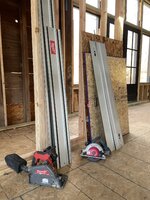
This barn is really a blessing. It’s really well built and will make a great home. But when it was built, they didn’t have sheet goods (c1912), so nothing is 16”o.c. That means every piece of plywood I use has to get custom cut. There’s 1800sqft on this floor alone. I cut all of it with my track saw.

I started with the little Bosch saw on the right. They don’t sell that track in the US which is a shame. It’s a lightweight, fast, cheap system that produces great results. Problem with it is, it doesn’t plunge, so you really need enough track hanging over to retract the blade guard and you can’t do bevels. That was the reason I chose the Milwaukee on the left, which runs on a Festool compatible track. The little Bosch has a proprietary track. (new Bosch saws ARE Festool compatible. Just not this model).

If anyone is interested, there’s a lot I don’t like about the Milwaukee saw.

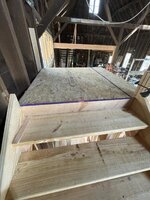
Built this landing yesterday.
IMG_8369.jpeg
It’s purposely out of square because the walls of the barn are slightly out of parallel. The plywood is a perfect fit, which I could not have easily done with a table saw.

Track saw for stuff like this is a must have.
 
Last edited:

IRQVET

Well-known member
Joined
Jun 29, 2015
Messages
1,188
Location
Forgotten Coast (FL)
VENT!

Why does Lowes offer the Kreg Track Saw online only for $249, just to add $85 for shipping? :mad:

Why can Home Depot offer free shipping on almost everything, while Lowes tries to f*#k people over on shipping. 💯:dunno:
 
To avoid these ads, REGISTER NOW!
Top Bottom