To avoid these ads, REGISTER NOW!

Track Saw Recommendation/Info

bmwpowere36m3

Well-known member
Joined
Nov 8, 2012
Messages
1,125
Been looking at track saws recently... I have a few cabinet projects coming up and thought it be a good time to pick up a track saw. First project is a built-in linen closet for our bathroom. Planned on using pre-finished maple plywood for the interior.

I've had my eye on Makita, either the corded or cordless models. I really like the idea of cordless, however indoors I'd be using it with a Flex vac. ALso the corded model is a good bit cheaper.

Are their any refinements, performance advantages of the newer cordless model (besides being cordless)?

Any tips on:

  1. Long rip cuts a single longer track would be ideal. However can shorter tracks be joined and achieve can level of precision? For example with: https://betterleytools.com/products/straight-line-connector-for-aligning-track-saw-rails.html
  2. For making repeatable long parallel cuts, can the back edge of the track be used as a reference? For example thinking of using combination square or story-stick. Using those against the "soft" splinter guide I could see being problematic. Or are only the splinter guard and raised rail on track actually truely straight?
  3. Cutting glue ready joints, once with track saw. (no final cutting on table saw)? Planning to cut plywood on top of foam sheets.
  4. Making repeatable cuts for cabinetry?

Any other tips advise welcome.
 
To avoid these ads, REGISTER NOW!

EZ_Garage

Well-known member
Joined
Dec 25, 2018
Messages
98
Location
US of A
Any tips on:

  1. Long rip cuts a single longer track would be ideal. However can shorter tracks be joined and achieve can level of precision? For example with: https://betterleytools.com/products/straight-line-connector-for-aligning-track-saw-rails.html
  2. For making repeatable long parallel cuts, can the back edge of the track be used as a reference? For example thinking of using combination square or story-stick. Using those against the "soft" splinter guide I could see being problematic. Or are only the splinter guard and raised rail on track actually truely straight?
  3. Cutting glue ready joints, once with track saw. (no final cutting on table saw)? Planning to cut plywood on top of foam sheets.
  4. Making repeatable cuts for cabinetry?

Any other tips advise welcome.

1) Most if not of all the manufacturers make an accessory to join shorter tracks. I actually have one and never used it because having multiple tracks including a long track is much more convenient.

2) Festool makes a parallel guide system for their tracks... it references the aluminum track and not the splinter guard.

3) With a tracksaw the ability to make "final" cuts is as easy as on a tablesaw if things are sharp and tuned well.

4) Repeatability is the weakness of a tracksaw set-up although it can be accomplished with jigs, etc.

As an FYI I have owned the Festool in the past and currently own the Dewalt. I use the tracksaw almost exclusively as a way to break down sheet goods. Once sheets are broken down to manageable sizes then final dimensioning is done in the shop.
 

todd_fuller

Well-known member
Joined
Jul 9, 2013
Messages
301
1. Don't waste money on the Festool ones. If you go Makita, I think theirs are OK, but there are still better options now that can self-align, like TSO GRC-12. One tip is to always leave a little gap between tracks since the ends may not be 100% square.

2. There are a number of parallel guides out there now. The Festool one doesn't seem to be the preferred one to use though. Check out the forums for more info on the various options. I have a Precision Dogs version. The other thing to be aware of is that, depending on the brand, bevel cuts can cut some of the splinter guard. Not all brands will do this. It's only ~.5mm. Also, if you don't cut the splinter guard properly the first time, measurements are going to be whacky.

3. You can do this. It's different than a table saw, so once you adapt, you'll be fine. When cutting plywood, I find that it's important to think about how the cut is going to splinter.

3. A lot of europeans do it this way. Nothing new, a table saw doesn't automatically cut magically.

4. Jigs and attachments are helpful. I have a TSO GRS-16 to help square up cuts. One thing to note is that for any of the measurements to come out right, you need to start with a straight edge and most factory edges are not square or straight.
 

LeeG

Well-known member
Joined
Nov 29, 2012
Messages
1,525
Location
Phoenix, AZ
1. I have the Betterley alignment tool. It works quite well, but I only use it when I am working off-site. When at home, I use an appropriate sized rail (I have all except the 5000).

2. I tried a bunch of different parallel guide systems. I think the best is one made by Seneca Woodworking . The one by Woodpeckers is good too. I have both, but tend to use the Seneca one more

3. I do all my cuts on a foam sheet laying on the floor, or on sawhorses. The cuts are as good as I can get with my tablesaw.

4. I use a Woodpecker's Story Stick Pro to set all my cut lengths. I find that this gives me good repeatability, although I do try to make all cuts of a given length with the same setup whenever possible.

I own the Festool Tracksaws, but either Dewalt or Makita would be good. Many of the tracks seem to be interchangeable between brands. It is real handy having the appropriate length track on hand and not have to join them.
 

Dumber than lumber

Well-known member
Joined
Dec 19, 2015
Messages
1,882
So here is a challenge:
1. Plan out your work so you can get it done in about 3 weeks.
2. Order the Festool tracksaw and vacuum.
3. Do your project.
4. Return all of the Festool equipment for a complete refund under their 30-day trial program.
5. Resist the urge to keep that "over-priced Festool junk"
Final thing - keep us in the loop whatever you use.
 
OP
B

bmwpowere36m3

Well-known member
Joined
Nov 8, 2012
Messages
1,125
1) Most if not of all the manufacturers make an accessory to join shorter tracks. I actually have one and never used it because having multiple tracks including a long track is much more convenient.

2) Festool makes a parallel guide system for their tracks... it references the aluminum track and not the splinter guard.

3) With a tracksaw the ability to make "final" cuts is as easy as on a tablesaw if things are sharp and tuned well.

4) Repeatability is the weakness of a tracksaw set-up although it can be accomplished with jigs, etc.

As an FYI I have owned the Festool in the past and currently own the Dewalt. I use the tracksaw almost exclusively as a way to break down sheet goods. Once sheets are broken down to manageable sizes then final dimensioning is done in the shop.

1) I'm aware of the connectors, such as: Guide Rail Connector Kit However I was reading they don't necessarily result in "perfectly" aligned tracks. Ideally a straight-edge is needed in conjunction or tool such as the Betterley.

2)I've looked at the TSO parallel guides and they seem to interface the track in a few spots (back edge, raised guide/slot from underneath). I wasn't sure if its safe to assume all those edges are parallel with the cut-line/splinter guard edge.
 
OP
B

bmwpowere36m3

Well-known member
Joined
Nov 8, 2012
Messages
1,125
1. Don't waste money on the Festool ones. If you go Makita, I think theirs are OK, but there are still better options now that can self-align, like TSO GRC-12. One tip is to always leave a little gap between tracks since the ends may not be 100% square.

2. There are a number of parallel guides out there now. The Festool one doesn't seem to be the preferred one to use though. Check out the forums for more info on the various options. I have a Precision Dogs version. The other thing to be aware of is that, depending on the brand, bevel cuts can cut some of the splinter guard. Not all brands will do this. It's only ~.5mm. Also, if you don't cut the splinter guard properly the first time, measurements are going to be whacky.

3. You can do this. It's different than a table saw, so once you adapt, you'll be fine. When cutting plywood, I find that it's important to think about how the cut is going to splinter.

3. A lot of europeans do it this way. Nothing new, a table saw doesn't automatically cut magically.

4. Jigs and attachments are helpful. I have a TSO GRS-16 to help square up cuts. One thing to note is that for any of the measurements to come out right, you need to start with a straight edge and most factory edges are not square or straight.

1) That's an interesting product, will keep in mind.

4) I've looked at the TSO GRS-16 for cross-cuts to achieve 90*. Would you feel comfortable making a full 48" (shorter/longer) cross-cut using the guide off a straight edge?
 
OP
B

bmwpowere36m3

Well-known member
Joined
Nov 8, 2012
Messages
1,125
1. I have the Betterley alignment tool. It works quite well, but I only use it when I am working off-site. When at home, I use an appropriate sized rail (I have all except the 5000).

2. I tried a bunch of different parallel guide systems. I think the best is one made by Seneca Woodworking . The one by Woodpeckers is good too. I have both, but tend to use the Seneca one more

3. I do all my cuts on a foam sheet laying on the floor, or on sawhorses. The cuts are as good as I can get with my tablesaw.

4. I use a Woodpecker's Story Stick Pro to set all my cut lengths. I find that this gives me good repeatability, although I do try to make all cuts of a given length with the same setup whenever possible.

I own the Festool Tracksaws, but either Dewalt or Makita would be good. Many of the tracks seem to be interchangeable between brands. It is real handy having the appropriate length track on hand and not have to join them.


4) How do you use the story stick in combination with the track? Marking consistently or setting the track into position? Referencing the splinter guard or back edge?

As far as making all cuts of a given length with the same setup, you mean cutting multiple pieces, stacked or aligned, at once?
 

tarbellb

Well-known member
Joined
Apr 17, 2011
Messages
5,742
Location
Oregon
Consensus is Makita is 95% the saw Festool is at about 60% the cost.

One thing to note about the Makita cordless is the new bluetooth vacuum system (AWS Auto Start Wireless), iirc the first model out does not have the ability to use AWS?

Also, and why I havent taken the cordless track saw plunge yet, you are still connected to a dust extractor hose....
 

RKA

Well-known member
Joined
Jun 9, 2010
Messages
1,744
Location
NJ
One thing to keep in mind, use clamps to lock the rail down and double check it's placement with your story sticks, parallel guides or whatever you're using for track placement. Prefinished is slippery stuff and the rails won't stay in place like you would expect with raw wood. This may get tricky because you have to work on a table with the wood overhanging the table so you can slip that clamps under the rail.

TSO connectors are very good (so I've heard) and their guide rail square is more than adequate to give you good results on a 4ft cut. On an 8ft, you shouldn't need it. Reason?

First cut your straight edge.
Second, use your parallel guides to rip the sheet to desired width.
Third, use the guide rail square to square up one edge.
Fourth, use the guide rail square and a story stick to finish crosscutting each panel to finished length.

In this scenario building cabinet panels, you never need to cut a 90 degree down an 8ft length of ply. You're only ripping down the 8ft length and the story stick or parallel guide solution should place the track parallel to your reference edge in the first step above.

Of course, practice first. Once you're confident you have your steps down, then chop down the expensive stuff.
 

LeeG

Well-known member
Joined
Nov 29, 2012
Messages
1,525
Location
Phoenix, AZ
4) How do you use the story stick in combination with the track? Marking consistently or setting the track into position? Referencing the splinter guard or back edge?

As far as making all cuts of a given length with the same setup, you mean cutting multiple pieces, stacked or aligned, at once?

I use the story stick to set the distance, usually between the outer edge of the rail and the inner edge of the guide. I don't notice much if any difference between the edge of the splinter guard and the back of the rail.

For the cuts, if I have 10 22 1/2" cuts to make, I try to make them all without changing the setup on the machines. I don't normally do gang cuts or try to align edges.
 

jar944

Well-known member
Joined
Jul 26, 2010
Messages
5,904
Location
Northern VA
I've had the corded makita for 6 years. The cordless runs a thinner blade.

You can join tracks, but a long track works better if you have the space.
 

Two Door

Well-known member
Joined
Jan 7, 2011
Messages
812
Location
Houston, TX - USA
For my very occasional purposes I haven't seen the need to join tracks. I use just a 55" track on 96" material with a finish nail placed beside the track at the midpoint. Make half the cut, reposition track, finish. It is necessary to make three marks, but I don't have to have a short track plus a long unwieldy one.

Also, despite what you may be led to believe online, the Dewalt will not work on the Makita track. Makita and Festool track are *pretty much* interchangeable relative to all saws other than Dewalt. Dewalt will work on Festool, but that does not imply Dewalt will work on Makita track. Although they are mostly interchangeable, they are not identical.
 

trojandj

Well-known member
Joined
Nov 6, 2011
Messages
45
I have the Dewalt and while it is fantastic, I like the track setup on the Festool/Makita with the one edge which can be referenced from.

For my homeowner use, If I were to do it again, I would get the Makita cordless. Or maybe the dewalt cordless with a makita long track and a festool short track.
 
OP
B

bmwpowere36m3

Well-known member
Joined
Nov 8, 2012
Messages
1,125
Consensus is Makita is 95% the saw Festool is at about 60% the cost.

One thing to note about the Makita cordless is the new bluetooth vacuum system (AWS Auto Start Wireless), iirc the first model out does not have the ability to use AWS?

Also, and why I havent taken the cordless track saw plunge yet, you are still connected to a dust extractor hose....

That's a pretty neat feature if you have a Makita vac. Cordless has the benefit if not using a dust extractor. Otherwise your connected to the vac. The cordless model also comes with a thinner kerf blade.
 
OP
B

bmwpowere36m3

Well-known member
Joined
Nov 8, 2012
Messages
1,125
Is the thinner blade on the cordless a pro or con? They claim 66% more cuts with the thinner blade (less power required). At the expense of shorter life, more blade flex?
 

jar944

Well-known member
Joined
Jul 26, 2010
Messages
5,904
Location
Northern VA
I'm sorry... I don't get track saws... why not use a quality straight edge and save $800???

I'm not *******... I can follow a straight edge perfectly.

Nope.. it's not even close to the same. More depth of cut, no offset to calculate, dust collection, no tearout.

Even with a straight edge you still need a decent saw.
 
To avoid these ads, REGISTER NOW!

PelicanPines

ALLIANCE MEMBER
Joined
Apr 30, 2014
Messages
38,107
Location
New Jersey, USA, Earth, My own reality
Nope.. it's not even close to the same. More depth of cut, no offset to calculate, dust collection, no tearout.

Even with a straight edge you still need a decent saw.

I get that... still don't see it... good saw... great blade... I'm good at measuring... offsets are reflex...

Depth of cut?... plywood is 3/4"... do you mean stacking? Ok... there's that.

I actually prefer a trim saw blade... I don't stack... to each his own.

It's like router lifts... I asked about them in this forum and everyone was waste of money. I can't live without my INCRA lift on my cast iron table.
 

EZ_Garage

Well-known member
Joined
Dec 25, 2018
Messages
98
Location
US of A
It's like almost anything related to woodworking... there is always differing opinions based on a persons needs, wants, resources, skills, preferences, etc. Within the realm of woodworking there are a myriad of ways to accomplish the same task.
 

Voi

Well-known member
Joined
Oct 10, 2010
Messages
5,140
Location
Western South Dakota
I get that... still don't see it....

I used to pride myself on woodworking with inexpensive tools, more expensive bits and blades and well thought out shop made jigs.

I now have a track saw but haven't had it for long.

To me the noticeable differences are 1) speed, mostly due to not needing to clamp the tracks 2) dust collection and 3) the quality of the cut edge.

Thinking about is as I type, I think the above three reasons are the main reasons I like having a track saw over my old shop made jigs.

I do like the plunge feature and have certainly taken advantage of it but I don't believe it is a feature that makes a track saw stand out. I may someday have an "ah-ha" moment and disagree with myself but I'm not there yet.

If it weren't for the dust collection I would have strongly considered one of the hybrid, track-ready saws from Makita, Festool or Metabo. Those probably fit best with the type of woodworking I do nowadays but I just can't image the dust collection would be as good.

I also think they're all cordless and like others have said of you're connected to an extractor the advantages of cordless are minimal.
 

rice rocket

Well-known member
Joined
Mar 24, 2011
Messages
3,175
I have the corded Makita, had the corded Festool before.

Makita is better overall, better features, more power which was a big "problem" on the Festool. The anti-tipover is useful when you need beveled cuts, not sure why Festool won't incorporate it into their saw since it's in every other track saw nowadays. Scoring feature is neat, I don't really use it though. Maybe I have low standards, but finish was sharp, even w/ the standard (non-finish) blade. You'd want to touch it up w/ a router anyways (or edge banding if that's your thing).

My one gripe is the tracks aren't terribly consistent. I have a pair of 1400mm tracks that I join, and I had to order 3 or 4 from Home Depot to get a "matching" set that wouldn't catch when I was transitioning to one track from another. Once you have a matching set though, no issues. The joined set is as good as single long track, in my experience (i.e. I can get it to measure the same for 110 inches from start to finish and every point in between).

I had the Festool parallel guides at one point but never used them. Some other options were mentioned earlier, which are better options.
 
Last edited:

alexwang32

Well-known member
Joined
Dec 27, 2018
Messages
137
Location
Ottawa
I bought a 8' saw guide at HD, costs $120, it's a two piece. Had to return it because it's not 100% straight, practically useless for anything precise. I hope these connected tracks you guys speak of are reliably straight.
 
Last edited:
OP
B

bmwpowere36m3

Well-known member
Joined
Nov 8, 2012
Messages
1,125
Ordered the Makita corded plunge saw kit (SP6000J1) last night. Thought about ordering another 55" track and TSO connector kit, however that would barely extend past a 8' sheet and the mention of consistency (lack of) swayed me away. For some reason I was thinking Makita has a 75" track which would give me options for cutting in future.

Would have been a nice choice for $120 vs. $250 for the 118" track.
 

jar944

Well-known member
Joined
Jul 26, 2010
Messages
5,904
Location
Northern VA
Ordered the Makita corded plunge saw kit (SP6000J1) last night. Thought about ordering another 55" track and TSO connector kit, however that would barely extend past a 8' sheet and the mention of consistency (lack of) swayed me away. For some reason I was thinking Makita has a 75" track which would give me options for cutting in future.

Would have been a nice choice for $120 vs. $250 for the 118" track.

Festool has the 75". The 118 is just about right for ripping sheets of plywood.
 

Minnesota Steve

Well-known member
Joined
Sep 24, 2019
Messages
72
Location
Minnesota
The question about repeatable cuts... Look into the Festool Multifunction table. Use it as inspiration and you can probably make a similar jig.
 

rice rocket

Well-known member
Joined
Mar 24, 2011
Messages
3,175
Ordered the Makita corded plunge saw kit (SP6000J1) last night. Thought about ordering another 55" track and TSO connector kit, however that would barely extend past a 8' sheet and the mention of consistency (lack of) swayed me away. For some reason I was thinking Makita has a 75" track which would give me options for cutting in future.

Would have been a nice choice for $120 vs. $250 for the 118" track.

Yeah, just keep ordering track at Home Depot and return what you don't use. :)

Not sure why there's variance in the extrusions unless the tooling is worn out, but it should progressively get larger, not jump around. Maybe just mixed stock.
 

el monte slim

Well-known member
Joined
Apr 4, 2018
Messages
243
Location
Midwest USA
Probably a little off of what you were looking for but has anyone tried any of the "cheaper" brands such as this?

https://www.amazon.ca/dp/B07VFXFTVP/?tag=atomicindus04-20

A review of the "cheaper" brands is relative to my interests as well. Does anyone have any experience using either of the following Masterforce models from Menards?

https://www.menards.com/main/tools/...k/2410748/p-1455839716898-c-1537277164163.htm

https://www.menards.com/main/tools/...k/2410706/p-1489990860634-c-1537277164163.htm
 

todd_fuller

Well-known member
Joined
Jul 9, 2013
Messages
301
2)I've looked at the TSO parallel guides and they seem to interface the track in a few spots (back edge, raised guide/slot from underneath). I wasn't sure if its safe to assume all those edges are parallel with the cut-line/splinter guard edge.

No guarantees, but keep in mind the rails the saw travels in is from the same extrusion. I just set the guides in place and then make my measurement to set the stops.
 

NORTON'S SHOP

Well-known member
Joined
Dec 30, 2010
Messages
1,576
Location
Upper Midwest
I get that... still don't see it... good saw... great blade... I'm good at measuring... offsets are reflex...

Depth of cut?... plywood is 3/4"... do you mean stacking? Ok... there's that.

I actually prefer a trim saw blade... I don't stack... to each his own.

It's like router lifts... I asked about them in this forum and everyone was waste of money. I can't live without my INCRA lift on my cast iron table.

Use a track saw once and you'll probably change your mind.
 
OP
B

bmwpowere36m3

Well-known member
Joined
Nov 8, 2012
Messages
1,125
Ordered the Makita corded plunge saw kit (SP6000J1) last night. Thought about ordering another 55" track and TSO connector kit, however that would barely extend past a 8' sheet and the mention of consistency (lack of) swayed me away. For some reason I was thinking Makita has a 75" track which would give me options for cutting in future.

Would have been a nice choice for $120 vs. $250 for the 118" track.

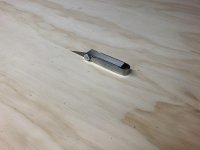
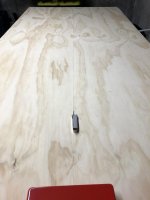
To follow up, I finally got around to unboxing and trying out the track saw. I ordered the corded Makita track saw kit with 55" rail, 118" rail, TSO GRS-16 PE guide rail square and TSO TPG-20 & TPG-30 parallel guides.

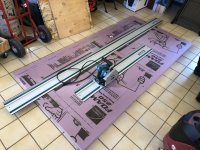
I started by trimming the splinter guard on both rails, following tips in Festool's TS55 Supplemental Manual. Placed the rails on a sheet of foam board, set depth of cut so blade teeth penetrated the strip by about half a tooth, adjusted guide rail cams and let it rip.

attachment.php


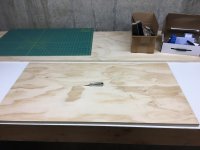
First test cut, split 3/4" sheet lengthwise using 118" rail. The cut quality is all its claimed to be, splinter-free and crisp. I stacked the cuts and made another lengthwise cut. By placing the cut edges together, it should show 2x any deviation in the cut. I measured a 0.008" gap, so ~ 0.004" deviation, as seen below. The sheet is a bit warped, thus the appearance of a bigger gap which is really the top edge of the sheets not lining up cross the entire length.

attachment.php


attachment.php


attachment.php


Last thing I measured the portion of the rail upon which the saw is guided on (small, square in cross-section, raised part of rail) using a set of calipers. The 118" rail was 15.68 mm at both ends and the short rail was 15.68-15.70 mm. So not the deviation other might have experienced.

Next I'll check the 55" rail and then the accuracy of the square and parallel guides prior to cutting down the prefinished plywood I picked up.
 

Attachments

  • IMG_0316.jpg
    IMG_0316.jpg
    133.1 KB · Views: 200
  • IMG_0317.jpg
    IMG_0317.jpg
    80.2 KB · Views: 197
  • IMG_0318.jpg
    IMG_0318.jpg
    53.3 KB · Views: 198
  • IMG_0319.jpg
    IMG_0319.jpg
    158.9 KB · Views: 203
OP
B

bmwpowere36m3

Well-known member
Joined
Nov 8, 2012
Messages
1,125
Repeated the test cut with the 55" rail and measured a 0.004" gap, so ~ 0.002" deviation. I also tried out the GRS PE guide and made a 4 cut square.... identical diagonals.
 

Attachments

  • IMG_3984.jpg
    IMG_3984.jpg
    108.5 KB · Views: 9
  • IMG_3985.jpg
    IMG_3985.jpg
    78.7 KB · Views: 9
  • IMG_3986.jpg
    IMG_3986.jpg
    51.5 KB · Views: 9
  • IMG_3988.jpg
    IMG_3988.jpg
    130.6 KB · Views: 12
OP
B

bmwpowere36m3

Well-known member
Joined
Nov 8, 2012
Messages
1,125
I can't tell if you're pleased or not by that amount of deviation.

I don't have a benchmark... however I suspect for woodworking those number are VERY acceptable. So yes, very pleased. I'm practicing cuts and techniques on this and was curious as to its precision.
 

Grant Gunderson

Well-known member
Joined
May 17, 2013
Messages
2,319
Location
Bellingham, WA
I don't have a benchmark... however I suspect for woodworking those number are VERY acceptable. So yes, very pleased. I'm practicing cuts and techniques on this and was curious as to its precision.

I have found that clamping the guide rail to the wood makes a big difference in cut accuracy, but the only time I notice that is on 8 foot rips and that's probably because I am using two shorter rails joined together as the 8 foot festool rail is ungodly expensive.
 

Grant Gunderson

Well-known member
Joined
May 17, 2013
Messages
2,319
Location
Bellingham, WA
I'm sorry... I don't get track saws... why not use a quality straight edge and save $800???

I'm not *******... I can follow a straight edge perfectly.

I used to do it this way. Now I won't go back. The track saw is faster to setup, more accurate and the dust collection alone makes it worth while. I've been building a ton of custom cabinets for our house and my shop. For less than the cost of hiring someone to build just a few cabinets I was able to buy the best tools / materials, do it myself exactly how I wanted it and I've done several rooms for less than the cost of the quote we had just for one room.

At the end of the day when making cabinets, mistakes cost money, if investing in good tools reduces mistakes / and is more accurate than its easy to save more money than what the tools cost. So for my situation all the $$$ I have invested in the full festool system has payed off greatly in just this one project. While I could have saved a bit getting the Makita saw, I went with Festool as I can use the same rail to do my shelf pins and the dust collection is amazing.

I sold my old table saw when I bought the Festool system and to bet frank, the only time I missed it where doing really narrow rips for trip (narrow cuts are the only spot I found track saws being lacking for a table saw replacement). I just picked up a cabinet saw for a steal, but realistically its only going to be used for riding hardwood for trim.
 
To avoid these ads, REGISTER NOW!
Top Bottom