Hmmm... not sure I agree with that as a solid rule5 or 6 lug is just a choice, makes no difference in weight rating.
5 or 6 lug is just a choice, makes no difference in weight rating.
Well, having 6 lug is no guarantee of having a heavier axle. Pretty sure he means you can't judge an axle capacityby how many lugs it has.Hmmm... not sure I agree with that as a solid rule
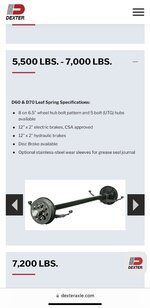
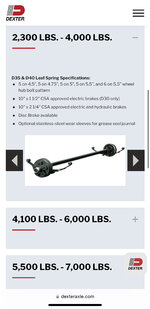
Dexter D60's run between 4100 and 7000# capacity. You would have to have Dexter run the s/n to be sure what the rating was.
Your Dexter label is about as good as you can expect and that will definitely decode into the actual axle rating. As I mentioned, it won't give the trailer any more capacity, just a far stiffer ride and a good safety margin for wheels, tires and bearings.
Not even close to true5 or 6 lug is just a choice, makes no difference in weight rating.
Yep, which means 5 or 6 lug DOES matter.
I don't see that in the field, honestly. I guess it's possible that somebody ordered some 6 lug 3500 pound axles, but I would never believe that without them telling me. It's his own father.5 or 6 lug is just a choice, makes no difference in weight rating.
In my experience 5 lugs normal at 3,500 and 6 lugs around 5k. Always 1/2 UNF so one definitely has more clamping and shear strength than the other. I actually have one set of the latter from the '50s!!!I don't see that in the field, honestly. I guess it's possible that somebody ordered some 6 lug 3500 pound axles, but I would never believe that without them telling me. It's his own father.
5 lug is usually 3500lb, 6 lug is 5-6k though not an absolute.5 or 6 lug is just a choice, makes no difference in weight rating.
Lug count and stud size. For instance 8 on 6.5 normal as dirt from 7k to 12k, but 7k usually 1./2, 8k 9/16 and 10-12k 5/8Lug count may not be perfect, but it's a pretty damn reliable way to gauge weight rating.
It does if you’re looking at a 5 lug hub. Then you know it’s 3500 or less. If it’s 6 lug it could be just about any weight rating up to 7000 pounds or so.Yep, which means 5 or 6 lug DOES matter.


they are 7k axles, but when you spec load rangew E (10ply) tires you are limited by 120 load index to 3,045 lbs. each.Can’t help the OP with his question, but I will say that I don’t think lug count is a definitive indicator. I bought this trailer a few years ago assuming that 8 lug hubs naturally meant 7k axles.
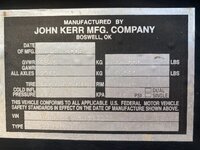
After getting it home and looking at the sticker, it showed to have 6,090 pound axles.
It worked fine for what I needed at the time so it wasn’t a problem. I’ve since sold the trailer and bought a bigger one (10k axles) to haul my skid steer.
Interesting, that makes sensethey are 7k axles, but when you spec load rangew E (10ply) tires you are limited by 120 load index to 3,045 lbs. each.
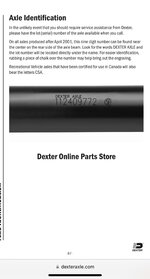
The springs, tire pressure, and tire construction determine the ride qualityOk, so I called Dexter today and it took them a little bit to decipher the decal numbers. I was not expecting their findings. They said I have two 6K lb axles. They were supposed to email me all the specs from the axle builds, but I have not received it yet. I will still find the serial numbers and see if the information is accurate. They provided the exact location for the serial numbers, so they should be easy to find. The 6K lb axle actually kind of makes sense, because the trailer, when loaded with the Jeep, seems to have a pretty stiff ride.
The springs, tire pressure, and tire construction determine the ride quality
I've put heavier axles on lighter springs for the peace of mind knowing I have heavier spindles. I have also seen a lot of trailers with bent axles from overloading but the springs didn't break. If I was going to overbuild somewhere, it would be the axle itself even if I stayed with lighter suspension for ride quality.I guess I’m assuming that if the axles were upgraded from 3500 lb to 6000 lb, the leaf springs would have been upgraded as well. Thus, a stiffer ride. I could be wrong though.
Interesting, that makes sense
Since we are on that topic: When I am forced to work with 16" wheels I generally use load range G tires (14 ply). There was a time when there were only a couple of choices but today I exclusively use Sailun ST in 235 80 or 85 (both available from them). The Chinese have now good enough tire plants and equipment (I happen to know the engineer in charge of making that happen). Scares the **** out of me when a developing nation can run circles around us on quality.Interesting, that makes sense
Same here. I don’t have a preferred brand but if I buy 16 inch trailer tires I buy foreign made 14 plys. When I hauled equipment weekly it was heavy stuff. Frequently 18k on the trailer, occasionally as much as 21k. No more than I haul now (a few times a month and generally not more than 14k) I could probably get by with 10 plys but the cost isn’t much more for foreign made 14 plys. Honestly, most of my trailer tires will dry rot way before they get worn out.Since we are on that topic: When I am forced to work with 16" wheels I generally use load range G tires (14 ply). There was a time when there were only a couple of choices but today I exclusively use Sailun ST in 235 80 or 85 (both available from them). The Chinese have now good enough tire plants and equipment (I happen to know the engineer in charge of making that happen). Scares the **** out of me when a developing nation can run circles around us on quality.