To avoid these ads, REGISTER NOW!

Transformer based phase converter

Bert_

Well-known member
Joined
Dec 24, 2016
Messages
9,776
Location
NW Iowa
I've read about powering a 3ph motor with a transformer and capacitors. Not a lot of talk out there about it but it is very interesting to me.

Supposedly the best way is a custom transformer but I read a report of using a 240-120 step down transformer wired as an autotransformer. The step down transformer is common and cheap.

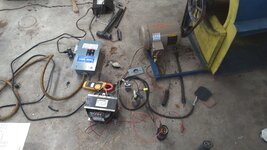
I scrapped out a control cabinet and grabbed a 1.5kva control transformer. Also had a 1hp 230v 3ph motor with bad bearings.

I put the motor on a belt drive furnace blower.

This stuff should all be running at 240v but I was lazy and set this up in 30 minutes powering it with 120v. Maybe tomorrow I'll find a pigtail for 240v. It starts ok but guessing it will be better with the right voltage.

I measured these voltages and currents. Not real balanced but I didn't have a 25mfd capacitor to try. Starts with no assistance.
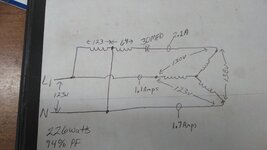
KIMG2954.JPG
 
To avoid these ads, REGISTER NOW!

walta

Well-known member
Joined
Jan 13, 2017
Messages
2,313
Location
Dutzow Missouri
The voltages balance is not the most important thing. The timing of the voltage and current peaks is. Getting the 3 peaks 120° apart while getting the current and voltage to peak at the same time is the hard part.

Transformers are used in phase converters for very rare 2 phase power with a 90° differential.

Google “Scott L transformer” for more info.

Since your convert has no active components it would be some sort of static converter. I am not a fan of static phase converters. Static converters only allow the motor to produce 30% of it rated horse power and almost always run more than the rated current thru 1 of the motor’s windings killing the motor slowly.

I do not understand the point of putting a cap in series with the inductor (transformer) as the inductor has a negative phase shift where voltage leads current and the cap has a positive shift where current leads voltage and cancel each other. The transformer with 123V does not affect the motor in any way.

Seems to me lots of very smart people in the early 1900 tried everything you can think of and failed. Think Tesla, Westinghouse and Edison

Walta
 
Last edited:

LopezBart

Well-known member
Joined
Oct 13, 2023
Messages
2,564
Location
Lopez Island, WA
With the cost of VFDs that accept 240V single phase and produce a reasonable clean 240 three-phase coming down all the time, they're a pretty attractive solution for most uses. Add the advantages of variable speed, controlled acceleration and (often) dynamic braking, they're often the obvious solution. Rotary converters have their place for shops w/ lots of large 3 phase equipment, of course, since they're often made w/ large surplus motors which lowers the purchase (but not the running) cost a lot.
 
OP
B

Bert_

Well-known member
Joined
Dec 24, 2016
Messages
9,776
Location
NW Iowa
With the cost of VFDs that accept 240V single phase and produce a reasonable clean 240 three-phase coming down all the time, they're a pretty attractive solution for most uses. Add the advantages of variable speed, controlled acceleration and (often) dynamic braking, they're often the obvious solution. Rotary converters have their place for shops w/ lots of large 3 phase equipment, of course, since they're often made w/ large surplus motors which lowers the purchase (but not the running) cost a lot.
That's actually a big reason for my recent interest in this. Last week I changed out a 50hp and a 100hp vfd on separate farm sites. One was around 6 years old the other right at 5 years. That's a lot of $$$

I've posted this before but these transformer based phase converters have been produced commercially and motors will make rated horse power if it's set up right.
 

mm08822

Well-known member
Joined
Jan 13, 2012
Messages
6,051
Location
NJ
With the cost of VFDs that accept 240V single phase and produce a reasonable clean 240 three-phase coming down all the time, they're a pretty attractive solution for most uses. Add the advantages of variable speed, controlled acceleration and (often) dynamic braking, they're often the obvious solution. Rotary converters have their place for shops w/ lots of large 3 phase equipment, of course, since they're often made w/ large surplus motors which lowers the purchase (but not the running) cost a lot.
Plus it's in a nice single compact package.
 

mm08822

Well-known member
Joined
Jan 13, 2012
Messages
6,051
Location
NJ
That's actually a big reason for my recent interest in this. Last week I changed out a 50hp and a 100hp vfd on separate farm sites. One was around 6 years old the other right at 5 years. That's a lot of $$$

I've posted this before but these transformer based phase converters have been produced commercially and motors will make rated up if it's set up right.
Pretty good for salvaged parts.
 
OP
B

Bert_

Well-known member
Joined
Dec 24, 2016
Messages
9,776
Location
NW Iowa
I've sold and installed many vfds for single phase input. Mostly 15, 20, and 30hp motors but have done a 75hp motor on single phase input.

Lifespan has always been a big question for me. How long are those electronics going to last? Replacing a vfd is not cheap. Rotary phase converters usually last for decades.

I don't really have any plans to build transformer converters for customers. It's really just something fun that caught my interest.
 

walta

Well-known member
Joined
Jan 13, 2017
Messages
2,313
Location
Dutzow Missouri
I've posted this before but these transformer based phase converters have been produced commercially and motors will make rated horse power if it's set up right.
Might make an interesting read got a link to a commercial unit.

Walta
 

theoldwizard1

Well-known member
Joined
Feb 22, 2011
Messages
43,250
Location
SE MI
With the cost of VFDs that accept 240V single phase and produce a reasonable clean 240 three-phase coming down all the time, they're a pretty attractive solution for most uses. Add the advantages of variable speed, controlled acceleration and (often) dynamic braking, they're often the obvious solution.
Using transformers and capacitor will not produce the full HP rating of the motor.
 

RPH

Well-known member
Joined
Dec 17, 2006
Messages
4,190
Location
Michigan Thumb
I've sold and installed many vfds for single phase input. Mostly 15, 20, and 30hp motors but have done a 75hp motor on single phase input.

Lifespan has always been a big question for me. How long are those electronics going to last? Replacing a vfd is not cheap. Rotary phase converters usually last for decades.

I don't really have any plans to build transformer converters for customers. It's really just something fun that caught my interest.
I have found lifespan on industrial converters usually connected to the level maintenance staff and understanding the systems. Companies that paid low wages to workers usually had maintenance skilled by those who stayed the longest. Not that they had skills but the good ones went elsewhere for higher wages. One plant in particular in the Carolina’s paid extremely well and was air conditioned transmission plant.
They would train people only to lose them to the car manufacturer up the road. I was always starting with a new crew on maintenance when the **** hit the fan. Most had no idea it worked or any idea of proper maintenance procedures. Last time maintenance was pulled was the last time it broke down and we as manufacturers came in. I digress though, the life of industrial electronics depends on many conditions. From design through component selection to assembly and calibration. All that begins the chain. Lifetime in places that manufacture graphite or use graphite in their process was much lower than places that were white suit clean.
I have fixed industrial inverters and control cards that were built in the 1970’s. Components no longer availability comes in. Every engineer that I worked with for the forty some years all had quirks. Right, wrong, indifferent they had them, especially the logic guys. When you lose that guy’s way of doing things and having to reverse engineer thought process gets expensive. That when the electronics get updated.
Hopefully management makes the investment in the systems and the people maintaining it. Electronics can live a long and fruitful life.
Dust, dirt, greases, and oils are only the beginning. Components aging and loss of tolerance has to be accounted for, especially in tuned resonant systems. But what do I know other than I made a great living, traveled the world, and met amazing people all along.
 

American Locomotive

Well-known member
Joined
Jan 8, 2017
Messages
11,014
Location
Rhode Island
I believe capacitor based "static" phase converters can actually produce a balanced 3-phase power. Using capacitors to create phase shifts is done all the time in the electronics and RF world. It's a valid way to do that.

The problem is that using capacitors in that manner is a highly "tuned" thing. To create balanced 3 phase power using just capacitors, it has to be tuned to a specific motor, at a specific speed, at a specific load, at a specific input voltage. The moment you change any of those parameters, the voltages and currents in the motor will become wildly unbalanced. If you have a steady state load like a fan or a pump it's doable. Any kind of machinery that "idles" or has varying loads like a saw, CNC machine, lathe, mill, grinder, air compressor, etc... will not be able to be balanced properly with just capacitors.

A rotary phase converter is just a 3 phase motor with a static phase converter attached to it. The idler motor and capacitors work together to help keep the generated leg better balanced over a wider range of conditions. It's still not perfect, and the better rotary phase converters will switch capacitors in/out based on load.

The fancy static converter Bert_ linked tries to split the difference. It looks like you dial it in under load with the taps on the transformer, and then it switches capacitors in/out based on the load.

You might want to look at Phase Perfect offerings for your customers. They're basically 1/3rd of a VFD, and generate a 3rd leg to create true 3 phase power. They seem to be constructed quite robustly compared to most VFDs. It looks like they offer them in sizes up to 118kVa or 175HP
 

theoldwizard1

Well-known member
Joined
Feb 22, 2011
Messages
43,250
Location
SE MI
That's actually a big reason for my recent interest in this. Last week I changed out a 50hp and a 100hp vfd on separate farm sites. One was around 6 years old the other right at 5 years. That's a lot of $$$
I would love to see a skilled electronics tech test into one of those and diagnose what failed. Could be less than $50 worth of MOSFETS.
 

RPH

Well-known member
Joined
Dec 17, 2006
Messages
4,190
Location
Michigan Thumb
The mosfets, igbt, thyresistors, and diodes were rather large devices. Mosfets only one fits in your hand. Where we used most of the mosfets were early tube welders. Mosfets do not take arcing lightly, it degrades them internally until they fail. One welding module carried 40 mosfets. 20 in parallel for each side of the dc bus. The modules could be linked to gather for more power if required.
Igbts are much more tolerant as a device to arcing and voltage spike created by arcing. They usually go bang when dying but not always. Sometimes it’s just a slow device. The thyresistors and diodes would just die. Shoot through is what lulled the thyresistors.
These units are not board mounted. These devices are attached to a water cooled plate. The thyresistors and hockey puck diodes are clamped into a fixture with water cooled blocks that transfer the current to the copper tubing. Tubing is water cooled wire in these units.
These devices usually start at 1200 v and 1000 amp is not uncommon. Mosfets and igbts sold for well over $1500 per device. Repairs are expensive.
I will have to get some pictures up of this stuff.
 
OP
B

Bert_

Well-known member
Joined
Dec 24, 2016
Messages
9,776
Location
NW Iowa
I found this page somewhere on the net several years ago. It looks like it's out of a book and I would really love to read more of it. I've never been able to find what it is from though.

Screenshot_20230903-075645~2.png
 

Steve from Socal

Well-known member
Joined
Jan 27, 2009
Messages
3,510
Location
Hutchinson Ks.
Bert,

Regarding the VFD's that died and in addition the Phase Perfect both use capacitors that have life spans. Most inverter companys have data on caps for the larger inverters as does Phase Perfect. Are you using inverters that are de-rated for single phase use? A 50 HP inverter on a 25 HP motor?
 
To avoid these ads, REGISTER NOW!
OP
B

Bert_

Well-known member
Joined
Dec 24, 2016
Messages
9,776
Location
NW Iowa
Bert,

Regarding the VFD's that died and in addition the Phase Perfect both use capacitors that have life spans. Most inverter companys have data on caps for the larger inverters as does Phase Perfect. Are you using inverters that are de-rated for single phase use? A 50 HP inverter on a 25 HP motor?
Yes both drives were derated. The 100 hp drive is actually only running a 40 horse motor since it's hard starting.

I've had drives with bad outputs, only output on 2 phases. I've had capacitor failure. I think the 100hp drive I replaced this year had issues in the computer portion. Kept getting a lot of weird faults that no one could explain to me.

Don't get me wrong, when they work they are awesome. You push a button and it starts. They just aren't really robust. I like to install things that will just work for 20 or 30 years with minimal service.
 
OP
B

Bert_

Well-known member
Joined
Dec 24, 2016
Messages
9,776
Location
NW Iowa
I was really struggling for a little bit. I found a 240v cord and had the transformer set up to supply 360v to the capacitor. I tried a variety of capacitors from 5 to 60mfd. Nothing would come close to balanced currents.

I was reading through some of the few sources I have found, and 360v was recommended for 1800rpm motors. I also noticed he recommended approximately 480V to the capacitor for a 3600rpm motor. The only explanation given for the higher voltage was that 2 pole motor usually have a higher power factor.

I wired my transformer to supply 480v to the capacitor and again tried many capacitors. It was almost worse than before.

I also tried different capacitors without the transformer. Nothing really worked well.
 
OP
B

Bert_

Well-known member
Joined
Dec 24, 2016
Messages
9,776
Location
NW Iowa
The motor I'm using is 1hp 230v 3ph 1750. It's on a fan and I'm probably only using 1/2hp.

A lightly loaded motor has a low power factor. I started wondering if higher voltage to the capacitor was not what I wanted.

I ended up wiring the transformer primary for 480, still feeding it 240v. And I wired the secondary out of phase so it will subtract 60v.

For reference I am using a 240/480 primary, 120v secondary 1.5kva control transformer.

I tried several capacitors again and to my surprise I got the currents very well balanced.

I don't totally understand the science and math of the thing but lower power factor requires lower voltage to the capacitor.

I really need to get something set up to load the motor to rated power.

KIMG2959.JPG
KIMG2958.JPG
 
Last edited:

Steve from Socal

Well-known member
Joined
Jan 27, 2009
Messages
3,510
Location
Hutchinson Ks.
One of my lathes has a single phase DC drive but, the coolant pump is 3 phase. It is a small Gusher 1/10 hp motor, I used a cap and potential relay to power it. A coolant pump should be a high load factor yet I have had no issues with it in 18 years?
 
OP
B

Bert_

Well-known member
Joined
Dec 24, 2016
Messages
9,776
Location
NW Iowa
I believe capacitor based "static" phase converters can actually produce a balanced 3-phase power. Using capacitors to create phase shifts is done all the time in the electronics and RF world. It's a valid way to do that.

The problem is that using capacitors in that manner is a highly "tuned" thing. To create balanced 3 phase power using just capacitors, it has to be tuned to a specific motor, at a specific speed, at a specific load, at a specific input voltage. The moment you change any of those parameters, the voltages and currents in the motor will become wildly unbalanced. If you have a steady state load like a fan or a pump it's doable. Any kind of machinery that "idles" or has varying loads like a saw, CNC machine, lathe, mill, grinder, air compressor, etc... will not be able to be balanced properly with just capacitors.

Honestly that's a big reason I am trying to experiment with it. Many (most) say exactly what you are.

I have also read a couple reports saying, if you balance for full load it may not be balanced at partial load but the current won't be over nameplate. Basically it will work fine at varying loads

There's a guy over on practical machinist saying he has built some of these decades ago and uses them on saws and an air compressor.

I really don't have the answers here. I'm just making an attempt and posting what I find.
 

Innovate1

Well-known member
Joined
Jul 28, 2014
Messages
4,296
Location
Illinois near St. Louis, Missouri
Yes both drives were derated. The 100 hp drive is actually only running a 40 horse motor since it's hard starting.

I've had drives with bad outputs, only output on 2 phases. I've had capacitor failure. I think the 100hp drive I replaced this year had issues in the computer portion. Kept getting a lot of weird faults that no one could explain to me.

Don't get me wrong, when they work they are awesome. You push a button and it starts. They just aren't really robust. I like to install things that will just work for 20 or 30 years with minimal service.
Electrolytic caps life calculation formulas from makers usually max out at 15 years. That's usually the part that limits life if other things are appropriately sized. The formula will give longer than that but there are notes that they are only good for 15 years even if the calculation is longer. Cooling air is important. Over the years dust and other crud can build up and cause early death.
 
OP
B

Bert_

Well-known member
Joined
Dec 24, 2016
Messages
9,776
Location
NW Iowa
With a start capacitor this motor will chirp even a fairly tight belt on startup. I don't have a potential relay for this test but would definitely add one for permanent use. I just touched the wire for a second.

I let it run for a couple hours powering the fan. Motor got warm but nothing abnormal.
 

Samh

Well-known member
Joined
Aug 16, 2006
Messages
482
Location
Canton GA
going to watch this, as I came across a few transformers from a shop that closed down, and was wondering how I could use them.
 
OP
B

Bert_

Well-known member
Joined
Dec 24, 2016
Messages
9,776
Location
NW Iowa
going to watch this, as I came across a few transformers from a shop that closed down, and was wondering how I could use them.
I did find a much bigger blower. So I think I could put a full load on a 1 or 1 1/2 hp motor.

I think I have 1 1/2hp single phase and three phase motors. What I should do is put the single phase motor on, find a pulley that gets close to full load amps, then swap over to the three phase motor.

That would prove whether or not it will make full power.

I'm almost tempted to order a potential relay. Then startup would be automatic. That's how it needs to be done for a permanent install.
 
OP
B

Bert_

Well-known member
Joined
Dec 24, 2016
Messages
9,776
Location
NW Iowa
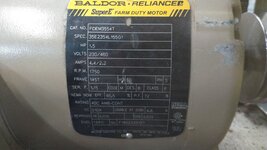
Alright, I tested both a 1.5hp 1ph motor and a 1.5hp 3ph motor on the same fan.

This method of running a three phase motor can definitely deliver full power. Like some others have mentioned the problem is with varying loads.

If your motor runs a constant load this is a REALLY good way to run it. The 3ph motor was able to drive the same fan, through the same belt and pulleys, without overloading. In fact the 3ph motor did not need to operate into its service factor and it also used less power than the single phase motor.

If a motor varies between 1/2 and full load think this is a acceptable way to run it. The currents become imbalanced but did not go above what the motor is rated for.

If it needs to run at no load the current on at least one phase will be substantially over the nameplate rating. The converter can be configured to run a lightly loaded motor but then it won't make full power without pulling too many amps on one or more phases.

What I really like about this method is that I used cheap, readily available and reliable parts to build the converter. The 1.5kva transformer I am using should be able to run a 5hp motor. A motor using this converter could easily be configured to start and stop automatically with no special consideration once commissioned.

KIMG3067.JPG
KIMG3070.JPG
KIMG3071.JPG
KIMG3057.JPG
KIMG3072.JPG
KIMG3061.JPG
KIMG3058.JPG
KIMG3059.JPG
 
Last edited:
OP
B

Bert_

Well-known member
Joined
Dec 24, 2016
Messages
9,776
Location
NW Iowa
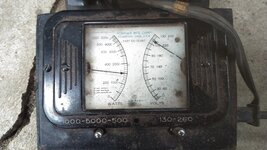
I compared watts to VA. I did not use a clamp amp meter to measure current, I metered it directly through a 10A meter.

One of my meters must be a little off because it's showing a power factor over 1. 1250va 1300w. But I probably do have a pretty good power factor.

Running the 240v 1.5hp 3ph motor and converter draws 5.2 amps from my single phase source. That is really low current. The 1ph motor used 7.5A to run the same fan through the same pulleys. Again that tells me I have a good power factor and good efficiency.

None of this is super important. On a residential service we are billed for watts only
 
Last edited:
OP
B

Bert_

Well-known member
Joined
Dec 24, 2016
Messages
9,776
Location
NW Iowa
I checked the power used by my single phase 120v single stage air compressor. 1550w with the tank empty, 1800w just before cutoff. Current starts at 7.6, quickly climbs to 10, then slowly and steadily rises to 15.2 at cutoff. Motor is rated at 15 fla

I think a three phase compressor could be powered with a transformer phase converter. This has way better starting characteristics than a rotary phase converter.

I don't have any plans to test a three phase compressor but if anyone wants to run one I would be happy to help as much as I can and get more results. The parts to power a 5hp motor could be put together for $150 pretty easily I think.
 
Last edited:
OP
B

Bert_

Well-known member
Joined
Dec 24, 2016
Messages
9,776
Location
NW Iowa
Some thoughts,

For something that spends half the time spinning with no load at all, like a saw or a drill press, I think you could do fine with just a couple capacitors and a potential relay. One winding would be overloaded on a heavy cut but I think it would be difficult to maintain that load long enough to do any damage. You would still have an overload relay to protect against prolonged overloading.

For a lathe or anything else that can spend a lot of time at either a light load, a heavy load or anything in between, a rpc or a vfd is still probably the best solution if you want full power.
 

isb cornbinder

Well-known member
Joined
Nov 3, 2010
Messages
7,073
Location
Pacific South West, BC, Canada
With the cost of VFDs that accept 240V single phase and produce a reasonable clean 240 three-phase coming down all the time, they're a pretty attractive solution for most uses. Add the advantages of variable speed, controlled acceleration and (often) dynamic braking, they're often the obvious solution. Rotary converters have their place for shops w/ lots of large 3 phase equipment, of course, since they're often made w/ large surplus motors which lowers the purchase (but not the running) cost a lot.
Several years ago, I bought an American Rotary Phase Converter. I unpacked it and never used it. I found this unit on Amazon. It was just over $1465cdn. I need to sell it. My needs have changed and it is unlikely I will ever use it.
 

Attachments

  • Rotary Phase copnverter.jpg
    Rotary Phase copnverter.jpg
    11.9 KB · Views: 8
  • rotary front view.jpg
    rotary front view.jpg
    74.5 KB · Views: 17
OP
B

Bert_

Well-known member
Joined
Dec 24, 2016
Messages
9,776
Location
NW Iowa
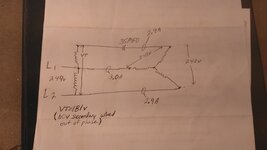
I haven't really posted a great diagram of the circuit I'm using.

I have just been touching a wire together in place of the start switch and don't have a motor controller since this has been experimental. This shows those components for a permanent install.

It's really not complicated so good for DIY.

KIMG3082.JPG
 
To avoid these ads, REGISTER NOW!
Top Bottom