To avoid these ads, REGISTER NOW!

Transition Ramp

jacobm99

Well-known member
Joined
Nov 9, 2007
Messages
45
Location
SF Bay Area
IMG_0771.jpg

IMG_0769.jpg

IMG_0754.jpg

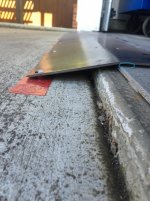
I fabbed up some transition ramps that will run the length of my garage door which I will be securing with tapcon screws. I coated the underside with chassis saver to prevent rust and will be covering the top with a bed liner product (Monstaliner) after it’s screwed down. Before I install however, I was hoping for some input on the following:

1. I want to put some sort of cement of other form of support in the void marked by the red X in the first picture. My initial thought was some concrete product that I would lay the ramps on top of when wet so that when I screwed the ramps down, the cement would form to the back side of the ramps and harden that way. I wouldn’t put the concrete the entire length, but instead every 6 inches in order to allow the concrete to flow somewhere when being pushed down as the ramps are screwed down.

2. Some of the ramps do not sit perfectly flat on the tile, as indicated by the blue circle in the second picture. This is due to some ramps being bent a little too much. When screwed down, it will only be 1/8th of an inch or so, but I want to fill that void (marked by the blue circle in the second picture) with something. My initial thought was liquid nails- not necessarily for the adhesion, but more for the support it would give when it dried.

3. I want to seal the front and rear edges of each ramp (see the yellow lines in the third picture) with sort of sealant to prevent water from getting underneath the ramps. Not sure what would be best, but I would like something relatively durable.
 
To avoid these ads, REGISTER NOW!

wdrumheller

Well-known member
Joined
Nov 15, 2012
Messages
198
Location
Virginia
I like your ramps, but from my experience there is some floor leveling epoxy that might fill your ramp-gap well without your ramps needed.

That being said, if your ramps are steel, they will rust. At a minimum have them powder coated or paint them if you can.

And, Tapcon screws are "ok" but in my trials with those screws I have frequently found that decent plastic inserts and zinc coated screws do better for things that will have movement or vibration.

For instance: I mounted three hose-reels on my brick house, and two of them used tapcon screws, and one of them I mounted using heavy duty zinc coated screws into heavy duty plastic inserts the same diameter as the hole I drilled for them.

The reel with the zinc screws and plastic inserts is still steady, and the vibration from normal hose reeling activity has loosened the tapcons inserted directly into concrete and brick.
 

DCarr2

Banned
Joined
Dec 12, 2015
Messages
1,339
Location
Akron NY
the other thing to think about is where are located? do you have a freeze thaw cycle/snow removal?

if so, this might not work out so well
 
OP
J

jacobm99

Well-known member
Joined
Nov 9, 2007
Messages
45
Location
SF Bay Area
Thanks.

I am coating the ramps. Monstaliner on the top and chassis saver on the underside (which i got free when ordering the Monstaliner).

I'm in the SF bay area, so no freeze/thaw cycle
 

matt_i

Well-known member
Joined
Mar 14, 2008
Messages
10,728
Location
SE Michigan
Thinking about some non-shrinking grout like one would use to "bed" a machine tool to the concrete floor in an old-time shop. Don't know how well this will hold up outdoors, but it certainly has the compressive strength.

Another way would be to build support with steel, either a heavy round tube like a piece of Sch 40 pipe or a piece of flat bar stood up vertically and stitch welded into place. Either of above could be "fine tuned" to the concrete surface by a number of cycles of checking and hand-grinding to fit.
 
OP
J

jacobm99

Well-known member
Joined
Nov 9, 2007
Messages
45
Location
SF Bay Area
Thinking about some non-shrinking grout like one would use to "bed" a machine tool to the concrete floor in an old-time shop. Don't know how well this will hold up outdoors, but it certainly has the compressive strength.

Another way would be to build support with steel, either a heavy round tube like a piece of Sch 40 pipe or a piece of flat bar stood up vertically and stitch welded into place. Either of above could be "fine tuned" to the concrete surface by a number of cycles of checking and hand-grinding to fit.

I thought about fabbing a steel support, but because the driveway is uneven, it would be incredibly difficult and nearly impossible to get perfect.

I like the non-shrinking grout idea. Any particular brands you would recommend?
 

wasfuzz

Well-known member
Joined
Nov 16, 2010
Messages
755
Location
Mn
Again not knowing where you are located makes it difficult to assist much. If it were me I would not fill that area in due to Temp related heaving and or further settling I would only anchor one side of the ramp, because if it does move, something is going to give and it won't be your steel. Your concrete will crack.
 

lonestarky

Well-known member
Joined
Mar 28, 2011
Messages
367
Location
Lindenhurst IL
Only thing I'll say is don't screw both sides in. You're asking for something to crack or pull loose. The two slabs need to move independent of each other.

I wouldn't worry about compression either but if you were going to fill with something, would cut some pressure treated that has some give rather than hard grouting it. Everything is going to rise/fall and nothing is square, so a compressible support like a piece of lumber is best.

Finally, a flexible seal like sikaflex may work best to seal tapcons, holes or seams. It's like the gray goop at pools or in retaining walls.

Overall, I just think all of this will move, and the tapcons probably aren't going to hold it and they'll shear or the concrete will crack.

Not knocking your fab work. Or your idea, but I think something independent of the garage floor only on the driveway is best. Grind a slot or some gouges in the driveway, dowel with some #2 or #3 re-bar into the driveway, and put some weldcrete down to make a ramp rather than bridge the gap with this metal.

I just think this may not last long. Hopefully others have better ideas than I do.

Sent from my XT1254 using Tapatalk
 
To avoid these ads, REGISTER NOW!

larry_g

Well-known member
Joined
Apr 28, 2007
Messages
16,880
Location
oregon
Only thing I'll say is don't screw both sides in. You're asking for something to crack or pull loose. The two slabs need to move independent of each other.

I wouldn't worry about compression either but if you were going to fill with something, would cut some pressure treated that has some give rather than hard grouting it. Everything is going to rise/fall and nothing is square, so a compressible support like a piece of lumber is best.

Finally, a flexible seal like sikaflex may work best to seal tapcons, holes or seams. It's like the gray goop at pools or in retaining walls.

Overall, I just think all of this will move, and the tapcons probably aren't going to hold it and they'll shear or the concrete will crack.

Not knocking your fab work. Or your idea, but I think something independent of the garage floor only on the driveway is best. Grind a slot or some gouges in the driveway, dowel with some #2 or #3 re-bar into the driveway, and put some weldcrete down to make a ramp rather than bridge the gap with this metal.

I just think this may not last long. Hopefully others have better ideas than I do.

Sent from my XT1254 using Tapatalk

I'm with lonestarky, do not fix both ends, movement will shear the fasteners. Looking at what you have I'd be tempted to weld a couple of pins on the bottom of the plate that would drop into holes drilled in the driveway. Gravity is going to hold the plates down and the pins will keep them from sliding around and you could just lift them up for cleaning or refinishing.

lg
no neat sig line
 
OP
J

jacobm99

Well-known member
Joined
Nov 9, 2007
Messages
45
Location
SF Bay Area
Thanks guys, appreciate the input. I only want to do this once.

Based on your input I am now thinking of either

(1) screwing only the garage side with the Tapcons, leaving the driveway side unbolted and no adding any sort of support underneath the ramps or

(2) Same as (1) but using drop in anchors and stainless socket flat head screws instead of Tapcons.

Any thoughts or other suggestions?
 

matt_i

Well-known member
Joined
Mar 14, 2008
Messages
10,728
Location
SE Michigan
Is this for cars to drive over regularly, or is it more for toolboxes and other small-wheeled devices which won't make the "jump"?

If you are driving a car over it, I'd add some more flat to it, both sides, this way the weight of the wheel is already pressing it into the ground, rather than simply trying to push it aside before the wheel is forced to climb. In other words, the inclined plane needs restraint parallel to the motion so it doesn't slide away. The tapcons would take care of this but you'd need several.

I think drop-ins will split the concrete edges or work loose eventually. I would choose the large diameter tapcons, I think there is a 1/4" or 5/16" dia.
 

OccupantRJ

Well-known member
Joined
May 15, 2009
Messages
11,081
Location
Eastern North Carolina
One method of anchoring is to install expanding wedge concrete anchors and tighten them down. Use a stiff knee to the door header and a small bottle jack to apply pressure beside the bolt to keep metal held down. Cut bolt off and weld all around. Grinding smooth is optional. Move to next bolt.
 

MagKarl

Well-known member
Joined
Oct 15, 2012
Messages
684
Location
Olympia, WA
Have you considered the idea of building the ramp out of some sort of sand mix grout? I'd worry the plate is going to clank and move eventually leading to loose fasteners or cracked holes.
 

DC73

Well-known member
Joined
Dec 27, 2014
Messages
1,627
Location
Lubbock TX
I'd be concerned with that many screws so close to the edge of either slab. It seems it could create a natural "fault" line that would lead to a crack all along the edge of the slab.

I'd be tempted to find a high strength epoxy both to fill the void and to glue the ramps down. If the epoxy fails to hold, you can go to plan B and try the screws.

DC
 
OP
J

jacobm99

Well-known member
Joined
Nov 9, 2007
Messages
45
Location
SF Bay Area
I am now thinking of using the epoxy drop in anchors like the power-sert ones made by Wej-it, which a lot of folks are using for their Max Jacks. This will reduce the likelihood of cracking and pullout due to the movement/pressure caused when the cars go over the ramps. The only problem is I need 72 of the 5/16 anchors (I have 2 garage door openings- so 36 each door) and they are expensive. The cheapest i can find is $250 for a box of 100. Does anyone know of any sources where you can buy them (or a similar product from another manufacturer) for a better price?
 

R6 Racer

Well-known member
Joined
Feb 21, 2010
Messages
1,632
Location
Northern Ontario Canada
I want to guess that the difference between the 2 levels is not constant.
Have you taken any measurements over time?

There are many factors that could cause that difference to change. You have stated that you do not have freeze thaw issues. Do you have a wet vs dry time of year? Is the home or drive relatively new? There could be settling going on that has not yet fully finished.
If the difference is subject to change, any kind of fastening could be a disaster waiting to happen. (disaster size being relevant to the fastening method)

Here is a thought going a slightly different direction...
Get a piece of 3/4" or 1" thick horse stall rubber matting & cut 4, 2" or 3" wide strips the length of your ramps. One for each edge of the ramps touching the ground. Cut a grove along the length of each strip that the ramp can sit in & taper the protruding edge of the mat to get a smooth transition.
Untitled.jpg
^^^^^With an end view kind of like this^^^^^.
You could fasten the rubber to the mat. The weight would keep everything in place & the rubber would allow the ramps to float quietly threw any slight elevation differences that could occur in the future. The rubber would also eliminate any bouncing, clanging or rattling you might get by using the ramps alone unfastened.

The only issue I see with this solution is that the ramps would not be permanently attached & could potentially be stolen. Is theft an issue that your concerned about in this situation?

Steve
 
To avoid these ads, REGISTER NOW!
Top Bottom