To avoid these ads, REGISTER NOW!

Treated or untreated bench legs?

whitesco

Well-known member
Joined
Aug 1, 2022
Messages
399
Location
Pittsburgh, PA (ish)
I'm sure this won't spark any debate at all :)

I'm starting my long overdue reloading bench build, using the NRMA bench plans as a guideline... but my my current analysis paralysis is stuck on whether to use treated or untreated 4*4 lumber for the legs. It will be sitting on a concrete floor, inside my unfinished basement so the left shoulder guy is saying "treated wood on concrete, always" but the right shoulder guy is saying "it's indoors, what's it going to do, **** moisture through the slab and do you really want the off-gassing in your basement?"

What say you? And yes, I could just buy cedar and make everyone but my wallet happy but I think they were 8x the cost of untreated when I looked so I don't wanna.
 
To avoid these ads, REGISTER NOW!

tarmy

Well-known member
Joined
May 28, 2014
Messages
4,670
Location
Nor Cal
This garage set up has leveling feet. Works great for sloping/uneven floors. My other shops has legs that rest on the concrete for decades with no issues. The lower pic is one of my other benches with leveling feet trimmed out for a cleaner look.
IMG_3795.jpegIMG_1315.jpeg
 

toolmiser

Well-known member
Joined
Sep 1, 2009
Messages
1,656
Location
La Crosse, WI
How about applying a flat piece of PVC to the bottom of the legs? It won't rot, plus it will keep the other wood off the concrete.
 

BillK

Well-known member
Joined
Aug 24, 2006
Messages
9,320
Location
Beautiful Southern Maryland
I have two large benches at my business that have 4x4 uprights. They are good old plain lumber and have been sitting on concrete for 35 years with absolutely no issues. I have a workbench in my attached garage at home that I built shortly after we moved in back in 1978. It has a 2x4x8 sitting flat on the floor for the front support "rail" It has also been fine.

I think you will be just fine with normal lumber.
 

NUTTSGT

Super Moderator
Staff member
Joined
Sep 14, 2009
Messages
50,904
Location
Northern Central Ohio
When I built, should say rebuilt, my work bench, I went with PT.

Basically, the PT 4x4s are more readily available around here. I'm not sure who carries or where they are in the lumber rack around here.
 

mikedodge

Well-known member
Joined
Jun 27, 2017
Messages
2,777
If youre going to be getting the floor wet regularely use a couple pieces of 2x4 or plywood at the bottom to be sacrificial and keep the legs directly off the floor. Otherwise don't bother. There's no point in using pressure treated. I have wooden machine stands and crates that have been on concrete floors off and on for over 40 years and wood that's been stored on garage floors for years and never had ussues.
Pressure treated is only required if it's out in the weather or constant damp locations.
 

jake28

Well-known member
Joined
Aug 28, 2018
Messages
481
Location
SF, CA
Given the choice, I’d avoid PT. It’s not as bad it used to be, but I don’t like touching it or breathing the sawdust if I can avoid it. If you’re really worried about mitigating rot, a nice urethane finish and a coaster or pad or leveling foot on the end grain will have the bench last for a couple of decades.
 

Colin Len

Well-known member
Joined
Jan 30, 2013
Messages
1,233
Location
Long Beach CA
I'd opt untreated. I just don't see there being any real benefit to PT for this use case while there are a handful of possible downsides. I know around here the PT is super wet and generally not great quality - like others have mentioned.

If you have enough moisture in your basement to warrant PT then you've got bigger problems than bench legs.
 
To avoid these ads, REGISTER NOW!

wolfhawk73

Well-known member
Joined
Aug 27, 2016
Messages
164
Location
Eastern North Carolina
Fortunately, a Lowes one town over carries Doug Fir 4x4's. I'd go that route if possible, since PT 4x4's are usually cut from the left-over log after plywood veneers are cut, causing them to warp like the devil. I've probably bought 20 Doug Fir 4x4's in the past couple of years, and not one was center-cut.

And definitely go with the leveling feet.
 

MovingAlong

Well-known member
Joined
Aug 17, 2013
Messages
1,213
I'm sure this won't spark any debate at all :)

I'm starting my long overdue reloading bench build, using the NRMA bench plans as a guideline... but my my current analysis paralysis is stuck on whether to use treated or untreated 4*4 lumber for the legs. It will be sitting on a concrete floor, inside my unfinished basement so the left shoulder guy is saying "treated wood on concrete, always" but the right shoulder guy is saying "it's indoors, what's it going to do, **** moisture through the slab and do you really want the off-gassing in your basement?"

What say you? And yes, I could just buy cedar and make everyone but my wallet happy but I think they were 8x the cost of untreated when I looked so I don't wanna.

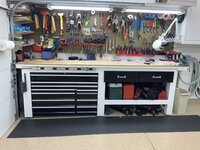
Skip the treated wood. Put a little Rustoleum on the bottom, add a sacrificial spacer of another wood, stick a shim of laminate flooring under it (grab four samples from Home Depot).

Be sure to post pics of the bench when finished! :thumbup:
 
Last edited:
OP
W

whitesco

Well-known member
Joined
Aug 1, 2022
Messages
399
Location
Pittsburgh, PA (ish)
Thanks to everyone who replied! I think I'll go with untreated and do the leveling feet - as someone said it does need to be level but it also needs to be sturdy since it's basically the base of a big lever on the press but I see some leveling feet that look plenty sturdy.

I don't EXPECT any moisture, it's new construction and this is just a small unfinished portion of a larger finished walk-out basement so again as someone said if the floor is wet, my bench legs will be the least of my worries!
 

csp

Well-known member
Joined
Mar 23, 2010
Messages
5,719
Location
Franktown, CO
Our home has some basement framing rot from a sprinkler leak many years ago (found the insurance info in a file the previous owner left) on the one exterior wall that's framed (walkout basement). In reconstructing this area I'm using zip tape on any lumber in contact with concrete. One board has several tapcons securing it to a concrete wall and I did all of my drilling first, wrapped the contact face with the zip tape then screwed it home. The zip tape is self repairing and should seal around the tapcons. I am not using pressure treated lumber either.
 

PotvinV8

Member
Joined
Nov 21, 2020
Messages
14
Location
California
A stick build on a concrete footing uses regular 2x4s. Why would a work bench be any different? It would take two lifetimes to rot away anyhow!
 

Miss the Pontiacs

Well-known member
Joined
Nov 7, 2016
Messages
16,441
Location
Saskatchewan Canada
I was always under the impression that PT was not to be used inside. I can’t even think of a reason it would be required.
When using the KD material for the odd time you may have water in your work area I would use hockey pucks or cut a couple of layers of shingles for the base of the leg.
 

Bucko

Well-known member
Joined
Aug 23, 2021
Messages
679
Today's PT wood is so prone to warping as it dries I try to avoid it if I can. Inside has no need for PT.
My thoughts as well as well as the shrinkage PT will have as it dries out will effect all of your joints vs just using KD with some levelers or trim to level if you plan to keep it in the same spot or use the bench for heavy items.
I will typically use two 2x4's to create a "L" which gives a solid area to attach a 2×4 shelf frame that plywood can be attached to and not have to notch the corners.
 

hobie18

Well-known member
Joined
Apr 29, 2024
Messages
1,181
Plate bottom, large levelers, full weight/strength.
Iow, cap the leg bottoms. Attach levelers to cap. Maintain full strength.
 

niget2002

Well-known member
Joined
Oct 2, 2012
Messages
11,123
Location
Josephine, TX
Use solid mahogany, cypress, or teak :)

All of those do better in moisture and are solid hardwoods.

Could use cedar, but that's softer.
 

csp

Well-known member
Joined
Mar 23, 2010
Messages
5,719
Location
Franktown, CO
I was always under the impression that PT was not to be used inside. I can’t even think of a reason it would be required.
Many local building AHJ's require PT lumber as the bottom plate for basement framing. My area required not only PT, but floating walls to allow for expansive soils (regardless of your soil test results).
 

Miss the Pontiacs

Well-known member
Joined
Nov 7, 2016
Messages
16,441
Location
Saskatchewan Canada
Many local building AHJ's require PT lumber as the bottom plate for basement framing. My area required not only PT, but floating walls to allow for expansive soils (regardless of your soil test results).
Yes that is code in our area as well. Wood basements as well, but I haven’t seen newly constructed homes using that option in years. I did see a couple that were backfilled a little too exuberantly and partially caved in the wall. If PT is used I’m under the impression it has to be encapsulated in some way.
I still wouldn’t use PT in a shop. My choice however.
 
To avoid these ads, REGISTER NOW!
Top Bottom