To avoid these ads, REGISTER NOW!

Tree root cracking garage slab

ninjajim4

Member
Joined
Jul 24, 2024
Messages
11
Hi all,finishing out the garage and next step is to lay flooring. However, looking at the garage floor a little more closely for the first time and realizing that the cracks in the slab aren't just from a poor install or unsettled base.

I can see now that all of the cracks are emanating from one spot that is actually bulging upward slightly. I assume that this is from a tree root, as there is an absolutely massive tree maybe 15 or 20 ft from the garage.

So... trying to figure out how to address this. My first instinct is to just cover it up with the flooring and re-do the whole slab later on at some point with rebar when it gets inevitably worse.

But I'm wondering if there is some stop gap i should be doing in the meantime or maybe I'm prematurely throwing in the towel on my existing slab. I don't care if its pretty, as i'm covering it up anyway, just want for it to last and be functional.

Thoughts?
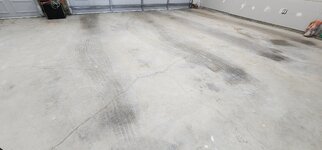
 

Attachments

  • 20240729_112057.jpg
    20240729_112057.jpg
    448.4 KB · Views: 70
To avoid these ads, REGISTER NOW!

Rusty Wrench

Well-known member
Joined
Aug 19, 2021
Messages
190
For a similar reason; I dug near the slab and severed a root probably 4 in diameter with no evident effect on the Silver maple.

I also removed probably the entire half of a root network from neighbors tree, red maple, that was putting up shoots in my garden.
Was astonished, still am, 4 years later no effect on the tree.
 
OP
N

ninjajim4

Member
Joined
Jul 24, 2024
Messages
11
For a similar reason; I dug near the slab and severed a root probably 4 in diameter with no evident effect on the Silver maple.

I also removed probably the entire half of a root network from neighbors tree, red maple, that was putting up shoots in my garden.
Was astonished, still am, 4 years later no effect on the tree.
I'm not overly concerned about killing the tree -- I'm sure it'll be fine if I tore in there and put in some root killer and then patched it up. I just don't know if it's a game of whack of mole and there will be other roots pushing up later and it's not worth it to even address this first issue at present.
 

BrandonV

Well-known member
Joined
Jun 9, 2023
Messages
4,030
Location
Arizona
For a similar reason; I dug near the slab and severed a root probably 4 in diameter with no evident effect on the Silver maple.

I also removed probably the entire half of a root network from neighbors tree, red maple, that was putting up shoots in my garden.
Was astonished, still am, 4 years later no effect on the tree.

Generally you can take out about 1/5 of the roots at a single time before making the tree suffer. A 4" diameter root isn't big at all. Some people worry about cutting but generally trees are pretty resilient creatures.
 

mike93lx

ALLIANCE MEMBER
Joined
Dec 9, 2013
Messages
37,947
Location
Richmond, VA
No control cuts? That didn't help with the random cracking, but no point in doing it now.

What kind of soil do you have? Feels doubtful to me that the issue is a tree root in the middle of the slab
 
OP
N

ninjajim4

Member
Joined
Jul 24, 2024
Messages
11
How long has the slab been there?

I don't see any cuts in the concrete
~10 years. And yes, it's just a solid slab

No control cuts? That didn't help with the random cracking, but no point in doing it now.

What kind of soil do you have? Feels doubtful to me that the issue is a tree root in the middle of the slab

I don't know what sort of soil we have or how i would determine it. if it's just the lack of control cuts then maybe i'm good here and i can just ignore the unslightly cracks, which I won't see after they're covered up with floor tile?

The only reason why I assumed it was a tree root is because of the way it's bulging upward slightly right at what looks likes the origination point for all of the cracking. and also because our patio brick pavers are lifting in spots as well, definitely due to tree roots (though not in the direction of the garage at all).
 
Last edited:

ConCretin

Well-known member
Joined
Jan 20, 2011
Messages
3,379
Location
Central Maine
It's impossible to say from a pic but those look like shrinkage cracks to me. You could to survey the floor with a straight edge to determine if it is actually heaved from tree roots below but it might not be determinative because you don't know how flat the floor was initially.

If they are shrinkage cracks, they are probably done moving and it's pretty easy to hide them. I'd chase them with a crack chaser, fill them with silica sand a polyuria crack sealer such as Legacy Industrial's XtremeSet-100 and then grind them flush. If it's tree roots, the problem is only going to get worse and you are wasting your money with a floor coating.
 
To avoid these ads, REGISTER NOW!
OP
N

ninjajim4

Member
Joined
Jul 24, 2024
Messages
11
It's impossible to say from a pic but those look like shrinkage cracks to me. You could to survey the floor with a straight edge to determine if it is actually heaved from tree roots below but it might not be determinative because you don't know how flat the floor was initially.

If they are shrinkage cracks, they are probably done moving and it's pretty easy to hide them. I'd chase them with a crack chaser, fill them with silica sand a polyuria crack sealer such as Legacy Industrial's XtremeSet-100 and then grind them flush. If it's tree roots, the problem is only going to get worse and you are wasting your money with a floor coating.
For sure its bulging upwards. Have an 8 ft level and its very obviously raised up in the section where the worst cracking is and smaller cracks appear to be radiating from.

Have no plans to coat the floor -- going to put floor tiling over -- but again trying to figure out if this is something to get ahead of or just let it ride until something needs to be done
 
OP
N

ninjajim4

Member
Joined
Jul 24, 2024
Messages
11
You don't have to get rid of the tree.

Find the root on the outside. Cut it with a reciprocating saw and a long coarse carbide blade. Take a section out if possible.

If you DO NOT, your floor problem will just get worse.
Even this isnt a straight forward task. Its all brick paver patio between the tree and the garage. Also question if getting rid of this one root will even be a good long term solution as others can grow under there just as easily
 

Copymutt

Well-known member
Joined
Sep 3, 2016
Messages
3,408
Location
Colorado
I’ve had numerous issues with tree roots, mostly sewer lines involved. I dug out a floor & found a 3” root had hit a stem wall and followed it 15’. Had a slab lifted, cracked from expansive clay, but not from roots. I do have a lifted sidewalk adjacent to an aspen caused by its root. I suspect it would take many years for a root to have no where to go but up underneath a slab. Sounds like slab on grade. Any expansive clay there?
 

djbmw

Well-known member
Joined
Jun 20, 2013
Messages
1,169
Location
Ottawa, Ontario, Canada
I've actually had success locating underground roots by using a radiodetection locator (meant for locating underground wires/pipes/etc. The better option, however, is ground penetrating radar. Both of these can be rented.. or available with an operator from your local 'locating' service.
Or just tear out some of those pavers closest to the garage where the crack is and get diggin'!
 
OP
N

ninjajim4

Member
Joined
Jul 24, 2024
Messages
11
I’ve had numerous issues with tree roots, mostly sewer lines involved. I dug out a floor & found a 3” root had hit a stem wall and followed it 15’. Had a slab lifted, cracked from expansive clay, but not from roots. I do have a lifted sidewalk adjacent to an aspen caused by its root. I suspect it would take many years for a root to have no where to go but up underneath a slab. Sounds like slab on grade. Any expansive clay there?

for sure we do have clay conditions beneath the soil, but I would be hard pressed to say that it's localized in any way to that one spot. It sounds like you don't think this is due to a tree root at all? I don't know enough about any of this to say one way or another. Even if it's not grown beneath since the garage was put up, I can easily imagine that there was a large deep root below where the slab was installed originally that's gradually growing thicker. But again this is all speculation. I was hoping someone would have some conclusive insights and a good approach for where to go from here.

It will take many, MANY years before other root will cause another problem.
It took years for this problem to develop. If it can be avoided, I wouldn't want to deal with this even on a per decade basis ;)


I've actually had success locating underground roots by using a radiodetection locator (meant for locating underground wires/pipes/etc. The better option, however, is ground penetrating radar. Both of these can be rented.. or available with an operator from your local 'locating' service.
Or just tear out some of those pavers closest to the garage where the crack is and get diggin'!
If I felt sure this was a root and also confident that it's not going to be a recurring issue, then to me the best course would be to cut into the slab right at this heaved section, kill the root and seal it up again. I *think* I also have the option to just wait and see if it gets worse and the fix at that point isn't any better or worse than doing it right now.

But again, a lot of "if"s here.
 

CoogarXR

Well-known member
Joined
Jan 11, 2016
Messages
6,873
Location
Ohio
I had this happen on my shed foundation. There was a root lifting up the side slowly over the years. It looked like it was a medium-sized root from a black walnut tree about 10' away. I decided to cut it with my sawsall. On the surface, the root didn't look that big. But It ended up being about 8" diameter! Oh well, I had already started cutting, might as well finish.

About a year later, I decided to have the tree taken down, and the tree guy was like "do you know the whole top of this tree is dead? Good thing you're taking it down." So cutting that root did kill the tree. But I suppose an 8" root was probably pretty important to it, lol.

But like others have said, it's weird if yours is poking up in the middle. Mine was lifting up the edge. Not sure where you are, but that's how the tree roots usually work around Ohio.
 
OP
N

ninjajim4

Member
Joined
Jul 24, 2024
Messages
11
I had this happen on my shed foundation. There was a root lifting up the side slowly over the years. It looked like it was a medium-sized root from a black walnut tree about 10' away. I decided to cut it with my sawsall. On the surface, the root didn't look that big. But It ended up being about 8" diameter! Oh well, I had already started cutting, might as well finish.

About a year later, I decided to have the tree taken down, and the tree guy was like "do you know the whole top of this tree is dead? Good thing you're taking it down." So cutting that root did kill the tree. But I suppose an 8" root was probably pretty important to it, lol.

But like others have said, it's weird if yours is poking up in the middle. Mine was lifting up the edge. Not sure where you are, but that's how the tree roots usually work around Ohio.

it's an interesting point. where it's lifting the patio blocks, it's also pretty clearly a winding path back to the tree. Where as the patio area between the garage and the tree is nice and level. So it may be that my initial immediate assumption that it's a root is totally off base.

If it's not a tree root, thoughts on what else could cause heaving in this specific location and/or if any remediation is needed if I don't care about the aesthetics?
 

Copymutt

Well-known member
Joined
Sep 3, 2016
Messages
3,408
Location
Colorado
To further determine the possibility of lifting/ cracking due to expansive clays, are you comfortable w/ the slab soils. I.E. those clays have to be dug out and replaced w/ properly compacted material. Secondly the clays need moisture to swell. They can shrink once the moisture wicks out leaving a hollow under a lifted slab. Tap around the slab & get a feel for the sound of that area compared to the rest of the floor. How’s the surface slope & drainage around the structure. Does the adjacent patio exhibit moisture under the pavers?
 
OP
N

ninjajim4

Member
Joined
Jul 24, 2024
Messages
11
To further determine the possibility of lifting/ cracking due to expansive clays, are you comfortable w/ the slab soils. I.E. those clays have to be dug out and replaced w/ properly compacted material. Secondly the clays need moisture to swell. They can shrink once the moisture wicks out leaving a hollow under a lifted slab. Tap around the slab & get a feel for the sound of that area compared to the rest of the floor. How’s the surface slope & drainage around the structure. Does the adjacent patio exhibit moisture under the pavers?

everything is pitched away from the foundation and no general issues with drainage or water accumulation. I didn't hear anything particular different when tapping various parts of my garage. It's not been my observation that the swelling area contracts or oscillates at all but I'll be keeping an eye on it in future (unless I cover it up!)
 
To avoid these ads, REGISTER NOW!
Top Bottom